
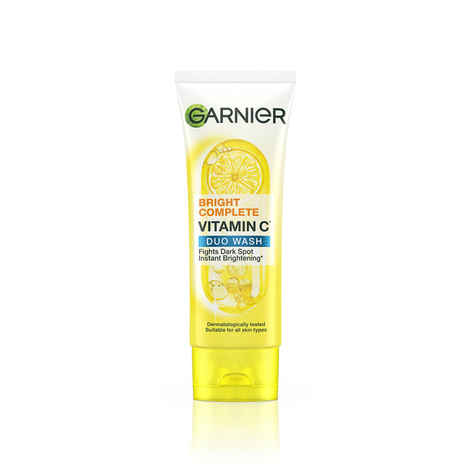

Garnier
Garnier Bright Complete BRIGHTENING DUO ACTION Face Wash, 100g

Garnier Bright Complete BRIGHTENING DUO ACTION Face Wash, 100g
Garnier
garnier-bright-complete-brightening-duo-action-face-wash-100g
Cleanse
10084868948261
Morning or Evening?
How often will you use this product?
Notes


Highlights
WHAT IS IT?
Face Wash, multiple key ingredients
FEATURES
Helps clear excess oil, reduces dark spots, brightens skin, enriched with white clay, lemon extracts, vitamin B3 and vitamin CG, suitable for dry and oily skin, helps fade dark spots and reduce dullness
BEST FOR
combination
CHECKS
Who Is It For?
All Genders No Specific Age Range MentionedWhat Does It Help With?
Dark Spots Dull Skin Excess Oil PigmentationBudget
Affordable (under $30)How To Use
Which routine should it be used in?
Instructions:
Key Information


What Garnier Says
Product Description:
Pollution, dirt, hectic lifestyle, and harsh environmental aggressors can make your skin dull & tired looking and give rise to skin pigmentation and dark spots. Meet your DAILY face cleansing needs and enjoy a radiant and bright skin tone with the Garnier Bright Complete BRIGHTENING Duo Action Face Wash. Enriched with WHITE CLAY, the brightening facewash helps CLEAR excess OIL, making it one of the best face washes for oily skin. The LEMON EXTRACTS and VITAMIN B3 and VITAMIN CG help REDUCE existing DARK SPOTS and prevent new ones from occurring. Use this face wash for dry and oily skin twice every day to fade away dark spots and REDUCE DULLNESS. How to use: Apply a small amount on wet face and gently massage with fingertips, avoiding the eye contour area. Rinse thoroughly. For best results, use twice daily and follow it up with the Garnier Bright Complete VITAMIN C Booster Serum. Follow with the Garnier Bright Complete VITAMIN C Serum Cream with SPF40 during the DAY and the Garnier Bright Complete VITAMIN C & Yoghurt Night Cream at NIGHT. Bonus step: To intensely hydrate skin and get a FACIAL-LIKE GLOW at home, use the Garnier Bright Complete VITAMIN C Serum Sheet Mask on a freshly cleansed face and get a radiant and glowing complexion in JUST 15 MINUTES. Follow with the Garnier Bright Complete face cream as usual.
About the Brand:
Ingredients Overview
Ingredients List
WATER, GLYCERIN, MYRISTIC ACID, STEARIC ACID, PALMITIC ACID, POTASSIUM HYDROXIDE, LAURIC ACID, BUTYLENE GLYCOL, SORBITOL, GLYCERYL STEARATE SE, PEG-8, CI 19140, CI 77891, LINALOOL, NIACINAMIDE, FRAGRANCE, SALICYLIC ACID, SILICA, KAOLIN, ALUMINA, ALUMINUM HYDROXIDE, PHENOXYETHANOL, LIMONENE, ASCORBYL GLUCOSIDE, TETRASODIUM EDTA, LEMON FRUIT EXTRACT, POLYQUATERNIUM-4, BENZYL SALICYLATE, BENZYL ALCOHOL. (F.I.L. C219779/1)
Key Ingredients
white-clay, lemon-extracts, vitamin-b3, vitamin-cg
Ingredients Details
Alumina
Common Name(s): Alumina,cosmetic active,functional ingredient
CAS Number: N/a
DESCRIPTION
What It Does: Delivers characteristic cosmetic function at recommended use concentration.
Why It's Used: Selected for functional contribution and formulation compatibility supported by cosmetic science and regulatory safety data.
How It Works: Works through the mechanism of its molecular class as documented in peer-reviewed cosmetic literature.
Typically Found In: Skin care formulations
TECHNICAL DETAILS
Primary Category: Active ingredient – cosmetic active
Secondary Functions: Skin conditioning
Application Areas:

Facial Skincare

Body Care
Hair Care
Beard Care
Color Cosmetics (Makeup)
Dietary/Oral Supplements
Typical Concentration Range: 0.1%–10%
SOURCING & ETHICS
Vegan Status: Conditional
Halal Status: Yes
Source Notes: Commercially produced for cosmetic use. verify vegan/halal status with supplier.
SKIN COMPATIBILITY
Irritancy Rating: 1/5 – very low
Comedogenicity Rating: 0/5 – non-comedogenic
Sensitivity Concerns: Well-tolerated by most skin types.
Safe for Sensitive Skin: Yes
SAFETY & COMPATIBILITY
Safety Profile: Good safety profile at recommended concentrations. ewg score: 1–2.
Works Well With: Standard skincare actives
Avoid Combining With: No known significant incompatibilities
SCIENTIFIC NOTE
Alumina has an established safety profile within the cosmetic regulatory framework at standard use concentrations.
Last Verified: Cosing database,alumina technical literature
Primary Sources: 2026-03-12
Aluminum Hydroxide
Common Name(s): Aluminum hydroxide,cosmetic active,functional ingredient
CAS Number: N/a
DESCRIPTION
What It Does: Delivers characteristic cosmetic function at recommended use concentration.
Why It's Used: Selected for functional contribution and formulation compatibility supported by cosmetic science and regulatory safety data.
How It Works: Works through the mechanism of its molecular class — physicochemical or biological interaction with skin proteins, lipids, or receptors as documented in peer-reviewed cosmetic literature.
Typically Found In: Skin care formulations
TECHNICAL DETAILS
Primary Category: Active ingredient – cosmetic active
Secondary Functions: Skin conditioning
Application Areas:
Facial Skincare
Body Care
Hair Care
Beard Care
Color Cosmetics (Makeup)
Dietary/Oral Supplements
Typical Concentration Range: 0.1%–10%
SOURCING & ETHICS
Vegan Status: Conditional
Halal Status: Yes
Source Notes: Commercially produced for cosmetic use. verify vegan/halal status with supplier.
SKIN COMPATIBILITY
Irritancy Rating: 1/5 – very low
Comedogenicity Rating: 0/5 – non-comedogenic
Sensitivity Concerns: Well-tolerated by most skin types.
Safe for Sensitive Skin: Yes
SAFETY & COMPATIBILITY
Safety Profile: Good safety profile at recommended concentrations. ewg score: 1–2.
Works Well With: Standard skincare actives
Avoid Combining With: No known significant incompatibilities
SCIENTIFIC NOTE
Aluminum hydroxide has an established safety and efficacy profile within the cosmetic regulatory framework at standard use concentrations.
Last Verified: Cosing database,aluminum hydroxide technical literature
Primary Sources: 2026-03-12
Ascorbyl Glucoside
Common Name(s): Aa2g,2-o-alpha-d-glucopyranosyl-l-ascorbic acid
CAS Number: 129499-78-1
DESCRIPTION
What It Does: Provides stable gradual-release vitamin c activity for brightening and antioxidant protection.
Why It's Used: Most formulation-stable vitamin c derivative — ascorbyl glucoside remains stable in aqueous formulations where pure ascorbic acid oxidises within days, providing sustained vitamin c delivery over weeks of shelf life.
How It Works: Alpha-glucoside bond resists oxidation until cleaved by skin alpha-glucosidase enzymes. releases free l-ascorbic acid in viable epidermis. released ascorbic acid inhibits tyrosinase, stimulates collagen synthesis, and provides antioxidant activity. glucose group provides enhanced water solubility vs ascorbic acid.
Typically Found In: Stable vitamin c serums,brightening products,anti-aging
TECHNICAL DETAILS
Primary Category: Active ingredient – stable vitamin c glucoside
Secondary Functions: Tyrosinase inhibitor,collagen cofactor
Application Areas:
Facial Skincare
Body Care
Hair Care
Beard Care
Color Cosmetics (Makeup)
Dietary/Oral Supplements
Typical Concentration Range: 1%–5%
SOURCING & ETHICS
Vegan Status: Yes – enzymatic synthesis from ascorbic acid and glucose
Halal Status: Yes
Source Notes: Synthetically produced vitamin c derivative.
SKIN COMPATIBILITY
Irritancy Rating: 1/5 – very low
Comedogenicity Rating: 0/5 – non-comedogenic
Sensitivity Concerns: Non-irritating; suitable for all skin types.
Safe for Sensitive Skin: Yes
SAFETY & COMPATIBILITY
Safety Profile: Excellent safety profile. ewg score: 1.
Works Well With: Tocopherol,ferulic acid,niacinamide,spf
Avoid Combining With: No significant incompatibilities
SCIENTIFIC NOTE
Ascorbyl glucoside's stability advantage (18+ months in aqueous formulation vs days for ascorbic acid) arises from the glucose group's steric protection of ascorbic acid's c2 enediol that is the primary oxidation site. glucosidase cleavage in skin removes this protection in situ, releasing active ascorbic acid only where enzymatic activity exists — providing both formulation stability and bioactivation where needed.
Last Verified: Cosing database,yamamoto et al. ascorbyl glucoside stability study
Primary Sources: 2026-03-12
Benzyl Salicylate
Common Name(s): Benzyl 2-hydroxybenzoate,salicylate ester
CAS Number: 118-58-1
DESCRIPTION
What It Does: Provides floral-balsamic scent with uv-absorbing fixative properties.
Why It's Used: Natural jasmine-associated fragrance ester with mild uv protection contribution for fragranced sun-exposed products.
How It Works: Salicylate ester absorbs uv-b mildly. provides fixative function by slowing evaporation of lighter fragrance top notes. naturally in jasmine absolute (1-3%). good skin absorption.
Typically Found In: Floral fragrances,sun-exposed products
TECHNICAL DETAILS
Primary Category: Fragrance component – floral fixative
Secondary Functions: Skin conditioning
Application Areas:
Facial Skincare
Body Care
Hair Care
Beard Care
Color Cosmetics (Makeup)
Dietary/Oral Supplements
Typical Concentration Range: 0.001%–1%
SOURCING & ETHICS
Vegan Status: Yes – from jasmine absolute, or synthetic
Halal Status: Yes
Source Notes: Commercially produced for cosmetic use. verify vegan/halal status with supplier.
SKIN COMPATIBILITY
Irritancy Rating: 1/5 – very low
Comedogenicity Rating: 0/5 – non-comedogenic
Sensitivity Concerns: Well-tolerated by most skin types.
Safe for Sensitive Skin: Yes
SAFETY & COMPATIBILITY
Safety Profile: Eu cosmetics regulation: declared fragrance allergen. ifra guidelines apply.
Works Well With: Standard skincare actives
Avoid Combining With: No known significant incompatibilities
SCIENTIFIC NOTE
Benzyl salicylate's salicylate moiety provides uv absorption in the uvb range (absorbs at 295-315nm) despite not being a registered uv filter. its occurrence in jasmine absolute means natural jasmine-fragranced products inherently contain a mild uv absorber – an incidental benefit of the natural fragrance chemistry that wasn't intentionally designed as photoprotection.
Last Verified: Cosing database,ifra standards
Primary Sources: 2026-03-12
