

Shiseido
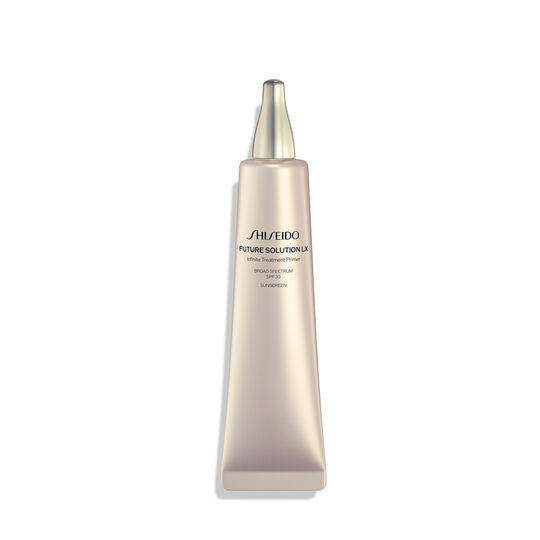
Future Solution LX Dual-Purpose Face Primer SPF 30

Future Solution LX Dual-Purpose Face Primer SPF 30
Shiseido
future-solution-lx-dual-purpose-face-primer-spf-30
Suncare
9605088641317
Morning or Evening?
How often will you use this product?
Notes


Highlights
WHAT IS IT?
Face primer with SPF 30
FEATURES
A dual-purpose primer with skincare and makeup benefits that hydrates for 8 hours* and corrects uneven skin tone to help achieve a radiant even complexion
BEST FOR
Combination, Dry, Normal, Oily
CHECKS
Oil-free, Paraben-free, Sulphate-free
Who Is It For?
Adults (18+) Women And MenWhat Does It Help With?
Uneven Skin Tone Dullness Pores Makeup LongevityBudget
PremiumHow To Use
Which routine should it be used in?
Instructions:
Key Information


What Shiseido Says
Product Description:
This primer instantly smooths away pores and corrects the look of dullness and uneven tone while providing 8-hour hydration*. The formula is crafted to deliver a pearlescent glow that replicates the luster of pearls. Skin is protected from UV rays with broad-spectrum SPF 30 protection as well as external stressors like pollution.
About the Brand:
Ingredients Overview
Ingredients List
WATER,DIMETHICONE,BUTYLENE GLYCOL,GLYCERIN,ISOHEXADECANE,SD ALCOHOL 40-B,ZEA MAYS (CORN) STARCH,PEG-9 POLYDIMETHYLSILOXYETHYL DIMETHICONE,DIPHENYLSILOXY PHENYL TRIMETHICONE,SILICA,TRIISOSTEARIN,DISTEARDIMONIUM HECTORITE,CETYL ETHYLHEXANOATE,XYLITOL,ERYTHRITOL,TRIMETHYLSILOXYSILICATE,TREHALOSE,TOCOPHERYL ACETATE,2-O-ETHYL ASCORBIC ACID,PRUNUS SPECIOSA LEAF EXTRACT,ANGELICA ACUTILOBA ROOT EXTRACT,SCUTELLARIA BAICALENSIS ROOT EXTRACT,CAMELLIA SINENSIS LEAF EXTRACT,SODIUM ACETYLATED HYALURONATE,ISODONIS JAPONICUS LEAF/STALK EXTRACT,HYDROLYZED CONCHIOLIN PROTEIN,ROSA ROXBURGHII FRUIT EXTRACT,GOLD,TRIETHANOLAMINE,ISOSTEARIC ACID,ALUMINUM HYDROXIDE,STEARIC ACID,DISODIUM EDTA,ALCOHOL,CALCIUM ALUMINUM BOROSILICATE,BHT,HYDROGEN DIMETHICONE,TOCOPHEROL,POLYSILICONE-2,TRIETHOXYCAPRYLYLSILANE,SODIUM CITRATE,TIN OXIDE,BARIUM SULFATE,CITRIC ACID,PHENOXYETHANOL,FRAGRANCE,TITANIUM DIOXIDE,MICA,IRON OXIDES,
Key Ingredients
ENSULIZOLE, OCTINOXATE, TITANIUM DIOXIDE
Ingredients Details
Butylene Glycol
Common Name(s): 1,3-butanediol,bg,1,3-butylene glycol
CAS Number: 107-88-0
DESCRIPTION
What It Does: Provides humectant hydration and active ingredient solubilization with excellent skin feel.
Why It's Used: Preferred glycol humectant in premium and k-beauty formulations for superior skin feel vs propylene glycol with equivalent functionality.
How It Works: Two hydroxyl groups at 1,3-positions provide water binding and solvent activity. better tolerated than propylene glycol with minimal sensitization risk. 4-carbon backbone provides slightly greater hydrophobic character enabling dissolution of less polar actives vs pg.
Typically Found In: Toners,essences,serums,k-beauty formulas
TECHNICAL DETAILS
Primary Category: Functional ingredient – glycol humectant
Secondary Functions: Tewl reduction,skin plumping
Application Areas:

Facial Skincare
Body Care
Hair Care

Beard Care
Color Cosmetics (Makeup)
Dietary/Oral Supplements
Typical Concentration Range: 1%–10%
SOURCING & ETHICS
Vegan Status: Yes – synthetic
Halal Status: Yes
Source Notes: Synthetic or naturally derived. excellent aqueous solubility.
SKIN COMPATIBILITY
Irritancy Rating: 1/5 – very low
Comedogenicity Rating: 0/5 – non-comedogenic
Sensitivity Concerns: Non-irritating; suitable for all skin types.
Safe for Sensitive Skin: Yes
SAFETY & COMPATIBILITY
Safety Profile: Excellent safety profile. ewg score: 1.
Works Well With: Ceramides,emollients,occlusives,glycerin,hyaluronic acid
Avoid Combining With: No significant incompatibilities
SCIENTIFIC NOTE
K-beauty's preference for butylene glycol over propylene glycol is driven by two factors: bg's superior skin feel (less tacky than pg's higher viscosity) and its lower sensitization potential (1,3-bg has better spatial distribution of hydroxyl groups that reduces protein interaction vs pg's 1,2-position oh groups).
Last Verified: 2026-03-12
Primary Sources: Cosing database,cir safety assessment
Dimethicone
Common Name(s): Pdms,polydimethylsiloxane,silicone fluid
CAS Number: 9006-65-9
DESCRIPTION
What It Does: Provides silicone-characteristic silky feel and skin protection with adjustable viscosity.
Why It's Used: The benchmark cosmetic silicone – sets the gold standard for silky application feel, spreadability, and skin protection in virtually all skin care categories.
How It Works: Polydimethylsiloxane chain flexibility provides extremely low surface tension and high spreadability. inert si-o backbone provides chemical stability and excellent skin tolerance. occlusive film formation reduces tewl. higher viscosity grades provide more intense conditioning.
Typically Found In: Moisturizers,foundations,primers,sunscreens – nearly universal
TECHNICAL DETAILS
Primary Category: Functional ingredient – polydimethylsiloxane
Secondary Functions: Barrier sealing,softening
Application Areas:
Facial Skincare
Body Care
Hair Care
Beard Care
Color Cosmetics (Makeup)
Dietary/Oral Supplements
Typical Concentration Range: 0.1%–30%
SOURCING & ETHICS
Vegan Status: Conditional - supplier confirmation required
Halal Status: Unverified - supplier confirmation required
Source Notes: Plant-derived, synthetic or animal-derived. verify source. [audit 2026-07-29 rev2: the record's own source_notes does not assert a non-animal origin, or instructs the reader to verify with the supplier; "yes" asserts knowledge the record does not hold. determination requires shariah-panel sign-off.]
SKIN COMPATIBILITY
Irritancy Rating: 1/5 – very low
Comedogenicity Rating: 1/5 – low; formulation-dependent
Sensitivity Concerns: Non-irritating.
Safe for Sensitive Skin: Yes
SAFETY & COMPATIBILITY
Safety Profile: Excellent safety profile. ewg score: 1.
Works Well With: Humectants,ceramides,actives as carrier
Avoid Combining With: No significant incompatibilities
SCIENTIFIC NOTE
Dimethicone's exceptional silky feel arises from its very low intermolecular attractive forces (weak van der waals forces due to non-polar methyl groups) that allow silicone chains to slide freely over skin. the coefficient of kinetic friction for pdms against skin (~0.04) is among the lowest of any cosmetic material – explaining why even small amounts transform product feel.
Last Verified: 2026-03-12
Primary Sources: Cosing database,cir safety assessment
Diphenylsiloxy Phenyl Trimethicone
Common Name(s): Diphenylsiloxy phenyl trimethicone,phenyl silicone,conditioning silky film-forming
CAS Number: N/a
DESCRIPTION
What It Does: Diphenylsiloxy phenyl trimethicone deposits an ultra-thin, flexible conditioning film on skin and hair that dramatically reduces surface friction, provides water-repellent moisture lock-in, protects hair from heat damage and humidity-induced frizz, and delivers the smooth, silky sensory experience that distinguishes premium personal care from basic functional products.
Why It's Used: Formulators choose diphenylsiloxy phenyl trimethicone for its unique functional profile that organic emollients cannot replicate: the si-o backbone (bond angle 150° vs c-c 109°) provides exceptional molecular flexibility allowing the silicone polymer to flatten along any surface topology, creating an ultra-conforming film. the surface energy of cured silicone (~20 mn/m) is lower than any organic emollient, providing superior lubricity without the heaviness or comedogenic character of equivalent organic oils. for hair specifically, silicone deposition dramatically reduces the coefficient of friction between hair fibres from ~0.8 (uncoated) to ~0.25 (silicone-coated), providing the detangling and smoothing that defines premium conditioner performance.
How It Works: Diphenylsiloxy phenyl trimethicone functions through the si-o siloxane backbone's fundamental physical chemistry: (1) surface deposition — the polymer's backbone flexibility allows it to flatten onto hair and skin surfaces, maximising contact area and van der waals adhesion. the polydimethylsiloxane chain adopts a helical conformation in free solution but extends to near-flat conformation on surfaces, providing maximum coverage per molecule deposited; (2) low surface energy film — the methyl groups surrounding the si-o backbone present an array of non-polar, non-hydrogen-bonding surfaces. the surface energy of ~20 mn/m is lower than water (~72 mn/m) and organic oils (~30–35 mn/m), providing excellent lubricity from the lowest-energy surface; (3) thermal stability — si-o bond energy (105 kcal/mol vs c-c 83 kcal/mol) provides exceptional heat resistance, making dimethicone uniquely suitable as a heat-protectant on hair during blow-drying and flat-ironing up to 230°c; (4) breathability — despite the water-repellent surface, silicone films have sufficient molecular-scale porosity to allow oxygen, co₂, and water vapour transmission from the film's non-crystalline, flexible structure — unlike occlusive waxes that form dense impermeable films.
Typically Found In: Hair conditioners,skin care emollients,heat protectants
TECHNICAL DETAILS
Primary Category: Functional ingredient – emollient
Secondary Functions: Barrier sealing,softening
Application Areas:
Facial Skincare
Body Care
Hair Care
Beard Care
Color Cosmetics (Makeup)
Dietary/Oral Supplements
Typical Concentration Range: 0.5%–25%
SOURCING & ETHICS
Vegan Status: Conditional - supplier confirmation required
Halal Status: Unverified - supplier confirmation required
Source Notes: Plant-derived, synthetic or animal-derived. verify source. [audit 2026-07-29 rev2: the record's own source_notes does not assert a non-animal origin, or instructs the reader to verify with the supplier; "yes" asserts knowledge the record does not hold. determination requires shariah-panel sign-off.]
SKIN COMPATIBILITY
Irritancy Rating: 1/5 – very low
Comedogenicity Rating: 1/5 – low; formulation-dependent
Sensitivity Concerns: Non-irritating.
Safe for Sensitive Skin: Yes
SAFETY & COMPATIBILITY
Safety Profile: Excellent safety profile. ewg score: 1.
Works Well With: Humectants,ceramides,actives as carrier
Avoid Combining With: No significant incompatibilities
SCIENTIFIC NOTE
Si-o backbone flexibility vs organic polymers: c-c bond angle is fixed at 109.5° (tetrahedral sp3) with restricted rotation, giving organic polymer chains a preferred helical structure that resists lying flat on surfaces. si-o bond angle is 150° with near-free rotation from the longer si-o bond (1.64 å vs c-c 1.54 å) and lower rotational barrier (~0.6 kcal/mol vs c-c ~3 kcal/mol). this 5× lower rotational barrier allows silicone chains to adopt virtually any conformation essentially free of energy cost — enabling the flat, conforming surface adsorption that provides optimal thin-film coverage and explains the silky-smooth feel unobtainable from rigid organic polymer films.
Last Verified: 2026-03-12
Primary Sources: Cosing database,diphenylsiloxy phenyl trimethicone silicone film conditioning review
Glycerin
Common Name(s): Glycerol,glycerine,1,2,3-propanetriol
CAS Number: 56-81-5
DESCRIPTION
What It Does: Glycerin pulls water from the environment and deeper skin layers into the outer skin layer (epidermis), boosting moisture levels and keeping skin soft, smooth, and plump.
Why It's Used: It is used in virtually every moisturizer, serum, and cleanser because it is highly effective at hydrating skin, is well-tolerated by all skin types, and enhances the texture and spreadability of formulations.
How It Works: As a humectant, glycerin forms hydrogen bonds with water molecules, trapping them in the skin. it also reinforces the skin barrier by integrating into lipid structures between skin cells.
Typically Found In: Moisturizers,serums,cleansers,toners,sheet masks,sunscreens,body lotions,shampoos,conditioners
TECHNICAL DETAILS
Primary Category: Humectant
Secondary Functions: Skin barrier support,emollient,solvent
Application Areas:
Facial Skincare
Body Care
Hair Care
Beard Care
Color Cosmetics (Makeup)
Dietary/Oral Supplements
Typical Concentration Range: 1%–30% (typical: 3–10%)
SOURCING & ETHICS
Vegan Status: Conditional - feedstock declaration required
Halal Status: Unverified - feedstock declaration required (plant, animal and petrochemical routes all exist)
Source Notes: Derived from plant oils via hydrolysis or saponification; synthetic versions also available. palm-derived glycerin carries sustainability concerns. [audit 2026-07-29 rev2: origin-dependent: the same inci exists in plant, animal and petrochemical versions and the name does not discriminate. determination requires shariah-panel sign-off.]
SKIN COMPATIBILITY
Irritancy Rating: 1/5 – very low; non-irritating at all standard concentrations
Comedogenicity Rating: 0/5 – non-comedogenic
Sensitivity Concerns: Extremely rare allergic reactions; generally safe for all skin types including sensitive and baby skin
Safe for Sensitive Skin: Yes
SAFETY & COMPATIBILITY
Safety Profile: Widely recognized as safe. ewg hazard score: 1. no significant concerns for irritation, sensitization, or toxicity at typical concentrations (up to 50%).
Works Well With: Hyaluronic acid,ceramides,niacinamide,panthenol,urea,peptides,retinol,ahas/bhas
Avoid Combining With: No known incompatibilities at standard concentrations
SCIENTIFIC NOTE
Glycerin is an endogenous skin component found naturally in the stratum corneum. aquaporin-3 channels in keratinocytes facilitate glycerin transport, making it integral to natural skin hydration pathways.
Last Verified: 2026-03-12
Primary Sources: Cosing database,cir safety assessment,ewg skin deep,inci decoder