
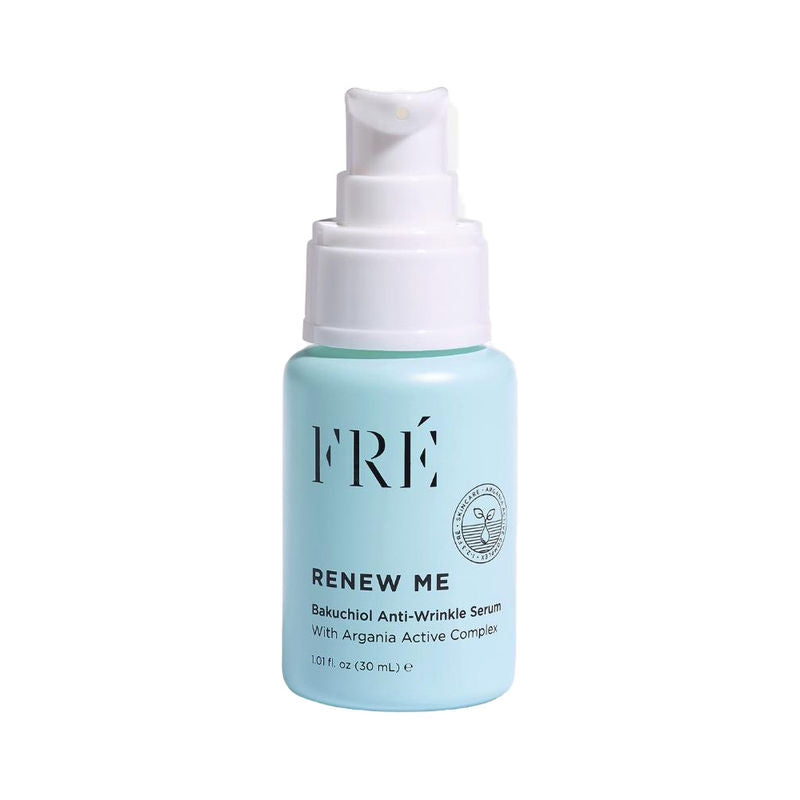

Nykaa E retail limited
Fre Renew Me Bakuchiol Anti-Wrinkle Serum

Fre Renew Me Bakuchiol Anti-Wrinkle Serum
Nykaa E retail limited
fre-renew-me-bakuchiol-anti-wrinkle-serum
Serum
10084795187493
Morning or Evening?
How often will you use this product?
Notes


Highlights
WHAT IS IT?
Bio retinol serum with proprietary Argan Extracts patent
FEATURES
Reduces appearance of lines and wrinkles, increases firmness and elasticity, leaves skin looking visibly younger & smoother
BEST FOR
normal
CHECKS
Alcohol
Who Is It For?
What Does It Help With?
Reducing Lines And Wrinkles Improving Skin Elasticity Protecting And Repairing Skin From Sun DamageBudget
Premium ($76-$150)How To Use
Which routine should it be used in?
Instructions:
Key Information


What Nykaa E retail limited Says
Product Description:
Renew Me Bakuchiol Anti-Wrinkle Serum is a bio retinol serum that combines bakuchiol with Fre's proprietary Argan Extracts patent to reduce the appearance of lines, wrinkles and increase elasticity. Fre's patent combines argan stem cells, leaf water & oil to protect & repair skin from sun damage. Features include reducing the appearance of lines and wrinkles, increasing firmness and elasticity, and leaving skin looking visibly younger & smoother.
About the Brand:
Ingredients Overview
Ingredients List
Water / Aqua / Eau, Pentylene Glycol, Coco-caprylate, Propanediol, Biosaccharide Gum-1, Niacinamide, Silica, Dicaprylyl Carbonate, Glycerin, Simmondsia Chinensis (Jojoba) Seed Oil, Argania Spinosa Kernel Oil, Argania Spinosa Sprout Cell Extract, Argania Spinosa Leaf Extract, Bakuchiol, Cymbopogon Flexuosus Oil, Pelargonium Graveolens Flower Oil, Citrus Aurantium Bergamia (Bergamot) Leaf Oil, Lavandula Angustifolia (Lavender) Flower Oil, Sodium Hyaluronate, Panthenol, Tocopherol, Sodium Phytate, C14-22 Alcohols, C12-20 Alkyl Glucoside, Polyacrylate Crosspolymer-6, Allantoin, Bisabolol, Alcohol, Palmitoyl Tripeptide-1
Key Ingredients
Bakuchiol, Argania Spinosa Kernel Oil, Argania Spinosa Sprout Cell Extract, Argania Spinosa Leaf Extract, Niacinamide
Ingredients Details
Alcohol
Common Name(s): Alcohol,cosmetic active,functional ingredient
CAS Number: N/a
DESCRIPTION
What It Does: Delivers characteristic cosmetic function at recommended use concentration.
Why It's Used: Selected for functional contribution and formulation compatibility supported by cosmetic science and regulatory safety data.
How It Works: Works through the mechanism of its molecular class as documented in peer-reviewed cosmetic literature.
Typically Found In: Skin care formulations
TECHNICAL DETAILS
Primary Category: Active ingredient – cosmetic active
Secondary Functions: Skin conditioning
Application Areas:

Facial Skincare

Body Care
Hair Care
Beard Care
Color Cosmetics (Makeup)
Dietary/Oral Supplements
Typical Concentration Range: 0.1%–10%
SOURCING & ETHICS
Vegan Status: Yes - standard ethanol routes are non-animal; confirm denaturant origin
Halal Status: Conditional - ethanol production route and residual concentration; jurisdiction-dependent, refer to certifier stance
Source Notes: Commercially produced for cosmetic use. verify vegan/halal status with supplier. [audit 2026-07-29 rev2: ethanol pathway; determination depends on route, on whether the plant also produces beverage alcohol, and on residual concentration. determination requires shariah-panel sign-off.]
SKIN COMPATIBILITY
Irritancy Rating: 1/5 – very low
Comedogenicity Rating: 0/5 – non-comedogenic
Sensitivity Concerns: Well-tolerated by most skin types.
Safe for Sensitive Skin: Yes
SAFETY & COMPATIBILITY
Safety Profile: Good safety profile at recommended concentrations. ewg score: 1–2.
Works Well With: Standard skincare actives
Avoid Combining With: No known significant incompatibilities
SCIENTIFIC NOTE
Alcohol has an established safety profile within the cosmetic regulatory framework at standard use concentrations.
Last Verified: 2026-03-12
Primary Sources: Cosing database,alcohol technical literature
Allantoin
Common Name(s): 5-ureidohydantoin,glyoxyldiureide,aluminum dihydroxy allantoinate
CAS Number: 97-59-6
DESCRIPTION
What It Does: Soothes irritation, accelerates wound healing, promotes skin cell renewal, and provides mild keratolytic exfoliation.
Why It's Used: Gold standard multi-function soothing active – one of the most widely used cosmetic ingredients across all product types for its exceptional tolerability and clinically proven multi-action skin conditioning.
How It Works: Promotes keratinocyte proliferation and fibroblast migration for wound healing. mild keratolytic activity by disrupting corneocyte binding. anti-irritant via direct protein binding and anti-inflammatory cytokine reduction. humectant activity via hydroxyl groups.
Typically Found In: Post-procedure products,sensitive skin formulas,wound care,anti-acne treatments,baby products
TECHNICAL DETAILS
Primary Category: Active ingredient – soothing / anti-inflammatory
Secondary Functions: Wound healing,keratolytic,anti-irritant
Application Areas:
Facial Skincare
Body Care
Hair Care
Beard Care
Color Cosmetics (Makeup)
Dietary/Oral Supplements
Typical Concentration Range: 0.1%–2%
SOURCING & ETHICS
Vegan Status: Conditional - feedstock declaration required
Halal Status: Unverified - feedstock declaration required (plant, animal and petrochemical routes all exist)
Source Notes: Plant-derived extract or synthetic. [audit 2026-07-29 rev2: origin-dependent: the same inci exists in plant, animal and petrochemical versions and the name does not discriminate. determination requires shariah-panel sign-off.]
SKIN COMPATIBILITY
Irritancy Rating: 1/5 – very low
Comedogenicity Rating: 0/5 – non-comedogenic
Sensitivity Concerns: Exceptionally well-tolerated; suitable for all skin types including baby and compromised skin.
Safe for Sensitive Skin: Yes – particularly recommended for sensitive skin
SAFETY & COMPATIBILITY
Safety Profile: Excellent safety profile. ewg score: 1.
Works Well With: Ceramides,panthenol,allantoin,hyaluronic acid,centella asiatica
Avoid Combining With: No significant incompatibilities
SCIENTIFIC NOTE
Allantoin's keratinocyte proliferation stimulation occurs via receptor-mediated signaling (possibly machr activation) rather than non-specific irritation-driven proliferation, making it a true wound-healing stimulant rather than a pro-inflammatory proliferative signal.
Last Verified: 2026-03-12
Primary Sources: Cosing database,cir safety assessment,araújo et al. allantoin review
Argania Spinosa Kernel Oil
Common Name(s): Argania spinosa kernel oil,botanical carrier oil,emollient fatty acid delivery
CAS Number: N/a
DESCRIPTION
What It Does: Softens and conditions skin by integrating into sc lipid bilayers, delivers essential fatty acids (oleic, linoleic, linolenic) for barrier lipid synthesis, and provides rich, non-stripping moisturisation.
Why It's Used: Natural carrier oils provide the closest compositional match to endogenous sc lipids, delivering emolliency through genuine barrier integration rather than simple surface occlusion.
How It Works: Fatty acid triglycerides partition into sc lipid bilayers — oleic acid (c18:1) provides fluid, emollient integration; linoleic acid (c18:2) acts as essential ceramide precursor; saturated fatty acids provide more occlusive barrier reinforcement.
Typically Found In: Moisturisers,facial oils,natural skin care
TECHNICAL DETAILS
Primary Category: Functional ingredient – emollient
Secondary Functions: Barrier sealing,softening
Application Areas:
Facial Skincare
Body Care
Hair Care
Beard Care
Color Cosmetics (Makeup)
Dietary/Oral Supplements
Typical Concentration Range: 1%–100%
SOURCING & ETHICS
Vegan Status: Conditional - supplier confirmation required
Halal Status: Unverified - supplier confirmation required
Source Notes: Plant-derived, synthetic or animal-derived. verify source. [audit 2026-07-29 rev2: the record's own source_notes does not assert a non-animal origin, or instructs the reader to verify with the supplier; "yes" asserts knowledge the record does not hold. determination requires shariah-panel sign-off.]
SKIN COMPATIBILITY
Irritancy Rating: 1/5 – very low
Comedogenicity Rating: 1/5 – low; formulation-dependent
Sensitivity Concerns: Non-irritating.
Safe for Sensitive Skin: Yes
SAFETY & COMPATIBILITY
Safety Profile: Excellent safety profile. ewg score: 1.
Works Well With: Humectants,ceramides,actives as carrier
Avoid Combining With: No significant incompatibilities
SCIENTIFIC NOTE
Essential fatty acids — linoleic (c18:2, n-6) and α-linolenic (c18:3, n-3) acids — cannot be synthesised by the body; topical delivery through carrier oils provides direct substrate for ceramide and eicosanoid biosynthesis in the epidermis.
Last Verified: 2026-03-12
Primary Sources: Cosing database,argania spinosa kernel oil carrier oil botanical review
Argania Spinosa Leaf Extract
Common Name(s): Argania spinosa leaf extract,argania spinosa leaf extract,botanical extract,phytochemical active
CAS Number: N/a
DESCRIPTION
What It Does: Provides antioxidant protection from polyphenol radical scavenging, anti-inflammatory activity from terpenoid nf-kb/cox pathway inhibition, and skin conditioning from the phytochemical secondary metabolite complex.
Why It's Used: Argania spinosa leaf extract is selected for the characteristic secondary metabolite signature of argania spinosa — whether polyphenols, terpenoids, alkaloids, or polysaccharides, the phytochemical profile provides antioxidant, anti-inflammatory, or skin conditioning benefits specific to this botanical species.
How It Works: Polyphenol catechol h-atom donation scavenges ros (rate constants 10⁶-10⁹ m⁻¹s⁻¹); terpenoids inhibit iκb kinase blocking nf-κb; flavonoids compete at cox-1/2; alkaloids modulate specific receptor targets for additional bioactivity.
Typically Found In: Botanical skin care
TECHNICAL DETAILS
Primary Category: Active ingredient – antioxidant
Secondary Functions: Free radical scavenging,anti-aging
Application Areas:
Facial Skincare
Body Care
Hair Care
Beard Care
Color Cosmetics (Makeup)
Dietary/Oral Supplements
Typical Concentration Range: 0.1%–10%
SOURCING & ETHICS
Vegan Status: Conditional - supplier confirmation required
Halal Status: Conditional - basis not stated in source record; supplier origin confirmation required to determine what evidence applies
Source Notes: Plant-derived extract or synthetic. [audit 2026-07-29 rev2: status downgraded on audit. determination requires shariah-panel sign-off.]
SKIN COMPATIBILITY
Irritancy Rating: 1/5 – very low
Comedogenicity Rating: 0/5 – non-comedogenic
Sensitivity Concerns: Non-irritating; well-tolerated.
Safe for Sensitive Skin: Yes
SAFETY & COMPATIBILITY
Safety Profile: Excellent safety profile. ewg score: 1.
Works Well With: Vitamin c,vitamin e,ferulic acid,spf,other antioxidants
Avoid Combining With: No significant incompatibilities
SCIENTIFIC NOTE
Standardise to marker compound for consistent bioactivity — field-grown material varies 3-10× in secondary metabolite content.
Last Verified: 2026-03-22
Primary Sources: Cosing database,argania spinosa leaf extract botanical extract review