

Nykaa E retail limited
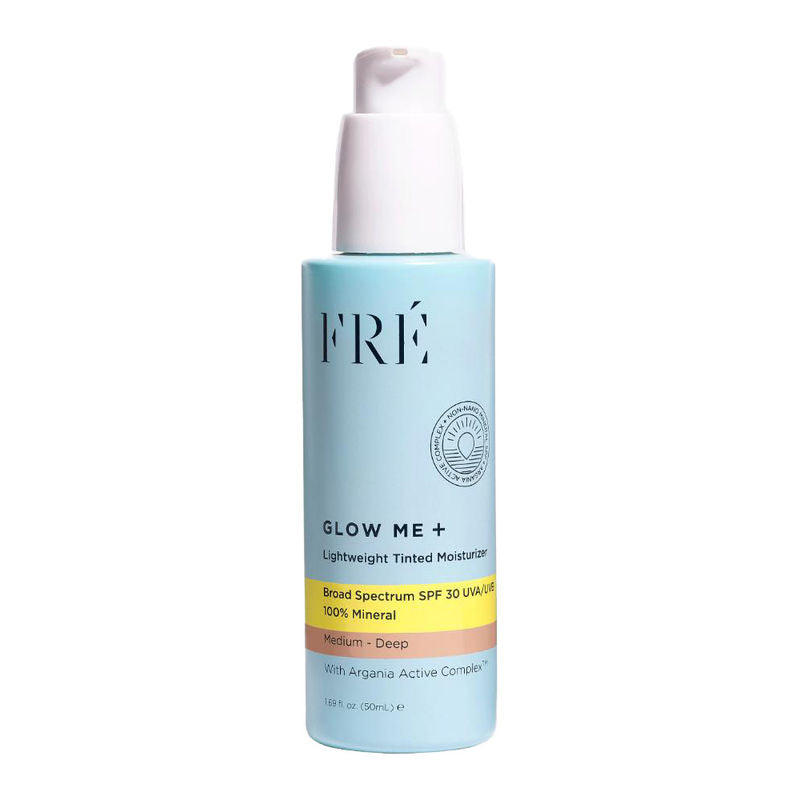
Fre Glow Me + Lightweight Tinted Mineral SPF 30 Moisturizer - Medium Deep

Fre Glow Me + Lightweight Tinted Mineral SPF 30 Moisturizer - Medium Deep
Nykaa E retail limited
fre-glow-me-lightweight-tinted-mineral-spf-30-moisturizer-medium-deep
Moisturize
10085005590821
Morning or Evening?
How often will you use this product?
Notes


Highlights
WHAT IS IT?
Lightweight tinted mineral SPF 30 moisturizer
FEATURES
Protects skin from the sun, Repairs sun damage, Moisturizes and nourishes skin, Blurs blemishes, enhances natural glow, water-resistant sunscreen, adapts to skin tone, won’t clog pores, won’t sting eyes
BEST FOR
normal
CHECKS
Does not clog pores, Does not sting eyes
Who Is It For?
What Does It Help With?
Sun Protection Repairing Sun Damage Moisturizing Nourishing Blurring Blemishes Enhancing Natural GlowBudget
Premium ($76-$150)How To Use
Which routine should it be used in?
Instructions:
Key Information


What Nykaa E retail limited Says
Product Description:
Meet Glow Me+, the breakthrough lightweight tinted moisturizer that delivers Fre’s antioxidant-rich proprietary Argan Extracts patent, SPF 30 mineral sunscreen, and adapts to your skin tone for glowy coverage. This 3-in-1 formula is your daily moisturizer, water-resistant sunscreen, and foundation. GLOW ME+ won’t clog pores or sting your eyes, so you can enjoy your active life without worrying about your skin. Use it every morning for skin that looks and feels softer, smoother, and healthier. Features: Protects skin from the sun, Repairs sun damage, Moisturizes and nourishes skin, Blurs blemishes, and enhances your natural glow. About the Brand: Fre was founded in 2016 out of the desire to produce disruptive, clean sun and skincare solutions and build a responsible brand with a strong social impact. Fre’s goal is to revolutionize suncare with clean, patented skincare formulas that not only provide advanced protection against UV radiation, but also treat and repair skin from the long-lasting effects.
About the Brand:
Ingredients Overview
Ingredients List
Water/Aqua/Eau,Coco-Caprylate,Glyceryl-Oleate-Citrate,Stearyl/Octyldodecyl-Citrate-Crosspolymer,Lauryl-Glucoside,Titanium-Dioxide,Iron-Oxide-Yellow-(CI-77492),Lauryl-Glucoside,Xanthan-Gum,Panthenol,Argania-Spinosa-Kernel-Oil,Polyglyceryl-6-Laurate,Propanediol,Polyhydroxystearic-Acid,Triethoxycaprylylsilane,Isomalt,Caprylic/Capric-Triglyceride,Glycerin,Myristyl-Glucoside,Caprylyl-Glycol,Sodium-Phytate,Lauroyl-Lysine,Argania-Spinosa-Leaf-Extract,Caprylhydroxamic-Acid,Tocopherol,Citrus-Aurantium-Bergamia-(Bergamot)-Fruit-Oil,Cymbopogon-Flexuosus-Oil,Lavandula-Angustifolia-(Lavender)-Oil,Carnosine,Argania-Spinosa-Callus-Culture-Extract,Lecithin,Iron-Oxide-Red-(CI-77491),Iron-Oxide-Black-(CI-77499)
Key Ingredients
Argania Spinosa Kernel Oil, Titanium Dioxide, Iron Oxides, Panthenol, Tocopherol
Ingredients Details
Carnosine
Common Name(s): Beta-alanyl-l-histidine,n-beta-alanyl-l-histidine dipeptide
CAS Number: 305-84-0
DESCRIPTION
What It Does: Provides anti-glycation and anti-carbonylation activity protecting collagen from glycation-induced crosslinking.
Why It's Used: Natural anti-age dipeptide targeting glycation — complementary to antioxidant-only anti-aging strategies with documented collagen protection.
How It Works: Histidine imidazole chelates cu²⁺ for antioxidant metal chelation. beta-alanine traps reactive carbonyl species (glycating aldehydes). quenches 4-hydroxynonenal (hne) protein carbonylation. anti-glycation via competing with lysine residues.
Typically Found In: Anti-aging serums,anti-glycation products,longevity skincare
TECHNICAL DETAILS
Primary Category: Active ingredient – antioxidant
Secondary Functions: Free radical scavenging,anti-aging
Application Areas:

Facial Skincare
Body Care

Hair Care
Beard Care
Color Cosmetics (Makeup)
Dietary/Oral Supplements
Typical Concentration Range: 0.5%–5%
SOURCING & ETHICS
Vegan Status: Yes – synthetic
Halal Status: Yes
Source Notes: Plant-derived extract or synthetic.
SKIN COMPATIBILITY
Irritancy Rating: 1/5 – very low
Comedogenicity Rating: 0/5 – non-comedogenic
Sensitivity Concerns: Non-irritating; well-tolerated.
Safe for Sensitive Skin: Yes
SAFETY & COMPATIBILITY
Safety Profile: Excellent safety profile. ewg score: 1.
Works Well With: Vitamin c,vitamin e,ferulic acid,spf,other antioxidants
Avoid Combining With: No significant incompatibilities
SCIENTIFIC NOTE
Carnosine's anti-glycation mechanism is sacrificial carbonyl trapping: reactive carbonyl species (methylglyoxal, glyoxal) that would normally glycate collagen lysines are instead captured by carnosine's free amino groups — carnosine acts as a sacrificial protector for collagen, being consumed in the process of preventing more damaging collagen glycation.
Last Verified: Cosing database,guiotto et al. carnosine anti-glycation review
Primary Sources: 2026-03-12
Coco-caprylate
Common Name(s): Coco-caprylate,coco-caprylate,cosmetic functional ingredient,established active
CAS Number: N/a
DESCRIPTION
What It Does: Provides emollient conditioning with spreading value determined by the ester molecular architecture.
Why It's Used: Coco-caprylate is selected for its c8 caprylic ester — the c-chain length provides ultra-light fast-dry short-chain emolliency, which distinguishes coco-caprylate from esters of adjacent chain lengths in the same polarity tier.
How It Works: Ester: acid chain → emolliency type; alcohol chain → spreading speed and skin feel.
Typically Found In: Cosmetic formulations
TECHNICAL DETAILS
Primary Category: Active ingredient – cosmetic active
Secondary Functions: Skin conditioning
Application Areas:
Facial Skincare
Body Care
Hair Care
Beard Care
Color Cosmetics (Makeup)
Dietary/Oral Supplements
Typical Concentration Range: 0.1%–10%
SOURCING & ETHICS
Vegan Status: Conditional
Halal Status: Yes
Source Notes: Commercially produced for cosmetic use. verify vegan/halal status with supplier.
SKIN COMPATIBILITY
Irritancy Rating: 1/5 – very low
Comedogenicity Rating: 0/5 – non-comedogenic
Sensitivity Concerns: Well-tolerated by most skin types.
Safe for Sensitive Skin: Yes
SAFETY & COMPATIBILITY
Safety Profile: Good safety profile at recommended concentrations. ewg score: 1–2.
Works Well With: Standard skincare actives
Avoid Combining With: No known significant incompatibilities
SCIENTIFIC NOTE
Safety documented in cosing at standard formulation concentrations.
Last Verified: Cosing database,coco-caprylate technical review
Primary Sources: 2026-03-22
Glycerin
Common Name(s): Glycerol,glycerine,1,2,3-propanetriol
CAS Number: 56-81-5
DESCRIPTION
What It Does: Glycerin pulls water from the environment and deeper skin layers into the outer skin layer (epidermis), boosting moisture levels and keeping skin soft, smooth, and plump.
Why It's Used: It is used in virtually every moisturizer, serum, and cleanser because it is highly effective at hydrating skin, is well-tolerated by all skin types, and enhances the texture and spreadability of formulations.
How It Works: As a humectant, glycerin forms hydrogen bonds with water molecules, trapping them in the skin. it also reinforces the skin barrier by integrating into lipid structures between skin cells.
Typically Found In: Moisturizers,serums,cleansers,toners,sheet masks,sunscreens,body lotions,shampoos,conditioners
TECHNICAL DETAILS
Primary Category: Humectant
Secondary Functions: Skin barrier support,emollient,solvent
Application Areas:
Facial Skincare
Body Care
Hair Care
Beard Care
Color Cosmetics (Makeup)
Dietary/Oral Supplements
Typical Concentration Range: 1%–30% (typical: 3–10%)
SOURCING & ETHICS
Vegan Status: Yes – plant-derived (coconut, soy, palm) or synthetic
Halal Status: Yes – when plant-derived or synthetic; verify source with supplier
Source Notes: Derived from plant oils via hydrolysis or saponification; synthetic versions also available. palm-derived glycerin carries sustainability concerns.
SKIN COMPATIBILITY
Irritancy Rating: 1/5 – very low; non-irritating at all standard concentrations
Comedogenicity Rating: 0/5 – non-comedogenic
Sensitivity Concerns: Extremely rare allergic reactions; generally safe for all skin types including sensitive and baby skin
Safe for Sensitive Skin: Yes
SAFETY & COMPATIBILITY
Safety Profile: Widely recognized as safe. ewg hazard score: 1. no significant concerns for irritation, sensitization, or toxicity at typical concentrations (up to 50%).
Works Well With: Hyaluronic acid,ceramides,niacinamide,panthenol,urea,peptides,retinol,ahas/bhas
Avoid Combining With: No known incompatibilities at standard concentrations
SCIENTIFIC NOTE
Glycerin is an endogenous skin component found naturally in the stratum corneum. aquaporin-3 channels in keratinocytes facilitate glycerin transport, making it integral to natural skin hydration pathways.
Last Verified: Cosing database,cir safety assessment,ewg skin deep,inci decoder
Primary Sources: 2026-03-12
Isomalt
Common Name(s): Isomalt,cosmetic active,functional ingredient
CAS Number: N/a
DESCRIPTION
What It Does: Delivers characteristic cosmetic function at recommended use concentration.
Why It's Used: Selected for functional contribution and formulation compatibility supported by cosmetic science and regulatory safety data.
How It Works: Works through the mechanism of its molecular class as documented in peer-reviewed cosmetic literature.
Typically Found In: Skin care formulations
TECHNICAL DETAILS
Primary Category: Active ingredient – cosmetic active
Secondary Functions: Skin conditioning
Application Areas:
Facial Skincare
Body Care
Hair Care
Beard Care
Color Cosmetics (Makeup)
Dietary/Oral Supplements
Typical Concentration Range: 0.1%–10%
SOURCING & ETHICS
Vegan Status: Conditional
Halal Status: Yes
Source Notes: Commercially produced for cosmetic use. verify vegan/halal status with supplier.
SKIN COMPATIBILITY
Irritancy Rating: 1/5 – very low
Comedogenicity Rating: 0/5 – non-comedogenic
Sensitivity Concerns: Well-tolerated by most skin types.
Safe for Sensitive Skin: Yes
SAFETY & COMPATIBILITY
Safety Profile: Good safety profile at recommended concentrations. ewg score: 1–2.
Works Well With: Standard skincare actives
Avoid Combining With: No known significant incompatibilities
SCIENTIFIC NOTE
Isomalt has an established safety profile within the cosmetic regulatory framework at standard use concentrations.
Last Verified: Cosing database,isomalt technical literature
Primary Sources: 2026-03-12
