

Fixderma
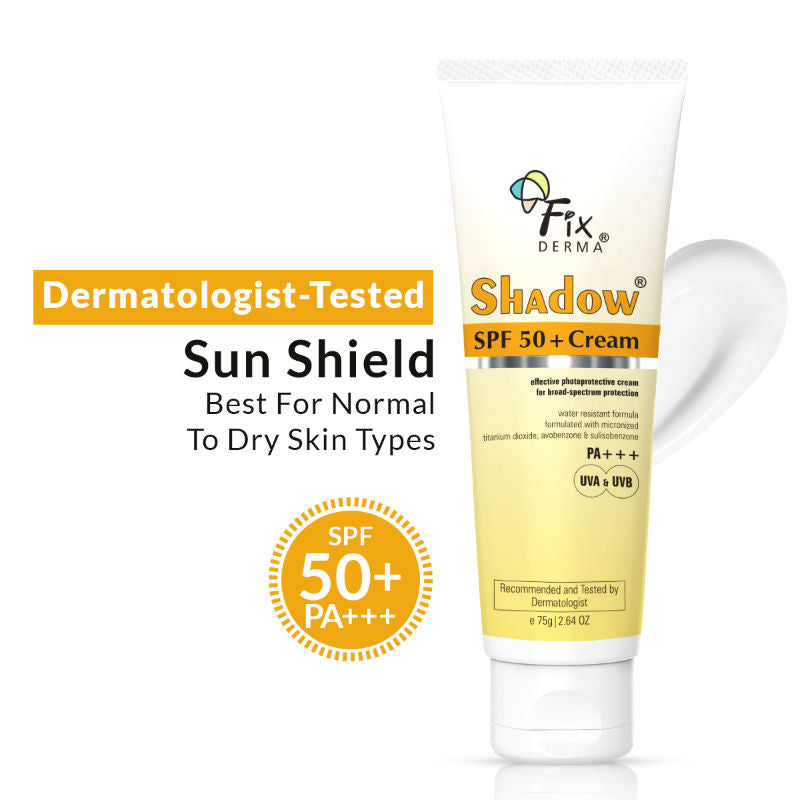
Fixderma Shadow SPF 50+ Cream To Protect Broad Spectrum

Fixderma Shadow SPF 50+ Cream To Protect Broad Spectrum
Fixderma
fixderma-shadow-spf-50-cream-to-protect-broad-spectrum
Suncare
10084955652389
Morning or Evening?
How often will you use this product?
Notes


Highlights
WHAT IS IT?
Sunscreen cream with broad spectrum SPF 50+ protection
FEATURES
Broad spectrum UVA and UVB protection, Lightweight, Non-greasy, No white cast, Oil-free, Water-resistant, Fragrance-free, Non-comedogenic, Does not penetrate skin
BEST FOR
all skin types
CHECKS
fragrance,comedogenic ingredients,oil
Who Is It For?
All Ages And GendersWhat Does It Help With?
Protects Against Uva And Uvb Rays Prevents Sunburn Suitable For Dry Oily Combination And Sensitive SkinBudget
Affordable (under $30)How To Use
Which routine should it be used in?
Instructions:
Key Information


What Fixderma Says
Product Description:
Fixderma Shadow SPF 50 + Cream has effective photoprotective property and suitable for all skin types. Sunscreen should be applied every two hours – even more, if you are swimming or sweating a lot. One ounce or two fingerfuls applied to dry skin 15 to 30 minutes before going outdoors is needed. Broad-spectrum protection (protects against UVA and UVB rays). Oil-free water-resistant Greater stability and provides better sun protection US FDA recommended formula. Lightweight sunscreen cream that provides sun protection with SPF 50+. Provides broad spectrum protection. Non greasy formula that has no white caste. Protects from UVA and UVB rays. Does not penetrate into the skin. 100% safe on skin. This sunscreen is fragrance free, non-comedogenic and water resistant.
About the Brand:
Ingredients Overview
Ingredients List
Octinoxate, Titanium Dioxide, Benzophenone-4, Avobenzone
Key Ingredients
Ingredients Details
Avobenzone
Common Name(s): Parsol 1789,avobenzone
DESCRIPTION
What It Does: Provides uva-i protection (340-400nm) critical for photoaging prevention — the only widely available chemical uva-i filter.
Why It's Used: The essential uva-i filter — avobenzone is the only commonly approved chemical filter providing protection in the photoaging-critical 340-400nm range essential for broad-spectrum sunscreen claims.
How It Works: Dibenzoylmethane chromophore absorbs uva-i (λmax 357nm, εmax ~36,000). photodegrades via photoisomerisation requiring photostabilisation (octocrylene, bemotrizinol) for durability.
Typically Found In: Broad-spectrum sunscreens,anti-aging spf products
TECHNICAL DETAILS
Primary Category: Active ingredient – chemical uva-i filter
Secondary Functions: Skin conditioning
Application Areas:

Facial Skincare

Body Care
Hair Care
Beard Care
Color Cosmetics (Makeup)
Dietary/Oral Supplements
Typical Concentration Range: Up to 5% (eu), 3% (us fda)
SOURCING & ETHICS
Vegan Status: Conditional - supplier confirmation required
Halal Status: Unverified - supplier confirmation required
Source Notes: Commercially produced for cosmetic use. verify vegan/halal status with supplier. [audit 2026-07-29 rev2: the record's own source_notes does not assert a non-animal origin, or instructs the reader to verify with the supplier; "yes" asserts knowledge the record does not hold. determination requires shariah-panel sign-off.]
SKIN COMPATIBILITY
Irritancy Rating: 1/5 – very low
Comedogenicity Rating: 0/5 – non-comedogenic
Sensitivity Concerns: Well-tolerated by most skin types.
Safe for Sensitive Skin: Yes
SAFETY & COMPATIBILITY
Safety Profile: Eu max 5%. fda: 3%. ewg score: 2. requires photostabilisation. photoallergy risk in some individuals.
Works Well With: Standard skincare actives
Avoid Combining With: No known significant incompatibilities
SCIENTIFIC NOTE
Avobenzone's photodegradation discovery drove development of photostabilisation technology — the period from avobenzone's 1978 introduction to development of effective photostabilisers in the 1990s was marked by sunscreens with inadequate uva durability. bemotrizinol (tinosorb s) development provided the most elegant solution by providing a photostable molecule with equivalent uva coverage.
Last Verified: 2026-03-12
Primary Sources: Cosing database,fda uv filter otc monograph,shaath sunscreen photostabilisation review
Benzophenone-4
Common Name(s): Benzophenone-4
DESCRIPTION
What It Does: Absorbs or reflects uv radiation, preventing uv-induced dna damage, photo-oxidative stress, and premature skin aging.
Why It's Used: Uv filters are the active ingredients in sun protection — without them, formulations cannot make spf claims or prevent solar-induced skin damage.
How It Works: The uv-absorbing chromophore undergoes photoexcitation by uv photons, then dissipates the absorbed energy through thermal relaxation (chemical filters) or photon scattering/reflection (physical filters), preventing photon penetration to skin cells.
Typically Found In: Sunscreens,moisturizers with spf,foundations with spf
TECHNICAL DETAILS
Primary Category: Uv filters
Secondary Functions: Skin-protecting
Application Areas:
Facial Skincare
Body Care
Hair Care
Beard Care
Color Cosmetics (Makeup)
Dietary/Oral Supplements
Typical Concentration Range: 0.5–25% (within regulatory limits)
SOURCING & ETHICS
Vegan Status: Yes
Halal Status: Yes
Source Notes: Synthetic uv filter; no animal components.
SKIN COMPATIBILITY
Irritancy Rating: 1
Comedogenicity Rating: 0
Sensitivity Concerns: Contact allergy to uv filters occurs in approximately 1–3% of the general population; patch testing recommended for those with known photosensitivity.
Safe for Sensitive Skin: Yes
SAFETY & COMPATIBILITY
Safety Profile: Regulatory approval required per market (eu annex vi, fda otc monograph, etc.). generally non-irritating at approved concentrations.
Works Well With: Other uv filters,antioxidants,emollients
Avoid Combining With: Incompatible filter combinations (photodegradation); check regulatory approvals per region
SCIENTIFIC NOTE
Uv filters operate through two mechanisms: organic/chemical filters absorb uv photons through electronic excitation (π→π* transitions in conjugated systems), then dissipate energy via thermal relaxation; inorganic/physical filters (tio2, zno) scatter and reflect photons through mie scattering (particle size 50–300 nm) and band gap absorption. spf is measured in vivo (iso 24444) as the ratio of minimal erythema doses with and without sunscreen.
Last Verified: 2025-01-15
Primary Sources: Cosing eu database; pcpc cosmetic ingredient safety reviews; eu cosmetics regulation annex vi; iso 24444 (in vivo spf testing)
Octinoxate
Common Name(s): Octyl methoxycinnamate,omc,parsol mcx
CAS Number: 5466-77-3
DESCRIPTION
What It Does: Provides the most widely used uvb chemical filtration with light, elegant aesthetics.
Why It's Used: The global uvb standard — octyl methoxycinnamate's combination of potent uvb absorption, light texture, and global approval makes it the most-used chemical uvb filter worldwide.
How It Works: Trans-cinnamate chromophore absorbs uvb at λmax 308nm (εmax ~24,000 l/mol·cm). undergoes trans-cis photoisomerisation reducing uv protection over time — requires photostabilisation with avobenzone or octocrylene. oil-soluble for elegant formulation.
Typically Found In: Sunscreens,foundation with spf,tinted moisturisers
TECHNICAL DETAILS
Primary Category: Active ingredient – chemical uvb filter
Secondary Functions: Skin conditioning
Application Areas:
Facial Skincare
Body Care
Hair Care
Beard Care
Color Cosmetics (Makeup)
Dietary/Oral Supplements
Typical Concentration Range: Up to 10% (eu), 7.5% (us fda)
SOURCING & ETHICS
Vegan Status: Conditional - supplier confirmation required
Halal Status: Unverified - supplier confirmation required
Source Notes: Commercially produced for cosmetic use. verify vegan/halal status with supplier. [audit 2026-07-29 rev2: the record's own source_notes does not assert a non-animal origin, or instructs the reader to verify with the supplier; "yes" asserts knowledge the record does not hold. determination requires shariah-panel sign-off.]
SKIN COMPATIBILITY
Irritancy Rating: 1/5 – very low
Comedogenicity Rating: 0/5 – non-comedogenic
Sensitivity Concerns: Well-tolerated by most skin types.
Safe for Sensitive Skin: Yes
SAFETY & COMPATIBILITY
Safety Profile: Eu max 10%. aquatic toxicity/coral reef concerns; hawaii and some us states restrict omc. requires photostabilisation for durable spf. ewg score: 5.
Works Well With: Standard skincare actives
Avoid Combining With: No known significant incompatibilities
SCIENTIFIC NOTE
Omc's trans-cis photoisomerisation (absorbing uv → converting trans to less-absorbing cis form) was identified as the mechanism for sunscreen product spf decay after uv exposure. this photodegradation led to development of octocrylene and avobenzone photostabilisation strategies — a pharmacokinetic discovery that fundamentally changed sunscreen formulation science.
Last Verified: 2026-03-12
Primary Sources: Cosing database,fda uv filter otc monograph,eu cosmetics annex vi
Titanium Dioxide
Common Name(s): Ci 77891,tio2,rutile,anatase
CAS Number: 13463-67-7
DESCRIPTION
What It Does: Physically reflects and scatters uvb and uva-ii radiation providing broad-spectrum physical sun protection.
Why It's Used: Most widely used mineral uv filter – photostable, non-irritating physical sun protection compatible with all skin types including baby and sensitive skin.
How It Works: High refractive index (2.5–2.7) and semiconductor bandgap provide physical reflection and absorption of uv radiation. primarily uvb (280–320nm) and uva-ii (320–340nm) protection, less effective for uva-i (340–400nm) vs zinc oxide.
Typically Found In: Sunscreens,tinted products,foundations,baby sunscreens
TECHNICAL DETAILS
Primary Category: Active ingredient – mineral uv filter
Secondary Functions: Photostable uv filter,opacifier
Application Areas:
Facial Skincare
Body Care
Hair Care
Beard Care
Color Cosmetics (Makeup)
Dietary/Oral Supplements
Typical Concentration Range: 1%–25% (spf products: eu max 25%)
SOURCING & ETHICS
Vegan Status: Yes – inorganic mineral
Halal Status: Yes
Source Notes: Produced from ilmenite or rutile mineral processing. nano tio2 (<100nm) for transparency; non-nano for opacity.
SKIN COMPATIBILITY
Irritancy Rating: 1/5 – very low
Comedogenicity Rating: 0/5 – non-comedogenic
Sensitivity Concerns: Non-irritating; suitable for baby and sensitive skin.
Safe for Sensitive Skin: Yes at recommended concentrations
SAFETY & COMPATIBILITY
Safety Profile: Excellent safety profile. fda category i grase for sunscreen. eu max 25%. non-nano preferred for safety. ewg score: 1.
Works Well With: Niacinamide,salicylic acid,other actives
Avoid Combining With: No significant incompatibilities at standard concentrations
SCIENTIFIC NOTE
Tio2 provides superior uvb protection vs zno but inferior uva-i coverage. this complementarity means tio2+zno combination sunscreens provide more complete uv spectrum coverage (uvb+uva-i+uva-ii) than either mineral filter alone.
Last Verified: 2026-03-12
Primary Sources: Cosing database,fda sunscreen grase ruling,ewg sunscreen database