

Fixderma Cosmetic Laboratories
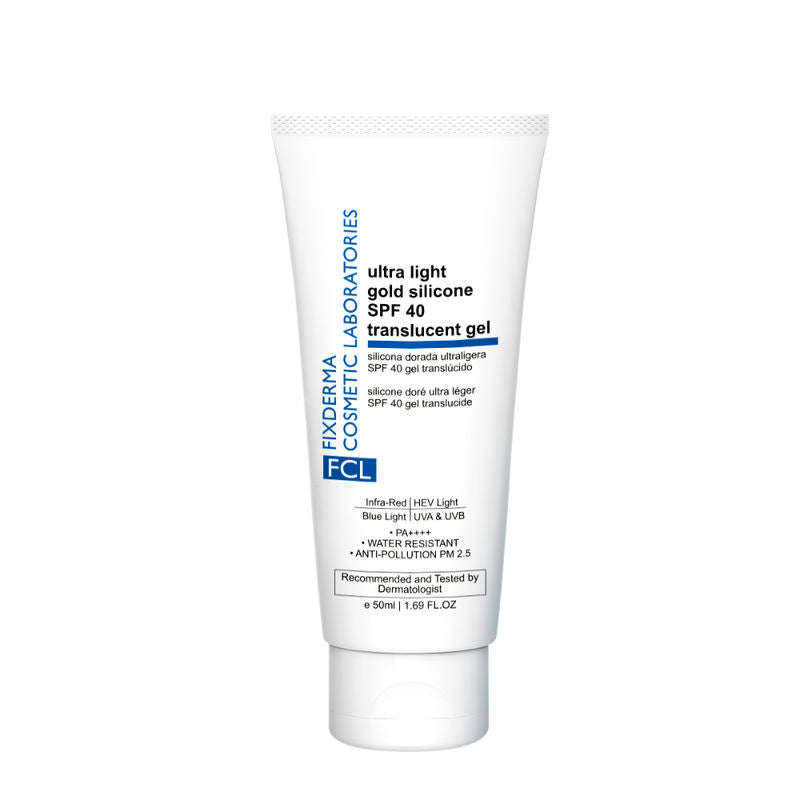
Fixderma Cosmetic Laboratories Ultra Light Gold Silicone SPF 40 Translucent Gel

Fixderma Cosmetic Laboratories Ultra Light Gold Silicone SPF 40 Translucent Gel
Fixderma Cosmetic Laboratories
fixderma-cosmetic-laboratories-ultra-light-gold-silicone-spf-40-translucent-gel
Suncare
10084965286181
Morning or Evening?
How often will you use this product?
Notes


Highlights
WHAT IS IT?
Sunscreen gel with 7 key active ingredients
FEATURES
Lightweight gel, SPF 40 PA+++ protection, protects against UVA, UVB, blue light, infra-red, high energy visible light and pollution PM 2.5, water resistant, non-comedogenic, fragrance free, suitable for sensitive skin
BEST FOR
combination
CHECKS
No fragrance, non-comedogenic, water resistant
Who Is It For?
All Genders Suitable For All Skin Types Including Sensitive SkinWhat Does It Help With?
Sun Protection Anti-pollution Anti-ageing Preventing Light Induced Skin DamageBudget
Mid-range ($30-$75)How To Use
Which routine should it be used in?
Instructions:
Key Information


What Fixderma Cosmetic Laboratories Says
Product Description:
Fixderma Cosmetic Laboratories Ultra Light Gold Silicone SPF40 Translucent Gel is a gel ideal for combination to oily skin providing superior sun protection against UVA, UVB, blue light, infra-red and high energy visible light. It forms an invisible protective layer without unpleasant appearance. Offers SPF 40 and PA+++ protection, water resistant, non-comedogenic, fragrance free and effective anti-pollution against PM 2.5. Suitable for all skin types including sensitive skin.
About the Brand:
Ingredients Overview
Ingredients List
aqua-water,ethylhexyl-methoxycinnamate,octocrylene,ethylhexyl-salicylate,butyl-methoxydibenzoylmethane,benzophenone-3,caprylyl-methicone,peg-12-dimethicone-ppg-20-crosspolymer,propanediol,phenylbenzimidazole-sulfonic-acid,butylene-glycol-cocoate,thermus-thermophillus-ferment,glycerin,silica,magnesium-aluminum-silicate-kaolin-montmorillonite-mica,titanium-dioxide,mica,tin-oxide,melanin,ectoin,diethylhexyl-syringylidenemalonate,caprylic-capric-triglyceride,fragrance
Key Ingredients
Galshield UV Care, Neo Haliopan Hydro, Beraclay Gold Clay, Ectoin, Melanin, Titanium Dioxide, Venuceane
Ingredients Details
Benzophenone-3
Common Name(s): Oxybenzone,2-hydroxy-4-methoxybenzophenone,uva+uvb filter
CAS Number: 131-57-7
DESCRIPTION
What It Does: Provides combined uva and uvb filtration in a single chemical uv filter molecule.
Why It's Used: Combined uva+uvb filter historically used for broad-spectrum coverage in a single ingredient, now increasingly restricted.
How It Works: Benzophenone chromophore absorbs uvb (305nm) and uva-ii (326nm) via two separate n→π* transitions. water-soluble allows aqueous phase formulation. single filter providing partial broad-spectrum coverage.
Typically Found In: Sunscreens (being phased out in many markets)
TECHNICAL DETAILS
Primary Category: Active ingredient – chemical uva/uvb filter
Secondary Functions: Skin conditioning
Application Areas:

Facial Skincare

Body Care
Hair Care
Beard Care
Color Cosmetics (Makeup)
Dietary/Oral Supplements
Typical Concentration Range: Up to 6% (eu), 6% (us fda)
SOURCING & ETHICS
Vegan Status: Yes – synthetic
Halal Status: Yes
Source Notes: Commercially produced for cosmetic use. verify vegan/halal status with supplier.
SKIN COMPATIBILITY
Irritancy Rating: 1/5 – very low
Comedogenicity Rating: 0/5 – non-comedogenic
Sensitivity Concerns: Well-tolerated by most skin types.
Safe for Sensitive Skin: Yes
SAFETY & COMPATIBILITY
Safety Profile: Eu max 6%. coral reef/aquatic toxicity — banned hawaii, palau, some us states. potential endocrine activity at high systemic exposure. ewg score: 7. use declining due to regulatory pressure.
Works Well With: Standard skincare actives
Avoid Combining With: No known significant incompatibilities
SCIENTIFIC NOTE
Benzophenone-3's declining use reflects evolving understanding of environmental and endocrine impacts: discovered in coral bleaching studies, its restriction in hawaii (2018) sparked a global trend in marine-safe sunscreen formulations that is reshaping the industry away from bp-3 toward mineral filters and marine-safer organic alternatives.
Last Verified: Cosing database,fda uv filter otc monograph,hawaii bp-3 restriction law
Primary Sources: 2026-03-12
Ectoin
Common Name(s): Ectoin,extremophile stress protector,anti-aging humectant
CAS Number: N/a
DESCRIPTION
What It Does: Hydrates by forming a water-shell around skin biomolecules, stabilises cellular membranes against heat/uv stress, and reduces inflammatory cytokine release in stressed skin.
Why It's Used: Provides dual humectancy plus cellular protection — unique among humectants for its documented ability to stabilise skin proteins and membranes against uv and environmental stress, not just attract water.
How It Works: Ectoin's tetrahydropyrimidine ring forms an ordered hydration shell around proteins, lipid bilayers, and dna through kosmotropic water structuring. this preferential hydration excludes denaturants and uv-stress mediators from biomolecule surfaces while simultaneously providing humectant moisture binding.
Typically Found In: Sensitive skin,uv protection actives,anti-inflammatory
TECHNICAL DETAILS
Primary Category: Functional ingredient – humectant
Secondary Functions: Tewl reduction,skin plumping
Application Areas:
Facial Skincare
Body Care
Hair Care
Beard Care
Color Cosmetics (Makeup)
Dietary/Oral Supplements
Typical Concentration Range: 0.1%–2%
SOURCING & ETHICS
Vegan Status: Yes
Halal Status: Yes
Source Notes: Synthetic or naturally derived. excellent aqueous solubility.
SKIN COMPATIBILITY
Irritancy Rating: 1/5 – very low
Comedogenicity Rating: 0/5 – non-comedogenic
Sensitivity Concerns: Non-irritating; suitable for all skin types.
Safe for Sensitive Skin: Yes
SAFETY & COMPATIBILITY
Safety Profile: Excellent safety profile. ewg score: 1.
Works Well With: Ceramides,emollients,occlusives,glycerin,hyaluronic acid
Avoid Combining With: No significant incompatibilities
SCIENTIFIC NOTE
Extremophile bacteria accumulate ectoin at up to 15% intracellular concentration to survive 100°c temperatures and extreme salinity — the same biomolecule protection mechanism applies to human skin cells at cosmetic concentrations.
Last Verified: Cosing database,ectoin extremophile anti-stress clinical review
Primary Sources: 2026-03-12
Fragrance
Common Name(s): Fragrance ingredient,eu allergen or aromatic component,olfactory/flavour
CAS Number: N/a
DESCRIPTION
What It Does: Provides the complete fragrance profile contributing to product sensory experience and consumer appeal.
Why It's Used: Fragrance is a major consumer purchase driver — up to 70% of consumers make purchasing decisions partially based on product scent.
How It Works: Fragrance blends interact with olfactory receptors providing the sensory profile — complex mixtures activate multiple receptor types for rich, multidimensional scent experiences.
Typically Found In: All fragrance products
TECHNICAL DETAILS
Primary Category: Active ingredient – cosmetic active
Secondary Functions: Skin conditioning
Application Areas:
Facial Skincare
Body Care
Hair Care
Beard Care
Color Cosmetics (Makeup)
Dietary/Oral Supplements
Typical Concentration Range: Standard use levels
SOURCING & ETHICS
Vegan Status: Conditional
Halal Status: Yes
Source Notes: Commercially produced for cosmetic use. verify vegan/halal status with supplier.
SKIN COMPATIBILITY
Irritancy Rating: 1/5 – very low
Comedogenicity Rating: 0/5 – non-comedogenic
Sensitivity Concerns: Well-tolerated by most skin types.
Safe for Sensitive Skin: Yes
SAFETY & COMPATIBILITY
Safety Profile: Good safety profile at recommended concentrations. ewg score: 1–2.
Works Well With: Standard skincare actives
Avoid Combining With: No known significant incompatibilities
SCIENTIFIC NOTE
Ifra guidelines set usage limits for fragrance ingredients based on skin sensitisation and phototoxicity assessment for each application category.
Last Verified: Eu regulation 1223/2009 annex iii,ifra standards,fragrance allergen declaration requirements
Primary Sources: 2026-03-12
Glycerin
Common Name(s): Glycerol,glycerine,1,2,3-propanetriol
CAS Number: 56-81-5
DESCRIPTION
What It Does: Glycerin pulls water from the environment and deeper skin layers into the outer skin layer (epidermis), boosting moisture levels and keeping skin soft, smooth, and plump.
Why It's Used: It is used in virtually every moisturizer, serum, and cleanser because it is highly effective at hydrating skin, is well-tolerated by all skin types, and enhances the texture and spreadability of formulations.
How It Works: As a humectant, glycerin forms hydrogen bonds with water molecules, trapping them in the skin. it also reinforces the skin barrier by integrating into lipid structures between skin cells.
Typically Found In: Moisturizers,serums,cleansers,toners,sheet masks,sunscreens,body lotions,shampoos,conditioners
TECHNICAL DETAILS
Primary Category: Humectant
Secondary Functions: Skin barrier support,emollient,solvent
Application Areas:
Facial Skincare
Body Care
Hair Care
Beard Care
Color Cosmetics (Makeup)
Dietary/Oral Supplements
Typical Concentration Range: 1%–30% (typical: 3–10%)
SOURCING & ETHICS
Vegan Status: Yes – plant-derived (coconut, soy, palm) or synthetic
Halal Status: Yes – when plant-derived or synthetic; verify source with supplier
Source Notes: Derived from plant oils via hydrolysis or saponification; synthetic versions also available. palm-derived glycerin carries sustainability concerns.
SKIN COMPATIBILITY
Irritancy Rating: 1/5 – very low; non-irritating at all standard concentrations
Comedogenicity Rating: 0/5 – non-comedogenic
Sensitivity Concerns: Extremely rare allergic reactions; generally safe for all skin types including sensitive and baby skin
Safe for Sensitive Skin: Yes
SAFETY & COMPATIBILITY
Safety Profile: Widely recognized as safe. ewg hazard score: 1. no significant concerns for irritation, sensitization, or toxicity at typical concentrations (up to 50%).
Works Well With: Hyaluronic acid,ceramides,niacinamide,panthenol,urea,peptides,retinol,ahas/bhas
Avoid Combining With: No known incompatibilities at standard concentrations
SCIENTIFIC NOTE
Glycerin is an endogenous skin component found naturally in the stratum corneum. aquaporin-3 channels in keratinocytes facilitate glycerin transport, making it integral to natural skin hydration pathways.
Last Verified: Cosing database,cir safety assessment,ewg skin deep,inci decoder
Primary Sources: 2026-03-12
