

RéVive
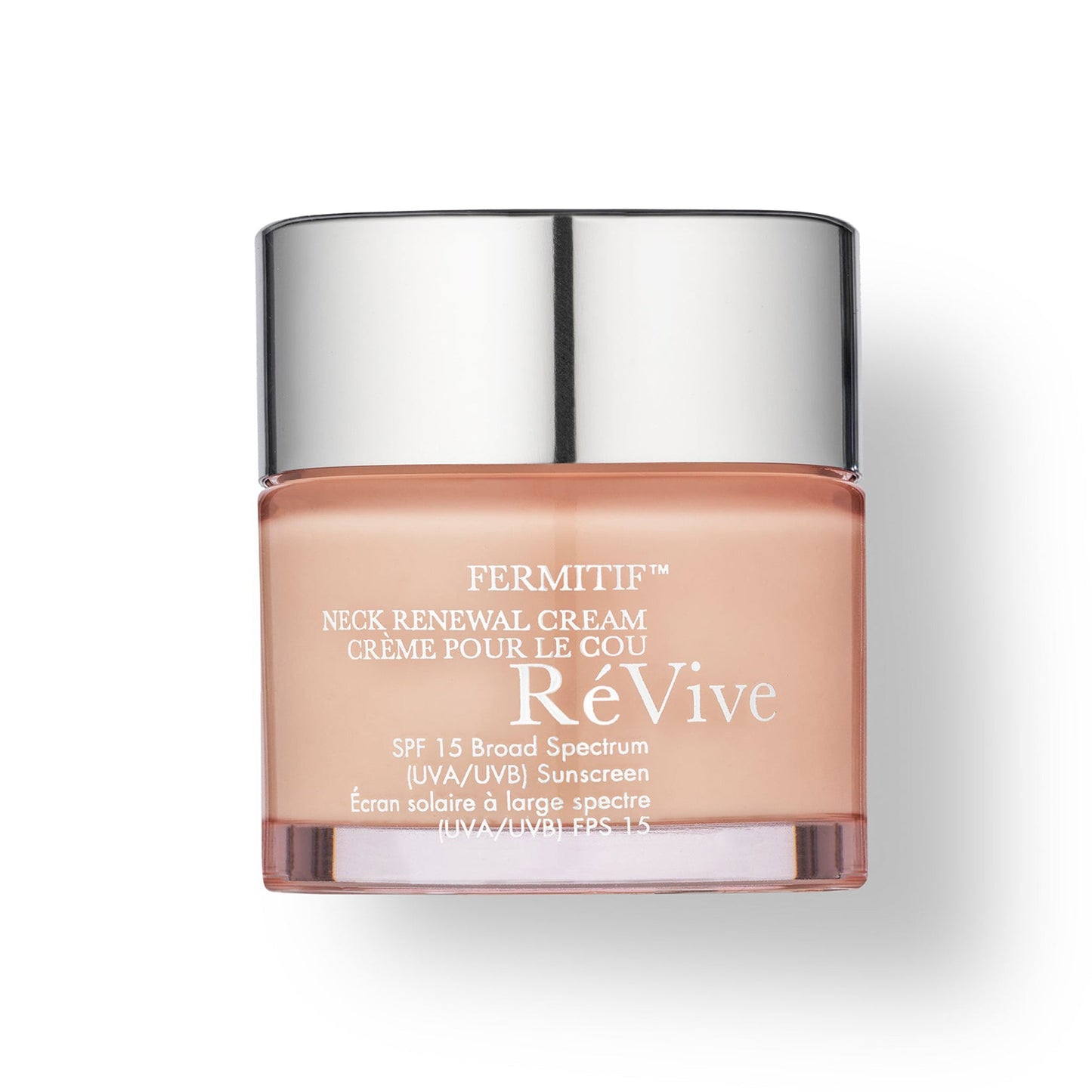
Fermitif Neck Renewal Cream

Fermitif Neck Renewal Cream
RéVive
fermitif-neck-renewal-cream
Moisturize, Suncare
9643601985829
Morning or Evening?
How often will you use this product?
Notes


Highlights
WHAT IS IT?
Neck cream and sunscreen
FEATURES
SPF 15, Increases skin renewal, Improves moisturization and elasticity, Reduces fine lines and wrinkles
BEST FOR
Not specified, likely suitable for all skin types
CHECKS
Does not contain parabens (not explicitly stated but implied)
Who Is It For?
Adults Both Men And Women (not Explicitly Stated But Implied)What Does It Help With?
Sun Damage Protection Improving Skin Texture Reducing Signs Of Aging On Neck And DécolletageBudget
PremiumHow To Use
Which routine should it be used in?
Instructions:
Key Information

What RéVive Says
Product Description:
Take care of the delicate skin on your neck and décolletage with our bestselling neck cream and sunscreen. Protect from sun damage with SPF 15 and increase skin renewal to resist the daily pull of gravity.
About the Brand:
Ingredients Overview
Ingredients List
Aqua (Water, Eau), Helianthus Annuus (Sunflower) Seed Oil, Squalane, Cetearyl Alcohol, Butylene Glycol, Sorbitan Stearate, PPG-2 Myristyl Ether Propionate, Potassium Cetyl Phosphate, Isocetyl Stearate, Oligopeptide-20, Oligopeptide-24, Sodium Hyaluronate, Terminalia Catappa Leaf Extract, Sambucus Nigra Flower Extract, Tocopherol, Magnesium Aluminum Silicate, Tocopheryl Acetate, Bisabolol, Caprylyl Glycol, Allantoin, Aloe Barbadensis Leaf Juice Powder, Glycolipids, Methylsilanol Hydroxyproline Aspartate, Hydrolyzed Soy Flour, Salicylic Acid, Glycerin, Sodium Oleate, Glycine Soja (Soybean) Oil, Hydrogenated Lecithin, Hydrogenated Phosphatidylcholine, Polysorbate 80, Dimethicone, Carbomer, Propylene Glycol, Aminomethyl Propanol, Sodium PCA, Parfum (Fragrance), PVP, Titanium Dioxide. Tannic Acid, Phenoxyethanol, Chlorphenesin, Disodium EDTA, Potassium Sorbate, Farnesol, Benzyl Benzoate, Citronellol, Geraniol, BHT, CI 17200 (Red 33)
Key Ingredients
Bio-Renewal Peptide, Bio-Firming Peptide, Powerful Phyto-Firming Agents (Soy protein, country almond leaf extract, and elderflower extract), Broad Spectrum Sunscreen
Ingredients Details
Butylene Glycol
Common Name(s): 1,3-butanediol,bg,1,3-butylene glycol
CAS Number: 107-88-0
DESCRIPTION
What It Does: Provides humectant hydration and active ingredient solubilization with excellent skin feel.
Why It's Used: Preferred glycol humectant in premium and k-beauty formulations for superior skin feel vs propylene glycol with equivalent functionality.
How It Works: Two hydroxyl groups at 1,3-positions provide water binding and solvent activity. better tolerated than propylene glycol with minimal sensitization risk. 4-carbon backbone provides slightly greater hydrophobic character enabling dissolution of less polar actives vs pg.
Typically Found In: Toners,essences,serums,k-beauty formulas
TECHNICAL DETAILS
Primary Category: Functional ingredient – glycol humectant
Secondary Functions: Tewl reduction,skin plumping
Application Areas:

Facial Skincare
Body Care
Hair Care

Beard Care
Color Cosmetics (Makeup)
Dietary/Oral Supplements
Typical Concentration Range: 1%–10%
SOURCING & ETHICS
Vegan Status: Yes – synthetic
Halal Status: Yes
Source Notes: Synthetic or naturally derived. excellent aqueous solubility.
SKIN COMPATIBILITY
Irritancy Rating: 1/5 – very low
Comedogenicity Rating: 0/5 – non-comedogenic
Sensitivity Concerns: Non-irritating; suitable for all skin types.
Safe for Sensitive Skin: Yes
SAFETY & COMPATIBILITY
Safety Profile: Excellent safety profile. ewg score: 1.
Works Well With: Ceramides,emollients,occlusives,glycerin,hyaluronic acid
Avoid Combining With: No significant incompatibilities
SCIENTIFIC NOTE
K-beauty's preference for butylene glycol over propylene glycol is driven by two factors: bg's superior skin feel (less tacky than pg's higher viscosity) and its lower sensitization potential (1,3-bg has better spatial distribution of hydroxyl groups that reduces protein interaction vs pg's 1,2-position oh groups).
Last Verified: 2026-03-12
Primary Sources: Cosing database,cir safety assessment
Cetearyl Alcohol
Common Name(s): Cetostearyl alcohol,c16-18 fatty alcohol
CAS Number: 8005-44-5
DESCRIPTION
What It Does: Provides fatty alcohol emulsification and thickening for stable, well-textured emulsions.
Why It's Used: The most widely used fatty alcohol in cosmetics – provides emulsification, thickening, and emolliency simultaneously from a single ingredient with excellent safety profile.
How It Works: Forms bilayer lamellar structures in water with emulsifiers creating a viscous structured network that thickens and stabilizes emulsions. fatty alcohol emolliency provides direct skin conditioning. bilayer formation reduces inter-droplet coalescence in emulsions.
Typically Found In: Creams,lotions,conditioners – virtually all emulsion products
TECHNICAL DETAILS
Primary Category: Functional ingredient – fatty alcohol emulsifier/thickener
Secondary Functions: Barrier sealing,softening
Application Areas:
Facial Skincare
Body Care
Hair Care
Beard Care
Color Cosmetics (Makeup)
Dietary/Oral Supplements
Typical Concentration Range: 1%–25%
SOURCING & ETHICS
Vegan Status: Yes - standard ethanol routes are non-animal; confirm denaturant origin
Halal Status: Conditional - ethanol production route and residual concentration; jurisdiction-dependent, refer to certifier stance
Source Notes: Plant-derived, synthetic or animal-derived. verify source. [audit 2026-07-29 rev2: ethanol pathway; determination depends on route, on whether the plant also produces beverage alcohol, and on residual concentration. determination requires shariah-panel sign-off.]
SKIN COMPATIBILITY
Irritancy Rating: 1/5 – very low
Comedogenicity Rating: 1/5 – low; formulation-dependent
Sensitivity Concerns: Non-irritating.
Safe for Sensitive Skin: Yes
SAFETY & COMPATIBILITY
Safety Profile: Excellent safety profile. ewg score: 1.
Works Well With: Humectants,ceramides,actives as carrier
Avoid Combining With: No significant incompatibilities
SCIENTIFIC NOTE
Cetearyl alcohol's ability to form lamellar liquid crystal structures ('krafft phases') with water and co-emulsifiers provides not only emulsion stability but also enhanced skin penetration via the lamellar skin barrier pathway. these crystalline structures can act as a reservoir for active ingredients, slowly releasing them as the lamellar structure melts on skin contact.
Last Verified: 2026-03-12
Primary Sources: Cosing database,cir safety assessment
Helianthus Annuus (sunflower) Seed Oil
Common Name(s): Helianthus annuus (sunflower) seed oil,botanical oil,phytochemical active
CAS Number: N/a
DESCRIPTION
What It Does: Provides antioxidant protection from reactive oxygen species, reduces inflammatory cytokine production in skin, and conditions skin through the plant's phytochemical complex.
Why It's Used: Natural origin narrative, traditional use heritage, and multi-functional phytochemical profile supporting concurrent skin care claims from one ingredient.
How It Works: Polyphenols, terpenoids, and alkaloids scavenge ros via h• donation, inhibit nf-kb or cox-2 inflammatory pathways, and interact with skin surface proteins for conditioning.
Typically Found In: Botanical skin care,natural products
TECHNICAL DETAILS
Primary Category: Active ingredient – antioxidant
Secondary Functions: Free radical scavenging,anti-aging
Application Areas:
Facial Skincare
Body Care
Hair Care
Beard Care
Color Cosmetics (Makeup)
Dietary/Oral Supplements
Typical Concentration Range: 0.1%–10%
SOURCING & ETHICS
Vegan Status: Conditional - supplier confirmation required
Halal Status: Yes
Source Notes: Plant-derived extract or synthetic. [audit 2026-07-29 rev2: status downgraded on audit. determination requires shariah-panel sign-off.]
SKIN COMPATIBILITY
Irritancy Rating: 1/5 – very low
Comedogenicity Rating: 0/5 – non-comedogenic
Sensitivity Concerns: Non-irritating; well-tolerated.
Safe for Sensitive Skin: Yes
SAFETY & COMPATIBILITY
Safety Profile: Excellent safety profile. ewg score: 1.
Works Well With: Vitamin c,vitamin e,ferulic acid,spf,other antioxidants
Avoid Combining With: No significant incompatibilities
SCIENTIFIC NOTE
Plant secondary metabolites evolved as photoprotectants and antimicrobials — mechanisms directly applicable to cosmetic antioxidant and anti-inflammatory activity in human skin.
Last Verified: 2026-03-12
Primary Sources: Cosing database,helianthus annuus (sunflower) seed botanical review
Isocetyl Stearate
Common Name(s): Isocetyl stearate,isocetyl alcohol (branched c16) stearic acid (c18) ester
DESCRIPTION
What It Does: Softens and conditions skin with a light, non-greasy feel.
Why It's Used: Used for its semi-solid non-greasy emollient; non-crystallizing due to branched alcohol; widely used emollient properties; suitable for lightweight skin care where non-greasy texture is key.
How It Works: Ester of isocetyl alcohol (branched c16) (branched or specialty alcohol) with stearic acid (c18); branching reduces crystallinity and greasiness; provides smooth, dry-oil skin feel.
Typically Found In: Lightweight moisturizers,sunscreens,skin serums,body lotions
TECHNICAL DETAILS
Primary Category: Functional ingredient – emollient
Secondary Functions: Skin conditioning,texture modification,spreading agent
Application Areas:
Facial Skincare
Body Care
Hair Care
Beard Care
Color Cosmetics (Makeup)
Dietary/Oral Supplements
Typical Concentration Range: 0.5%–10%
SOURCING & ETHICS
Vegan Status: Conditional - feedstock declaration required
Halal Status: Unverified - feedstock declaration required (plant, animal and petrochemical routes all exist)
Source Notes: Isocetyl alcohol (branched c16) and stearic acid (c18); plant or synthetic origin. [audit 2026-07-29 rev2: origin-dependent: the same inci exists in plant, animal and petrochemical versions and the name does not discriminate. determination requires shariah-panel sign-off.]
SKIN COMPATIBILITY
Irritancy Rating: 1/5 – very low
Comedogenicity Rating: 1/5 – low
Sensitivity Concerns: Generally well tolerated.
Safe for Sensitive Skin: Yes
SAFETY & COMPATIBILITY
Safety Profile: Good safety profile. ewg score: 1.
Works Well With: Other emollients,silicones,natural oils,humectants
Avoid Combining With: No significant incompatibilities
SCIENTIFIC NOTE
Isocetyl stearate: branched c16 + c18 stearate; semi-solid at room temperature but non-crystallizing due to branching; widely used non-greasy emollient in premium skin care and color cosmetics.
Last Verified: 2026-03-28
Primary Sources: Cosing database,inci dictionary