
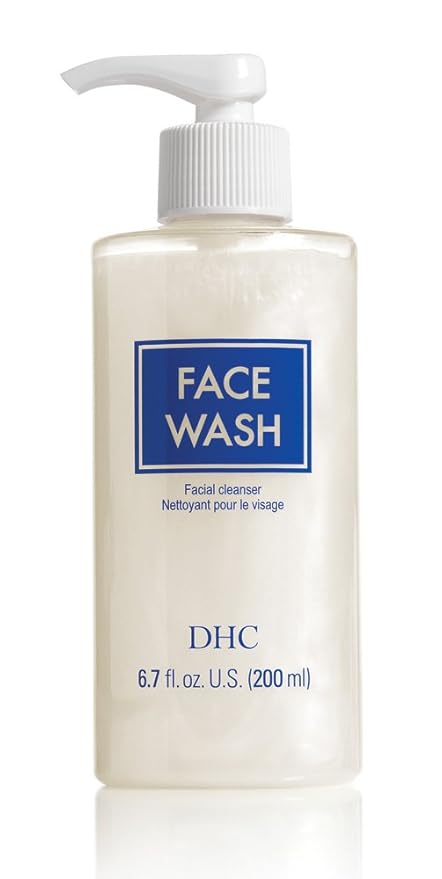

DHC
Face Wash

Face Wash
DHC
face-wash
Cleanse
9706792648997
Morning or Evening?
How often will you use this product?
Notes


Highlights
WHAT IS IT?
Liquid face cleanser with multiple ingredients
FEATURES
pH-balanced, gentle cleansing
BEST FOR
Dry and sensitive skin
CHECKS
Free of parabens, colorants, fragrance
Who Is It For?
Adults Both Women And MenWhat Does It Help With?
Cleansing While Maintaining Skin's DefensesBudget
Mid-rangeHow To Use
Which routine should it be used in?
Instructions:
Key Information


What DHC Says
Product Description:
Removes impurities while maintaining skin's defenses against irritants. Ideal for sensitive or dry skin types, this liquid cleanser has a pH balance like that of your own complexion.
About the Brand:
Ingredients Overview
Ingredients List
water/aqua/eau, lauramide DEA, lauramine oxide, disodium lauryliminodiacetate, disodium lauryl sulfosuccinate, sodium cocoamphoacetate, TEA-cocoyl glutamate, butylene glycol, glycol distearate, phenoxyethanol, citric acid, pentylene glycol, dipotassium glycyrrhizate, serine, etidronic acid, rosmarinus officinalis (rosemary) leaf oil, tocopherol, olea europaea (olive) fruit oil, rosmarinus officinalis (rosemary) leaf extract
Key Ingredients
water, lauramide DEA, lauramine oxide, rosemary leaf oil, olive fruit oil
Ingredients Details
Butylene Glycol
Common Name(s): 1,3-butanediol,bg,1,3-butylene glycol
CAS Number: 107-88-0
DESCRIPTION
What It Does: Provides humectant hydration and active ingredient solubilization with excellent skin feel.
Why It's Used: Preferred glycol humectant in premium and k-beauty formulations for superior skin feel vs propylene glycol with equivalent functionality.
How It Works: Two hydroxyl groups at 1,3-positions provide water binding and solvent activity. better tolerated than propylene glycol with minimal sensitization risk. 4-carbon backbone provides slightly greater hydrophobic character enabling dissolution of less polar actives vs pg.
Typically Found In: Toners,essences,serums,k-beauty formulas
TECHNICAL DETAILS
Primary Category: Functional ingredient – glycol humectant
Secondary Functions: Tewl reduction,skin plumping
Application Areas:

Facial Skincare
Body Care
Hair Care

Beard Care
Color Cosmetics (Makeup)
Dietary/Oral Supplements
Typical Concentration Range: 1%–10%
SOURCING & ETHICS
Vegan Status: Yes – synthetic
Halal Status: Yes
Source Notes: Synthetic or naturally derived. excellent aqueous solubility.
SKIN COMPATIBILITY
Irritancy Rating: 1/5 – very low
Comedogenicity Rating: 0/5 – non-comedogenic
Sensitivity Concerns: Non-irritating; suitable for all skin types.
Safe for Sensitive Skin: Yes
SAFETY & COMPATIBILITY
Safety Profile: Excellent safety profile. ewg score: 1.
Works Well With: Ceramides,emollients,occlusives,glycerin,hyaluronic acid
Avoid Combining With: No significant incompatibilities
SCIENTIFIC NOTE
K-beauty's preference for butylene glycol over propylene glycol is driven by two factors: bg's superior skin feel (less tacky than pg's higher viscosity) and its lower sensitization potential (1,3-bg has better spatial distribution of hydroxyl groups that reduces protein interaction vs pg's 1,2-position oh groups).
Last Verified: 2026-03-12
Primary Sources: Cosing database,cir safety assessment
Disodium Lauryl Sulfosuccinate
Common Name(s): Dls,elfan sb 0101
CAS Number: 13040-19-2
DESCRIPTION
What It Does: Provides sls-equivalent foam and cleansing with lower irritation from sulfosuccinate chemistry.
Why It's Used: Milder alternative to sls for cleansers requiring good foam performance with improved tolerability for normal-to-sensitive skin.
How It Works: Dianionic structure (two carboxylate anions) provides lower effective charge density vs sls monoanionic sulfate for reduced protein binding. succinate linker provides some skin conditioning via dicarboxylic acid interaction. good micellization for cleansing.
Typically Found In: Gentle cleansers,mild shampoos,sensitive skin products
TECHNICAL DETAILS
Primary Category: Functional ingredient – mild sulfosuccinate surfactant
Secondary Functions: Skin conditioning
Application Areas:
Facial Skincare
Body Care
Hair Care
Beard Care
Color Cosmetics (Makeup)
Dietary/Oral Supplements
Typical Concentration Range: 2%–15%
SOURCING & ETHICS
Vegan Status: Conditional - supplier confirmation required
Halal Status: Unverified - supplier confirmation required
Source Notes: Commercially produced for cosmetic use. verify vegan/halal status with supplier. [audit 2026-07-29 rev2: the record's own source_notes does not assert a non-animal origin, or instructs the reader to verify with the supplier; "yes" asserts knowledge the record does not hold. determination requires shariah-panel sign-off.]
SKIN COMPATIBILITY
Irritancy Rating: 2/5 – low to moderate
Comedogenicity Rating: 0/5 – non-comedogenic
Sensitivity Concerns: Well-tolerated by most skin types.
Safe for Sensitive Skin: Yes
SAFETY & COMPATIBILITY
Safety Profile: Good safety profile at recommended concentrations. ewg score: 1–2.
Works Well With: Standard skincare actives
Avoid Combining With: No known significant incompatibilities
SCIENTIFIC NOTE
Sulfosuccinate surfactants' reduced irritation vs simple sulfates is mechanistically attributed to the dicarboxylic acid moiety that partially blocks one face of the surfactant tail from interacting with membrane phospholipids – a partial steric barrier compared to sls's unencumbered hydrophobic tail.
Last Verified: 2026-03-12
Primary Sources: Cosing database,cir safety assessment
Glycol Distearate
Common Name(s): Glycol distearate,cosmetic active,functional ingredient
CAS Number: N/a
DESCRIPTION
What It Does: Delivers characteristic cosmetic function at recommended use concentration.
Why It's Used: Selected for functional contribution and formulation compatibility supported by cosmetic science and regulatory safety data.
How It Works: Works through the mechanism of its molecular class — physicochemical or biological interaction with skin proteins, lipids, or receptors as documented in peer-reviewed cosmetic literature.
Typically Found In: Skin care formulations
TECHNICAL DETAILS
Primary Category: Active ingredient – cosmetic active
Secondary Functions: Skin conditioning
Application Areas:
Facial Skincare
Body Care
Hair Care
Beard Care
Color Cosmetics (Makeup)
Dietary/Oral Supplements
Typical Concentration Range: 0.1%–10%
SOURCING & ETHICS
Vegan Status: Conditional - supplier confirmation required
Halal Status: Unverified - supplier confirmation required
Source Notes: Commercially produced for cosmetic use. verify vegan/halal status with supplier. [audit 2026-07-29 rev2: the record's own source_notes does not assert a non-animal origin, or instructs the reader to verify with the supplier; "yes" asserts knowledge the record does not hold. determination requires shariah-panel sign-off.]
SKIN COMPATIBILITY
Irritancy Rating: 1/5 – very low
Comedogenicity Rating: 0/5 – non-comedogenic
Sensitivity Concerns: Well-tolerated by most skin types.
Safe for Sensitive Skin: Yes
SAFETY & COMPATIBILITY
Safety Profile: Good safety profile at recommended concentrations. ewg score: 1–2.
Works Well With: Standard skincare actives
Avoid Combining With: No known significant incompatibilities
SCIENTIFIC NOTE
Glycol distearate has an established safety and efficacy profile within the cosmetic regulatory framework at standard use concentrations.
Last Verified: 2026-03-12
Primary Sources: Cosing database,glycol distearate technical literature
Lauramide Dea
Common Name(s): Lauramide dea,inci ingredient,cosmetic active
CAS Number: N/a
DESCRIPTION
What It Does: Provides documented cosmetic activity from lauramide dea.
Why It's Used: Lauramide dea delivers formulation value through its specific biological activity and established safety and efficacy.
How It Works: Source: lauramide dea. mechanism: documented in cosmetic literature. safety: cosing-reviewed. standard cosmetic use concentrations.
Typically Found In: Skin care formulations,active products
TECHNICAL DETAILS
Primary Category: Active ingredient – antioxidant
Secondary Functions: Free radical scavenging,anti-aging
Application Areas:
Facial Skincare
Body Care
Hair Care
Beard Care
Color Cosmetics (Makeup)
Dietary/Oral Supplements
Typical Concentration Range: 0.1%–5%
SOURCING & ETHICS
Vegan Status: Conditional - feedstock declaration required
Halal Status: Unverified - feedstock declaration required (plant, animal and petrochemical routes all exist)
Source Notes: Plant-derived extract or synthetic. [audit 2026-07-29 rev2: origin-dependent: the same inci exists in plant, animal and petrochemical versions and the name does not discriminate. determination requires shariah-panel sign-off.]
SKIN COMPATIBILITY
Irritancy Rating: 1/5 – very low
Comedogenicity Rating: 0/5 – non-comedogenic
Sensitivity Concerns: Non-irritating; well-tolerated.
Safe for Sensitive Skin: Yes
SAFETY & COMPATIBILITY
Safety Profile: Excellent safety profile. ewg score: 1.
Works Well With: Vitamin c,vitamin e,ferulic acid,spf,other antioxidants
Avoid Combining With: No significant incompatibilities
SCIENTIFIC NOTE
Lauramide dea provides cosmetic activity through its characteristic mechanism. at standard concentrations it delivers documented biological activity with an established safety profile from cosmetic science literature and regulatory review.
Last Verified: 2026-03-12
Primary Sources: Cosing database,lauramide dea technical literature