

AfricanBotanicsStaging
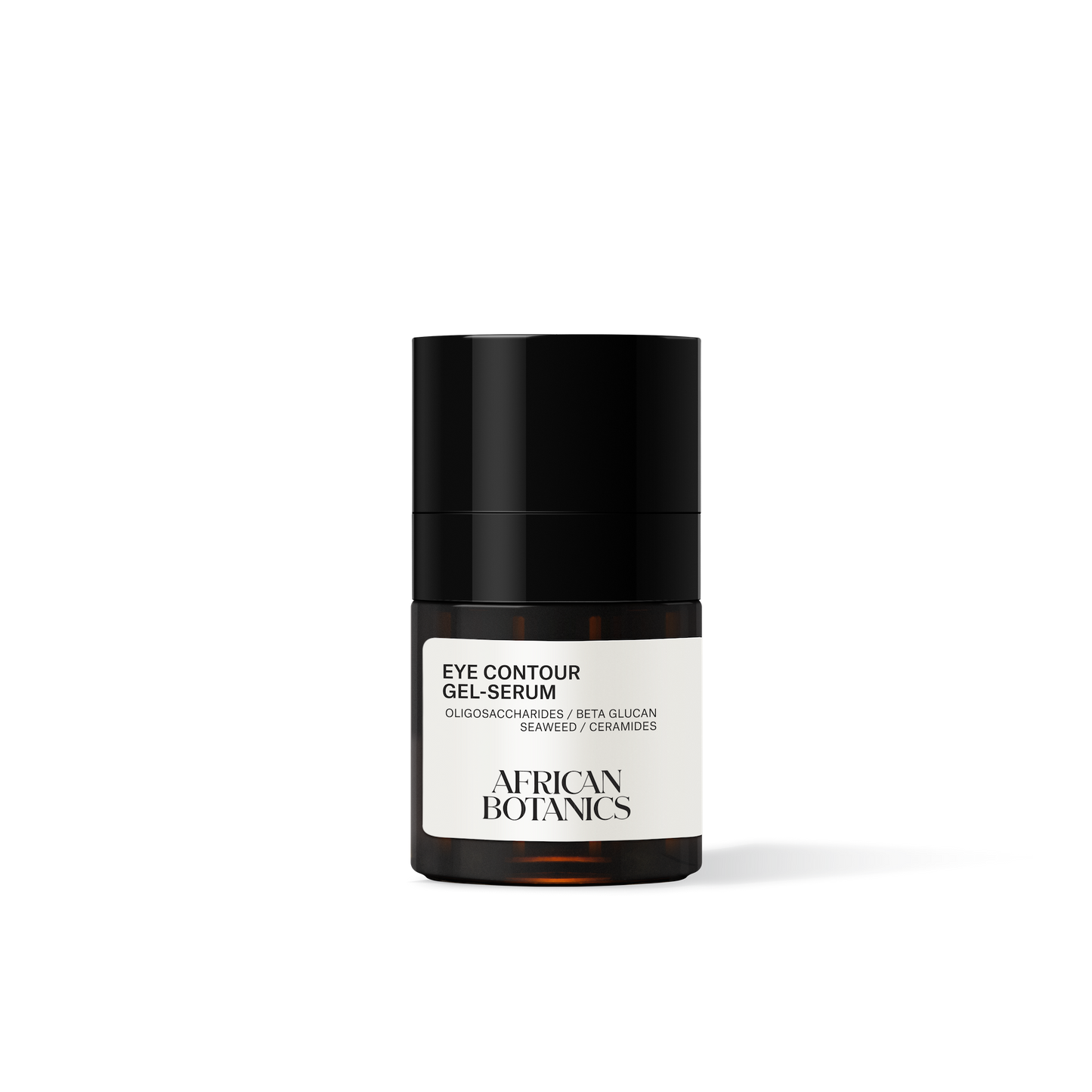
Eye Contour Gel-Serum

Eye Contour Gel-Serum
AfricanBotanicsStaging
eye-contour-gel-serum
Eyecare
9784848056613
Morning or Evening?
How often will you use this product?
Notes


Highlights
WHAT IS IT?
Eye Gel-Serum
FEATURES
Energizing, cooling gel-serum, targets puffiness, dark circles, fine lines and wrinkles, soothing, tightening, barrier reinforcing
BEST FOR
sensitive
CHECKS
Parabens-free, silicones-free, phthalates-free, mineral oil-free, artificial fragrance-free, colorants-free, SLS-free
Who Is It For?
Adults Concerned With Eye Area Aging SignsWhat Does It Help With?
Puffiness Dark Circles Fine Lines Wrinkles Skin Barrier FunctionBudget
Professional (over $150)How To Use
Which routine should it be used in?
Instructions:
Key Information


What AfricanBotanicsStaging Says
Product Description:
Eye Contour Gel-Serum is an energizing and highly concentrated cooling gel-serum that targets the appearance of puffiness, dark circles, fine lines and wrinkles while visibly soothing, tightening and reinforcing the barrier function of the skin for a more youthful appearance.
About the Brand:
Ingredients Overview
Ingredients List
Aqua (Water), Glycerin, Medicago Sativa (Alfalfa) Seed Extract, Hydrolyzed Lupine Protein Oligosaccharides, Yeast Beta-Glucan _x0003_Extract, Butylene Glycol, Hamamelis Virginia (Witch Hazel) Extract, Niacinamide, Ceramide NP, Ceramide AP, Ceramide EOP, Cholesterol, Fucus Vesiculosis (Seaweed) Extract, Caffein, Aspalathus Linearis (Rooibos) Leaf Extract, Cyclopia Genistoides (Honeybush) Leaf Extract, Bulbine Frutescens Leaf Extract, Hypoxis Hemerocallidea (African Potatoe) Extract, Sclerocarya Birrea (Marula) Seed Oil, Sodium Ascorbyl Phosphate (Vitiamin C), Alpha Tocopheryl Acetate (Vitamin E), Schinziophyton Rautanenii (Mongongo) Kernel Oil, Arnica Cordifolia (Arnica) Extract, Hyaluronic Acid, Copper Sulphate, Croton Lechleri (Dragon’s Blood) Resin Extract, Ethoxydiglycol, Glycerin, Ferulic Acid, Hydrogenated Castor Oil, Oryza Sativa (Rice) Bran Oil, Tetrasodium Glutamate Diacetate, Phenoxyethanol, Ethylhexylglycerin
Key Ingredients
LUPINE & ALFALFA OLIGOSACCHARIDES/OLIGOPEPTIDES, BETA GLUCAN, SEAWEED, NIACINAMIDE, VIT C, TOCOPHEROL, CERAMIDES, CAFFEIN, FERULIC ACID, HYALURONIC ACID, DRAGON’S BLOOD + ARNICA, ROOIBOS LEAF + HONEYBUSH, MARULA + KIGELIA
Ingredients Details
Butylene Glycol
Common Name(s): 1,3-butanediol,bg,1,3-butylene glycol
CAS Number: 107-88-0
DESCRIPTION
What It Does: Provides humectant hydration and active ingredient solubilization with excellent skin feel.
Why It's Used: Preferred glycol humectant in premium and k-beauty formulations for superior skin feel vs propylene glycol with equivalent functionality.
How It Works: Two hydroxyl groups at 1,3-positions provide water binding and solvent activity. better tolerated than propylene glycol with minimal sensitization risk. 4-carbon backbone provides slightly greater hydrophobic character enabling dissolution of less polar actives vs pg.
Typically Found In: Toners,essences,serums,k-beauty formulas
TECHNICAL DETAILS
Primary Category: Functional ingredient – glycol humectant
Secondary Functions: Tewl reduction,skin plumping
Application Areas:

Facial Skincare
Body Care
Hair Care

Beard Care
Color Cosmetics (Makeup)
Dietary/Oral Supplements
Typical Concentration Range: 1%–10%
SOURCING & ETHICS
Vegan Status: Yes – synthetic
Halal Status: Yes
Source Notes: Synthetic or naturally derived. excellent aqueous solubility.
SKIN COMPATIBILITY
Irritancy Rating: 1/5 – very low
Comedogenicity Rating: 0/5 – non-comedogenic
Sensitivity Concerns: Non-irritating; suitable for all skin types.
Safe for Sensitive Skin: Yes
SAFETY & COMPATIBILITY
Safety Profile: Excellent safety profile. ewg score: 1.
Works Well With: Ceramides,emollients,occlusives,glycerin,hyaluronic acid
Avoid Combining With: No significant incompatibilities
SCIENTIFIC NOTE
K-beauty's preference for butylene glycol over propylene glycol is driven by two factors: bg's superior skin feel (less tacky than pg's higher viscosity) and its lower sensitization potential (1,3-bg has better spatial distribution of hydroxyl groups that reduces protein interaction vs pg's 1,2-position oh groups).
Last Verified: 2026-03-12
Primary Sources: Cosing database,cir safety assessment
Ceramide Ap
Common Name(s): Ceramide 6 ii,n-(2-hydroxy)-stearoyl phytosphingosine,alpha-hydroxy ceramide
CAS Number: 100403-19-8
DESCRIPTION
What It Does: Provides alpha-hydroxy ceramide for complementary barrier repair alongside ceramide np and eop.
Why It's Used: Essential barrier ceramide trio component — ceramide ap's alpha-hydroxy fatty acid provides the specific lamellar body formation chemistry needed for complete barrier restoration with ceramide np and ceramide eop.
How It Works: N-(2-hydroxyfatty acid) phytosphingosine: 2-hydroxylation of fatty acid is critical for optimal packing of ceramide ap in lamellar lipid bilayers. the alpha-hydroxy group creates stronger intermolecular hydrogen bonding between ceramide ap molecules than non-hydroxylated ceramides. used in combination with ceramide np and ceramide eop for comprehensive barrier repair.
Typically Found In: Complete barrier repair formulas,triple ceramide systems,eczema treatment
TECHNICAL DETAILS
Primary Category: Active ingredient – alpha-hydroxy ceramide
Secondary Functions: Skin conditioning
Application Areas:
Facial Skincare
Body Care
Hair Care
Beard Care
Color Cosmetics (Makeup)
Dietary/Oral Supplements
Typical Concentration Range: 0.01%–1%
SOURCING & ETHICS
Vegan Status: Conditional - feedstock declaration required
Halal Status: Unverified - feedstock declaration required (plant, animal and petrochemical routes all exist)
Source Notes: Commercially produced for cosmetic use. verify vegan/halal status with supplier. [audit 2026-07-29 rev2: origin-dependent: the same inci exists in plant, animal and petrochemical versions and the name does not discriminate. determination requires shariah-panel sign-off.]
SKIN COMPATIBILITY
Irritancy Rating: 1/5 – very low
Comedogenicity Rating: 0/5 – non-comedogenic
Sensitivity Concerns: Well-tolerated by most skin types.
Safe for Sensitive Skin: Yes
SAFETY & COMPATIBILITY
Safety Profile: Good safety profile at recommended concentrations. ewg score: 1–2.
Works Well With: Standard skincare actives
Avoid Combining With: No known significant incompatibilities
SCIENTIFIC NOTE
The ceramide np + ceramide ap + ceramide eop triple combination mimics the natural ratio of ceramide classes in healthy stratum corneum (approximately 1:0.5:0.3 ratio). clinical studies comparing single ceramide vs triple ceramide barrier repair show significantly greater tewl reduction with triple ceramide combinations — the complementary molecular packing geometries of different ceramide classes creating a more complete lamellar bilayer than any single ceramide can provide.
Last Verified: 2026-03-12
Primary Sources: Cosing database,elias & feingold barrier ceramide review
Ceramide Np
Common Name(s): Ceramide 3,n-stearoyl phytosphingosine,ceramide type iii
CAS Number: 100403-19-8
DESCRIPTION
What It Does: Provides the most abundant natural skin ceramide for precise stratum corneum barrier lipid replacement.
Why It's Used: The primary skin ceramide — ceramide np's identity as the dominant stratum corneum ceramide fraction makes it the most physiologically relevant barrier lipid replacement for dry skin and eczema.
How It Works: N-stearoyl-phytosphingosine provides the exact molecular structure of the most abundant natural skin ceramide. integrates into stratum corneum lamellar lipid bilayers restoring barrier architecture. reduces tewl, improves corneometer moisture, restores barrier integrity. synergistic with cholesterol and fatty acids in barrier restoration.
Typically Found In: Barrier repair moisturisers,eczema care,dry skin treatment
TECHNICAL DETAILS
Primary Category: Active ingredient – phytosphingosine ceramide
Secondary Functions: Skin conditioning
Application Areas:
Facial Skincare
Body Care
Hair Care
Beard Care
Color Cosmetics (Makeup)
Dietary/Oral Supplements
Typical Concentration Range: 0.01%–5%
SOURCING & ETHICS
Vegan Status: Conditional - feedstock declaration required
Halal Status: Unverified - feedstock declaration required (plant, animal and petrochemical routes all exist)
Source Notes: Commercially produced for cosmetic use. verify vegan/halal status with supplier. [audit 2026-07-29 rev2: origin-dependent: the same inci exists in plant, animal and petrochemical versions and the name does not discriminate. determination requires shariah-panel sign-off.]
SKIN COMPATIBILITY
Irritancy Rating: 1/5 – very low
Comedogenicity Rating: 0/5 – non-comedogenic
Sensitivity Concerns: Well-tolerated by most skin types.
Safe for Sensitive Skin: Yes
SAFETY & COMPATIBILITY
Safety Profile: Good safety profile at recommended concentrations. ewg score: 1–2.
Works Well With: Standard skincare actives
Avoid Combining With: No known significant incompatibilities
SCIENTIFIC NOTE
Ceramide np's structural identity to natural skin ceramide 3 (the dominant sc ceramide at approximately 18% of total sc ceramide fraction) means it integrates into the stratum corneum's lamellar bilayer structure with perfect molecular recognition. no other moisturising ingredient can achieve this level of structural identity to the natural barrier component it replaces — providing barrier repair rather than simply occlusive surface coating.
Last Verified: 2026-03-12
Primary Sources: Cosing database,elias skin barrier ceramide review,cir safety assessment
Cholesterol
Common Name(s): 5-cholesten-3-ol,cholesterin
CAS Number: 57-88-5
DESCRIPTION
What It Does: Provides essential barrier sterol function as one of three critical stratum corneum lipid components.
Why It's Used: Essential component of complete barrier repair formulations – the stratum corneum barrier requires ceramides:cholesterol:fatty acids in approximately 1:1:1 molar ratio for complete barrier restoration.
How It Works: Integrates between ceramide headgroups in lamellar body structures, providing fluidity and flexibility to the otherwise rigid ceramide-dominated lipid matrix. controls lamellar body phase behavior for functional barrier.
Typically Found In: Barrier repair moisturizers,eczema treatments,dry skin formulations
TECHNICAL DETAILS
Primary Category: Active ingredient – barrier sterol
Secondary Functions: Lamellar body structure,barrier sterol
Application Areas:
Facial Skincare
Body Care
Hair Care
Beard Care
Color Cosmetics (Makeup)
Dietary/Oral Supplements
Typical Concentration Range: 0.01%–1%
SOURCING & ETHICS
Vegan Status: Conditional - feedstock declaration required
Halal Status: Unverified - feedstock declaration required (plant, animal and petrochemical routes all exist)
Source Notes: Traditionally from lanolin (wool grease). plant-derived cholesterol alternatives include phytosterols, though these show slightly different barrier integration. verify for vegan/halal. [audit 2026-07-29 rev2: origin-dependent: the same inci exists in plant, animal and petrochemical versions and the name does not discriminate. determination requires shariah-panel sign-off.]
SKIN COMPATIBILITY
Irritancy Rating: 1/5 – very low
Comedogenicity Rating: 0/5 – non-comedogenic
Sensitivity Concerns: Endogenous molecule; excellent tolerability.
Safe for Sensitive Skin: Yes
SAFETY & COMPATIBILITY
Safety Profile: Exceptional safety profile. natural skin component. ewg score: 1.
Works Well With: Other ceramides,cholesterol,free fatty acids,hyaluronic acid,niacinamide
Avoid Combining With: No significant incompatibilities
SCIENTIFIC NOTE
Elias demonstrated that barrier repair requires all three lipid classes (ceramides, cholesterol, fatty acids) in approximately equimolar ratios. formulations providing only ceramides without cholesterol and fatty acids show significantly inferior barrier restoration vs complete triple-lipid combinations.
Last Verified: 2026-03-12
Primary Sources: Cosing database,elias et al. barrier lipid ratio study,loden barrier repair review