
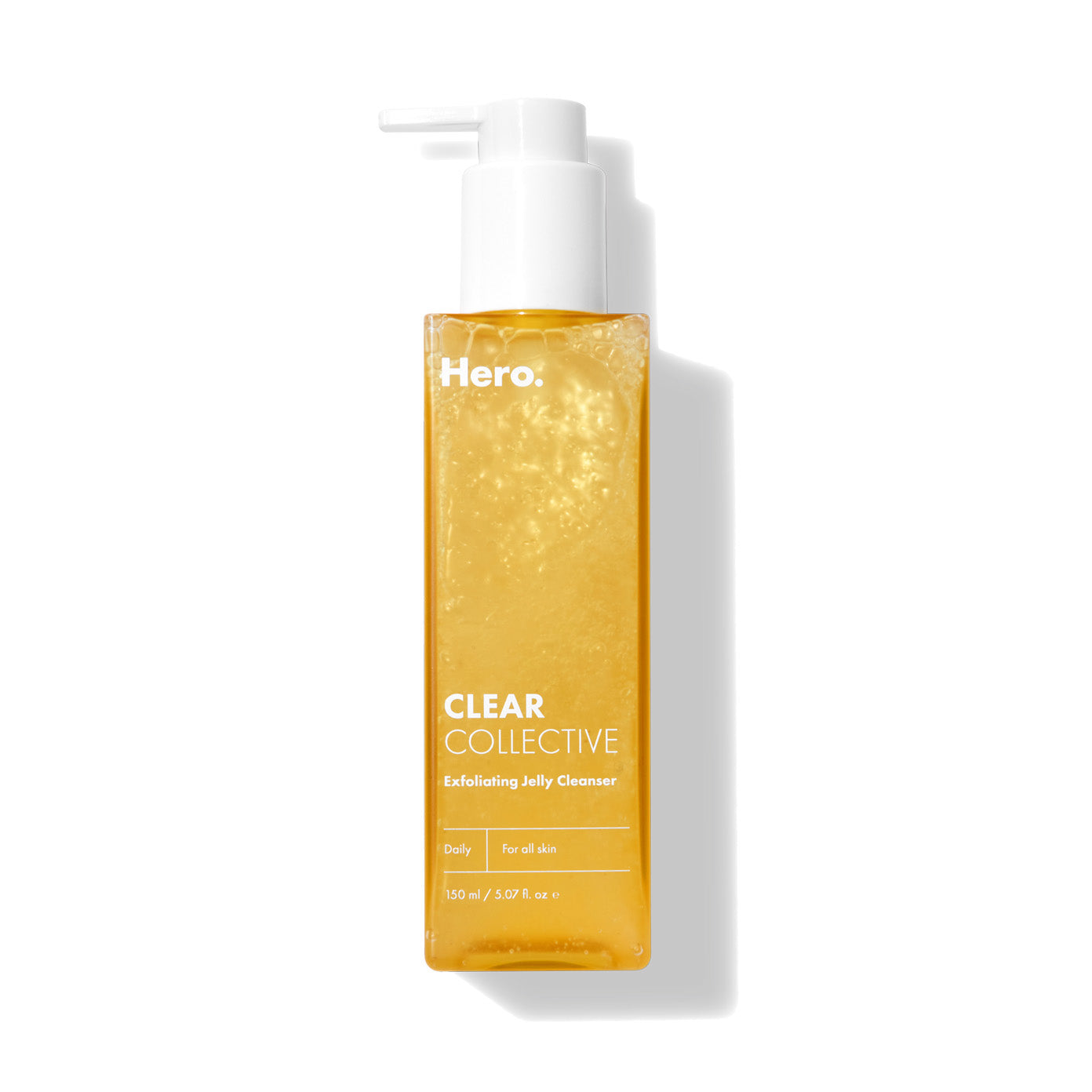

Hero Cosmetics
Exfoliating Jelly Cleanser

Exfoliating Jelly Cleanser
Hero Cosmetics
exfoliating-jelly-cleanser
Cleanse
9818398032165
Morning or Evening?
How often will you use this product?
Notes


Highlights
WHAT IS IT?
Exfoliating Jelly Cleanser
FEATURES
Unclogs pores, visibly brightens skin, evens out texture, leaves skin feeling velvety soft
BEST FOR
All skin types
CHECKS
Free of alcohol, Fragrance, essential oil
Who Is It For?
All Ages All GendersWhat Does It Help With?
Pore Unclogging Skin Brightening Texture ImprovementBudget
Affordable (under $30)How To Use
Which routine should it be used in?
Instructions:
Key Information


What Hero Cosmetics Says
Product Description:
Unclogs pores, visibly brightens skin, and evens out texture. This cleanser leaves skin feeling velvety soft — even before moisturizer!
About the Brand:
Ingredients Overview
Ingredients List
Water, Decyl Glucoside, Cocamidopropyl Betaine, Hydroxypropyl Starch Phosphate, Butylene Glycol, Glycolic Acid, Glycerin, Mandelic Acid, 1,2-Hexanediol, Sodium Hydroxide, Sodium Chloride, Tromethamine, Amorphophallus Konjac Root Powder, Gluconolactone, Citrus Junos (Yuzu) Fruit Extract, Ananas Sativus (Pineapple) Fruit Extract, Salix Alba (Willow) Bark Extract, Hamamelis Virginiana (Witch Hazel) Extract, Lactobacillus/Rice Ferment, Bifida Ferment Lysate, Salvia Officinalis (Sage) Leaf Extract, Sodium Hyaluronate, Hyaluronic Acid, Hydrolyzed Hyaluronic Acid, Hydrolyzed Sodium Hyaluronate, Hydroxypropyltrimonium Hyaluronate, Potassium Hyaluronate, Sodium Acetylated Hyaluronate, Zinc PCA, Maltitol, Allantoin, Sodium Hyaluronate Crosspolymer, Xanthan Gum, Arginine, Pentylene Glycol, Ethylhexylglycerin
Key Ingredients
Glycolic Acid, Mandelic Acid, Tropical Superfruits, Gluconolactone (PHA), Willow Bark Extract (BHA)
Ingredients Details
Glycolic Acid
Common Name(s): Hydroxyacetic acid,2-hydroxyacetic acid
CAS Number: 79-14-1
DESCRIPTION
What It Does: Provides maximum aha efficacy from the smallest most penetrating alpha-hydroxy acid.
Why It's Used: The most potent aha — glycolic acid's smallest molecular size provides the deepest penetration and highest efficacy of any alpha-hydroxy acid for exfoliation and anti-aging.
How It Works: Smallest aha (mw 76) provides deepest stratum corneum penetration. disrupts corneodesmosomes reducing cohesion. stimulates fibroblast collagen i and iii synthesis. efficacy is ph-dependent — free acid fraction determines activity.
Typically Found In: Chemical peels,body lotions,anti-aging serums,exfoliating toners
TECHNICAL DETAILS
Primary Category: Active ingredient – primary aha
Secondary Functions: Brightening,collagen stimulation
Application Areas:

Facial Skincare
Body Care

Hair Care
Beard Care
Color Cosmetics (Makeup)
Dietary/Oral Supplements
Typical Concentration Range: 1%–10% cosmetic; higher professional
SOURCING & ETHICS
Vegan Status: Yes – synthetic or fermentation-derived
Halal Status: Yes
Source Notes: Fermentation-derived or synthetic. ph must be ≤4.0 for aha activity.
SKIN COMPATIBILITY
Irritancy Rating: 2/5 – low to moderate
Comedogenicity Rating: 0/5 – non-comedogenic
Sensitivity Concerns: Photosensitizing – mandatory spf use. start at low frequency.
Safe for Sensitive Skin: Use with caution – spf required
SAFETY & COMPATIBILITY
Safety Profile: Eu cosmetics: max 10% leave-on, ph ≥3.5, mandatory sun protection advisory. professional peel concentrations regulated separately.
Works Well With: Niacinamide,ceramides,hyaluronic acid,spf
Avoid Combining With: Retinol in same step; multiple exfoliants simultaneously
SCIENTIFIC NOTE
Glycolic acid's ph-dependent efficacy is critical: at ph 3.0 ~100% is in the free acid (membrane-permeable) form; at ph 3.5 ~70%; at ph 4.0 ~50%. the eu ph ≥3.5 requirement reduces free acid proportion, lowering efficacy but also reducing irritation — why professional peel concentrations at lower ph are far more active than equivalent cosmetic concentrations.
Last Verified: 2026-03-12
Primary Sources: Cosing database,eu aha guidelines,cir safety assessment
Water
Common Name(s): Water,purified water,deionised water,inci water
CAS Number: 7732-18-5
DESCRIPTION
What It Does: Provides the universal solvent and vehicle for water-soluble actives and the continuous phase of all o/w emulsions.
Why It's Used: The most essential cosmetic ingredient — aqua (water) is listed first on virtually all water-containing cosmetic inci labels as the highest-concentration ingredient, serving as the foundation of the global cosmetics industry.
How It Works: Acts as solvent for all water-soluble ingredients (glycols, amino acids, water-soluble actives). forms the continuous external phase of o/w emulsions (lotions, creams, serums). provides aqueous environment for enzymatic and chemical reactions between actives. ph adjustment medium.
Typically Found In: Virtually all cosmetic products — the most universal cosmetic ingredient globally
TECHNICAL DETAILS
Primary Category: Functional ingredient – water
Secondary Functions: Skin conditioning
Application Areas:
Facial Skincare
Body Care
Hair Care
Beard Care
Color Cosmetics (Makeup)
Dietary/Oral Supplements
Typical Concentration Range: Varies widely — up to 95% in some toners and serums
SOURCING & ETHICS
Vegan Status: Yes – water (deionised/purified)
Halal Status: Yes
Source Notes: Cosmetic-grade water is purified (deionised, distilled, or ro filtered) to prevent mineral content interference with formulation stability. european pharmacopoeial water (aqua purificata ph. eur.) is the quality standard for pharmaceutical and high-end cosmetic formulations.
SKIN COMPATIBILITY
Irritancy Rating: 1/5 – non-irritant
Comedogenicity Rating: 0/5 – non-comedogenic
Sensitivity Concerns: Well-tolerated by most skin types.
Safe for Sensitive Skin: Yes
SAFETY & COMPATIBILITY
Safety Profile: Good safety profile at recommended concentrations. ewg score: 1–2.
Works Well With: Standard skincare actives
Avoid Combining With: No known significant incompatibilities
SCIENTIFIC NOTE
Water's position as the first inci ingredient on most cosmetic labels reflects the regulatory requirement to list ingredients in descending concentration order — meaning water is the most abundant ingredient in the majority of cosmetic products. the fundamental role of water as the universal cosmetic solvent and vehicle makes it simultaneously the most important cosmetic ingredient and the one that requires the most sophisticated formulation chemistry to control — every emulsifier, thickener, preservative, and ph adjuster exists primarily to manage water's interaction with other ingredients in formulation.
Last Verified: 2026-03-12
Primary Sources: Cosing database,eu cosmetics regulation 1223/2009 inci requirements,ph. eur. aqua purificata monograph