

AlumierMD
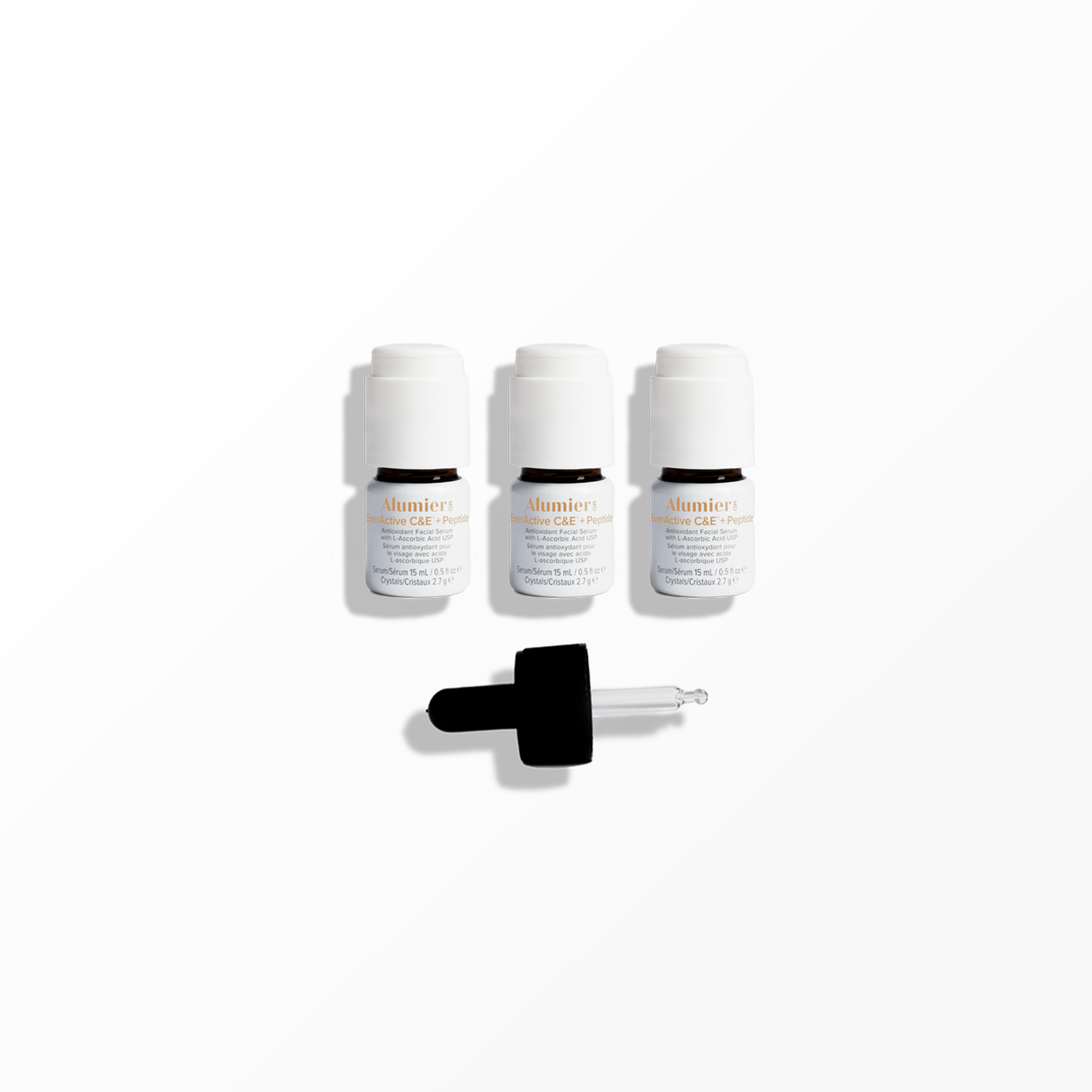
EverActive C&E®+ Peptide

EverActive C&E®+ Peptide
AlumierMD
everactive-c-e-r-peptide
Serum
9643595071781
Morning or Evening?
How often will you use this product?
Notes


Highlights
WHAT IS IT?
Vitamin C serum with 15% L-Ascorbic Acid
FEATURES
Unique packaging to prevent oxidation, clinically proven results
BEST FOR
Dry, Combination, Oily, All Skin Types, Acne Prone/Congested, Mature, Normal, Sensitive
CHECKS
Dye free, Paraben Free, Sulfate Free, Phthalate Free, Cruelty Free
Who Is It For?
Adults (no Specific Age Range Mentioned) Suitable For Both Women And MenWhat Does It Help With?
Signs Of Aging Fine Lines And Wrinkles Uneven Skin ToneBudget
PremiumHow To Use
Which routine should it be used in?
Instructions:
Key Information


What AlumierMD Says
Product Description:
Our innovative, multi award-winning 15% Vitamin C serum targets signs of aging, revitalizing skin with clinically proven results. Its unique packaging defies the processes of oxidation, ensuring the freshest dose of Vitamin C.
About the Brand:
Ingredients Overview
Ingredients List
SERUM - WATER/AQUA/EAU, PROPANEDIOL, POLYGLYCERYL-4 CAPRATE, POLYGLYCERYL-6 CAPRYLATE, GLYCERIN, PALMITOYL TRIPEPTIDE-38, CAMELLIA SINENSIS LEAF EXTRACT, TOCOPHERYL ACETATE, POLYGLYCERYL-3 COCOATE, POLYGLYCERYL-6 RICINOLEATE, HYDROXYETHYLCELLULOSE, HYDROXYPROPYL CYCLODEXTRIN, 1,2-HEXANEDIOL, HYDROXYACETOPHENONE, CITRIC ACID, DISODIUM EDTA, SODIUM BENZOATE, POTASSIUM SORBATE. CRYSTAL - ASCORBIC ACID.
Key Ingredients
L-Ascorbic Acid (USP grade), Tocopherol Acetate USP, MATRIXYL® Synthe'6®
Ingredients Details
Camellia Sinensis Leaf Extract
Common Name(s): Camellia sinensis leaf extract,botanical extract,phytochemical active
CAS Number: N/a
DESCRIPTION
What It Does: Provides antioxidant protection from reactive oxygen species, reduces inflammatory cytokine production in skin, and conditions skin surface through the plant's secondary metabolite complex.
Why It's Used: Chosen for its natural origin narrative, traditional use heritage, and multi-functional phytochemical profile that supports several concurrent skin care claims from one ingredient.
How It Works: Polyphenols, terpenoids, and alkaloids in the extract scavenge ros via hydrogen atom transfer, inhibit nf-kb or cox-2 inflammatory pathways, and interact with skin surface proteins for conditioning.
Typically Found In: Botanical skin care,natural products
TECHNICAL DETAILS
Primary Category: Active ingredient – antioxidant
Secondary Functions: Free radical scavenging,anti-aging
Application Areas:

Facial Skincare
Body Care

Hair Care
Beard Care
Color Cosmetics (Makeup)
Dietary/Oral Supplements
Typical Concentration Range: 0.1%–10%
SOURCING & ETHICS
Vegan Status: Yes
Halal Status: Yes
Source Notes: Plant-derived extract or synthetic.
SKIN COMPATIBILITY
Irritancy Rating: 1/5 – very low
Comedogenicity Rating: 0/5 – non-comedogenic
Sensitivity Concerns: Non-irritating; well-tolerated.
Safe for Sensitive Skin: Yes
SAFETY & COMPATIBILITY
Safety Profile: Excellent safety profile. ewg score: 1.
Works Well With: Vitamin c,vitamin e,ferulic acid,spf,other antioxidants
Avoid Combining With: No significant incompatibilities
SCIENTIFIC NOTE
Plant secondary metabolites evolved as uv photoprotectants and antimicrobial agents — mechanisms that directly translate to cosmetic antioxidant and anti-inflammatory activity in human skin.
Last Verified: Cosing database,camellia sinensis leaf extract botanical review
Primary Sources: 2026-03-12
Glycerin
Common Name(s): Glycerol,glycerine,1,2,3-propanetriol
CAS Number: 56-81-5
DESCRIPTION
What It Does: Glycerin pulls water from the environment and deeper skin layers into the outer skin layer (epidermis), boosting moisture levels and keeping skin soft, smooth, and plump.
Why It's Used: It is used in virtually every moisturizer, serum, and cleanser because it is highly effective at hydrating skin, is well-tolerated by all skin types, and enhances the texture and spreadability of formulations.
How It Works: As a humectant, glycerin forms hydrogen bonds with water molecules, trapping them in the skin. it also reinforces the skin barrier by integrating into lipid structures between skin cells.
Typically Found In: Moisturizers,serums,cleansers,toners,sheet masks,sunscreens,body lotions,shampoos,conditioners
TECHNICAL DETAILS
Primary Category: Humectant
Secondary Functions: Skin barrier support,emollient,solvent
Application Areas:
Facial Skincare
Body Care
Hair Care
Beard Care
Color Cosmetics (Makeup)
Dietary/Oral Supplements
Typical Concentration Range: 1%–30% (typical: 3–10%)
SOURCING & ETHICS
Vegan Status: Yes – plant-derived (coconut, soy, palm) or synthetic
Halal Status: Yes – when plant-derived or synthetic; verify source with supplier
Source Notes: Derived from plant oils via hydrolysis or saponification; synthetic versions also available. palm-derived glycerin carries sustainability concerns.
SKIN COMPATIBILITY
Irritancy Rating: 1/5 – very low; non-irritating at all standard concentrations
Comedogenicity Rating: 0/5 – non-comedogenic
Sensitivity Concerns: Extremely rare allergic reactions; generally safe for all skin types including sensitive and baby skin
Safe for Sensitive Skin: Yes
SAFETY & COMPATIBILITY
Safety Profile: Widely recognized as safe. ewg hazard score: 1. no significant concerns for irritation, sensitization, or toxicity at typical concentrations (up to 50%).
Works Well With: Hyaluronic acid,ceramides,niacinamide,panthenol,urea,peptides,retinol,ahas/bhas
Avoid Combining With: No known incompatibilities at standard concentrations
SCIENTIFIC NOTE
Glycerin is an endogenous skin component found naturally in the stratum corneum. aquaporin-3 channels in keratinocytes facilitate glycerin transport, making it integral to natural skin hydration pathways.
Last Verified: Cosing database,cir safety assessment,ewg skin deep,inci decoder
Primary Sources: 2026-03-12
Palmitoyl Tripeptide-38
Common Name(s): Matrixyl synthe'6,lys-val-lys palmitoyl variant
CAS Number: 1447025-32-2
DESCRIPTION
What It Does: Provides simultaneous stimulation of 6 major skin matrix proteins for comprehensive anti-aging matrix restoration.
Why It's Used: The most comprehensive matrix-stimulating peptide — matrixyl synthe'6's simultaneous upregulation of all six major skin matrix proteins provides more complete extracellular matrix restoration than any single-target peptide.
How It Works: Activates multiple fibroblast receptor pathways simultaneously. upregulates collagen i, iii, iv synthesis. stimulates fibronectin, laminin-5, and ha synthase (has2) expression. comprehensive matrix restoration reduces wrinkle depth from all collagen and ha-dependent skin architecture components.
Typically Found In: Premium anti-aging serums,comprehensive anti-aging products
TECHNICAL DETAILS
Primary Category: Active ingredient – signal peptide
Secondary Functions: Collagen stimulation,skin firming,anti-aging
Application Areas:
Facial Skincare
Body Care
Hair Care
Beard Care
Color Cosmetics (Makeup)
Dietary/Oral Supplements
Typical Concentration Range: 0.0001%–0.01%
SOURCING & ETHICS
Vegan Status: Yes – synthetic
Halal Status: Yes
Source Notes: Synthetically produced by solid-phase peptide synthesis (spps). may be palmitoylated for stability.
SKIN COMPATIBILITY
Irritancy Rating: 1/5 – very low
Comedogenicity Rating: 0/5 – non-comedogenic
Sensitivity Concerns: Non-irritating; suitable for all skin types.
Safe for Sensitive Skin: Yes
SAFETY & COMPATIBILITY
Safety Profile: Exceptional safety profile. ewg score: 1.
Works Well With: Hyaluronic acid,ceramides,retinol,vitamin c,niacinamide
Avoid Combining With: Avoid mixing with high-concentration ahas at same ph (may hydrolyze peptide bonds)
SCIENTIFIC NOTE
Matrixyl synthe'6's six-protein stimulation was characterised by sederma's research demonstrating simultaneous mrna upregulation for all six matrix proteins in human skin explants. the breadth of matrix stimulation from a single tripeptide reflects the convergent gene regulation of extracellular matrix proteins — many share common transcription factor binding sites (ap-1, sp1) allowing coordinated upregulation from a single signalling peptide.
Last Verified: Cosing database,sederma matrixyl synthe'6 technical data
Primary Sources: 2026-03-12
Polyglyceryl-3 Cocoate
Common Name(s): Polyglyceryl-3 cocoate,polyglyceryl-3 coconut fatty acids ester,polyglycerol-3 coconut fatty acids
DESCRIPTION
What It Does: Helps oil and water blend in creams and lotions while conditioning skin.
Why It's Used: Polyglyceryl-3 head provides hydrophilicity (hlb ~5–7); coconut fatty acids tail provides oil-phase affinity; natural-origin compatible.
How It Works: Polyglycerol-3 backbone with coconut fatty acids ester tail; hlb ~5–7; polyglyceryl esters are widely used natural-origin emulsifiers suitable for organic cosmetic certification.
Typically Found In: O/w emulsions,natural cosmetics,organic formulations,skin conditioning products
TECHNICAL DETAILS
Primary Category: Functional ingredient – emulsifier
Secondary Functions: Skin conditioning,surfactant,natural origin
Application Areas:
Facial Skincare
Body Care
Hair Care
Beard Care
Color Cosmetics (Makeup)
Dietary/Oral Supplements
Typical Concentration Range: 0.5%–5%
SOURCING & ETHICS
Vegan Status: Yes
Halal Status: Yes
Source Notes: Polyglycerin from vegetable glycerol polymerization; coconut fatty acids acid from plant sources; naturally derived.
SKIN COMPATIBILITY
Irritancy Rating: 1/5 – very low
Comedogenicity Rating: 1/5 – low
Sensitivity Concerns: Very mild; suitable for sensitive skin. natural-origin ingredient.
Safe for Sensitive Skin: Yes
SAFETY & COMPATIBILITY
Safety Profile: Excellent safety profile. ewg score: 1.
Works Well With: Natural oils,plant butters,other natural emulsifiers,humectants
Avoid Combining With: No significant incompatibilities
SCIENTIFIC NOTE
Pg-3 cocoate; mixed coconut fatty acids; balanced to w/o emulsification hlb ~5-7; widely used natural emulsifier.
Last Verified: Cosing database,inci dictionary,supplier technical data
Primary Sources: 2026-03-27
