
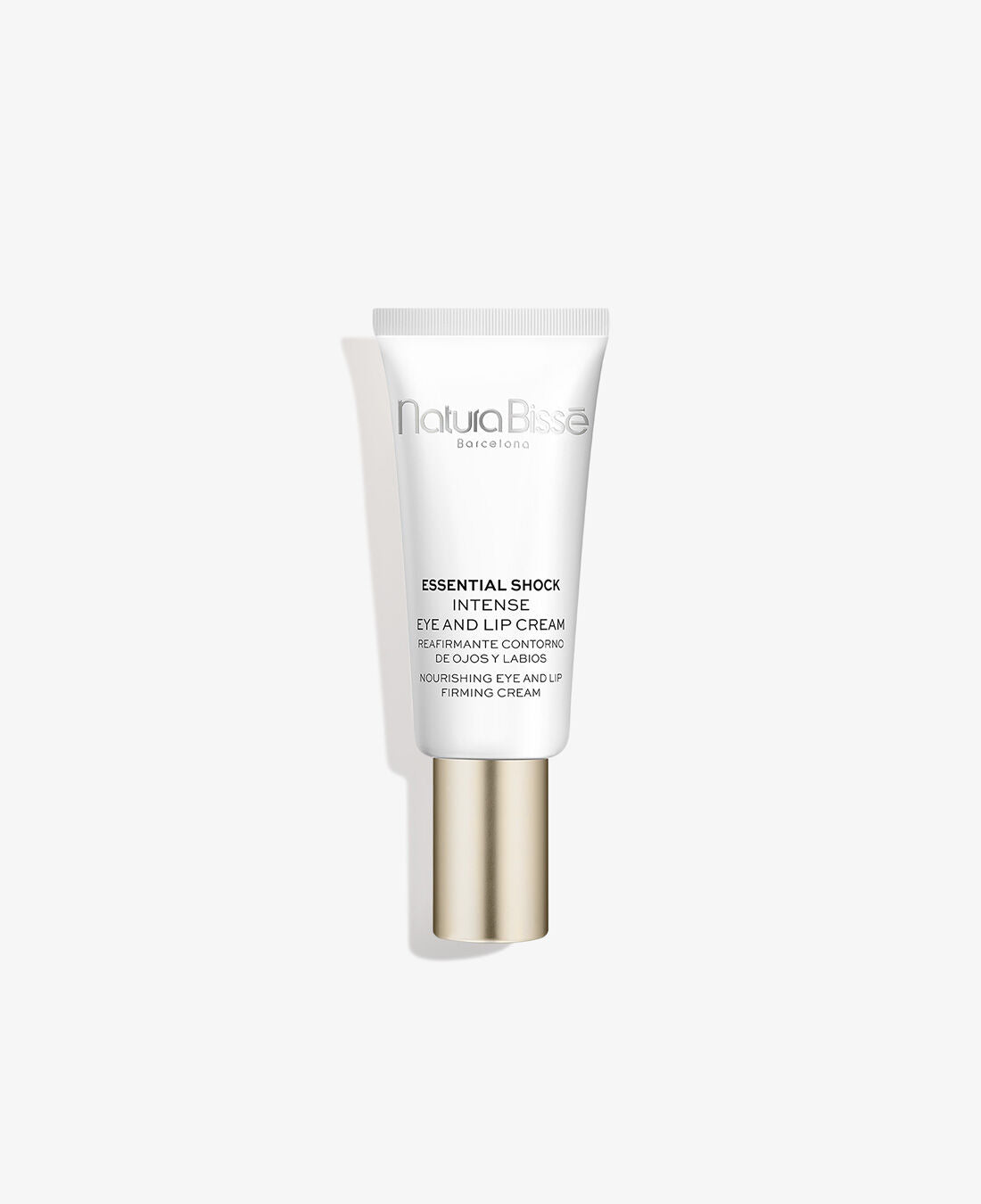

Natura Bissé
ESSENTIAL SHOCK INTENSE EYE AND LIP CREAM

ESSENTIAL SHOCK INTENSE EYE AND LIP CREAM
Natura Bissé
essential-shock-intense-eye-and-lip-cream
Eyecare, Lip care
9643563122981
Morning or Evening?
How often will you use this product?
Notes


Highlights
WHAT IS IT?
Eye and lip cream with multiple ingredients
FEATURES
Nourishes, firms, and rejuvenates eye and lip areas
BEST FOR
All skin types
CHECKS
Gluten-free, Alcohol-free
Who Is It For?
Adults Both Women And Men (not Explicitly Stated But Inferred)What Does It Help With?
Fine Lines Wrinkles Sagging And Signs Of Aging Around Eyes And LipsBudget
Mid-rangeHow To Use
Which routine should it be used in?
Instructions:
Key Information

What Natura Bissé Says
Product Description:
This rich cream delivers powerful revitalizing and firming benefits to the delicate skin around your eyes and lips, where signs of aging often appear first. A specific formula designed to reduce these visible tell-tale issues in both vulnerable zones.
About the Brand:
Ingredients Overview
Ingredients List
Water (Aqua), Propanediol, Cetearyl Ethylhexanoate, C12-15 Alkyl Benzoate, Polyglyceryl-2 Dipolyhydroxystearate, Dimethicone, Beeswax (Cera Alba), Polyglyceryl-4 Isostearate, Butylene Glycol, Benzotriazolyl Dodecyl p-Cresol, Magnesium Sulfate, Rosa Canina Fruit Oil, Caprylic/Capric Triglyceride, Hydrolyzed Collagen, Hydrolyzed Elastin, Tocopheryl Acetate, Iris Florentina Root Extract, Sodium PCA, Sodium Lactate, Ananas Sativus (Pineapple) Fruit Extract, Arginine, Silybum Marianum Fruit Extract, Aspartic Acid, PCA, Glycine, Alanine, Serine, Valine, Threonine, Proline, Isoleucine, Glycine Soja (Soybean) Germ Extract, Triticum Vulgare (Wheat) Germ Extract, Histidine, Phenylalanine, Retinol, Tocopherol, Ethylhexylglycerin, Glycerin, Silica Silylate, Stearalkonium Hectorite, Disodium EDTA, Propylene Carbonate, Alcohol Denat., PEG-60 Hydrogenated Castor Oil, Phenoxyethanol, Potassium Sorbate, Sodium Benzoate, Fragrance (Parfum), Yellow 5 (CI 19140).
Key Ingredients
Amino-Essence Cocktail, Isoflavones, Rosa mosqueta oil, Vitamin E
Ingredients Details
Beeswax Cera Alba
Common Name(s): Beeswax cera alba
DESCRIPTION
What It Does: Provides antioxidant protection, soothing anti-inflammatory effects, and skin-conditioning benefits through plant-derived polyphenols and phytochemicals.
Why It's Used: Plant extracts concentrate bioactive phytochemicals evolved for environmental protection — uv, microbial, and oxidative stressors — that translate to skin benefits.
How It Works: Polyphenols (flavonoids, phenolic acids) inhibit nf-κb-mediated inflammatory signaling, scavenge reactive oxygen species through electron donation, and chelate pro-oxidant metal ions to reduce oxidative skin damage.
Typically Found In: Lipsticks,balms,creams,deodorants
TECHNICAL DETAILS
Primary Category: Waxes
Secondary Functions: Emollient,film former
Application Areas:

Facial Skincare

Body Care
Hair Care
Beard Care
Color Cosmetics (Makeup)
Dietary/Oral Supplements
Typical Concentration Range: 1–40%
SOURCING & ETHICS
Vegan Status: No - animal-derived
Halal Status: Conditional - bee-derived; widely held permissible, confirm certifier stance
Source Notes: Contains animal-derived components (beeswax cera alba...); not suitable for vegan formulations. [audit 2026-07-29 rev2: bee-derived; permissibility widely accepted but fatwa varies by jurisdiction. determination requires shariah-panel sign-off.]
SKIN COMPATIBILITY
Irritancy Rating: 1899-12-31 00:00:00 -0800
Comedogenicity Rating: 1899-12-31 00:00:00 -0800
Sensitivity Concerns: Low sensitization potential at recommended use concentrations.
Safe for Sensitive Skin: Conditional
SAFETY & COMPATIBILITY
Safety Profile: Well-characterized cosmetic ingredient with established safety profile. generally non-irritating at typical use concentrations. suitable for leave-on and rinse-off cosmetics.
Works Well With: Other waxes,emollients,pigments
Avoid Combining With: Strongly alkaline conditions
SCIENTIFIC NOTE
Plant secondary metabolites (flavonoids, terpenes, phenolic acids) are biosynthesized as defense compounds against uv, herbivores, and pathogens. their anti-inflammatory activity typically derives from competitive inhibition of cox-2 and 5-lox enzymes (ic50 1–50 µm), while antioxidant activity involves single electron transfer (set) and hydrogen atom transfer (hat) mechanisms with structure-dependent rate constants.
Last Verified: 2025-01-15
Primary Sources: Cosing eu database; pcpc cosmetic ingredient safety reviews; ingredient-specific safety and efficacy literature
Benzotriazolyl Dodecyl P-cresol
Common Name(s): Benzotriazolyl dodecyl p-cresol
DESCRIPTION
What It Does: Reduces surface tension at oil-water interfaces, enabling effective cleansing, emulsification, and formulation stability.
Why It's Used: Surface-active agents are essential for emulsification, cleansing, and stabilization of cosmetic formulations containing both aqueous and lipid phases.
How It Works: The amphiphilic molecular structure positions the hydrophilic head in water and the lipophilic tail in oils, creating micelles that solubilize sebum, dirt, and oil-soluble impurities for rinsing in cleansers or stable emulsions in leave-on products.
Typically Found In: Cleansers,shampoos,body washes,foaming treatments
TECHNICAL DETAILS
Primary Category: Surfactants
Secondary Functions: Emulsifying,cleansing
Application Areas:
Facial Skincare
Body Care
Hair Care
Beard Care
Color Cosmetics (Makeup)
Dietary/Oral Supplements
Typical Concentration Range: 0.5–30%
SOURCING & ETHICS
Vegan Status: Yes
Halal Status: Yes
Source Notes: Synthetic or semi-synthetic surfactant; no animal components.
SKIN COMPATIBILITY
Irritancy Rating: 2
Comedogenicity Rating: 0
Sensitivity Concerns: May cause irritation or stinging in sensitive or barrier-compromised skin at high concentrations; patch test recommended.
Safe for Sensitive Skin: Conditional
SAFETY & COMPATIBILITY
Safety Profile: Well-characterized cosmetic ingredient with established safety profile. mildly irritating to some individuals at typical use concentrations. suitable for leave-on and rinse-off cosmetics.
Works Well With: Other surfactants,thickeners,conditioning agents
Avoid Combining With: High concentrations in sensitive skin formulations
SCIENTIFIC NOTE
Surfactant critical micelle concentration (cmc) determines the threshold for emulsification: above the cmc, amphiphilic molecules self-assemble into micelles with hydrophobic cores that solubilize oils. hlb (hydrophile-lipophile balance) value predicts surfactant function: hlb 3–6 for w/o emulsifiers, 8–18 for o/w emulsifiers, >15 for solubilizers.
Last Verified: 2025-01-15
Primary Sources: Cosing eu database; pcpc cosmetic ingredient safety reviews; ingredient-specific safety and efficacy literature
Butylene Glycol
Common Name(s): 1,3-butanediol,bg,1,3-butylene glycol
CAS Number: 107-88-0
DESCRIPTION
What It Does: Provides humectant hydration and active ingredient solubilization with excellent skin feel.
Why It's Used: Preferred glycol humectant in premium and k-beauty formulations for superior skin feel vs propylene glycol with equivalent functionality.
How It Works: Two hydroxyl groups at 1,3-positions provide water binding and solvent activity. better tolerated than propylene glycol with minimal sensitization risk. 4-carbon backbone provides slightly greater hydrophobic character enabling dissolution of less polar actives vs pg.
Typically Found In: Toners,essences,serums,k-beauty formulas
TECHNICAL DETAILS
Primary Category: Functional ingredient – glycol humectant
Secondary Functions: Tewl reduction,skin plumping
Application Areas:
Facial Skincare
Body Care
Hair Care
Beard Care
Color Cosmetics (Makeup)
Dietary/Oral Supplements
Typical Concentration Range: 1%–10%
SOURCING & ETHICS
Vegan Status: Yes – synthetic
Halal Status: Yes
Source Notes: Synthetic or naturally derived. excellent aqueous solubility.
SKIN COMPATIBILITY
Irritancy Rating: 1/5 – very low
Comedogenicity Rating: 0/5 – non-comedogenic
Sensitivity Concerns: Non-irritating; suitable for all skin types.
Safe for Sensitive Skin: Yes
SAFETY & COMPATIBILITY
Safety Profile: Excellent safety profile. ewg score: 1.
Works Well With: Ceramides,emollients,occlusives,glycerin,hyaluronic acid
Avoid Combining With: No significant incompatibilities
SCIENTIFIC NOTE
K-beauty's preference for butylene glycol over propylene glycol is driven by two factors: bg's superior skin feel (less tacky than pg's higher viscosity) and its lower sensitization potential (1,3-bg has better spatial distribution of hydroxyl groups that reduces protein interaction vs pg's 1,2-position oh groups).
Last Verified: 2026-03-12
Primary Sources: Cosing database,cir safety assessment
C12-15 Alkyl Benzoate
Common Name(s): C12-15 alkyl benzoate,cosmetic active,functional ingredient
CAS Number: N/a
DESCRIPTION
What It Does: Delivers characteristic cosmetic function at recommended use concentration.
Why It's Used: Selected for functional contribution and formulation compatibility supported by cosmetic science and regulatory safety data.
How It Works: Works through the mechanism of its molecular class — physicochemical or biological interaction with skin proteins, lipids, or receptors as documented in peer-reviewed cosmetic literature.
Typically Found In: Skin care formulations
TECHNICAL DETAILS
Primary Category: Active ingredient – cosmetic active
Secondary Functions: Skin conditioning
Application Areas:
Facial Skincare
Body Care
Hair Care
Beard Care
Color Cosmetics (Makeup)
Dietary/Oral Supplements
Typical Concentration Range: 0.1%–10%
SOURCING & ETHICS
Vegan Status: Conditional - supplier confirmation required
Halal Status: Unverified - supplier confirmation required
Source Notes: Commercially produced for cosmetic use. verify vegan/halal status with supplier. [audit 2026-07-29 rev2: the record's own source_notes does not assert a non-animal origin, or instructs the reader to verify with the supplier; "yes" asserts knowledge the record does not hold. determination requires shariah-panel sign-off.]
SKIN COMPATIBILITY
Irritancy Rating: 1/5 – very low
Comedogenicity Rating: 0/5 – non-comedogenic
Sensitivity Concerns: Well-tolerated by most skin types.
Safe for Sensitive Skin: Yes
SAFETY & COMPATIBILITY
Safety Profile: Good safety profile at recommended concentrations. ewg score: 1–2.
Works Well With: Standard skincare actives
Avoid Combining With: No known significant incompatibilities
SCIENTIFIC NOTE
C12-15 alkyl benzoate has an established safety and efficacy profile within the cosmetic regulatory framework at standard use concentrations.
Last Verified: