
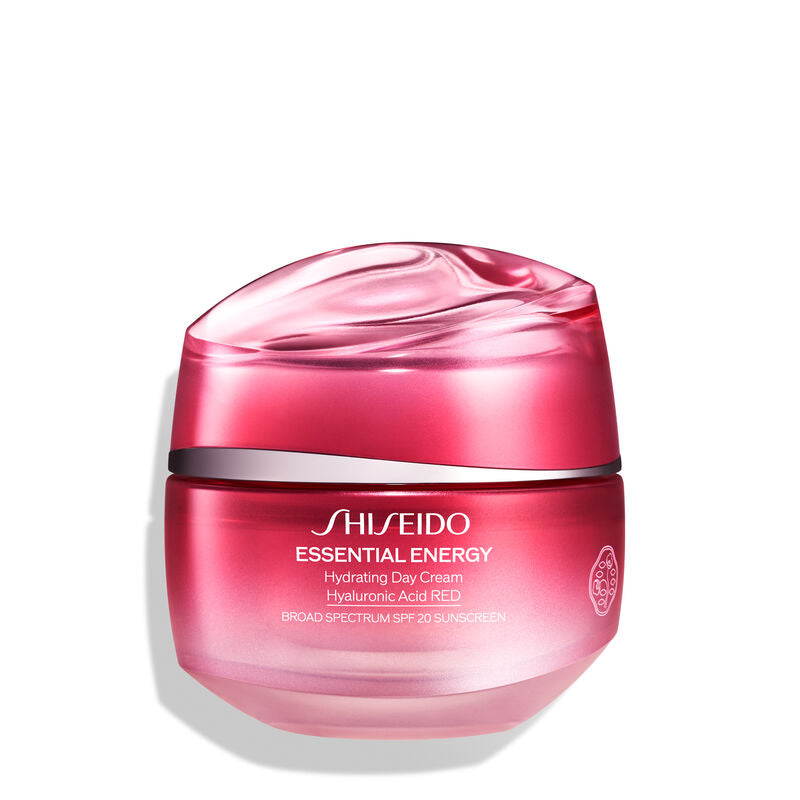

Shiseido
Essential Energy Hydrating Day Cream Broad Spectrum SPF 20

Essential Energy Hydrating Day Cream Broad Spectrum SPF 20
Shiseido
essential-energy-hydrating-day-cream-broad-spectrum-spf-20
Moisturize
9605083660581
Morning or Evening?
How often will you use this product?
Notes


Highlights
WHAT IS IT?
Moisturizing day cream with SPF
FEATURES
Deliver deep, intense hydration so skin is protected and ready for makeup. Sensitive skin-friendly, it also minimizes the appearance of pores and fine lines.
BEST FOR
All skin types
CHECKS
Oil-free, Paraben-free, Sulphate-free
Who Is It For?
Adults (default Above 18) Both Men And WomenWhat Does It Help With?
Hydration Sun Protection Minimizing Pores And Fine LinesBudget
Mid-rangeHow To Use
Which routine should it be used in?
Instructions:
Key Information


What Shiseido Says
Product Description:
A lightweight moisturizing day cream for all skin types with SPF 20 that provides 24 hours of intense hydration with Hyaluronic Acid.
About the Brand:
Ingredients Overview
Ingredients List
WATER,SD ALCOHOL 40-B,DIMETHICONE,GLYCERIN,DIPROPYLENE GLYCOL,ISODECYL NEOPENTANOATE,PEG-20,AMMONIUM ACRYLOYLDIMETHYLTAURATE/BEHENETH-25 METHACRYLATE CROSSPOLYMER,ERYTHRITOL,PEG/PPG-14/7 DIMETHYL ETHER,PEG/PPG-17/4 DIMETHYL ETHER,LAURYL BETAINE,XANTHAN GUM,2-O-ETHYL ASCORBIC ACID,CAFFEINE,PHYTOSTERYL MACADAMIATE,SODIUM HYALURONATE,CITRUS UNSHIU PEEL EXTRACT,ANGELICA KEISKEI LEAF/STEM EXTRACT,ZIZIPHUS JUJUBA FRUIT EXTRACT,PANAX GINSENG ROOT EXTRACT,SODIUM ACETYLATED HYALURONATE,SCUTELLARIA BAICALENSIS ROOT EXTRACT,SANGUISORBA OFFICINALIS ROOT EXTRACT,PYROLA INCARNATA EXTRACT,BEHENYL ALCOHOL,SILICA,DIGLYCERIN,POLYSILICONE-11,BATYL ALCOHOL,BUTYLENE GLYCOL,BIS-BUTYLDIMETHICONE POLYGLYCERYL-3,CARBOMER,POTASSIUM HYDROXIDE,PEG-60 GLYCERYL ISOSTEARATE,ALCOHOL,TOCOPHEROL,BHT,ACRYLATES/C10-30 ALKYL ACRYLATE CROSSPOLYMER,SODIUM METABISULFITE,ISOSTEARIC ACID,DISODIUM EDTA,SODIUM METAPHOSPHATE,PPG-3 DIPIVALATE,SYZYGIUM JAMBOS LEAF EXTRACT,ALPINIA SPECIOSA LEAF EXTRACT,ROSMARINUS OFFICINALIS (ROSEMARY) LEAF EXTRACT,PHENOXYETHANOL,SODIUM BENZOATE,FRAGRANCE,IRON OXIDES,
Key Ingredients
AVOBENZONE, HOMOSALATE, OCTISALATE, OCTOCRYLENE
Ingredients Details
Ammonium Acryloyldimethyltaurate/beheneth-25 Methacrylate Crosspolymer
Common Name(s): Ammonium acryloyldimethyltaurate/beheneth-25 methacrylate crosspolymer
DESCRIPTION
What It Does: Delivers targeted skin-conditioning or bioactive benefits through a specific mechanism of action suited to the formulation's intended purpose.
Why It's Used: Specialty actives address specific skin concerns through targeted molecular mechanisms, providing efficacy beyond what base formulation ingredients alone can achieve.
How It Works: The bioactive compound interacts with specific molecular targets in skin cells or the extracellular matrix — enzymes, receptors, structural proteins, or signaling molecules — triggering beneficial biological responses.
Typically Found In: Serums,treatments,moisturizers,specialty products
TECHNICAL DETAILS
Primary Category: Specialty actives
Secondary Functions: Skin-conditioning,anti-aging
Application Areas:

Facial Skincare

Body Care
Hair Care
Beard Care
Color Cosmetics (Makeup)
Dietary/Oral Supplements
Typical Concentration Range: 0.01–5%
SOURCING & ETHICS
Vegan Status: Conditional - feedstock declaration required
Halal Status: Unverified - feedstock declaration required (plant, animal and petrochemical routes all exist)
Source Notes: Specialty active ingredient; check individual sourcing for vegan status. [audit 2026-07-29 rev2: origin-dependent: the same inci exists in plant, animal and petrochemical versions and the name does not discriminate. determination requires shariah-panel sign-off.]
SKIN COMPATIBILITY
Irritancy Rating: 1
Comedogenicity Rating: 0
Sensitivity Concerns: Low sensitization potential at recommended use concentrations.
Safe for Sensitive Skin: Yes
SAFETY & COMPATIBILITY
Safety Profile: Well-characterized cosmetic ingredient with established safety profile. generally non-irritating at typical use concentrations. suitable for leave-on and rinse-off cosmetics.
Works Well With: Niacinamide,hyaluronic acid,vitamin c,peptides
Avoid Combining With: Incompatible with oxidizing agents; check ph stability
SCIENTIFIC NOTE
Specialty actives typically work through enzyme inhibition (e.g., tyrosinase inhibition for brightening, mmp inhibition for anti-aging), receptor activation (e.g., retinoid receptors, ppar-γ for barrier genes), or transcription factor modulation (e.g., nrf2 for antioxidant gene upregulation). structure-activity relationships determine potency and selectivity.
Last Verified: 2025-01-15
Primary Sources: Cosing eu database; pcpc cosmetic ingredient safety reviews; ingredient-specific safety and efficacy literature
Dimethicone
Common Name(s): Pdms,polydimethylsiloxane,silicone fluid
CAS Number: 9006-65-9
DESCRIPTION
What It Does: Provides silicone-characteristic silky feel and skin protection with adjustable viscosity.
Why It's Used: The benchmark cosmetic silicone – sets the gold standard for silky application feel, spreadability, and skin protection in virtually all skin care categories.
How It Works: Polydimethylsiloxane chain flexibility provides extremely low surface tension and high spreadability. inert si-o backbone provides chemical stability and excellent skin tolerance. occlusive film formation reduces tewl. higher viscosity grades provide more intense conditioning.
Typically Found In: Moisturizers,foundations,primers,sunscreens – nearly universal
TECHNICAL DETAILS
Primary Category: Functional ingredient – polydimethylsiloxane
Secondary Functions: Barrier sealing,softening
Application Areas:
Facial Skincare
Body Care
Hair Care
Beard Care
Color Cosmetics (Makeup)
Dietary/Oral Supplements
Typical Concentration Range: 0.1%–30%
SOURCING & ETHICS
Vegan Status: Conditional - supplier confirmation required
Halal Status: Unverified - supplier confirmation required
Source Notes: Plant-derived, synthetic or animal-derived. verify source. [audit 2026-07-29 rev2: the record's own source_notes does not assert a non-animal origin, or instructs the reader to verify with the supplier; "yes" asserts knowledge the record does not hold. determination requires shariah-panel sign-off.]
SKIN COMPATIBILITY
Irritancy Rating: 1/5 – very low
Comedogenicity Rating: 1/5 – low; formulation-dependent
Sensitivity Concerns: Non-irritating.
Safe for Sensitive Skin: Yes
SAFETY & COMPATIBILITY
Safety Profile: Excellent safety profile. ewg score: 1.
Works Well With: Humectants,ceramides,actives as carrier
Avoid Combining With: No significant incompatibilities
SCIENTIFIC NOTE
Dimethicone's exceptional silky feel arises from its very low intermolecular attractive forces (weak van der waals forces due to non-polar methyl groups) that allow silicone chains to slide freely over skin. the coefficient of kinetic friction for pdms against skin (~0.04) is among the lowest of any cosmetic material – explaining why even small amounts transform product feel.
Last Verified: 2026-03-12
Primary Sources: Cosing database,cir safety assessment
Dipropylene Glycol
Common Name(s): Dipropylene glycol,glycol co-solvent,humectant formulation aid
CAS Number: N/a
DESCRIPTION
What It Does: Provides humectant, co-solvent, and fragrance fixative in cosmetic formulations, improving active ingredient dissolution and product texture while delivering mild skin conditioning.
Why It's Used: Glycol solvents are essential for dissolving actives with limited water or oil solubility — the intermediate polarity of glycol ethers provides access to the wider solubility parameter space between pure water and oil phases.
How It Works: Hydroxyl and ether groups provide h-bonding for water miscibility; the organic chain provides compatibility with lipophilic actives. medium-chain glycols (c3–c6) provide the optimal balance of water compatibility, lipophilic active dissolution, and skin-compatible humectancy.
Typically Found In: Skin care formulations,co-solvent systems
TECHNICAL DETAILS
Primary Category: Functional ingredient – humectant
Secondary Functions: Tewl reduction,skin plumping
Application Areas:
Facial Skincare
Body Care
Hair Care
Beard Care
Color Cosmetics (Makeup)
Dietary/Oral Supplements
Typical Concentration Range: 1%–30%
SOURCING & ETHICS
Vegan Status: Conditional - supplier confirmation required
Halal Status: Unverified - supplier confirmation required
Source Notes: Synthetic or naturally derived. excellent aqueous solubility. [audit 2026-07-29 rev2: status downgraded on audit. determination requires shariah-panel sign-off.]
SKIN COMPATIBILITY
Irritancy Rating: 1/5 – very low
Comedogenicity Rating: 0/5 – non-comedogenic
Sensitivity Concerns: Non-irritating; suitable for all skin types.
Safe for Sensitive Skin: Yes
SAFETY & COMPATIBILITY
Safety Profile: Excellent safety profile. ewg score: 1.
Works Well With: Ceramides,emollients,occlusives,glycerin,hyaluronic acid
Avoid Combining With: No significant incompatibilities
SCIENTIFIC NOTE
Glycol ether co-solvents enhance sc penetration of co-applied actives by increasing their thermodynamic activity in the sc lipid phase — high thermodynamic activity (near saturation) drives diffusion by concentration gradient even when absolute concentration is low.
Last Verified: 2026-03-12
Primary Sources: Cosing database,dipropylene glycol glycol solvent review
Erythritol
Common Name(s): Meso-erythritol,erythrite
CAS Number: 149-32-6
DESCRIPTION
What It Does: Provides humectant moisture retention with additional antioxidant free-radical scavenging activity.
Why It's Used: Natural fermentation-derived humectant with antioxidant activity in clean beauty and natural formulations.
How It Works: 4 hydroxyl groups enable water binding (humectant). direct free radical scavenging via hydroxyl groups contributes antioxidant activity complementing standard antioxidants.
Typically Found In: Natural moisturizers,clean beauty formulations,antioxidant products
TECHNICAL DETAILS
Primary Category: Functional ingredient – sugar alcohol humectant
Secondary Functions: Natural humectant,antioxidant
Application Areas:
Facial Skincare
Body Care
Hair Care
Beard Care
Color Cosmetics (Makeup)
Dietary/Oral Supplements
Typical Concentration Range: 1%–10%
SOURCING & ETHICS
Vegan Status: Yes – fermentation-derived
Halal Status: Yes
Source Notes: Produced by fermentation of glucose using torula yeast. gras food-approved. zero-calorie sugar substitute with excellent safety profile.
SKIN COMPATIBILITY
Irritancy Rating: 1/5 – very low
Comedogenicity Rating: 0/5 – non-comedogenic
Sensitivity Concerns: Non-irritating; suitable for all skin types.
Safe for Sensitive Skin: Yes
SAFETY & COMPATIBILITY
Safety Profile: Excellent safety profile. ewg score: 1.
Works Well With: Ceramides,emollients,occlusives,glycerin,hyaluronic acid
Avoid Combining With: No significant incompatibilities
SCIENTIFIC NOTE
Erythritol's free radical scavenging activity (measured by orac assay) is unique among sugar alcohol humectants, providing dual humectant + antioxidant function from a single naturally derived ingredient.
Last Verified: 2026-03-12
Primary Sources: Cosing database,cir safety assessment