

EltaMD
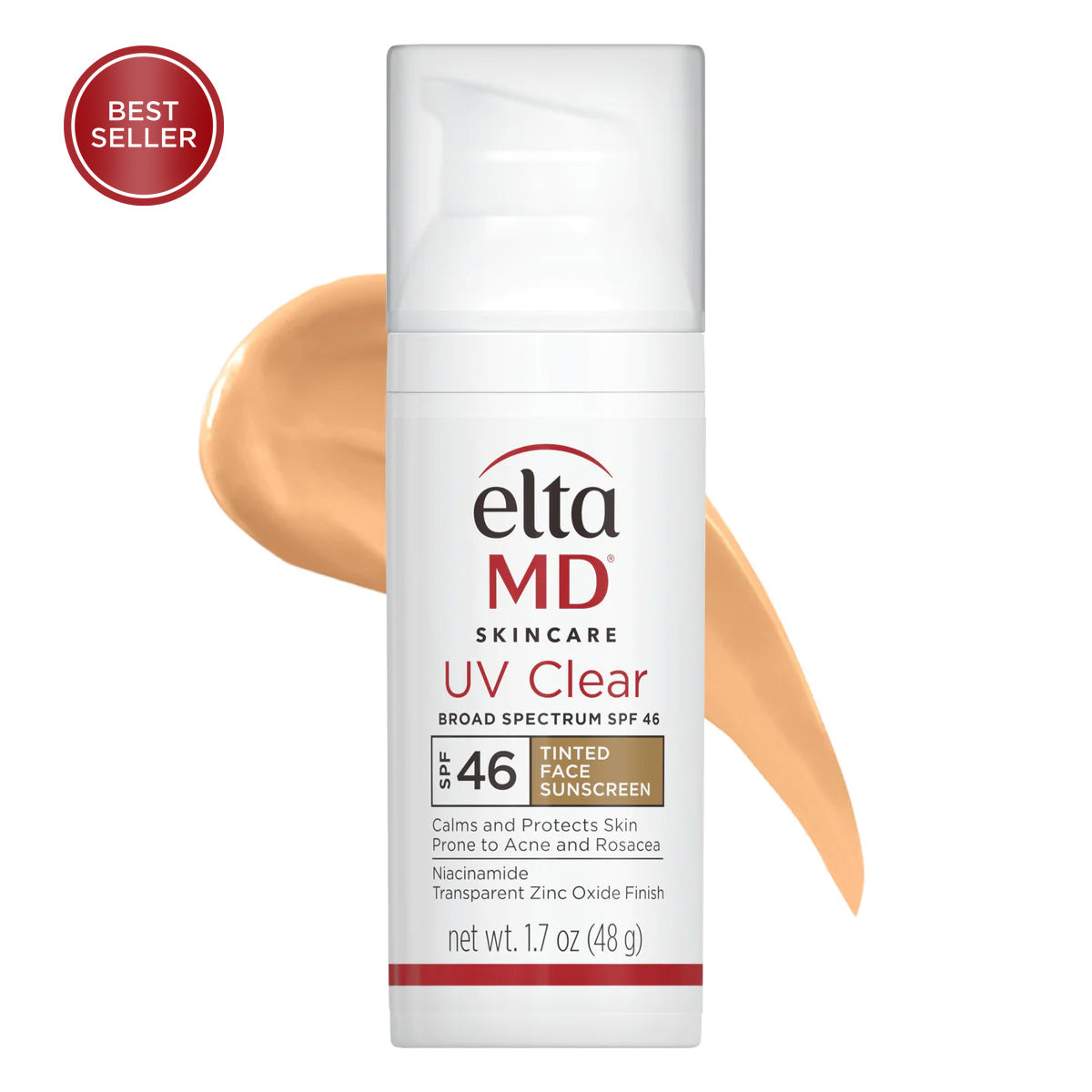
EltaMD UV Clear Tinted Broad-Spectrum SPF 46

EltaMD UV Clear Tinted Broad-Spectrum SPF 46
EltaMD
eltamd-uv-clear-tinted-broad-spectrum-spf-46
Suncare
9643641176357
Morning or Evening?
How often will you use this product?
Notes


Highlights
WHAT IS IT?
Tinted sunscreen with SPF 46
FEATURES
Lightweight, sheer tint, helps even skin tone, contains niacinamide and zinc oxide
BEST FOR
Acne-prone, oily, and sensitive skin
CHECKS
Does not contain fragrances, parabens
Who Is It For?
Adults Both Men And WomenWhat Does It Help With?
Blemishes Discoloration Sun ProtectionBudget
Mid-rangeHow To Use
Which routine should it be used in?
Instructions:
Key Information


What EltaMD Says
Product Description:
EltaMD UV Clear Broad Spectrum SPF 46 is a lightweight sunscreen with a sheer tint to help even skin tone. Formulated with 5% Niacinamide (Vitamin B3) to help reduce the appearance of blemishes and discoloration on your skin for a more smooth appearance. This broad spectrum sunscreen contains micronized zinc oxide to protect your skin from damaging UVA (aging) and UVB (burning) rays.
About the Brand:
Ingredients Overview
Ingredients List
Water, Cyclopentasiloxane, Niacinamide, Octyldodecyl Neopentanoate, Hydroxyethyl Acrylate/Sodium Acryloyldimethyl Taurate Copolymer, Butylene Glycol, Phenoxyethanol, Polyisobutene, Triethoxycaprylylsilane, Iron Oxides, Isopropyl Palmitate, Ethylhexyl Stearate,Tocopheryl Acetate, PEG-7 Trimethylolpropane Coconut Ether, Oleth-3 Phosphate,Iodopropynyl Butylcarbamate, Lactic Acid, Sodium Hyaluronate, Phosphoric Acid.
Key Ingredients
Zinc Oxide, Niacinamide, Sodium Hyaluronate, Tocopheryl Acetate (Vitamin E)
Ingredients Details
Iodopropynyl Butylcarbamate
Common Name(s): Cosmetic preservative,microbial growth inhibitor,product stability agent
CAS Number: N/a
DESCRIPTION
What It Does: Prevents microbial contamination that would otherwise render water-containing cosmetics unsafe — inhibiting bacterial, fungal, and yeast growth through membrane disruption, enzyme inhibition, or metabolic interference at permitted regulatory concentrations.
Why It's Used: Preservatives are safety-critical — un-preserved water-containing cosmetics can develop dangerous microbial contamination (pseudomonas aeruginosa eye infections, s. aureus skin infections) within days. preservation is a regulatory requirement, not an optional enhancement.
How It Works: Mechanism varies by class: organic acids (benzoic, dehydroacetic) disrupt intracellular ph in bacteria and fungi by proton flux across membranes; parabens inhibit membrane-associated enzyme function; chlorhexidine disrupts bacterial and fungal membrane integrity through divalent ion chelation of membrane phospholipids.
Typically Found In: All aqueous formulations
TECHNICAL DETAILS
Primary Category: Active ingredient – cosmetic active
Secondary Functions: Skin conditioning
Application Areas:

Facial Skincare

Body Care
Hair Care
Beard Care
Color Cosmetics (Makeup)
Dietary/Oral Supplements
Typical Concentration Range: Check annex v eu limits
SOURCING & ETHICS
Vegan Status: Yes
Halal Status: Yes
Source Notes: Commercially produced for cosmetic use. verify vegan/halal status with supplier.
SKIN COMPATIBILITY
Irritancy Rating: 1/5 – very low
Comedogenicity Rating: 0/5 – non-comedogenic
Sensitivity Concerns: Well-tolerated by most skin types.
Safe for Sensitive Skin: Yes
SAFETY & COMPATIBILITY
Safety Profile: Good safety profile at recommended concentrations. ewg score: 1–2.
Works Well With: Standard skincare actives
Avoid Combining With: No known significant incompatibilities
SCIENTIFIC NOTE
Eu regulation 1223/2009 annex v lists all permitted preservatives with maximum concentrations — preservatives not listed are prohibited. formulators must verify both permitted status and maximum concentration for each market before finalising preservation systems.
Last Verified: Eu regulation 1223/2009 annex v,cosmetic preservative regulatory review
Primary Sources: 2026-03-12
Tocopheryl Acetate
Common Name(s): Vitamin e acetate,alpha-tocopherol acetate,dl-alpha-tocopheryl acetate
CAS Number: 7695-91-2
DESCRIPTION
What It Does: Provides stable vitamin e delivery with antioxidant activity after esterase hydrolysis in skin.
Why It's Used: The formulation-stable vitamin e — tocopheryl acetate's ester protection prevents oxidative degradation during shelf life while releasing active tocopherol in skin for equivalent biological activity.
How It Works: Acetate ester blocks the phenolic oh group responsible for oxidation and radical scavenging. skin esterases cleave acetate bond releasing free tocopherol. released tocopherol provides lipid peroxyl radical scavenging in cell membranes. also provides direct emollient and skin conditioning.
Typically Found In: Moisturisers,sunscreens,anti-aging products — extremely widespread
TECHNICAL DETAILS
Primary Category: Active ingredient – stable vitamin e ester
Secondary Functions: Free radical scavenging,anti-aging
Application Areas:
Facial Skincare
Body Care
Hair Care
Beard Care
Color Cosmetics (Makeup)
Dietary/Oral Supplements
Typical Concentration Range: 0.1%–5%
SOURCING & ETHICS
Vegan Status: Conditional – natural from vegetable oils (soy, sunflower); synthetic dl-form
Halal Status: Yes
Source Notes: Plant-derived extract or synthetic.
SKIN COMPATIBILITY
Irritancy Rating: 1/5 – very low
Comedogenicity Rating: 0/5 – non-comedogenic
Sensitivity Concerns: Non-irritating; well-tolerated.
Safe for Sensitive Skin: Yes
SAFETY & COMPATIBILITY
Safety Profile: The d-alpha-tocopheryl acetate (natural isomer) is biologically superior to dl-alpha-tocopheryl acetate (racemic synthetic) for skin antioxidant activity. ingredient label d- vs dl- prefix identifies natural vs synthetic origin.
Works Well With: Vitamin c,vitamin e,ferulic acid,spf,other antioxidants
Avoid Combining With: No significant incompatibilities
SCIENTIFIC NOTE
Tocopheryl acetate's conversion to active tocopherol in skin is quantitatively efficient: skin esterase activity is sufficient to cleave 60-80% of applied tocopheryl acetate within 24 hours of application. however, the conversion rate varies with skin condition (eczematous or barrier-compromised skin has reduced esterase activity), meaning tocopheryl acetate efficacy may be reduced precisely in the skin conditions that most need antioxidant support.
Last Verified: Cosing database,cir safety assessment
Primary Sources: 2026-03-12
Water
Common Name(s): Water,purified water,deionised water,inci water
CAS Number: 7732-18-5
DESCRIPTION
What It Does: Provides the universal solvent and vehicle for water-soluble actives and the continuous phase of all o/w emulsions.
Why It's Used: The most essential cosmetic ingredient — aqua (water) is listed first on virtually all water-containing cosmetic inci labels as the highest-concentration ingredient, serving as the foundation of the global cosmetics industry.
How It Works: Acts as solvent for all water-soluble ingredients (glycols, amino acids, water-soluble actives). forms the continuous external phase of o/w emulsions (lotions, creams, serums). provides aqueous environment for enzymatic and chemical reactions between actives. ph adjustment medium.
Typically Found In: Virtually all cosmetic products — the most universal cosmetic ingredient globally
TECHNICAL DETAILS
Primary Category: Functional ingredient – water
Secondary Functions: Skin conditioning
Application Areas:
Facial Skincare
Body Care
Hair Care
Beard Care
Color Cosmetics (Makeup)
Dietary/Oral Supplements
Typical Concentration Range: Varies widely — up to 95% in some toners and serums
SOURCING & ETHICS
Vegan Status: Yes – water (deionised/purified)
Halal Status: Yes
Source Notes: Cosmetic-grade water is purified (deionised, distilled, or ro filtered) to prevent mineral content interference with formulation stability. european pharmacopoeial water (aqua purificata ph. eur.) is the quality standard for pharmaceutical and high-end cosmetic formulations.
SKIN COMPATIBILITY
Irritancy Rating: 1/5 – non-irritant
Comedogenicity Rating: 0/5 – non-comedogenic
Sensitivity Concerns: Well-tolerated by most skin types.
Safe for Sensitive Skin: Yes
SAFETY & COMPATIBILITY
Safety Profile: Good safety profile at recommended concentrations. ewg score: 1–2.
Works Well With: Standard skincare actives
Avoid Combining With: No known significant incompatibilities
SCIENTIFIC NOTE
Water's position as the first inci ingredient on most cosmetic labels reflects the regulatory requirement to list ingredients in descending concentration order — meaning water is the most abundant ingredient in the majority of cosmetic products. the fundamental role of water as the universal cosmetic solvent and vehicle makes it simultaneously the most important cosmetic ingredient and the one that requires the most sophisticated formulation chemistry to control — every emulsifier, thickener, preservative, and ph adjuster exists primarily to manage water's interaction with other ingredients in formulation.
Last Verified: Cosing database,eu cosmetics regulation 1223/2009 inci requirements,ph. eur. aqua purificata monograph
Primary Sources: 2026-03-12
Zinc Oxide
Common Name(s): Zinc white,chinese white,calamine component
CAS Number: 1314-13-2
DESCRIPTION
What It Does: Physically reflects and scatters uv radiation while providing antimicrobial, anti-inflammatory, and wound healing benefits.
Why It's Used: Multi-action mineral uv filter that simultaneously provides sun protection and skin-therapeutic benefits – the cornerstone of physical sunscreen formulations.
How It Works: Wide bandgap semiconductor physically reflects and scatters uv radiation (uva 320–400nm and uvb 280–320nm). dissolves to zn²⁺ providing antimicrobial activity, inhibiting bacterial and fungal growth. anti-inflammatory via inhibition of 5-lipoxygenase and il-8 production.
Typically Found In: Sunscreens,baby products,diaper creams,wound care,anti-acne formulations
TECHNICAL DETAILS
Primary Category: Active ingredient – mineral uv filter / antimicrobial
Secondary Functions: Broad-spectrum uv filter,anti-acne,diaper rash treatment
Application Areas:
Facial Skincare
Body Care
Hair Care
Beard Care
Color Cosmetics (Makeup)
Dietary/Oral Supplements
Typical Concentration Range: 1%–25% (spf products: 10–25%; eu max 25%)
SOURCING & ETHICS
Vegan Status: Yes – mineral/inorganic
Halal Status: Yes
Source Notes: Produced from zinc metal oxidation or chemical synthesis. nano zinc oxide (<100nm) improves aesthetics.
SKIN COMPATIBILITY
Irritancy Rating: 1/5 – very low
Comedogenicity Rating: 0/5 – non-comedogenic
Sensitivity Concerns: Non-irritating; recommended for sensitive, baby, and rosacea-prone skin.
Safe for Sensitive Skin: Yes at recommended concentrations
SAFETY & COMPATIBILITY
Safety Profile: Excellent safety profile. fda category i generally recognized as safe and effective (grase) for sunscreen. eu cosmetics regulation: max 25%. ewg sunscreen score: 1.
Works Well With: Niacinamide,salicylic acid,other actives
Avoid Combining With: No significant incompatibilities at standard concentrations
SCIENTIFIC NOTE
Zinc oxide's broad-spectrum uv coverage extends into the uva1 region (360–400nm) more effectively than titanium dioxide, making it preferred for photoaging protection. nano zinc oxide (<100nm) achieves transparency on skin while maintaining uv protection efficiency.
Last Verified: Cosing database,fda sunscreen grase ruling,ewg sunscreen database,eu cosmetics regulation
Primary Sources: 2026-03-12
