

Elizabeth Arden
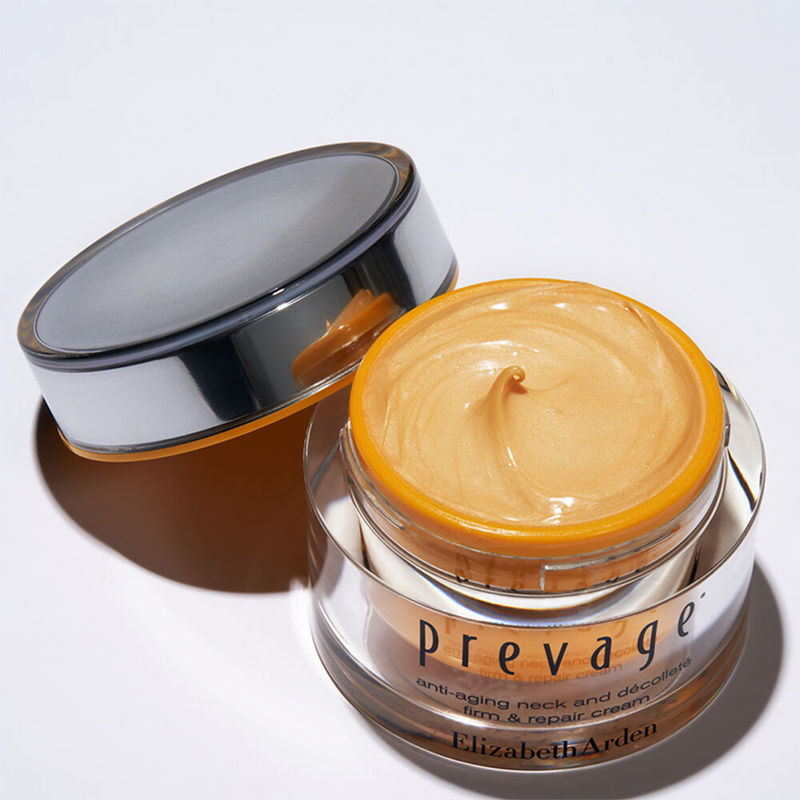
Elizabeth Arden PREVAGE Anti-Aging Neck and Decollete Firm & Repair Cream

Elizabeth Arden PREVAGE Anti-Aging Neck and Decollete Firm & Repair Cream
Elizabeth Arden
elizabeth-arden-prevage-anti-aging-neck-and-decollete-firm-repair-cream
Moisturize
10084865474853
Morning or Evening?
How often will you use this product?
Notes


Highlights
WHAT IS IT?
Anti-aging neck and decollete firm & repair cream with advanced Idebenone technology and protein restoring complex
FEATURES
Instantly tightens, tones and intensely nourishes; fights dryness; reduces appearance of dark spots and sun damage; uses antioxidants and collagen support ingredients
BEST FOR
sensitive
CHECKS
Paraben-Free,Preservative-Free
Who Is It For?
What Does It Help With?
Aging Signs Dryness Dark Spots Sun Damage Skin Firmness RadianceBudget
Premium ($76-$150)How To Use
Which routine should it be used in?
Instructions:
Key Information


What Elizabeth Arden Says
Product Description:
Stop signs of aging below the chin with Estee's Neck and Decollete Firm & Repair Cream with award-winning advanced Idebenone technology plus a protein restoring complex. Fight aging below the jawline with this luxurious formula that helps correct and protect the appearance of dry, delicate, vulnerable skin in the neck and decollete. Instantly tightens, tones and intensely nourishes with moisture. With continued use, fights dryness and reduces the appearance of existing dark spots and sun damage.
About the Brand:
Ingredients Overview
Ingredients List
Water/Aqua/Eau, Glycerin, Pentylene Glycol, Butylene Glycol, Caprylic/Capric Triglyceride, Cyclopentasiloxane, Dimethicone, Peg-11 Methyl Ether Dimethicone, Alpha-Glucan Oligosaccharide, Ammonium Acryloyldimethyltaurate/Vp Copolymer, Amodimethicone, Caprylyl Glycol, Carbomer, Ceramide 1, Ceramide 3, Ceramide 6 Ii, Cholesterol, Crithmum Maritimum Extract, Dimethicone/Vinyl Dimethicone Crosspolymer, Disodium Edta, Ethylhexylglycerin, Kefiran, Lactobacillus, Linum Usitatissimum (Linseed) Seed Extract, Maltodextrin, Parfum/Fragrance, Phytosphingosine, Polymnia Sonchifolia Root Juice, Saccharide Isomerate, Salicornia Herbacea Extract, Sodium Hydroxide, Sodium Lauroyl Lactylate, Sodium Polyacrylate Starch, Xanthan Gum, Chlorphenesin, Phenoxyethanol, Sodium Benzoate
Key Ingredients
Idebenone,Thiotaine,Vitamin E derivative,Retinyl Linoleate,Lupin Seed Extract,Lipo Amino Acid,Tightening polymers,Optical pigments,Encapsulated citroflavonoids,Hyaluronic acid,Sea plant Extract Complex,Glycerin,Shea Butter,Palm Butter
Ingredients Details
Alpha-glucan Oligosaccharide
Common Name(s): Cosmetic ingredient,functional cosmetic active,skin care
CAS Number: N/a
DESCRIPTION
What It Does: Provides documented functional activity from alpha-glucan oligosaccharide.
Why It's Used: Alpha-glucan oligosaccharide contributes established cosmetic function from its characteristic chemical structure and physicochemical properties.
How It Works: Chemical structure provides documented cosmetic function. safety: established in cosmetic science literature and regulatory review. use: standard cosmetic concentrations.
Typically Found In: Skin care formulations
TECHNICAL DETAILS
Primary Category: Active ingredient – cosmetic active
Secondary Functions: Skin conditioning
Application Areas:

Facial Skincare

Body Care
Hair Care
Beard Care
Color Cosmetics (Makeup)
Dietary/Oral Supplements
Typical Concentration Range: 0.1%–10%
SOURCING & ETHICS
Vegan Status: Conditional
Halal Status: Yes
Source Notes: Commercially produced for cosmetic use. verify vegan/halal status with supplier.
SKIN COMPATIBILITY
Irritancy Rating: 1/5 – very low
Comedogenicity Rating: 0/5 – non-comedogenic
Sensitivity Concerns: Well-tolerated by most skin types.
Safe for Sensitive Skin: Yes
SAFETY & COMPATIBILITY
Safety Profile: Good safety profile at recommended concentrations. ewg score: 1–2.
Works Well With: Standard skincare actives
Avoid Combining With: No known significant incompatibilities
SCIENTIFIC NOTE
Alpha-glucan oligosaccharide provides documented cosmetic activity through its characteristic mechanism. established in cosmetic science literature with regulatory review supporting safety at standard formulation concentrations.
Last Verified: Cosing database,alpha-glucan oligosaccharide technical literature
Primary Sources: 2026-03-12
Ammonium Acryloyldimethyltaurate/vp Copolymer
Common Name(s): Ammonium acryloyldimethyltaurate/vp copolymer
DESCRIPTION
What It Does: Delivers targeted skin-conditioning or bioactive benefits through a specific mechanism of action suited to the formulation's intended purpose.
Why It's Used: Specialty actives address specific skin concerns through targeted molecular mechanisms, providing efficacy beyond what base formulation ingredients alone can achieve.
How It Works: The bioactive compound interacts with specific molecular targets in skin cells or the extracellular matrix — enzymes, receptors, structural proteins, or signaling molecules — triggering beneficial biological responses.
Typically Found In: Serums,treatments,moisturizers,specialty products
TECHNICAL DETAILS
Primary Category: Specialty actives
Secondary Functions: Skin-conditioning,anti-aging
Application Areas:
Facial Skincare
Body Care
Hair Care
Beard Care
Color Cosmetics (Makeup)
Dietary/Oral Supplements
Typical Concentration Range: 0.01–5%
SOURCING & ETHICS
Vegan Status: Yes
Halal Status: Yes
Source Notes: Specialty active ingredient; check individual sourcing for vegan status.
SKIN COMPATIBILITY
Irritancy Rating: 1
Comedogenicity Rating: 0
Sensitivity Concerns: Low sensitization potential at recommended use concentrations.
Safe for Sensitive Skin: Yes
SAFETY & COMPATIBILITY
Safety Profile: Well-characterized cosmetic ingredient with established safety profile. generally non-irritating at typical use concentrations. suitable for leave-on and rinse-off cosmetics.
Works Well With: Niacinamide,hyaluronic acid,vitamin c,peptides
Avoid Combining With: Incompatible with oxidizing agents; check ph stability
SCIENTIFIC NOTE
Specialty actives typically work through enzyme inhibition (e.g., tyrosinase inhibition for brightening, mmp inhibition for anti-aging), receptor activation (e.g., retinoid receptors, ppar-γ for barrier genes), or transcription factor modulation (e.g., nrf2 for antioxidant gene upregulation). structure-activity relationships determine potency and selectivity.
Last Verified: Cosing eu database; pcpc cosmetic ingredient safety reviews; ingredient-specific safety and efficacy literature
Primary Sources: 2025-01-15
Amodimethicone
Common Name(s): Aminosilicone,amino-modified polydimethylsiloxane
CAS Number: 71750-79-3
DESCRIPTION
What It Does: Provides amino group-mediated preferential adsorption to damaged hair for targeted conditioning.
Why It's Used: Premium hair conditioning silicone – amino groups provide substantive adsorption to hair far exceeding pdms, with automatic targeting to the most damaged areas requiring conditioning.
How It Works: Amino (nh2) groups on silicone chain provide cationic character at normal ph, electrostatic adsorption to anionic hair surface. higher charge density at damaged sites increases adsorption where conditioning is most needed. si-o-si backbone provides permanent conditioning film with heat protection.
Typically Found In: Intensive conditioners,anti-frizz products,damage repair conditioners
TECHNICAL DETAILS
Primary Category: Functional ingredient – amino-functional silicone
Secondary Functions: Skin conditioning
Application Areas:
Facial Skincare
Body Care
Hair Care
Beard Care
Color Cosmetics (Makeup)
Dietary/Oral Supplements
Typical Concentration Range: 0.1%–5%
SOURCING & ETHICS
Vegan Status: Yes – synthetic
Halal Status: Yes
Source Notes: Commercially produced for cosmetic use. verify vegan/halal status with supplier.
SKIN COMPATIBILITY
Irritancy Rating: 1/5 – very low
Comedogenicity Rating: 0/5 – non-comedogenic
Sensitivity Concerns: Well-tolerated by most skin types.
Safe for Sensitive Skin: Yes
SAFETY & COMPATIBILITY
Safety Profile: Good safety profile at recommended concentrations. ewg score: 1–2.
Works Well With: Standard skincare actives
Avoid Combining With: No known significant incompatibilities
SCIENTIFIC NOTE
Amodimethicone's amino group-driven substantivity to damaged hair is dramatically greater than non-functionalized pdms. studies show amodimethicone deposits 50-200× more mass on bleach-damaged hair vs virgin hair, providing an automatic 'damage detection' conditioning system that directs the most conditioning to the hair areas that need it most.
Last Verified: Cosing database,robbins hair science,cir safety assessment
Primary Sources: 2026-03-12
Butylene Glycol
Common Name(s): 1,3-butanediol,bg,1,3-butylene glycol
CAS Number: 107-88-0
DESCRIPTION
What It Does: Provides humectant hydration and active ingredient solubilization with excellent skin feel.
Why It's Used: Preferred glycol humectant in premium and k-beauty formulations for superior skin feel vs propylene glycol with equivalent functionality.
How It Works: Two hydroxyl groups at 1,3-positions provide water binding and solvent activity. better tolerated than propylene glycol with minimal sensitization risk. 4-carbon backbone provides slightly greater hydrophobic character enabling dissolution of less polar actives vs pg.
Typically Found In: Toners,essences,serums,k-beauty formulas
TECHNICAL DETAILS
Primary Category: Functional ingredient – glycol humectant
Secondary Functions: Tewl reduction,skin plumping
Application Areas:
Facial Skincare
Body Care
Hair Care
Beard Care
Color Cosmetics (Makeup)
Dietary/Oral Supplements
Typical Concentration Range: 1%–10%
SOURCING & ETHICS
Vegan Status: Yes – synthetic
Halal Status: Yes
Source Notes: Synthetic or naturally derived. excellent aqueous solubility.
SKIN COMPATIBILITY
Irritancy Rating: 1/5 – very low
Comedogenicity Rating: 0/5 – non-comedogenic
Sensitivity Concerns: Non-irritating; suitable for all skin types.
Safe for Sensitive Skin: Yes
SAFETY & COMPATIBILITY
Safety Profile: Excellent safety profile. ewg score: 1.
Works Well With: Ceramides,emollients,occlusives,glycerin,hyaluronic acid
Avoid Combining With: No significant incompatibilities
SCIENTIFIC NOTE
K-beauty's preference for butylene glycol over propylene glycol is driven by two factors: bg's superior skin feel (less tacky than pg's higher viscosity) and its lower sensitization potential (1,3-bg has better spatial distribution of hydroxyl groups that reduces protein interaction vs pg's 1,2-position oh groups).
Last Verified: Cosing database,cir safety assessment
Primary Sources: 2026-03-12
