

Dr. Sheth's
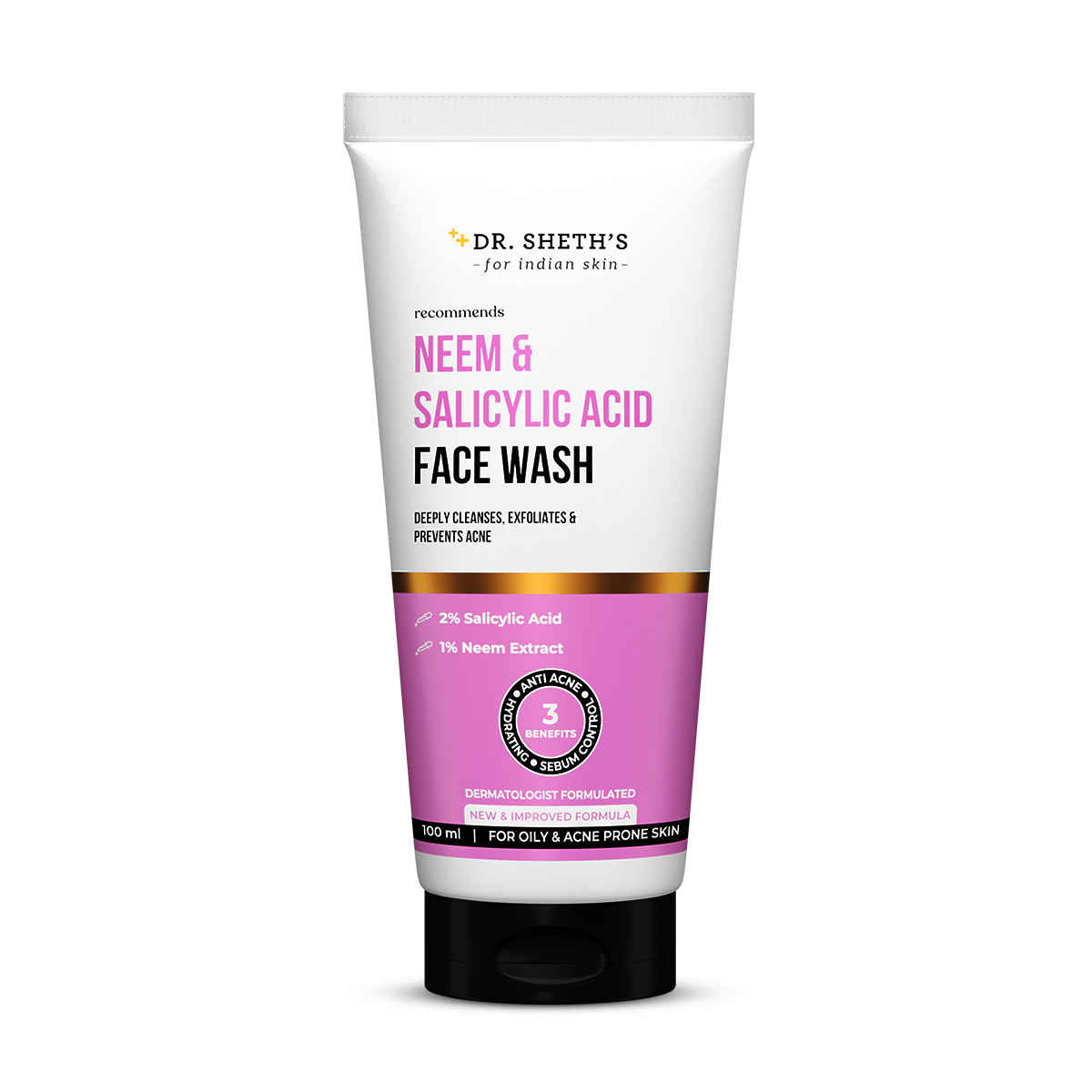
Dr. Sheth's Neem & Salicylic Acid Face Wash - 100 gm

Dr. Sheth's Neem & Salicylic Acid Face Wash - 100 gm
Dr. Sheth's
dr-sheths-neem-salicylic-acid-face-wash-100-gm
Cleanse
10084850532645
Morning or Evening?
How often will you use this product?
Notes


Highlights
WHAT IS IT?
Face Wash, 3 main ingredients shown
FEATURES
Deeply cleanses, gently exfoliates, helps prevent acne, lifts off dirt and impurities
BEST FOR
sensitive
CHECKS
Does not contain artificial fragrances or harmful chemicals explicitly stated
Who Is It For?
Adults Suitable For Sensitive Indian SkinWhat Does It Help With?
Acne Prevention Cleansing Exfoliation Inflammation Healing Revealing Glowing SkinBudget
Affordable (under $30)How To Use
Which routine should it be used in?
Instructions:
Key Information


What Dr. Sheth's Says
Product Description:
Dr. Sheths Neem & Salicylic Acid Face Wash is an exfoliating cleanser crafted for sensitive Indian Skin keeping in mind the humid climate and various environmental stressors that may bog the skin down. Enriched with Salicylic Acid, Neem & Tulsi Extract, the formulation dives deep into your pores & unclogs trapped debris while healing inflammation to reveal glowing, fresh skin with every use.
About the Brand:
Ingredients Overview
Ingredients List
Aqua, Sodium Alpha Olefin Sulfonate, Cocamidopropyl Betaine, Glycerin, Cocamide MEA, Sodium Lactate, Salicylic Acid, Aloe Barbadensis Leaf Juice, Melia Azadirachta Leaf Extract, Ocimum Sanctum Leaf Extract, Coco-Glucoside, Glyceryl Oleate, PEG-120 Methyl Glucose Dioleate, Sodium Chloride, Phenoxyethanol, Triethylene glycol, Sodium Hydroxide, Disodium EDTA
Key Ingredients
Salicylic Acid, Neem Extract, Tulsi Extract
Ingredients Details
Aloe Barbadensis Leaf Juice
Common Name(s): Aloe barbadensis leaf juice,cosmetic active,functional ingredient
CAS Number: N/a
DESCRIPTION
What It Does: Delivers characteristic cosmetic function — skin conditioning, protection, preservation, or active biological benefit — at recommended use concentration.
Why It's Used: Selected for its functional contribution and formulation compatibility — supported by cosmetic science literature and regulatory safety assessment.
How It Works: Works through the mechanism of its molecular class — physicochemical interaction with the formulation or biological interaction with skin proteins, lipids, or receptors as documented in peer-reviewed literature.
Typically Found In: Skin care formulations
TECHNICAL DETAILS
Primary Category: Active ingredient – cosmetic active
Secondary Functions: Skin conditioning
Application Areas:

Facial Skincare

Body Care
Hair Care
Beard Care
Color Cosmetics (Makeup)
Dietary/Oral Supplements
Typical Concentration Range: 0.1%–10%
SOURCING & ETHICS
Vegan Status: Conditional
Halal Status: Yes
Source Notes: Commercially produced for cosmetic use. verify vegan/halal status with supplier.
SKIN COMPATIBILITY
Irritancy Rating: 1/5 – very low
Comedogenicity Rating: 0/5 – non-comedogenic
Sensitivity Concerns: Well-tolerated by most skin types.
Safe for Sensitive Skin: Yes
SAFETY & COMPATIBILITY
Safety Profile: Good safety profile at recommended concentrations. ewg score: 1–2.
Works Well With: Standard skincare actives
Avoid Combining With: No known significant incompatibilities
SCIENTIFIC NOTE
Aloe barbadensis leaf juice delivers documented functional benefit with an established safety profile within the cosmetic regulatory framework (cosing eu, cir usa).
Last Verified: Cosing database,aloe barbadensis leaf juice technical literature
Primary Sources: 2026-03-12
Cocamide Mea
Common Name(s): Cocamide mea,fatty acid alkanolamide,foam booster viscosity builder
CAS Number: N/a
DESCRIPTION
What It Does: Boosts foam quality, stabilises foam lamellae, builds viscosity in surfactant systems, and reduces surface tension in cleansing formulations.
Why It's Used: Mea/mipa alkanolamides provide the same foam and viscosity benefits without n-nitrosamine concerns — the preferred choice in modern surfactant systems.
How It Works: Amide nitrogen lone pair inserts at foam bubble air-water interface alongside the fatty acid chain — the amide geometry stabilises foam lamellae through the gibbs-marangoni effect reducing drainage. viscosity building in surfactant systems arises from rod micelle formation above critical packing parameter.
Typically Found In: Shampoos,body wash,cleansers
TECHNICAL DETAILS
Primary Category: Active ingredient – cosmetic active
Secondary Functions: Skin conditioning
Application Areas:
Facial Skincare
Body Care
Hair Care
Beard Care
Color Cosmetics (Makeup)
Dietary/Oral Supplements
Typical Concentration Range: 1%–5%
SOURCING & ETHICS
Vegan Status: Conditional
Halal Status: Yes
Source Notes: Commercially produced for cosmetic use. verify vegan/halal status with supplier.
SKIN COMPATIBILITY
Irritancy Rating: 1/5 – very low
Comedogenicity Rating: 0/5 – non-comedogenic
Sensitivity Concerns: Well-tolerated by most skin types.
Safe for Sensitive Skin: Yes
SAFETY & COMPATIBILITY
Safety Profile: Good safety profile at recommended concentrations. ewg score: 1–2.
Works Well With: Standard skincare actives
Avoid Combining With: No known significant incompatibilities
SCIENTIFIC NOTE
Mea/mipa equivalents are not subject to nitrosamine restrictions and are the recommended modern alternative to dea in surfactant systems.
Last Verified: Cosing database,cocamide mea alkanolamide review
Primary Sources: 2026-03-12
Cocamidopropyl Betaine
Common Name(s): Capb,cocoamidopropyl betaine,coconut betaine
CAS Number: 61789-40-0
DESCRIPTION
What It Does: Boosts foam, enhances mildness, and conditions skin and hair when combined with primary surfactants.
Why It's Used: The standard foam booster and mildness enhancer in virtually all shampoos, body washes, and facial cleansers – provides synergistic mildness improvement with anionic surfactants.
How It Works: Amphoteric (zwitterionic) character provides positive charge interaction with hair keratin for antistatic conditioning. reduces irritation of co-formulated anionic surfactants via ionic complex formation. foam stabilization via bilayer reinforcement in foam lamellae.
Typically Found In: Shampoos,body washes,facial cleansers,baby products
TECHNICAL DETAILS
Primary Category: Functional ingredient – amphoteric surfactant
Secondary Functions: Skin conditioning
Application Areas:
Facial Skincare
Body Care
Hair Care
Beard Care
Color Cosmetics (Makeup)
Dietary/Oral Supplements
Typical Concentration Range: 2%–15%
SOURCING & ETHICS
Vegan Status: Yes – from coconut fatty acids and dimethylaminopropylamine
Halal Status: Yes
Source Notes: Commercially produced for cosmetic use. verify vegan/halal status with supplier.
SKIN COMPATIBILITY
Irritancy Rating: 1/5 – very low
Comedogenicity Rating: 0/5 – non-comedogenic
Sensitivity Concerns: Well-tolerated by most skin types.
Safe for Sensitive Skin: Yes
SAFETY & COMPATIBILITY
Safety Profile: Good safety profile at recommended concentrations. ewg score: 1–2.
Works Well With: Standard skincare actives
Avoid Combining With: No known significant incompatibilities
SCIENTIFIC NOTE
Capb's mildness-enhancing synergy with sls has a molecular mechanism: capb's positive imidazoline head group forms an ion pair complex with sls's anionic sulfate group, reducing sls's free monomer concentration (the irritation-causing species) without significantly reducing micelle-forming capacity (the cleansing species).
Last Verified: Cosing database,ananthapadmanabhan surfactant review,cir safety assessment
Primary Sources: 2026-03-12
Coco-glucoside
Common Name(s): Coconut glucoside,apg c8-c16
CAS Number: 68515-73-1
DESCRIPTION
What It Does: Provides gentle, natural-origin cleansing with good foam from mixed coconut chain alkyl glucosides.
Why It's Used: Widely used natural surfactant for green beauty formulations requiring good foam performance with natural-origin and mild credentials.
How It Works: Mixed c8-c16 fatty alcohol chain lengths from coconut provide broader foam stability than single-chain glucosides. non-ionic glucoside headgroup provides mildness. better detergency and rinsing than individual chain-length apgs due to mixed chain distribution.
Typically Found In: Natural shampoos,body washes,facial cleansers
TECHNICAL DETAILS
Primary Category: Functional ingredient – coconut alkyl glucoside
Secondary Functions: Skin conditioning
Application Areas:
Facial Skincare
Body Care
Hair Care
Beard Care
Color Cosmetics (Makeup)
Dietary/Oral Supplements
Typical Concentration Range: 2%–20%
SOURCING & ETHICS
Vegan Status: Yes – from coconut fatty alcohols and glucose
Halal Status: Yes
Source Notes: Commercially produced for cosmetic use. verify vegan/halal status with supplier.
SKIN COMPATIBILITY
Irritancy Rating: 1/5 – very low
Comedogenicity Rating: 0/5 – non-comedogenic
Sensitivity Concerns: Well-tolerated by most skin types.
Safe for Sensitive Skin: Yes
SAFETY & COMPATIBILITY
Safety Profile: Good safety profile at recommended concentrations. ewg score: 1–2.
Works Well With: Standard skincare actives
Avoid Combining With: No known significant incompatibilities
SCIENTIFIC NOTE
Coco-glucoside's natural chain length distribution (c8-c16) provides synergistic surfactant effects where different chain lengths optimize different properties: shorter chains provide initial foam burst, longer chains provide foam stability and soil removal, creating better overall performance than any single chain length alone.
Last Verified: Cosing database,cir safety assessment
Primary Sources: 2026-03-12
