

Dr. Sheth's
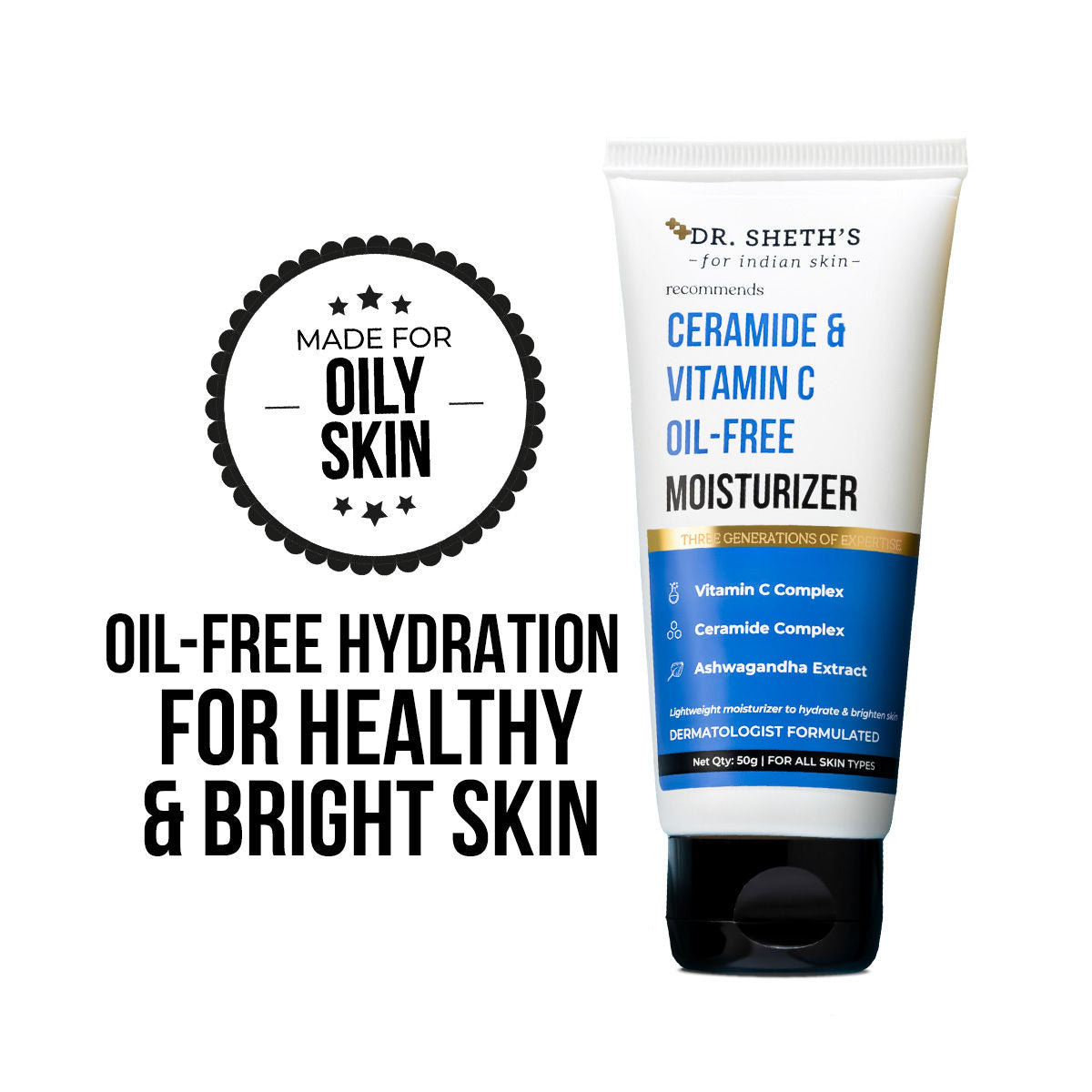
Dr. Sheth's Ceramide & Vitamin C Oil - Free Moisturizer to Hydrate, Brighten Skin

Dr. Sheth's Ceramide & Vitamin C Oil - Free Moisturizer to Hydrate, Brighten Skin
Dr. Sheth's
dr-sheths-ceramide-vitamin-c-oil-free-moisturizer-to-hydrate-brighten-skin
Moisturize
10084761174309
Morning or Evening?
How often will you use this product?
Notes


Highlights
WHAT IS IT?
Oil-Free Moisturizer with ceramide complex, vitamin C complex, and ashwagandha extract
FEATURES
Deeply hydrates with ceramide complex, fades dark spots and brightens skin with vitamin C complex, strengthens and restores skin barrier with ceramides and ashwagandha
BEST FOR
sensitive
CHECKS
oil, fragrance, silicone, alcohol, preservative, paraben
Who Is It For?
Suitable For All Genders No Specific Age Range StatedWhat Does It Help With?
Hydration Brightening Dark Spots Pigmentation Skin Barrier Repair Inflammation CalmingBudget
Affordable (under $30)How To Use
Which routine should it be used in?
Instructions:
Key Information


What Dr. Sheth's Says
Product Description:
Dr. Sheths Ceramide & Vitamin C Oil-Free Moisturizer is a lightweight, non-sticky formulation power-packed with brightening and hydrating actives to give you intensely hydrated, ultra-glowing, and smooth skin! Designed with ceramide complex, this moisturizer repairs a compromised barrier and deeply nourishes it, ensuring all-day hydration. Vitamin C complex brightens uneven skin tone, while ashwagandha extract calms inflammation and makes skin supple.
About the Brand:
Ingredients Overview
Ingredients List
Purified Water, Caprylic Capric Triglycerides, Glycerin, Sodium acrylates Copolymer, Coconut alkanes, Dimethicone, Amla extract, Vitamin E Acetate, Terminalia Ferdinandiana Fruit Extract, Laminaria Digitata Extract, 3-O-Ethyl Ascorbic Acid, Phenoxyethanol, Lecithin, Cetyl-PG Hydroxyethyl Palmitamide, Ceramide 1, Ceramide 2, Ceramide 3, Ceramide 4, Ceramide 6II, Ashwagandha extract, Disodium EDTA, Ethylhexylglycerin, Phenoxyethanol
Key Ingredients
ceramide-complex, vitamin-c-complex, ashwagandha-extract
Ingredients Details
3-o-ethyl Ascorbic Acid
Common Name(s): 3-o-ethyl ascorbic acid
DESCRIPTION
What It Does: Loosens corneocyte adhesion in the stratum corneum, accelerating cell turnover, refining skin texture, and improving radiance.
Why It's Used: Organic acids at cosmetic ph values provide controlled keratolytic exfoliation that improves skin texture, pore appearance, and radiance without mechanical irritation.
How It Works: At appropriate ph, the acid's undissociated form penetrates the stratum corneum and dissolves the ionic bonds between corneocyte desmosomes (calcium chelation mechanism), facilitating controlled desquamation and cell renewal.
Typically Found In: Toners,exfoliants,serums,peels,cleansers
TECHNICAL DETAILS
Primary Category: Exfoliants
Secondary Functions: Brightening,keratolytic
Application Areas:

Facial Skincare

Body Care
Hair Care
Beard Care
Color Cosmetics (Makeup)
Dietary/Oral Supplements
Typical Concentration Range: 0.5–20%
SOURCING & ETHICS
Vegan Status: Yes
Halal Status: Yes
Source Notes: Synthetic or plant-derived acid; no animal components.
SKIN COMPATIBILITY
Irritancy Rating: 2
Comedogenicity Rating: 0
Sensitivity Concerns: May cause irritation or stinging in sensitive or barrier-compromised skin at high concentrations; patch test recommended.
Safe for Sensitive Skin: Conditional
SAFETY & COMPATIBILITY
Safety Profile: Safe within recommended ph and concentration ranges. sensitization risk increases above 10% aha. patch test recommended for sensitive skin. mildly irritating to some individuals at typical cosmetic use concentrations.
Works Well With: Niacinamide,hyaluronic acid,ceramides,vitamin c
Avoid Combining With: High concentrations on sensitive/broken skin; avoid with physical exfoliants
SCIENTIFIC NOTE
Cosmetic acids function at the pka boundary: only the undissociated acid (rcooh) penetrates the stratum corneum lipid barrier, while the ionized carboxylate (rcoo⁻) does not. the henderson-hasselbalch equation governs the fraction of active species at formulation ph; typically 0.5–3.0% undissociated acid provides efficacy while minimizing irritation.
Last Verified: Cosing eu database; pcpc cosmetic ingredient safety reviews; ingredient-specific safety and efficacy literature
Primary Sources: 2025-01-15
Ceramide 1
Common Name(s): Ceramide 1
DESCRIPTION
What It Does: Provides antioxidant protection, soothing anti-inflammatory effects, and skin-conditioning benefits through plant-derived polyphenols and phytochemicals.
Why It's Used: Plant extracts concentrate bioactive phytochemicals evolved for environmental protection — uv, microbial, and oxidative stressors — that translate to skin benefits.
How It Works: Polyphenols (flavonoids, phenolic acids) inhibit nf-κb-mediated inflammatory signaling, scavenge reactive oxygen species through electron donation, and chelate pro-oxidant metal ions to reduce oxidative skin damage.
Typically Found In: Lipsticks,balms,creams,deodorants
TECHNICAL DETAILS
Primary Category: Waxes
Secondary Functions: Emollient,film former
Application Areas:
Facial Skincare
Body Care
Hair Care
Beard Care
Color Cosmetics (Makeup)
Dietary/Oral Supplements
Typical Concentration Range: 1–40%
SOURCING & ETHICS
Vegan Status: Yes
Halal Status: Yes
Source Notes: Plant-derived or synthetic wax; check source for vegan status.
SKIN COMPATIBILITY
Irritancy Rating: 1
Comedogenicity Rating: 1
Sensitivity Concerns: Low sensitization potential at recommended use concentrations.
Safe for Sensitive Skin: Yes
SAFETY & COMPATIBILITY
Safety Profile: Well-characterized cosmetic ingredient with established safety profile. generally non-irritating at typical use concentrations. suitable for leave-on and rinse-off cosmetics.
Works Well With: Other waxes,emollients,pigments
Avoid Combining With: Strongly alkaline conditions
SCIENTIFIC NOTE
Plant secondary metabolites (flavonoids, terpenes, phenolic acids) are biosynthesized as defense compounds against uv, herbivores, and pathogens. their anti-inflammatory activity typically derives from competitive inhibition of cox-2 and 5-lox enzymes (ic50 1–50 µm), while antioxidant activity involves single electron transfer (set) and hydrogen atom transfer (hat) mechanisms with structure-dependent rate constants.
Last Verified: Cosing eu database; pcpc cosmetic ingredient safety reviews; ingredient-specific safety and efficacy literature
Primary Sources: 2025-01-15
Ceramide 2
Common Name(s): Ceramide 2
DESCRIPTION
What It Does: Provides antioxidant protection, soothing anti-inflammatory effects, and skin-conditioning benefits through plant-derived polyphenols and phytochemicals.
Why It's Used: Plant extracts concentrate bioactive phytochemicals evolved for environmental protection — uv, microbial, and oxidative stressors — that translate to skin benefits.
How It Works: Polyphenols (flavonoids, phenolic acids) inhibit nf-κb-mediated inflammatory signaling, scavenge reactive oxygen species through electron donation, and chelate pro-oxidant metal ions to reduce oxidative skin damage.
Typically Found In: Lipsticks,balms,creams,deodorants
TECHNICAL DETAILS
Primary Category: Waxes
Secondary Functions: Emollient,film former
Application Areas:
Facial Skincare
Body Care
Hair Care
Beard Care
Color Cosmetics (Makeup)
Dietary/Oral Supplements
Typical Concentration Range: 1–40%
SOURCING & ETHICS
Vegan Status: Yes
Halal Status: Yes
Source Notes: Plant-derived or synthetic wax; check source for vegan status.
SKIN COMPATIBILITY
Irritancy Rating: 1
Comedogenicity Rating: 1
Sensitivity Concerns: Low sensitization potential at recommended use concentrations.
Safe for Sensitive Skin: Yes
SAFETY & COMPATIBILITY
Safety Profile: Well-characterized cosmetic ingredient with established safety profile. generally non-irritating at typical use concentrations. suitable for leave-on and rinse-off cosmetics.
Works Well With: Other waxes,emollients,pigments
Avoid Combining With: Strongly alkaline conditions
SCIENTIFIC NOTE
Plant secondary metabolites (flavonoids, terpenes, phenolic acids) are biosynthesized as defense compounds against uv, herbivores, and pathogens. their anti-inflammatory activity typically derives from competitive inhibition of cox-2 and 5-lox enzymes (ic50 1–50 µm), while antioxidant activity involves single electron transfer (set) and hydrogen atom transfer (hat) mechanisms with structure-dependent rate constants.
Last Verified: Cosing eu database; pcpc cosmetic ingredient safety reviews; ingredient-specific safety and efficacy literature
Primary Sources: 2025-01-15
Ceramide 3
Common Name(s): Ceramide 3
DESCRIPTION
What It Does: Provides antioxidant protection, soothing anti-inflammatory effects, and skin-conditioning benefits through plant-derived polyphenols and phytochemicals.
Why It's Used: Plant extracts concentrate bioactive phytochemicals evolved for environmental protection — uv, microbial, and oxidative stressors — that translate to skin benefits.
How It Works: Polyphenols (flavonoids, phenolic acids) inhibit nf-κb-mediated inflammatory signaling, scavenge reactive oxygen species through electron donation, and chelate pro-oxidant metal ions to reduce oxidative skin damage.
Typically Found In: Lipsticks,balms,creams,deodorants
TECHNICAL DETAILS
Primary Category: Waxes
Secondary Functions: Emollient,film former
Application Areas:
Facial Skincare
Body Care
Hair Care
Beard Care
Color Cosmetics (Makeup)
Dietary/Oral Supplements
Typical Concentration Range: 1–40%
SOURCING & ETHICS
Vegan Status: Yes
Halal Status: Yes
Source Notes: Plant-derived or synthetic wax; check source for vegan status.
SKIN COMPATIBILITY
Irritancy Rating: 1
Comedogenicity Rating: 1
Sensitivity Concerns: Low sensitization potential at recommended use concentrations.
Safe for Sensitive Skin: Yes
SAFETY & COMPATIBILITY
Safety Profile: Well-characterized cosmetic ingredient with established safety profile. generally non-irritating at typical use concentrations. suitable for leave-on and rinse-off cosmetics.
Works Well With: Other waxes,emollients,pigments
Avoid Combining With: Strongly alkaline conditions
SCIENTIFIC NOTE
Plant secondary metabolites (flavonoids, terpenes, phenolic acids) are biosynthesized as defense compounds against uv, herbivores, and pathogens. their anti-inflammatory activity typically derives from competitive inhibition of cox-2 and 5-lox enzymes (ic50 1–50 µm), while antioxidant activity involves single electron transfer (set) and hydrogen atom transfer (hat) mechanisms with structure-dependent rate constants.
Last Verified: Cosing eu database; pcpc cosmetic ingredient safety reviews; ingredient-specific safety and efficacy literature
Primary Sources: 2025-01-15
