

Nykaa E retail limited
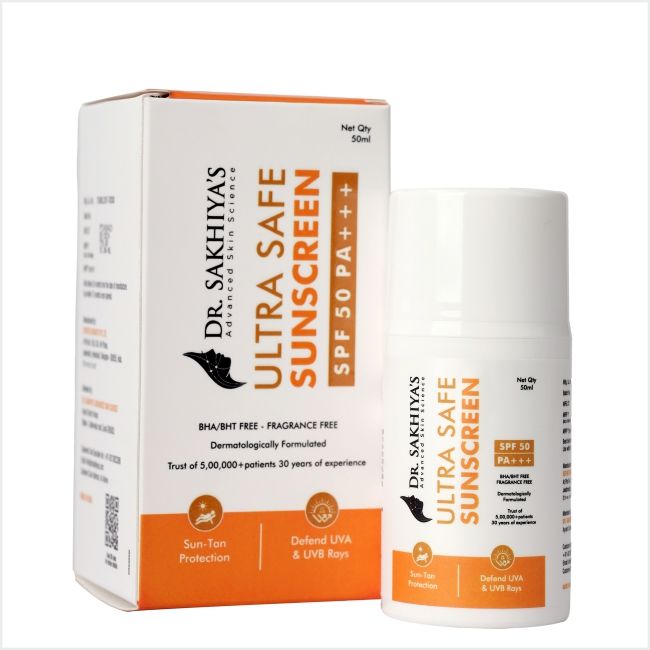
Dr. Sakhiya Ultra Safe Sunscreen SPF 50 PA+++ Broad Spectrum UVA & UVB Protection

Dr. Sakhiya Ultra Safe Sunscreen SPF 50 PA+++ Broad Spectrum UVA & UVB Protection
Nykaa E retail limited
dr-sakhiya-ultra-safe-sunscreen-spf-50-pa-broad-spectrum-uva-uvb-protection
Suncare
10085081252133
Morning or Evening?
How often will you use this product?
Notes


Highlights
WHAT IS IT?
Ultra Safe Sunscreen with 11 ingredients
FEATURES
Broad-spectrum protection against UVA and UVB rays, enriched with vitamin E for antioxidant benefits, lightweight and non-greasy formula, dermatologically tested, fragrance-free, free from BHA/BHT, parabens, harmful silicones, and sulfates, suitable for sensitive and acne-prone skin, vegan and cruelty-free
BEST FOR
sensitive
CHECKS
Fragrances,BHA,BHT,Parabens,Harmful Silicones,Sulfates
Who Is It For?
What Does It Help With?
Prevents Sunburn Tan Premature Aging And Dullness; Protects Skin From Harmful Sun ExposureBudget
Mid-range ($30-$75)How To Use
Which routine should it be used in?
Instructions:
Key Information


What Nykaa E retail limited Says
Product Description:
Dr. Sakhiya's Ultra Safe Sunscreen SPF 50 PA+++ offers broad-spectrum protection against UVA and UVB rays, making it ideal for sun-sensitive skin. This lightweight, non-greasy formula combines physical and chemical filters to effectively shield your skin from harmful sun exposure, preventing sunburn, tan, premature aging, and dullness. Enriched with vitamin E, it provides antioxidant benefits, enhancing the skin's natural glow and resilience. Free from fragrances, BHA, and BHT, it is suitable for all skin types, including sensitive and acne-prone skin. Use this waterproof sunscreen daily to achieve optimal protection without any white cast.
About the Brand:
Ingredients Overview
Ingredients List
Cyclopentasiloxane-Dimethicone/-Vinyl-Dimethicone-Crosspolymer,Homosalate,Ethylhexyl-Methoxycinnamate,Ethylhexyl-Salicylate,Bis-Ethylhexyloxyphenol-Methoxyphenyl-Triazine,Butyl-Methoxydibenzoylmethane,Methyl-Methacrylate-Crosspolymer,Silica,PEG-40,Hydrogenated-Castor-Oil,Phenoxyethanol,Tocopheryl-Acetate,Zinc-Oxide,Titanium-Dioxide,C12-C15-Alkyl-Benzoate,Polyhydroxystearic-Acid
Key Ingredients
Tocopheryl Acetate (Vitamin E), Zinc Oxide, Titanium Dioxide, Homosalate, Ethylhexyl Methoxycinnamate
Ingredients Details
Homosalate
Common Name(s): Hms,3,3,5-trimethylcyclohexyl salicylate
CAS Number: 118-56-9
DESCRIPTION
What It Does: Provides uvb filtration and co-solvent function enabling higher uv filter concentrations in high-spf formulas.
Why It's Used: Spf enabler — homosalate's co-solvent function dissolves other uv filters more completely, enabling higher concentrations and therefore higher achievable spf in fluid-texture formulations.
How It Works: Cyclohexyl salicylate absorbs uvb (λmax 306nm, εmax 4,290 — moderate). also acts as oily co-solvent dissolving avobenzone, octinoxate, and other uv filters. photostable cyclohexyl structure.
Typically Found In: High-spf combination sunscreens
TECHNICAL DETAILS
Primary Category: Active ingredient – cyclohexyl salicylate uvb filter
Secondary Functions: Skin conditioning
Application Areas:

Facial Skincare

Body Care
Hair Care
Beard Care
Color Cosmetics (Makeup)
Dietary/Oral Supplements
Typical Concentration Range: Up to 15% (eu), 10% (us fda)
SOURCING & ETHICS
Vegan Status: Conditional - supplier confirmation required
Halal Status: Unverified - supplier confirmation required
Source Notes: Commercially produced for cosmetic use. verify vegan/halal status with supplier. [audit 2026-07-29 rev2: the record's own source_notes does not assert a non-animal origin, or instructs the reader to verify with the supplier; "yes" asserts knowledge the record does not hold. determination requires shariah-panel sign-off.]
SKIN COMPATIBILITY
Irritancy Rating: 1/5 – very low
Comedogenicity Rating: 0/5 – non-comedogenic
Sensitivity Concerns: Well-tolerated by most skin types.
Safe for Sensitive Skin: Yes
SAFETY & COMPATIBILITY
Safety Profile: Eu max 15% (sccs 2019 reduced limit). fda: 10%. potential endocrine activity at high concentrations. ewg score: 4.
Works Well With: Standard skincare actives
Avoid Combining With: No known significant incompatibilities
SCIENTIFIC NOTE
Homosalate's maximum concentration in eu was reduced from 10% to 15% in sccs opinion 2019 (counter-intuitively raised, not reduced) specifically to enable effective uv filter dissolution — demonstrating that homosalate's primary value is as a co-solvent enabling other uv filters to function, not solely as a uv filter itself.
Last Verified: 2026-03-12
Primary Sources: Cosing database,fda uv filter otc monograph,sccs homosalate opinion
Peg-40
Common Name(s): Peg-40,peg-40,polyethylene glycol medium mw,humectant co-solvent emulsifier
CAS Number: N/a
DESCRIPTION
What It Does: Provides hygroscopic moisture retention and co-solvent activity for active ingredient dissolution from the polyether backbone's multiple ether oxygen water-binding groups.
Why It's Used: Peg molecular weight determines primary function: low mw (co-solvent/humectant), medium mw (emulsifier/solubiliser), high mw (film-former/thickener) — enabling the same chemical class to address multiple formulation needs across the mw range.
How It Works: Peg ether oxygens (1 per ch₂ch₂o repeat unit) provide 2-3 h-bond acceptors per unit — the chain of ether oxygens binding water molecules creating the hygroscopic character. at low mw (liquid state), provides co-solvent dissolution; at high mw (waxy solid), provides film-forming character through chain entanglement.
Typically Found In: Versatile formulations
TECHNICAL DETAILS
Primary Category: Active ingredient – cosmetic active
Secondary Functions: Skin conditioning
Application Areas:
Facial Skincare
Body Care
Hair Care
Beard Care
Color Cosmetics (Makeup)
Dietary/Oral Supplements
Typical Concentration Range: 0.5%–20%
SOURCING & ETHICS
Vegan Status: Conditional - supplier confirmation required
Halal Status: Unverified - supplier confirmation required
Source Notes: Commercially produced for cosmetic use. verify vegan/halal status with supplier. [audit 2026-07-29 rev2: the record's own source_notes does not assert a non-animal origin, or instructs the reader to verify with the supplier; "yes" asserts knowledge the record does not hold. determination requires shariah-panel sign-off.]
SKIN COMPATIBILITY
Irritancy Rating: 1/5 – very low
Comedogenicity Rating: 0/5 – non-comedogenic
Sensitivity Concerns: Well-tolerated by most skin types.
Safe for Sensitive Skin: Yes
SAFETY & COMPATIBILITY
Safety Profile: Good safety profile at recommended concentrations. ewg score: 1–2.
Works Well With: Standard skincare actives
Avoid Combining With: No known significant incompatibilities
SCIENTIFIC NOTE
1,4-dioxane contamination monitoring: ethylene oxide polymerisation generates trace 1,4-dioxane — eu and us regulations require <10 ppm in finished products. supplier coa confirming dioxane level is required for regulatory compliance.
Last Verified: 2026-03-22
Primary Sources: Cosing database,peg-40 peg polyethylene glycol review
Phenoxyethanol
Common Name(s): 2-phenoxyethanol,rose ether,ethylene glycol monophenyl ether
CAS Number: 122-99-6
DESCRIPTION
What It Does: Prevents microbial contamination and spoilage in cosmetic formulations.
Why It's Used: The benchmark cosmetic preservative – eu-permitted up to 1%, effective against virtually all cosmetically relevant microorganisms, and excellent tolerability.
How It Works: Phenol ring provides broad antimicrobial activity via disruption of bacterial and fungal cell membranes and inhibition of enzymatic activity. effective against gram-positive and gram-negative bacteria, yeasts (candida), and molds (aspergillus). activity ph range: 3-9.
Typically Found In: All cosmetic formulations as primary preservative
TECHNICAL DETAILS
Primary Category: Functional ingredient – broad-spectrum preservative
Secondary Functions: Skin conditioning
Application Areas:
Facial Skincare
Body Care
Hair Care
Beard Care
Color Cosmetics (Makeup)
Dietary/Oral Supplements
Typical Concentration Range: 0.1%–1% (eu max 1%)
SOURCING & ETHICS
Vegan Status: Conditional - supplier confirmation required
Halal Status: Unverified - supplier confirmation required
Source Notes: Commercially produced for cosmetic use. verify vegan/halal status with supplier. [audit 2026-07-29 rev2: the record's own source_notes does not assert a non-animal origin, or instructs the reader to verify with the supplier; "yes" asserts knowledge the record does not hold. determination requires shariah-panel sign-off.]
SKIN COMPATIBILITY
Irritancy Rating: 1/5 – very low
Comedogenicity Rating: 0/5 – non-comedogenic
Sensitivity Concerns: Well-tolerated by most skin types.
Safe for Sensitive Skin: Yes
SAFETY & COMPATIBILITY
Safety Profile: Eu cosmetics regulation max 1%. sccs assessed as safe at ≤1%. avoid use around eyes in baby products per some country regulations. ewg score: 4.
Works Well With: Standard skincare actives
Avoid Combining With: No known significant incompatibilities
SCIENTIFIC NOTE
Phenoxyethanol's widespread adoption as the primary cosmetic preservative followed the phaseout of parabens from many formulations in the 2000s-2010s. despite having a comparable or better safety profile to parabens, it is often cited in 'free-from' formulations – a consumer perception issue rather than a scientific safety concern.
Last Verified:
Silica
Common Name(s): Silica,cosmetic active,functional ingredient
CAS Number: N/a
DESCRIPTION
What It Does: Delivers characteristic cosmetic function at recommended use concentration.
Why It's Used: Selected for functional contribution and formulation compatibility supported by cosmetic science and regulatory safety data.
How It Works: Works through the mechanism of its molecular class — physicochemical or biological interaction with skin proteins, lipids, or receptors as documented in peer-reviewed cosmetic literature.
Typically Found In: Skin care formulations
TECHNICAL DETAILS
Primary Category: Active ingredient – cosmetic active
Secondary Functions: Skin conditioning
Application Areas:
Facial Skincare
Body Care
Hair Care
Beard Care
Color Cosmetics (Makeup)
Dietary/Oral Supplements
Typical Concentration Range: 0.1%–10%
SOURCING & ETHICS
Vegan Status: Conditional - supplier confirmation required
Halal Status: Unverified - supplier confirmation required
Source Notes: Commercially produced for cosmetic use. verify vegan/halal status with supplier. [audit 2026-07-29 rev2: the record's own source_notes does not assert a non-animal origin, or instructs the reader to verify with the supplier; "yes" asserts knowledge the record does not hold. determination requires shariah-panel sign-off.]
SKIN COMPATIBILITY
Irritancy Rating: 1/5 – very low
Comedogenicity Rating: 0/5 – non-comedogenic
Sensitivity Concerns: Well-tolerated by most skin types.
Safe for Sensitive Skin: Yes
SAFETY & COMPATIBILITY
Safety Profile: Good safety profile at recommended concentrations. ewg score: 1–2.
Works Well With: Standard skincare actives
Avoid Combining With: No known significant incompatibilities
SCIENTIFIC NOTE
Silica has an established safety and efficacy profile within the cosmetic regulatory framework at standard use concentrations.
Last Verified: 2026-03-12
Primary Sources: Cosing database,silica technical literature