

Dot & Key
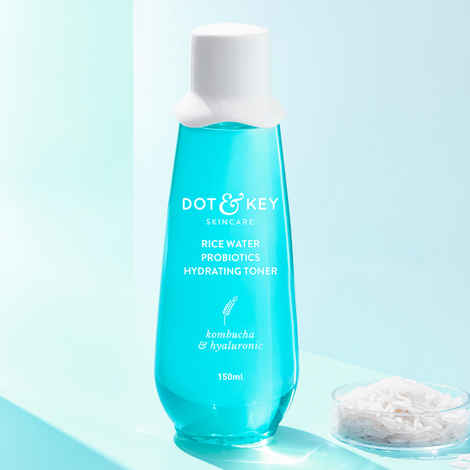
Dot & Key Rice Water Probiotics Hydrating Toner (150 ml)

Dot & Key Rice Water Probiotics Hydrating Toner (150 ml)
Dot & Key
dot-key-rice-water-probiotics-hydrating-toner-150-ml
Tone
10084842176805
Morning or Evening?
How often will you use this product?
Notes


Highlights
WHAT IS IT?
Toner with moisture-rich ingredients including Rice Water, Probiotics and Hyaluronic Acid
FEATURES
Hydrates dehydrated skin, balances skin's pH, strengthens microbiome barrier, alcohol-free formula
BEST FOR
dry
CHECKS
Alcohol
Who Is It For?
Unisex AdultsWhat Does It Help With?
Hydration Pore Minimization Skin Barrier StrengtheningBudget
Affordable (under ₹30)How To Use
Which routine should it be used in?
Instructions:
Key Information


What Dot & Key Says
Product Description:
Dot & Keys Rice Water Probiotics Hydrating Toner blends the potency of moisture-rich ingredients like Rice Water, Probiotics and Hyaluronic Acid in an alcohol-free formula to hydrate dehydrated, thirsty skin. This toner also balances the skin's pH and strengthens the microbiome barrier.
About the Brand:
Ingredients Overview
Ingredients List
Aqua, Lactic Acid, Propanediol, Sodium Hydroxide, Glycerine, PEG-40 Hydrogenated Castor Oil, Hydroxyethylcellulose, Silanetriol (and) Hyaluronic Acid (and) Methylpropanediol (and) Citric Acid (and) Water (Aqua), PPG-26-Buteth-26 (and) PEG-40 Hydrogenated Castor Oil (and) Water, Polysorbate 20, Mentha Piperita (Peppermint) Oil, Allantoin, Lactobacillus (and) Maltodextrin, Saccharomyces/Xylinum/Black Tea Ferment, Laminaria Digitata Extract (and) Hydrogenated Lecithin (and) Cetyl-PG Hydroxyethyl Palmitamide (and) Ceramide 1, 2,3,4,6II (and) Cholesterol (and) 1,2-hexanediol, Aqua (and) Oryza Sativa (Rice) Extract (and) Saccharomyces ferment lysate filtrate (and) Citric acid (and) Sodium Benzoate (and) Potassium sorbate, Glycerin (and) Aqua (and) Vaccinium Angustifolium (Blueberry) Fruit Extract, Glycyrrhiza Glabra (Licorice) Root Extract, Phenoxyethanol (and) Ethylhexylglycerin
Key Ingredients
Rice Water, Probiotics, Hyaluronic Acid
Ingredients Details
Allantoin
Common Name(s): 5-ureidohydantoin,glyoxyldiureide,aluminum dihydroxy allantoinate
CAS Number: 97-59-6
DESCRIPTION
What It Does: Soothes irritation, accelerates wound healing, promotes skin cell renewal, and provides mild keratolytic exfoliation.
Why It's Used: Gold standard multi-function soothing active – one of the most widely used cosmetic ingredients across all product types for its exceptional tolerability and clinically proven multi-action skin conditioning.
How It Works: Promotes keratinocyte proliferation and fibroblast migration for wound healing. mild keratolytic activity by disrupting corneocyte binding. anti-irritant via direct protein binding and anti-inflammatory cytokine reduction. humectant activity via hydroxyl groups.
Typically Found In: Post-procedure products,sensitive skin formulas,wound care,anti-acne treatments,baby products
TECHNICAL DETAILS
Primary Category: Active ingredient – soothing / anti-inflammatory
Secondary Functions: Wound healing,keratolytic,anti-irritant
Application Areas:

Facial Skincare
Body Care

Hair Care
Beard Care
Color Cosmetics (Makeup)
Dietary/Oral Supplements
Typical Concentration Range: 0.1%–2%
SOURCING & ETHICS
Vegan Status: Yes – synthetic or comfrey-derived
Halal Status: Yes
Source Notes: Plant-derived extract or synthetic.
SKIN COMPATIBILITY
Irritancy Rating: 1/5 – very low
Comedogenicity Rating: 0/5 – non-comedogenic
Sensitivity Concerns: Exceptionally well-tolerated; suitable for all skin types including baby and compromised skin.
Safe for Sensitive Skin: Yes – particularly recommended for sensitive skin
SAFETY & COMPATIBILITY
Safety Profile: Excellent safety profile. ewg score: 1.
Works Well With: Ceramides,panthenol,allantoin,hyaluronic acid,centella asiatica
Avoid Combining With: No significant incompatibilities
SCIENTIFIC NOTE
Allantoin's keratinocyte proliferation stimulation occurs via receptor-mediated signaling (possibly machr activation) rather than non-specific irritation-driven proliferation, making it a true wound-healing stimulant rather than a pro-inflammatory proliferative signal.
Last Verified: Cosing database,cir safety assessment,araújo et al. allantoin review
Primary Sources: 2026-03-12
Glycerine
Common Name(s): Glycerin,universal humectant,water-binding skin conditioning
CAS Number: N/a
DESCRIPTION
What It Does: Attracts and retains moisture in the sc, improves skin barrier function at low concentrations, provides gentle keratolytic softening, and acts as a co-solvent for water-soluble actives.
Why It's Used: The reference humectant — lowest cost, best safety profile, universal formulation compatibility, and present naturally in the sc via lipase-mediated glycerolipid hydrolysis makes glycerin the industry standard against which all humectants are benchmarked.
How It Works: Three hydroxyl groups form 6 h-bonds with water molecules per glycerol unit — the highest oh-group density per carbon of any commercial humectant. glycerin also down-regulates epidermal serine proteases that overactivate in dry sc, improving desquamation and barrier integrity.
Typically Found In: All cosmetics,universal
TECHNICAL DETAILS
Primary Category: Functional ingredient – humectant
Secondary Functions: Tewl reduction,skin plumping
Application Areas:
Facial Skincare
Body Care
Hair Care
Beard Care
Color Cosmetics (Makeup)
Dietary/Oral Supplements
Typical Concentration Range: 1%–40%
SOURCING & ETHICS
Vegan Status: Yes
Halal Status: Yes
Source Notes: Synthetic or naturally derived. excellent aqueous solubility.
SKIN COMPATIBILITY
Irritancy Rating: 1/5 – very low
Comedogenicity Rating: 0/5 – non-comedogenic
Sensitivity Concerns: Non-irritating; suitable for all skin types.
Safe for Sensitive Skin: Yes
SAFETY & COMPATIBILITY
Safety Profile: Excellent safety profile. ewg score: 1.
Works Well With: Ceramides,emollients,occlusives,glycerin,hyaluronic acid
Avoid Combining With: No significant incompatibilities
SCIENTIFIC NOTE
Epidermal lipases hydrolyse sc glycerophospholipids during cornification, releasing glycerol that contributes to the natural nmf — topical glycerin directly supplements this endogenous sc humectant pool.
Last Verified: Cosing database,glycerin universal humectant review
Primary Sources: 2026-03-12
Glycyrrhiza Glabra (licorice) Root Extract
Common Name(s): Licorice triterpenoid,glycyrrhetinic acid active,anti-inflammatory brightening
CAS Number: N/a
DESCRIPTION
What It Does: Reduces skin inflammation and redness through 11β-hsd inhibition (cortisol-amplifying mechanism), inhibits tyrosinase and melanogenesis for brightening, and provides antioxidant protection from the triterpenoid phenol system.
Why It's Used: One of few botanicals with documented cortisone-amplifying anti-inflammatory mechanism — 11β-hsd inhibition elevates local cortisol concentration in skin tissue, providing a pharmaceutical-level anti-inflammatory effect without direct corticosteroid application.
How It Works: Glycyrrhetinic acid inhibits 11β-hydroxysteroid dehydrogenase (11β-hsd) — the enzyme that converts active cortisol to inactive cortisone in peripheral tissues. inhibition elevates local skin cortisol, amplifying the glucocorticoid anti-inflammatory response. simultaneously, glabridin (a flavonoid in licorice) inhibits tyrosinase for brightening.
Typically Found In: Anti-inflammatory,soothing,brightening
TECHNICAL DETAILS
Primary Category: Active ingredient – antioxidant
Secondary Functions: Free radical scavenging,anti-aging
Application Areas:
Facial Skincare
Body Care
Hair Care
Beard Care
Color Cosmetics (Makeup)
Dietary/Oral Supplements
Typical Concentration Range: 0.01%–2%
SOURCING & ETHICS
Vegan Status: Yes
Halal Status: Yes
Source Notes: Plant-derived extract or synthetic.
SKIN COMPATIBILITY
Irritancy Rating: 1/5 – very low
Comedogenicity Rating: 0/5 – non-comedogenic
Sensitivity Concerns: Non-irritating; well-tolerated.
Safe for Sensitive Skin: Yes
SAFETY & COMPATIBILITY
Safety Profile: Excellent safety profile. ewg score: 1.
Works Well With: Vitamin c,vitamin e,ferulic acid,spf,other antioxidants
Avoid Combining With: No significant incompatibilities
SCIENTIFIC NOTE
11β-hsd inhibition by glycyrrhetinic acid was first documented in the context of licorice consumption causing pseudoaldosteronism — the same enzyme inhibition applied topically provides localised cortisol amplification for cosmetic anti-inflammatory activity without systemic effects.
Last Verified: Cosing database,glycyrrhetinic acid 11β-hsd anti-inflammatory review
Primary Sources: 2026-03-12
Hydroxyethylcellulose
Common Name(s): Hec,natrosol,ethylhydroxyethylcellulose
CAS Number: 9004-62-0
DESCRIPTION
What It Does: Provides non-ionic thickening compatible with anionic surfactants and electrolyte-containing formulations.
Why It's Used: Non-ionic cellulose thickener for surfactant systems where anionic/cationic thickener incompatibility is a concern.
How It Works: Hydroxyethyl substitution disrupts cellulose crystallinity enabling water solubility. non-ionic nature provides compatibility with anionic, cationic, and amphoteric surfactants. pseudoplastic rheology provides shear-thinning for dispensing. film formation from cellulose backbone.
Typically Found In: Shampoos,body washes,clear gels,surfactant systems
TECHNICAL DETAILS
Primary Category: Functional ingredient – cellulose thickener
Secondary Functions: Tewl reduction,skin plumping
Application Areas:
Facial Skincare
Body Care
Hair Care
Beard Care
Color Cosmetics (Makeup)
Dietary/Oral Supplements
Typical Concentration Range: 0.1%–3%
SOURCING & ETHICS
Vegan Status: Yes – from cellulose (plant)
Halal Status: Yes
Source Notes: Synthetic or naturally derived. excellent aqueous solubility.
SKIN COMPATIBILITY
Irritancy Rating: 1/5 – very low
Comedogenicity Rating: 0/5 – non-comedogenic
Sensitivity Concerns: Non-irritating; suitable for all skin types.
Safe for Sensitive Skin: Yes
SAFETY & COMPATIBILITY
Safety Profile: Excellent safety profile. ewg score: 1.
Works Well With: Ceramides,emollients,occlusives,glycerin,hyaluronic acid
Avoid Combining With: No significant incompatibilities
SCIENTIFIC NOTE
Hydroxyethylcellulose's non-ionic character is its primary differentiator from anionic carboxymethylcellulose – the absence of ionizable groups means hec maintains stable viscosity across ph 2-12 and at high electrolyte concentrations where carboxymethylcellulose destabilizes. this ionic independence makes hec the preferred cellulose thickener for acidic and salt-containing formulations.
Last Verified: Cosing database,ashland hec technical data,cir safety assessment
Primary Sources: 2026-03-12
