
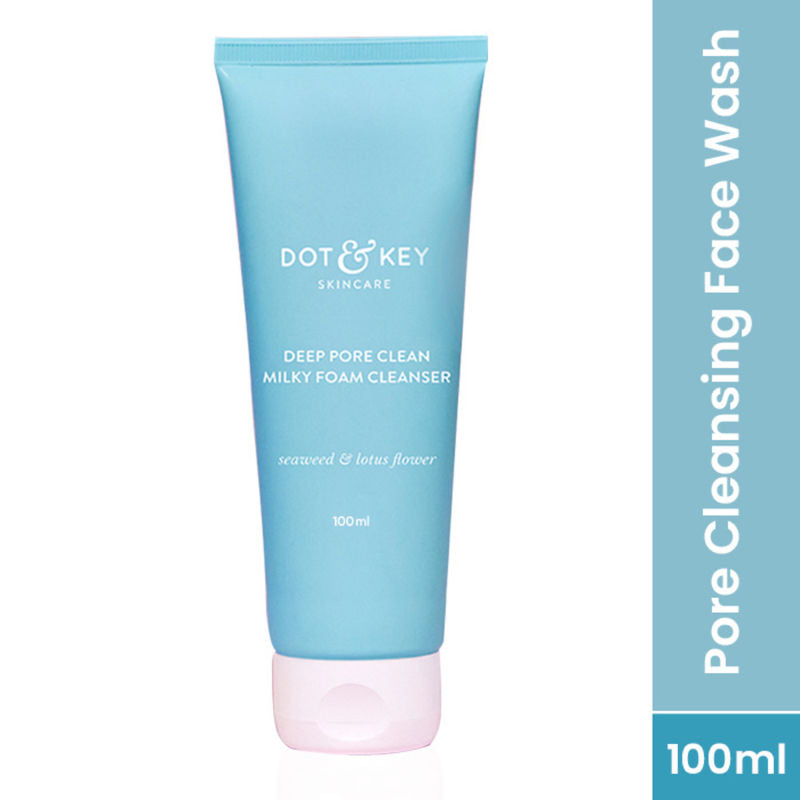

Dot & Key
Dot & Key Deep Pore Clean Milky Foam Cleanser

Dot & Key Deep Pore Clean Milky Foam Cleanser
Dot & Key
dot-key-deep-pore-clean-milky-foam-cleanser
Cleanse
10084902830373
Morning or Evening?
How often will you use this product?
Notes


Highlights
WHAT IS IT?
Face wash with 3 key ingredients
FEATURES
Deep cleansing, Pore refining, Foaming, Exfoliating, Unclogging, Detoxifying, Skin renewal, Oil control, Gentle formula, pH balancing
BEST FOR
combination
CHECKS
Does not contain harsh chemicals that clog pores
Who Is It For?
All Genders Adult Age RangeWhat Does It Help With?
Removing Dead Skin Cells Unclogging Pores Controlling Excess Sebum Fading Dark Spots HydrationBudget
Affordable (under $30)How To Use
Which routine should it be used in?
Instructions:
Key Information


What Dot & Key Says
Product Description:
Deep cleansing, Pore refining, Foaming. Face wash, Exfoliating, Unclogging. Detoxifying, Skin renewal, Oil control. Gentle formula, Non-comedogenic, pH balancing.
About the Brand:
Ingredients Overview
Ingredients List
Aqua, Myristic Acid, Glycerine, Acrylates / Steareth-20 Methacrylate Crosspolymer, Stearic Acid, Potassium Hydroxide, Propylene Glycol, Glycol Stearate, Dimethiconol (and) TEA-Dodecylbenzenesulfonate, Aqua (and) Lactic Acid (and) Glycolic Acid (and) Vaccinium Myrtillus Fruit Extract (and) Saccharum Officinarum (Sugarcane) Extract (and) Citric Acid (and) Citrus Aurantium Dulcis (Orange) Fruit Extract (and) Citrus Limon (Lemon) Fruit Extract (and)Acer Saccharum (Sugar Maple) Extract (and) Tartaric Acid (and) Malic Acid, Disodium EDTA, PEG-45M, Fucus Vesiculosus (Seaweed) Extract, Nelumbo Nucifera (Lotus) Flower Extract, Phenoxyethanol (and) Ethylhexylglycerin, Fragrance, CI 42090
Key Ingredients
Malic Acid,Tartaric Acid,Lactic Acid,Seaweed Extract,Lotus Flower Extract
Ingredients Details
Ci 42090
Common Name(s): Ci 42090,approved cosmetic colorant,fd&c blue 1 pigment
CAS Number: N/a
DESCRIPTION
What It Does: Provides colour in cosmetic formulations within permitted application areas (eye, lip, or general) as specified per ci 42090 in fda 21 cfr 73/74 and eu annex iv.
Why It's Used: Regulatory compliance requires verifying permitted use category (fd&c, d&c, ext. d&c) and approved application area for each target market before formulating.
How It Works: Colour from electronic transitions in the chromophore structure — metal d-orbital transitions (inorganic pigments) or π→π* transitions (organic chromophores) absorb specific visible wavelengths providing the perceived complementary colour.
Typically Found In: Colour cosmetics
TECHNICAL DETAILS
Primary Category: Active ingredient – mineral / metal active
Secondary Functions: Antimicrobial,sebum regulation,antioxidant enzyme cofactor
Application Areas:

Facial Skincare

Body Care
Hair Care
Beard Care
Color Cosmetics (Makeup)
Dietary/Oral Supplements
Typical Concentration Range: Per fda/eu permitted list
SOURCING & ETHICS
Vegan Status: Conditional - supplier confirmation required
Halal Status: Conditional - basis not stated in source record; supplier origin confirmation required to determine what evidence applies
Source Notes: Mineral/inorganic compound. cosmetic or pharmaceutical grade. [audit 2026-07-29 rev2: status downgraded on audit. determination requires shariah-panel sign-off.]
SKIN COMPATIBILITY
Irritancy Rating: 1/5 – very low
Comedogenicity Rating: 0/5 – non-comedogenic
Sensitivity Concerns: Non-irritating at recommended concentrations.
Safe for Sensitive Skin: Yes at recommended concentrations
SAFETY & COMPATIBILITY
Safety Profile: Excellent safety profile at cosmetic concentrations. ewg score: 1–2.
Works Well With: Niacinamide,salicylic acid,other actives
Avoid Combining With: No significant incompatibilities at standard concentrations
SCIENTIFIC NOTE
Us fda requires batch certification per lot; eu annex iv restricts by product type. both markets require verifying the specific permitted use category for each colorant.
Last Verified: 2026-03-12
Primary Sources: Fda 21 cfr 73/74,eu annex iv cosmetic colorant
Disodium Edta
Common Name(s): Edathamil disodium,edta disodium,versene 100
CAS Number: 139-33-3
DESCRIPTION
What It Does: Provides metal ion chelation to prevent product degradation and boost preservative and antioxidant efficacy.
Why It's Used: The most essential stability ingredient in cosmetics — disodium edta's metal chelation prevents rancidity, discoloration, and preservative failure caused by trace metal contamination in virtually all aqueous cosmetic formulations.
How It Works: Ethylenediaminetetraacetic acid provides six potential coordination sites for metal ions (aminodiacetate groups). chelates ca²⁺, mg²⁺ (stability), fe³⁺ (fenton radical prevention), cu²⁺ (oxidase inhibition). disrupts gram-negative bacterial outer membrane by chelating membrane calcium, enhancing preservative penetration.
Typically Found In: Virtually all aqueous cosmetics — creams, lotions, shampoos, toners
TECHNICAL DETAILS
Primary Category: Functional ingredient – chelating agent
Secondary Functions: Skin conditioning
Application Areas:
Facial Skincare
Body Care
Hair Care
Beard Care
Color Cosmetics (Makeup)
Dietary/Oral Supplements
Typical Concentration Range: 0.005%–0.1%
SOURCING & ETHICS
Vegan Status: Conditional - supplier confirmation required
Halal Status: Unverified - supplier confirmation required
Source Notes: Commercially produced for cosmetic use. verify vegan/halal status with supplier. [audit 2026-07-29 rev2: the record's own source_notes does not assert a non-animal origin, or instructs the reader to verify with the supplier; "yes" asserts knowledge the record does not hold. determination requires shariah-panel sign-off.]
SKIN COMPATIBILITY
Irritancy Rating: 1/5 – very low
Comedogenicity Rating: 0/5 – non-comedogenic
Sensitivity Concerns: Well-tolerated by most skin types.
Safe for Sensitive Skin: Yes
SAFETY & COMPATIBILITY
Safety Profile: Good safety profile at recommended concentrations. ewg score: 1–2.
Works Well With: Standard skincare actives
Avoid Combining With: No known significant incompatibilities
SCIENTIFIC NOTE
Disodium edta's preservative potentiation against gram-negative bacteria is mechanistically elegant: gram-negative outer membranes contain lipopolysaccharide stabilised by calcium and magnesium bridges. edta chelates these metal ions, destabilising the lps layer and creating pores that allow hydrophobic preservatives (phenoxyethanol, parabens) to penetrate — converting gram-negative-resistant preservatives into broad-spectrum ones.
Last Verified: 2026-03-12
Primary Sources: Cosing database,cir safety assessment
Fragrance
Common Name(s): Fragrance ingredient,eu allergen or aromatic component,olfactory/flavour
CAS Number: N/a
DESCRIPTION
What It Does: Provides the complete fragrance profile contributing to product sensory experience and consumer appeal.
Why It's Used: Fragrance is a major consumer purchase driver — up to 70% of consumers make purchasing decisions partially based on product scent.
How It Works: Fragrance blends interact with olfactory receptors providing the sensory profile — complex mixtures activate multiple receptor types for rich, multidimensional scent experiences.
Typically Found In: All fragrance products
TECHNICAL DETAILS
Primary Category: Active ingredient – cosmetic active
Secondary Functions: Skin conditioning
Application Areas:
Facial Skincare
Body Care
Hair Care
Beard Care
Color Cosmetics (Makeup)
Dietary/Oral Supplements
Typical Concentration Range: Standard use levels
SOURCING & ETHICS
Vegan Status: Conditional - supplier confirmation required
Halal Status: Unverified - supplier confirmation required
Source Notes: Commercially produced for cosmetic use. verify vegan/halal status with supplier. [audit 2026-07-29 rev2: the record's own source_notes does not assert a non-animal origin, or instructs the reader to verify with the supplier; "yes" asserts knowledge the record does not hold. determination requires shariah-panel sign-off.]
SKIN COMPATIBILITY
Irritancy Rating: 1/5 – very low
Comedogenicity Rating: 0/5 – non-comedogenic
Sensitivity Concerns: Well-tolerated by most skin types.
Safe for Sensitive Skin: Yes
SAFETY & COMPATIBILITY
Safety Profile: Good safety profile at recommended concentrations. ewg score: 1–2.
Works Well With: Standard skincare actives
Avoid Combining With: No known significant incompatibilities
SCIENTIFIC NOTE
Ifra guidelines set usage limits for fragrance ingredients based on skin sensitisation and phototoxicity assessment for each application category.
Last Verified: 2026-03-12
Primary Sources: Eu regulation 1223/2009 annex iii,ifra standards,fragrance allergen declaration requirements
Glycerine
Common Name(s): Glycerin,universal humectant,water-binding skin conditioning
CAS Number: N/a
DESCRIPTION
What It Does: Attracts and retains moisture in the sc, improves skin barrier function at low concentrations, provides gentle keratolytic softening, and acts as a co-solvent for water-soluble actives.
Why It's Used: The reference humectant — lowest cost, best safety profile, universal formulation compatibility, and present naturally in the sc via lipase-mediated glycerolipid hydrolysis makes glycerin the industry standard against which all humectants are benchmarked.
How It Works: Three hydroxyl groups form 6 h-bonds with water molecules per glycerol unit — the highest oh-group density per carbon of any commercial humectant. glycerin also down-regulates epidermal serine proteases that overactivate in dry sc, improving desquamation and barrier integrity.
Typically Found In: All cosmetics,universal
TECHNICAL DETAILS
Primary Category: Functional ingredient – humectant
Secondary Functions: Tewl reduction,skin plumping
Application Areas:
Facial Skincare
Body Care
Hair Care
Beard Care
Color Cosmetics (Makeup)
Dietary/Oral Supplements
Typical Concentration Range: 1%–40%
SOURCING & ETHICS
Vegan Status: Yes
Halal Status: Yes
Source Notes: Synthetic or naturally derived. excellent aqueous solubility.
SKIN COMPATIBILITY
Irritancy Rating: 1/5 – very low
Comedogenicity Rating: 0/5 – non-comedogenic
Sensitivity Concerns: Non-irritating; suitable for all skin types.
Safe for Sensitive Skin: Yes
SAFETY & COMPATIBILITY
Safety Profile: Excellent safety profile. ewg score: 1.
Works Well With: Ceramides,emollients,occlusives,glycerin,hyaluronic acid
Avoid Combining With: No significant incompatibilities
SCIENTIFIC NOTE
Epidermal lipases hydrolyse sc glycerophospholipids during cornification, releasing glycerol that contributes to the natural nmf — topical glycerin directly supplements this endogenous sc humectant pool.
Last Verified: 2026-03-12
Primary Sources: Cosing database,glycerin universal humectant review