

Nykaa E retail limited
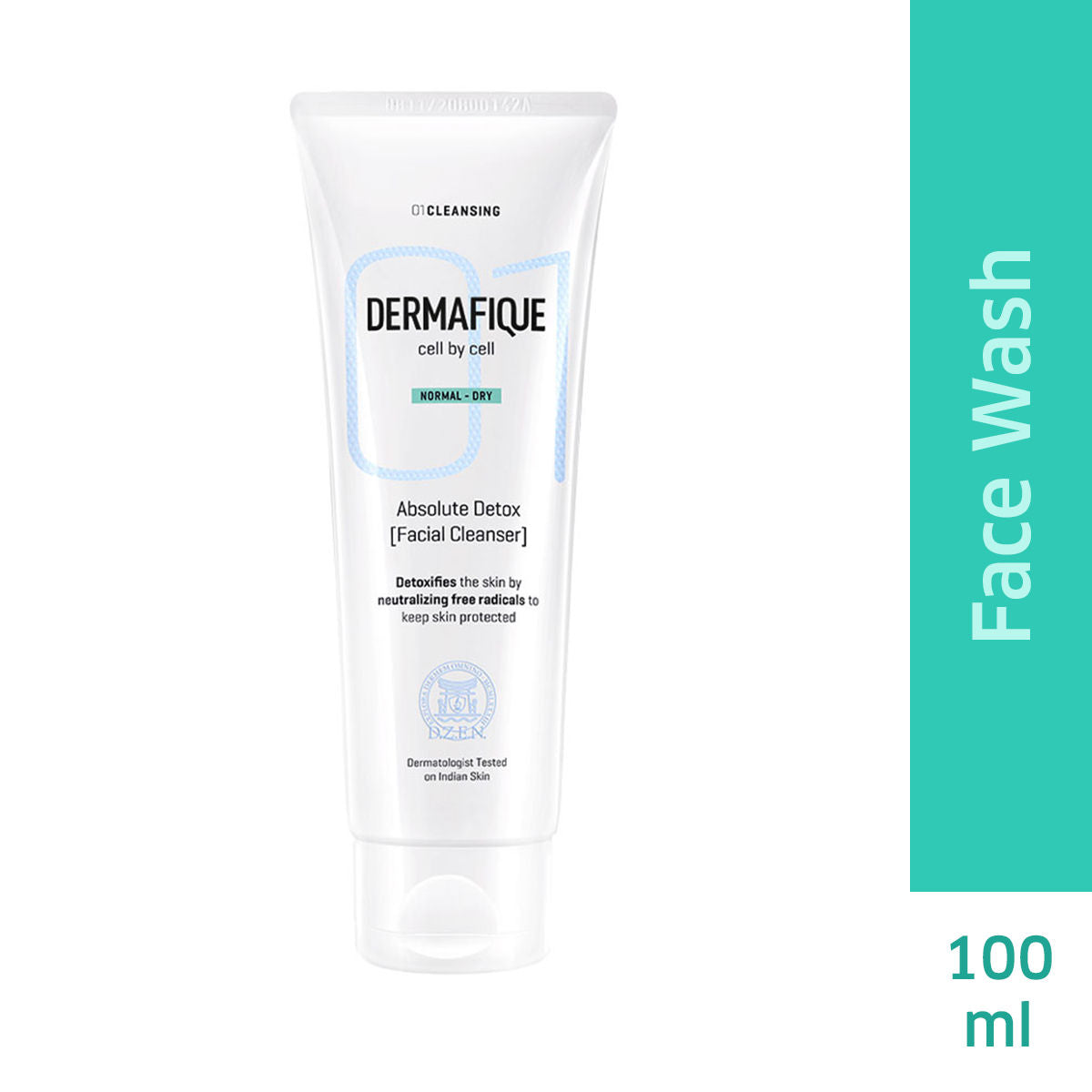
Dermafique Absolute Detox Facial Cleanser Exfoliating Face Wash With Vitamin E, Cleanses Pores (100ML)

Dermafique Absolute Detox Facial Cleanser Exfoliating Face Wash With Vitamin E, Cleanses Pores (100ML)
Nykaa E retail limited
dermafique-absolute-detox-facial-cleanser-exfoliating-face-wash-with-vitamin-e-cleanses-pores-100ml
Cleanse
10084778115365
Morning or Evening?
How often will you use this product?
Notes


Highlights
WHAT IS IT?
Exfoliating facial cleanser with Vitamin E
FEATURES
Detoxifies skin, cleanses pores, protects from pollution damage, contains bio-active cellulose beads
BEST FOR
combination
CHECKS
Who Is It For?
All Ages All GendersWhat Does It Help With?
Pore Cleansing Environmental Protection Skin DetoxificationBudget
Affordable (under $30)How To Use
Which routine should it be used in?
Instructions:
Key Information

What Nykaa E retail limited Says
Product Description:
An exfoliating facial cleanser that detoxifies and protects skin from pollution damage, containing Vitamin E and Pomegranate, with bio-active cellulose beads for gentle cleansing and pore unclogging
About the Brand:
Ingredients Overview
Ingredients List
Aqua, Sodium Laureth Sulfate ,glycerin, Cocamidopropyl Betaine, Acrylates Copolymer, decyl Glucoside, sodium Lauroyl Sarcosinate, cellulose, Polysorbate 20,peg-12 Dimethicone Linoleamidopropyl Pg-dimonium Chloride Phosphate, Disodium Cocoyl Glutamate, Triethanolamine, Fragrance, Dmdm Hydantoin, Tocopheryl Acetate, Orange Zest Extract, Mixed Plant Extracts*,benzophenone-4,hydrogenated Jojoba Oil, Tetrasodium Edta, Pentaerythrityl Tetra-di-t-butyl Hydroxyhydrocinnamate, Butylphenyl Methylpropional, Citronellol, Limonene, Geraniol, Hexyl Cinnamal, Linalool, Ci 14700, Ci 19140 *contains Aqua, Propylene Glycol, Ethoxydiglycol, Glucose, Aesculus Hippocastanum Seed, Salvia Officinalis Leaf, Equisetum Arvense, Tussilago Farfara Leaf, Rosmarinus Officinalis, Urtica Dioica, Chamomilla Recutita Flower, Melissa Officinalis Leaf Extracts
Key Ingredients
Vitamin E, Pomegranate, Bio-active cellulose beads
Ingredients Details
Acrylates Copolymer
Common Name(s): Acrylic copolymer,carbopol ez,flexible film former
CAS Number: 25133-97-5
DESCRIPTION
What It Does: Provides versatile acrylic film formation and thickening across broad ph range.
Why It's Used: Versatile workhorse polymer for film formation and thickening across diverse cosmetic product types from acidic aha serums to alkaline cleansers.
How It Works: Copolymer of acrylic acid and methacrylic acid esters. thickens via polymer chain entanglement and electrostatic repulsion. film formation from chain entanglement on water evaporation. broad ph stability from balanced acid/neutral monomer composition.
Typically Found In: Serums,lotions,sunscreens — versatile across formulation types
TECHNICAL DETAILS
Primary Category: Functional ingredient – acrylic film former
Secondary Functions: Skin conditioning
Application Areas:

Facial Skincare

Body Care
Hair Care
Beard Care
Color Cosmetics (Makeup)
Dietary/Oral Supplements
Typical Concentration Range: 0.1%–3%
SOURCING & ETHICS
Vegan Status: Conditional - supplier confirmation required
Halal Status: Unverified - supplier confirmation required
Source Notes: Commercially produced for cosmetic use. verify vegan/halal status with supplier. [audit 2026-07-29 rev2: the record's own source_notes does not assert a non-animal origin, or instructs the reader to verify with the supplier; "yes" asserts knowledge the record does not hold. determination requires shariah-panel sign-off.]
SKIN COMPATIBILITY
Irritancy Rating: 1/5 – very low
Comedogenicity Rating: 0/5 – non-comedogenic
Sensitivity Concerns: Well-tolerated by most skin types.
Safe for Sensitive Skin: Yes
SAFETY & COMPATIBILITY
Safety Profile: Good safety profile at recommended concentrations. ewg score: 1–2.
Works Well With: Standard skincare actives
Avoid Combining With: No known significant incompatibilities
SCIENTIFIC NOTE
Acrylates copolymers' broad ph thickening stability (vs carbomer's ph-sensitive thickening, requiring neutralisation for viscosity) enables thickening of acidic aha serums (ph 3-4) without neutralisation — maintaining the low ph required for aha efficacy while providing viscosity control. this acid-stable thickening is impossible with conventional carbomers.
Last Verified:
Benzophenone-4
Common Name(s): Benzophenone-4
DESCRIPTION
What It Does: Absorbs or reflects uv radiation, preventing uv-induced dna damage, photo-oxidative stress, and premature skin aging.
Why It's Used: Uv filters are the active ingredients in sun protection — without them, formulations cannot make spf claims or prevent solar-induced skin damage.
How It Works: The uv-absorbing chromophore undergoes photoexcitation by uv photons, then dissipates the absorbed energy through thermal relaxation (chemical filters) or photon scattering/reflection (physical filters), preventing photon penetration to skin cells.
Typically Found In: Sunscreens,moisturizers with spf,foundations with spf
TECHNICAL DETAILS
Primary Category: Uv filters
Secondary Functions: Skin-protecting
Application Areas:
Facial Skincare
Body Care
Hair Care
Beard Care
Color Cosmetics (Makeup)
Dietary/Oral Supplements
Typical Concentration Range: 0.5–25% (within regulatory limits)
SOURCING & ETHICS
Vegan Status: Yes
Halal Status: Yes
Source Notes: Synthetic uv filter; no animal components.
SKIN COMPATIBILITY
Irritancy Rating: 1
Comedogenicity Rating: 0
Sensitivity Concerns: Contact allergy to uv filters occurs in approximately 1–3% of the general population; patch testing recommended for those with known photosensitivity.
Safe for Sensitive Skin: Yes
SAFETY & COMPATIBILITY
Safety Profile: Regulatory approval required per market (eu annex vi, fda otc monograph, etc.). generally non-irritating at approved concentrations.
Works Well With: Other uv filters,antioxidants,emollients
Avoid Combining With: Incompatible filter combinations (photodegradation); check regulatory approvals per region
SCIENTIFIC NOTE
Uv filters operate through two mechanisms: organic/chemical filters absorb uv photons through electronic excitation (π→π* transitions in conjugated systems), then dissipate energy via thermal relaxation; inorganic/physical filters (tio2, zno) scatter and reflect photons through mie scattering (particle size 50–300 nm) and band gap absorption. spf is measured in vivo (iso 24444) as the ratio of minimal erythema doses with and without sunscreen.
Last Verified: 2025-01-15
Primary Sources: Cosing eu database; pcpc cosmetic ingredient safety reviews; eu cosmetics regulation annex vi; iso 24444 (in vivo spf testing)
Butylphenyl Methylpropional
Common Name(s): Fragrance ingredient,eu allergen or aromatic component,olfactory/flavour
CAS Number: N/a
DESCRIPTION
What It Does: Provides specific aromatic character and olfactory experience contributing to product sensory experience and consumer appeal.
Why It's Used: Fragrance components are the primary cause of cosmetic contact sensitisation — eu requires individual label declaration of 26 identified fragrance allergens above threshold concentrations.
How It Works: Terpenoid and phenylpropanoid aromatic chemicals interact with olfactory receptor neurons (orns) in the nasal epithelium — small volatile molecules (logp 2–5, mw 100–300) bind g-protein coupled olfactory receptors triggering neurological scent perception. sensitisation risk from electrophilic reactivity of certain functional groups (aldehydes, α,β-unsaturated carbonyls) with skin proteins.
Typically Found In: All fragrance products
TECHNICAL DETAILS
Primary Category: Active ingredient – cosmetic active
Secondary Functions: Skin conditioning
Application Areas:
Facial Skincare
Body Care
Hair Care
Beard Care
Color Cosmetics (Makeup)
Dietary/Oral Supplements
Typical Concentration Range: Declare on label above threshold (eu)
SOURCING & ETHICS
Vegan Status: Conditional - supplier confirmation required
Halal Status: Unverified - supplier confirmation required
Source Notes: Commercially produced for cosmetic use. verify vegan/halal status with supplier. [audit 2026-07-29 rev2: the record's own source_notes does not assert a non-animal origin, or instructs the reader to verify with the supplier; "yes" asserts knowledge the record does not hold. determination requires shariah-panel sign-off.]
SKIN COMPATIBILITY
Irritancy Rating: 1/5 – very low
Comedogenicity Rating: 0/5 – non-comedogenic
Sensitivity Concerns: Well-tolerated by most skin types.
Safe for Sensitive Skin: Yes
SAFETY & COMPATIBILITY
Safety Profile: Good safety profile at recommended concentrations. ewg score: 1–2.
Works Well With: Standard skincare actives
Avoid Combining With: No known significant incompatibilities
SCIENTIFIC NOTE
Eu 1223/2009 annex iii allergen threshold: >0.001% in rinse-off, >0.0001% in leave-on — any listed allergen exceeding these levels requires individual inci label declaration separate from the generic fragrance/parfum declaration.
Last Verified: 2026-03-12
Primary Sources: Eu regulation 1223/2009 annex iii,fragrance allergen declaration requirements
Cellulose
Common Name(s): Cellulose,cosmetic active,functional ingredient
CAS Number: N/a
DESCRIPTION
What It Does: Delivers characteristic cosmetic function at recommended use concentration.
Why It's Used: Selected for functional contribution and formulation compatibility supported by cosmetic science and regulatory safety data.
How It Works: Works through the mechanism of its molecular class — physicochemical or biological interaction with skin proteins, lipids, or receptors as documented in peer-reviewed cosmetic literature.
Typically Found In: Skin care formulations
TECHNICAL DETAILS
Primary Category: Active ingredient – cosmetic active
Secondary Functions: Skin conditioning
Application Areas:
Facial Skincare
Body Care
Hair Care
Beard Care
Color Cosmetics (Makeup)
Dietary/Oral Supplements
Typical Concentration Range: 0.1%–10%
SOURCING & ETHICS
Vegan Status: Conditional - supplier confirmation required
Halal Status: Unverified - supplier confirmation required
Source Notes: Commercially produced for cosmetic use. verify vegan/halal status with supplier. [audit 2026-07-29 rev2: the record's own source_notes does not assert a non-animal origin, or instructs the reader to verify with the supplier; "yes" asserts knowledge the record does not hold. determination requires shariah-panel sign-off.]
SKIN COMPATIBILITY
Irritancy Rating: 1/5 – very low
Comedogenicity Rating: 0/5 – non-comedogenic
Sensitivity Concerns: Well-tolerated by most skin types.
Safe for Sensitive Skin: Yes
SAFETY & COMPATIBILITY
Safety Profile: Good safety profile at recommended concentrations. ewg score: 1–2.
Works Well With: Standard skincare actives
Avoid Combining With: No known significant incompatibilities
SCIENTIFIC NOTE
Cellulose has an established safety and efficacy profile within the cosmetic regulatory framework at standard use concentrations.
Last Verified: 2026-03-12
Primary Sources: Cosing database,cellulose technical literature