

Nykaa E retail limited
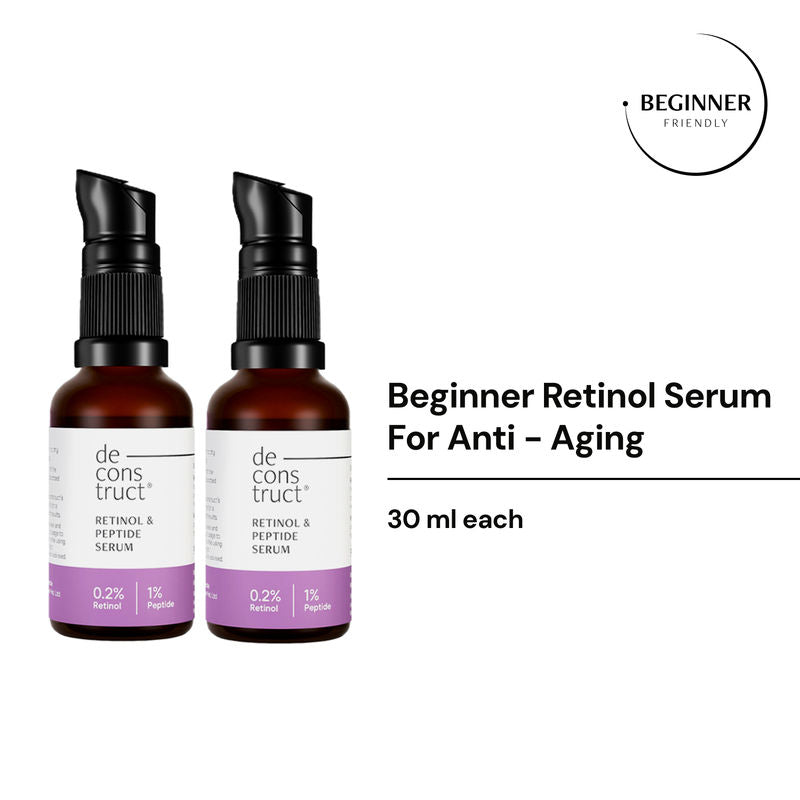
Deconstruct Retinol & Peptide Serum - 0.2% Retinol + 1% Peptides - Pack Of 2

Deconstruct Retinol & Peptide Serum - 0.2% Retinol + 1% Peptides - Pack Of 2
Nykaa E retail limited
deconstruct-retinol-peptide-serum-0-2-retinol-1-peptides-pack-of-2
Serum
10084872487205
Morning or Evening?
How often will you use this product?
Notes


Highlights
WHAT IS IT?
Retinol Face Serum with 0.2% Retinol and 1% Peptides
FEATURES
Anti-Aging, Beginner-Friendly, Contains Retinol and Peptides, Non-Greasy, Non-Sticky, Absorbs Well, Glow Enhancing
BEST FOR
sensitive
CHECKS
fragrance-free not explicitly stated, so empty
Who Is It For?
All Genders No Specific Age Range Mentioned But Implied For AdultsWhat Does It Help With?
Anti-aging Skin Glow Skin Barrier ImprovementBudget
Mid-range ($30-$75)How To Use
Which routine should it be used in?
Instructions:
Key Information


What Nykaa E retail limited Says
Product Description:
Deconstruct 0.2% Retinol Face Serum + 1% Peptide, Anti-Aging Serum, Beginner-Friendly: (MRP: 799.00/-) | Quantity: 2 | Expiry Date: 15 July 2026
About the Brand:
Ingredients Overview
Ingredients List
Aqua, Rosa Damascena Flower Water, Pisum Sativum (Pea) Extract, Pentylene Glycol, Lecithin, Retinol, Betaine, Polysorbate 20, Potassium Phosphate, Glycerin, Phenoxyethanol, Ethylhexylglycerin, Palmaria Palmata Extract, Xanthan Gum, Amylopectin, Magnesium Aspartate, Zinc Gluconate, Copper Gluconate, Sodium Gluconate, Hyaluronic Acid, Tocopheryl Acetate
Key Ingredients
0.2% Retinol, 1% Peptides
Ingredients Details
Amylopectin
Common Name(s): Amylopectin,cosmetic active,functional ingredient
CAS Number: N/a
DESCRIPTION
What It Does: Delivers characteristic cosmetic function at recommended use concentration.
Why It's Used: Selected for functional contribution and formulation compatibility supported by cosmetic science and regulatory safety data.
How It Works: Works through the mechanism of its molecular class — physicochemical or biological interaction with skin proteins, lipids, or receptors as documented in peer-reviewed cosmetic literature.
Typically Found In: Skin care formulations
TECHNICAL DETAILS
Primary Category: Active ingredient – cosmetic active
Secondary Functions: Skin conditioning
Application Areas:

Facial Skincare

Body Care
Hair Care
Beard Care
Color Cosmetics (Makeup)
Dietary/Oral Supplements
Typical Concentration Range: 0.1%–10%
SOURCING & ETHICS
Vegan Status: Conditional
Halal Status: Yes
Source Notes: Commercially produced for cosmetic use. verify vegan/halal status with supplier.
SKIN COMPATIBILITY
Irritancy Rating: 1/5 – very low
Comedogenicity Rating: 0/5 – non-comedogenic
Sensitivity Concerns: Well-tolerated by most skin types.
Safe for Sensitive Skin: Yes
SAFETY & COMPATIBILITY
Safety Profile: Good safety profile at recommended concentrations. ewg score: 1–2.
Works Well With: Standard skincare actives
Avoid Combining With: No known significant incompatibilities
SCIENTIFIC NOTE
Amylopectin has an established safety and efficacy profile within the cosmetic regulatory framework at standard use concentrations.
Last Verified: Cosing database,amylopectin technical literature
Primary Sources: 2026-03-12
Betaine
Common Name(s): Trimethylglycine,tmg,natural betaine
CAS Number: 107-43-7
DESCRIPTION
What It Does: Provides osmoprotective humectant conditioning with anti-irritant and mild foam-boosting activity.
Why It's Used: Natural-origin multifunctional osmolyte from sugar beet providing hydration, anti-irritancy, and conditioning in virtually every cosmetic category.
How It Works: Quaternary ammonium betaine provides zwitterionic character for water binding via ionic hydration. osmoprotective function at 100–500mm as compatible solute protecting cells from osmotic stress. reduces surfactant irritation by competing with sls for protein binding sites. mild foam enhancement.
Typically Found In: Virtually all categories — moisturisers, shampoos, cleansers
TECHNICAL DETAILS
Primary Category: Functional ingredient – humectant
Secondary Functions: Tewl reduction,skin plumping
Application Areas:
Facial Skincare
Body Care
Hair Care
Beard Care
Color Cosmetics (Makeup)
Dietary/Oral Supplements
Typical Concentration Range: 0.5%–10%
SOURCING & ETHICS
Vegan Status: Yes – from beta vulgaris (sugar beet) molasses
Halal Status: Yes
Source Notes: Synthetic or naturally derived. excellent aqueous solubility.
SKIN COMPATIBILITY
Irritancy Rating: 1/5 – very low
Comedogenicity Rating: 0/5 – non-comedogenic
Sensitivity Concerns: Non-irritating; suitable for all skin types.
Safe for Sensitive Skin: Yes
SAFETY & COMPATIBILITY
Safety Profile: Excellent safety profile. ewg score: 1.
Works Well With: Ceramides,emollients,occlusives,glycerin,hyaluronic acid
Avoid Combining With: No significant incompatibilities
SCIENTIFIC NOTE
Betaine's anti-irritant mechanism for surfactant systems involves competitive protein protection: betaine at high concentrations preferentially interacts with skin proteins, occupying binding sites that would otherwise be occupied by surfactant molecules causing protein denaturation. this competition reduces available protein binding for irritating surfactants, explaining betaine's well-documented ability to reduce sls irritation when co-formulated.
Last Verified: Cosing database,craig betaine osmoprotective review,cir safety assessment
Primary Sources: 2026-03-12
Copper Gluconate
Common Name(s): Cupric gluconate,copper(ii) d-gluconate
CAS Number: 0527-09-03
DESCRIPTION
What It Does: Provides bioavailable copper for skin enzyme cofactor functions including antioxidant, collagen crosslinking, and wound healing.
Why It's Used: Bioavailable organic copper for enzyme cofactor delivery to support antioxidant defense (sod), collagen maturation (lysyl oxidase), and wound healing.
How It Works: Cu²⁺ is the cofactor for sod1 (antioxidant), tyrosinase (melanin), lysyl oxidase (collagen crosslinking), and cytochrome c oxidase (cellular energy). organic gluconate complexation improves bioavailability vs inorganic copper salts.
Typically Found In: Anti-aging serums,wound healing products,antioxidant formulations
TECHNICAL DETAILS
Primary Category: Active ingredient – copper salt skin active
Secondary Functions: Sod cofactor,collagen crosslinking support,wound healing
Application Areas:
Facial Skincare
Body Care
Hair Care
Beard Care
Color Cosmetics (Makeup)
Dietary/Oral Supplements
Typical Concentration Range: 0.01%–0.5%
SOURCING & ETHICS
Vegan Status: Yes – mineral/inorganic
Halal Status: Yes
Source Notes: Mineral/inorganic compound. cosmetic or pharmaceutical grade.
SKIN COMPATIBILITY
Irritancy Rating: 1/5 – very low
Comedogenicity Rating: 0/5 – non-comedogenic
Sensitivity Concerns: Non-irritating at recommended concentrations.
Safe for Sensitive Skin: Yes at recommended concentrations
SAFETY & COMPATIBILITY
Safety Profile: Excellent safety profile at cosmetic concentrations. ewg score: 1–2.
Works Well With: Niacinamide,salicylic acid,other actives
Avoid Combining With: No significant incompatibilities at standard concentrations
SCIENTIFIC NOTE
Copper deficiency in skin manifests as impaired collagen crosslinking (reduced mechanical strength), reduced sod1 activity (increased oxidative stress), and hypopigmentation. topical copper supplementation addresses all three manifestations simultaneously through enzyme cofactor restoration.
Last Verified: Cosing database,cir safety assessment,pickart copper peptide literature
Primary Sources: 2026-03-12
Ethylhexylglycerin
Common Name(s): Octylglycerin,2-ethylhexyl glycerol ether,sensiva sc 10
CAS Number: 70445-33-9
DESCRIPTION
What It Does: Provides antimicrobial skin conditioning with deodorant activity and preservation system enhancement.
Why It's Used: Multifunctional clean beauty preservation active — ethylhexylglycerin provides antimicrobial, deodorant, and skin conditioning in a single ingredient accepted in most natural cosmetic certification schemes.
How It Works: Glycerol ether provides antimicrobial via bacterial membrane phospholipid disruption. deodorant activity via reduction of underarm lipase enzyme activity (similar mechanism to triethyl citrate). skin conditioning from glycerol humectant component. synergistic with phenoxyethanol and diols.
Typically Found In: Natural preservation systems,deodorants,skin conditioning products
TECHNICAL DETAILS
Primary Category: Functional ingredient – antimicrobial glycerol ether
Secondary Functions: Skin conditioning
Application Areas:
Facial Skincare
Body Care
Hair Care
Beard Care
Color Cosmetics (Makeup)
Dietary/Oral Supplements
Typical Concentration Range: 0.1%–0.5%
SOURCING & ETHICS
Vegan Status: Yes – synthetic
Halal Status: Yes
Source Notes: Commercially produced for cosmetic use. verify vegan/halal status with supplier.
SKIN COMPATIBILITY
Irritancy Rating: 1/5 – very low
Comedogenicity Rating: 0/5 – non-comedogenic
Sensitivity Concerns: Well-tolerated by most skin types.
Safe for Sensitive Skin: Yes
SAFETY & COMPATIBILITY
Safety Profile: Good safety profile at recommended concentrations. ewg score: 1–2.
Works Well With: Standard skincare actives
Avoid Combining With: No known significant incompatibilities
SCIENTIFIC NOTE
Ethylhexylglycerin's deodorant mechanism is pharmacologically identical to triethyl citrate: both inhibit skin surface microbial lipase enzymes that convert odourless triglycerides to odorous free fatty acids. the glycerol ether structure of ethylhexylglycerin, combined with the 2-ethylhexyl chain, provides lipase inhibition similar to ester-based lipase inhibitors from a different chemical class.
Last Verified: Cosing database,schülke sensiva sc 10 technical data,cir safety assessment
Primary Sources: 2026-03-12
