

Deconstruct
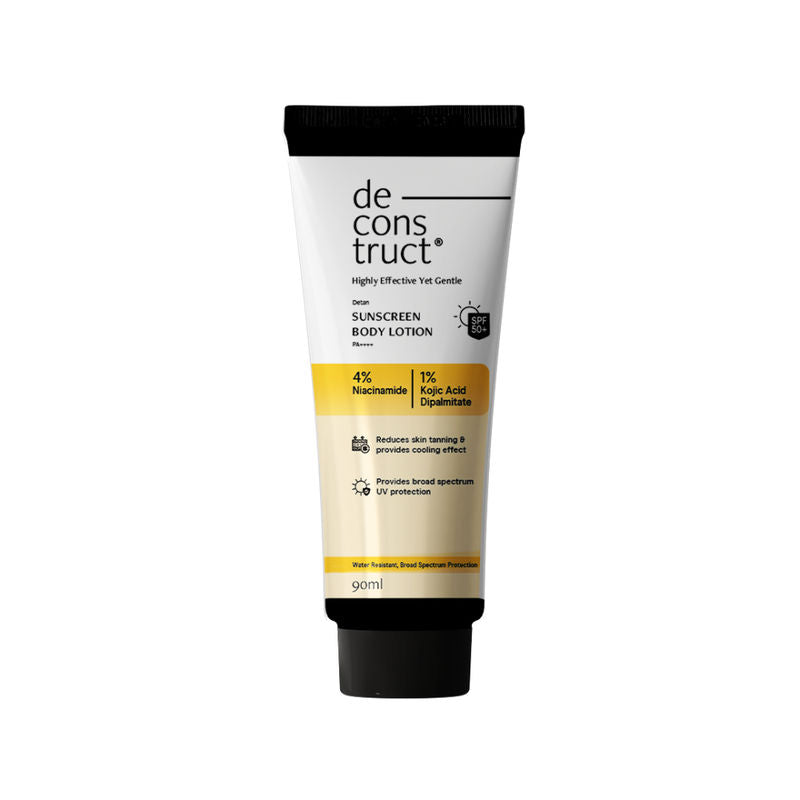
Deconstruct Detan Sunscreen Body Lotion With SPF 50+ PA ++++

Deconstruct Detan Sunscreen Body Lotion With SPF 50+ PA ++++
Deconstruct
deconstruct-detan-sunscreen-body-lotion-with-spf-50-pa
Moisturize
10084964958501
Morning or Evening?
How often will you use this product?
Notes


Highlights
WHAT IS IT?
Body sunscreen lotion with 11+ key ingredients
FEATURES
Reduces melanin production, brightens skin, provides broad spectrum UV protection SPF 50+ PA ++++
BEST FOR
sensitive
CHECKS
Parabens, Artificial fragrances
Who Is It For?
All Genders General Adult Use (age Not Specified)What Does It Help With?
Reduces Tanning Brightening Skin Uv ProtectionBudget
Affordable (under $30)How To Use
Which routine should it be used in?
Instructions:
Key Information


What Deconstruct Says
Product Description:
Body sunscreen lotion with UV protection and skin brightening properties containing Kojic Acid Dipalmitate, Niacinamide and UV filters.
About the Brand:
Ingredients Overview
Ingredients List
demineralised-water, ethylhexyl-methoxycinnamate, butyl-methoxydibenzoylmethane, benzophenone-3, phospholipids, 1,3-butylene-glycol, phenoxyethanol, niacinamide, glycerin, betaine, butylene-glycol, amps-hema-crosspolymer, c13-15-alkane, coco-glucoside, kojic-acid-dipalmitate, licorice-extract, d-panthenol, phenoxyethanol, petrolatum, cetearyl-olivate, sorbitan-olivate, tocopherol, helianthus-annuus-seed-oil, menthol
Key Ingredients
Kojic Acid Dipalmitate, Niacinamide, UV filter
Ingredients Details
Benzophenone-3
Common Name(s): Oxybenzone,2-hydroxy-4-methoxybenzophenone,uva+uvb filter
CAS Number: 131-57-7
DESCRIPTION
What It Does: Provides combined uva and uvb filtration in a single chemical uv filter molecule.
Why It's Used: Combined uva+uvb filter historically used for broad-spectrum coverage in a single ingredient, now increasingly restricted.
How It Works: Benzophenone chromophore absorbs uvb (305nm) and uva-ii (326nm) via two separate n→π* transitions. water-soluble allows aqueous phase formulation. single filter providing partial broad-spectrum coverage.
Typically Found In: Sunscreens (being phased out in many markets)
TECHNICAL DETAILS
Primary Category: Active ingredient – chemical uva/uvb filter
Secondary Functions: Skin conditioning
Application Areas:

Facial Skincare

Body Care
Hair Care
Beard Care
Color Cosmetics (Makeup)
Dietary/Oral Supplements
Typical Concentration Range: Up to 6% (eu), 6% (us fda)
SOURCING & ETHICS
Vegan Status: Conditional - supplier confirmation required
Halal Status: Unverified - supplier confirmation required
Source Notes: Commercially produced for cosmetic use. verify vegan/halal status with supplier. [audit 2026-07-29 rev2: the record's own source_notes does not assert a non-animal origin, or instructs the reader to verify with the supplier; "yes" asserts knowledge the record does not hold. determination requires shariah-panel sign-off.]
SKIN COMPATIBILITY
Irritancy Rating: 1/5 – very low
Comedogenicity Rating: 0/5 – non-comedogenic
Sensitivity Concerns: Well-tolerated by most skin types.
Safe for Sensitive Skin: Yes
SAFETY & COMPATIBILITY
Safety Profile: Eu max 6%. coral reef/aquatic toxicity — banned hawaii, palau, some us states. potential endocrine activity at high systemic exposure. ewg score: 7. use declining due to regulatory pressure.
Works Well With: Standard skincare actives
Avoid Combining With: No known significant incompatibilities
SCIENTIFIC NOTE
Benzophenone-3's declining use reflects evolving understanding of environmental and endocrine impacts: discovered in coral bleaching studies, its restriction in hawaii (2018) sparked a global trend in marine-safe sunscreen formulations that is reshaping the industry away from bp-3 toward mineral filters and marine-safer organic alternatives.
Last Verified: 2026-03-12
Primary Sources: Cosing database,fda uv filter otc monograph,hawaii bp-3 restriction law
Betaine
Common Name(s): Trimethylglycine,tmg,natural betaine
CAS Number: 107-43-7
DESCRIPTION
What It Does: Provides osmoprotective humectant conditioning with anti-irritant and mild foam-boosting activity.
Why It's Used: Natural-origin multifunctional osmolyte from sugar beet providing hydration, anti-irritancy, and conditioning in virtually every cosmetic category.
How It Works: Quaternary ammonium betaine provides zwitterionic character for water binding via ionic hydration. osmoprotective function at 100–500mm as compatible solute protecting cells from osmotic stress. reduces surfactant irritation by competing with sls for protein binding sites. mild foam enhancement.
Typically Found In: Virtually all categories — moisturisers, shampoos, cleansers
TECHNICAL DETAILS
Primary Category: Functional ingredient – humectant
Secondary Functions: Tewl reduction,skin plumping
Application Areas:
Facial Skincare
Body Care
Hair Care
Beard Care
Color Cosmetics (Makeup)
Dietary/Oral Supplements
Typical Concentration Range: 0.5%–10%
SOURCING & ETHICS
Vegan Status: Conditional - feedstock declaration required
Halal Status: Unverified - feedstock declaration required (plant, animal and petrochemical routes all exist)
Source Notes: Synthetic or naturally derived. excellent aqueous solubility. [audit 2026-07-29 rev2: origin-dependent: the same inci exists in plant, animal and petrochemical versions and the name does not discriminate. determination requires shariah-panel sign-off.]
SKIN COMPATIBILITY
Irritancy Rating: 1/5 – very low
Comedogenicity Rating: 0/5 – non-comedogenic
Sensitivity Concerns: Non-irritating; suitable for all skin types.
Safe for Sensitive Skin: Yes
SAFETY & COMPATIBILITY
Safety Profile: Excellent safety profile. ewg score: 1.
Works Well With: Ceramides,emollients,occlusives,glycerin,hyaluronic acid
Avoid Combining With: No significant incompatibilities
SCIENTIFIC NOTE
Betaine's anti-irritant mechanism for surfactant systems involves competitive protein protection: betaine at high concentrations preferentially interacts with skin proteins, occupying binding sites that would otherwise be occupied by surfactant molecules causing protein denaturation. this competition reduces available protein binding for irritating surfactants, explaining betaine's well-documented ability to reduce sls irritation when co-formulated.
Last Verified: 2026-03-12
Primary Sources: Cosing database,craig betaine osmoprotective review,cir safety assessment
Coco-glucoside
Common Name(s): Coconut glucoside,apg c8-c16
CAS Number: 68515-73-1
DESCRIPTION
What It Does: Provides gentle, natural-origin cleansing with good foam from mixed coconut chain alkyl glucosides.
Why It's Used: Widely used natural surfactant for green beauty formulations requiring good foam performance with natural-origin and mild credentials.
How It Works: Mixed c8-c16 fatty alcohol chain lengths from coconut provide broader foam stability than single-chain glucosides. non-ionic glucoside headgroup provides mildness. better detergency and rinsing than individual chain-length apgs due to mixed chain distribution.
Typically Found In: Natural shampoos,body washes,facial cleansers
TECHNICAL DETAILS
Primary Category: Functional ingredient – coconut alkyl glucoside
Secondary Functions: Skin conditioning
Application Areas:
Facial Skincare
Body Care
Hair Care
Beard Care
Color Cosmetics (Makeup)
Dietary/Oral Supplements
Typical Concentration Range: 2%–20%
SOURCING & ETHICS
Vegan Status: Conditional - supplier confirmation required
Halal Status: Unverified - supplier confirmation required
Source Notes: Commercially produced for cosmetic use. verify vegan/halal status with supplier. [audit 2026-07-29 rev2: the record's own source_notes does not assert a non-animal origin, or instructs the reader to verify with the supplier; "yes" asserts knowledge the record does not hold. determination requires shariah-panel sign-off.]
SKIN COMPATIBILITY
Irritancy Rating: 1/5 – very low
Comedogenicity Rating: 0/5 – non-comedogenic
Sensitivity Concerns: Well-tolerated by most skin types.
Safe for Sensitive Skin: Yes
SAFETY & COMPATIBILITY
Safety Profile: Good safety profile at recommended concentrations. ewg score: 1–2.
Works Well With: Standard skincare actives
Avoid Combining With: No known significant incompatibilities
SCIENTIFIC NOTE
Coco-glucoside's natural chain length distribution (c8-c16) provides synergistic surfactant effects where different chain lengths optimize different properties: shorter chains provide initial foam burst, longer chains provide foam stability and soil removal, creating better overall performance than any single chain length alone.
Last Verified: 2026-03-12
Primary Sources: Cosing database,cir safety assessment
D-panthenol
Common Name(s): D-panthenol,b-vitamin skin active,multi-benefit conditioning
CAS Number: N/a
DESCRIPTION
What It Does: Provides the specific b-vitamin's characteristic skin and hair benefits: brightening and barrier reinforcement (niacinamide), keratin structural support (biotin), deep conditioning humectancy (panthenol).
Why It's Used: B-vitamins operate through fundamental cellular biochemistry pathways — nad⁺ for niacinamide, carboxylase cofactor for biotin, coa synthesis for panthenol — providing multi-benefit activity from essential metabolic chemistry.
How It Works: Acts as coenzyme or substrate in essential metabolic pathways: niacinamide → nad⁺/nadp⁺ → ceramide synthesis, melanosome transfer inhibition; biotin → carboxylase → fatty acid synthesis for ceramide; panthenol → pantothenic acid → coa → lipid metabolism.
Typically Found In: Multi-function skin care,b-vitamin formulas
TECHNICAL DETAILS
Primary Category: Active ingredient – vitamin b complex
Secondary Functions: Antioxidant cofactor,metabolic support
Application Areas:
Facial Skincare
Body Care
Hair Care
Beard Care
Color Cosmetics (Makeup)
Dietary/Oral Supplements
Typical Concentration Range: 0.1%–10%
SOURCING & ETHICS
Vegan Status: Yes
Halal Status: Yes
Source Notes: Synthetically produced for cosmetic use.
SKIN COMPATIBILITY
Irritancy Rating: 1/5 – very low
Comedogenicity Rating: 0/5 – non-comedogenic
Sensitivity Concerns: Non-irritating; excellent tolerability.
Safe for Sensitive Skin: Yes
SAFETY & COMPATIBILITY
Safety Profile: Excellent safety profile. ewg score: 1.
Works Well With: Other b vitamins,niacinamide,antioxidant complexes
Avoid Combining With: No significant incompatibilities
SCIENTIFIC NOTE
B-vitamins are water-soluble, non-irritating, and well-tolerated across all skin types — providing clinical efficacy with an exceptional safety profile from their essential nutrient status.
Last Verified: 2026-03-12
Primary Sources: Cosing database,d-panthenol b-vitamin skin review