
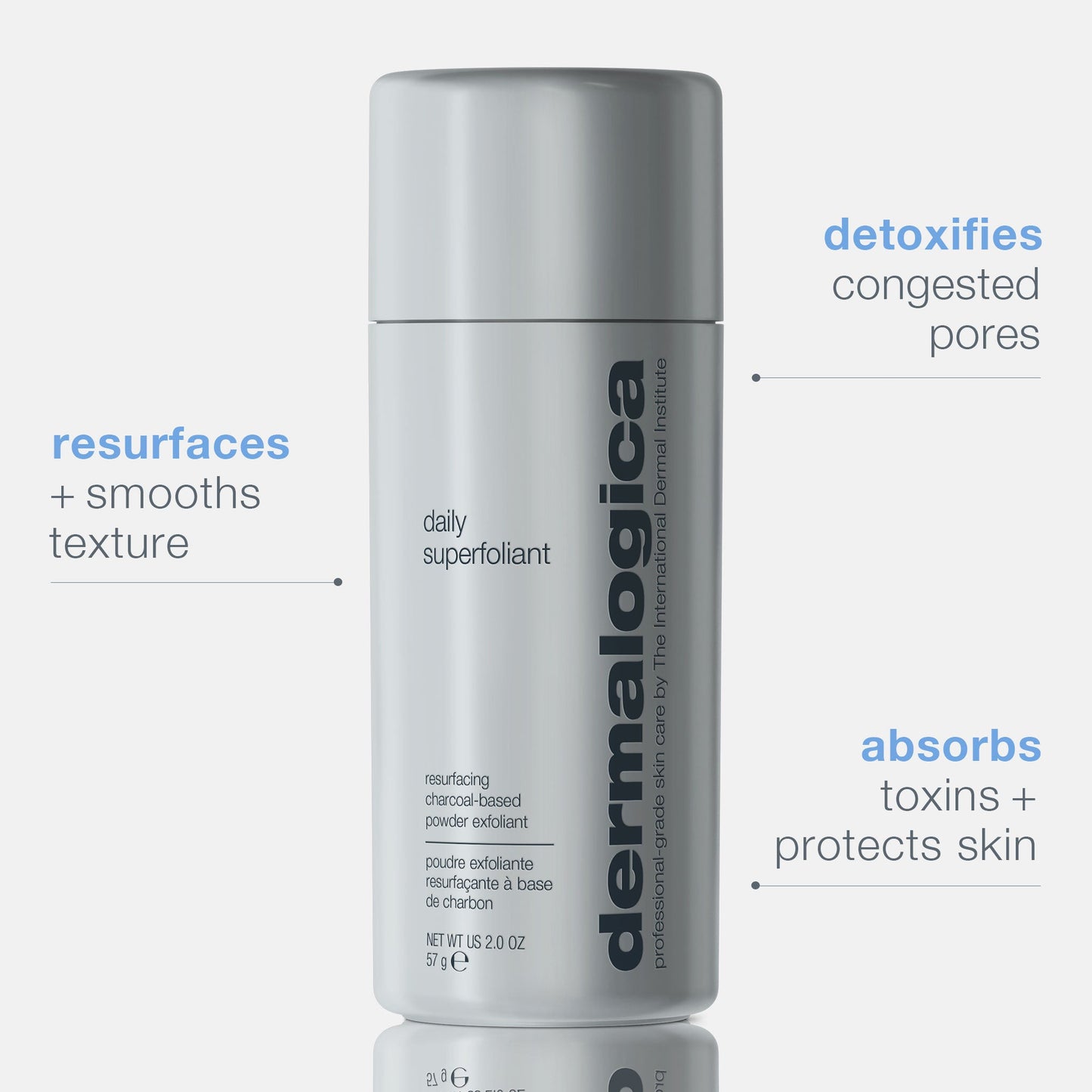

dermalogica
Daily Superfoliant Exfoliator

Daily Superfoliant Exfoliator
dermalogica
daily-superfoliant-exfoliator
Exfoliation
9784809554213
Morning or Evening?
How often will you use this product?
Notes


Highlights
WHAT IS IT?
Powder exfoliant with multiple active ingredients
FEATURES
Anti-pollution technology, resurfacing, skin-smoothing, pore-purifying
BEST FOR
combination
CHECKS
Free of sulfates SLS, SLES, parabens, formaldehydes, formaldehyde-releasing agents, phthalates, mineral oil, retinyl palmitate, oxybenzone, coal tar, hydroquinone, triclosan, triclocarban, gluten.
Who Is It For?
Adults With Normal Combination And Oily SkinWhat Does It Help With?
Dullness Fine Lines Wrinkles Pores Uneven TextureBudget
Mid-range ($30-$75)How To Use
Which routine should it be used in?
Instructions:
Key Information


What dermalogica Says
Product Description:
Resurfacing, anti-pollution powder exfoliant that delivers smooth skin and fights environmental triggers known to accelerate skin aging. Features activated Binchotan Charcoal, Lactic Acid, Niacinamide, Red Algae and Tara Fruit Extract.
About the Brand:
Ingredients Overview
Ingredients List
Microcrystalline Cellulose, Sodium Bicarbonate, Sodium Cocoyl Glutamate, Sodium Myristoyl Glutamate, Malic Acid, Sodium Methyl Cocoyl Taurate, Charcoal Powder, Vinyl Dimethicone/Methicone Silsesquioxane Crosspolymer, Maltodextrin, Silica, Magnesium Oxide, Oryza Sativa (Rice) Bran Extract, Polymethylsilsesquioxane, Sapindus Trifoliatus Fruit Extract, Niacinamide, Citrus Aurantium Amara (Bitter Orange) Peel Oil, Zingiber Officinale (Ginger) Root Extract, Lavandula Angustifolia (Lavender) Oil, Lavandula Hybrida Oil, Camellia Sinensis Leaf, Kappaphycus Alvarezii Extract, Caesalpinia Spinosa Fruit Pod Extract, Citrus Limon (Lemon) Peel Oil, Rosmarinus Officinalis (Rosemary) Leaf Oil, Salvia Officinalis (Sage) Oil, Subtilisin, Lipase, Papain, Lactic Acid, Oryza Sativa (Rice) Starch, Sodium Chloride, Sodium Dehydroacetate, Xanthan Gum, Water/Aqua/ Eau, Coconut Acid, Calcium Lactate, Capryloyl Glycine, Undecylenoyl Glycine, Cetrimonium Chloride, Limonene, Linalool.
Key Ingredients
Activated Binchotan Charcoal, Lactic Acid, Niacinamide, Red Algae, Tara Fruit Extract
Ingredients Details
Charcoal Powder
Common Name(s): Activated charcoal/fuller's earth,pore cleansing adsorbent,detoxifying clay
CAS Number: N/a
DESCRIPTION
What It Does: Physically adsorbs excess sebum, environmental pollution particulates, and skin surface impurities into the porous structure, purifies pores during mask application, and provides the 'detox' pore-drawing action validated by the visible sebum and debris transfer to the mask on removal.
Why It's Used: Provides genuine documented high-capacity physical adsorption — not a marketing claim but a measurable adsorbent capacity. activated charcoal's ~2000 m²/g surface area adsorbs sebum lipids and particulate pollutants through van der waals forces at concentrations no clay or silica alternative can match.
How It Works: Activated charcoal's turbostratic graphite structure (disordered graphene layers) provides pore sizes of 0.5–50 nm covering micro, meso, and macro pore ranges. sebum lipids adsorb into mesopores (2–50 nm) via van der waals forces; pollutant pahs adsorb via π-π stacking with graphene rings; the high-capacity adsorption drives equilibrium-driven partitioning from pore to charcoal surface.
Typically Found In: Charcoal masks,pore purifying,detox
TECHNICAL DETAILS
Primary Category: Active ingredient – mineral / metal active
Secondary Functions: Antimicrobial,sebum regulation,antioxidant enzyme cofactor
Application Areas:

Facial Skincare

Body Care
Hair Care
Beard Care
Color Cosmetics (Makeup)
Dietary/Oral Supplements
Typical Concentration Range: 5%–30%
SOURCING & ETHICS
Vegan Status: Yes
Halal Status: Yes
Source Notes: Mineral/inorganic compound. cosmetic or pharmaceutical grade.
SKIN COMPATIBILITY
Irritancy Rating: 1/5 – very low
Comedogenicity Rating: 0/5 – non-comedogenic
Sensitivity Concerns: Non-irritating at recommended concentrations.
Safe for Sensitive Skin: Yes at recommended concentrations
SAFETY & COMPATIBILITY
Safety Profile: Excellent safety profile at cosmetic concentrations. ewg score: 1–2.
Works Well With: Niacinamide,salicylic acid,other actives
Avoid Combining With: No significant incompatibilities at standard concentrations
SCIENTIFIC NOTE
Activated charcoal's adsorption capacity (1–3 g sebum/g charcoal) significantly exceeds kaolin clay (~0.5 g/g) and bentonite (~0.8 g/g) — the higher porosity-to-mass ratio from carbonisation providing the most efficient sebum adsorption per gram of any cosmetic adsorbent.
Last Verified: Cosing database,activated charcoal pore adsorption capacity review
Primary Sources: 2026-03-12
Malic Acid
Common Name(s): L-malic acid,2-hydroxybutanedioic acid,apple acid
CAS Number: 6915-15-7
DESCRIPTION
What It Does: Gently exfoliates skin, brightens complexion, balances ph, acts as chelating agent.
Why It's Used: Gentle exfoliant for multi-aha blends; larger molecular size provides moderate exfoliation with low irritation.
How It Works: At low ph, disrupts corneocyte adhesion for gentle exfoliation. dicarboxylic acid structure enables metal chelation as formulation stabilizer.
Typically Found In: Chemical exfoliants,toners,serums,professional peels
TECHNICAL DETAILS
Primary Category: Active ingredient – alpha hydroxy acid (aha)
Secondary Functions: Chelating agent,ph adjuster,mild exfoliant
Application Areas:
Facial Skincare
Body Care
Hair Care
Beard Care
Color Cosmetics (Makeup)
Dietary/Oral Supplements
Typical Concentration Range: 1%–10%
SOURCING & ETHICS
Vegan Status: Yes – synthetic or fermentation-derived
Halal Status: Yes
Source Notes: Derived from apples and other fruits or synthetically produced via maleic acid hydration.
SKIN COMPATIBILITY
Irritancy Rating: 2/5 – low to moderate
Comedogenicity Rating: 0/5 – non-comedogenic
Sensitivity Concerns: Very well-tolerated; gentler than glycolic or lactic acid; low photosensitization.
Safe for Sensitive Skin: Yes – preferred aha for sensitive skin
SAFETY & COMPATIBILITY
Safety Profile: Safe at otc concentrations. eu: ≤10% leave-on at ph ≥3.5. mandatory spf advisory.
Works Well With: Niacinamide,ceramides,hyaluronic acid,spf
Avoid Combining With: Retinol in same step; multiple exfoliants simultaneously
SCIENTIFIC NOTE
Malic acid's molecular weight (~134 da vs 76 da for glycolic acid) provides shallower skin penetration and more superficial exfoliating action, ideal for sensitive skin.
Last Verified: Cosing database,cir safety assessment,sccs aha opinion
Primary Sources: 2026-03-12
Maltodextrin
Common Name(s): Maltodextrin,cosmetic active,functional ingredient
CAS Number: N/a
DESCRIPTION
What It Does: Delivers characteristic cosmetic function at recommended use concentration.
Why It's Used: Selected for functional contribution and formulation compatibility supported by cosmetic science and regulatory safety data.
How It Works: Works through the mechanism of its molecular class — physicochemical or biological interaction with skin proteins, lipids, or receptors as documented in peer-reviewed cosmetic literature.
Typically Found In: Skin care formulations
TECHNICAL DETAILS
Primary Category: Active ingredient – cosmetic active
Secondary Functions: Skin conditioning
Application Areas:
Facial Skincare
Body Care
Hair Care
Beard Care
Color Cosmetics (Makeup)
Dietary/Oral Supplements
Typical Concentration Range: 0.1%–10%
SOURCING & ETHICS
Vegan Status: Conditional
Halal Status: Yes
Source Notes: Commercially produced for cosmetic use. verify vegan/halal status with supplier.
SKIN COMPATIBILITY
Irritancy Rating: 1/5 – very low
Comedogenicity Rating: 0/5 – non-comedogenic
Sensitivity Concerns: Well-tolerated by most skin types.
Safe for Sensitive Skin: Yes
SAFETY & COMPATIBILITY
Safety Profile: Good safety profile at recommended concentrations. ewg score: 1–2.
Works Well With: Standard skincare actives
Avoid Combining With: No known significant incompatibilities
SCIENTIFIC NOTE
Maltodextrin has an established safety and efficacy profile within the cosmetic regulatory framework at standard use concentrations.
Last Verified: Cosing database,maltodextrin technical literature
Primary Sources: 2026-03-12
Microcrystalline Cellulose
Common Name(s): Natural or modified biopolymer thickener,rheology modifier,film-former
CAS Number: N/a
DESCRIPTION
What It Does: Builds aqueous viscosity through polymer chain entanglement above the overlap concentration, forms conditioning films on skin and hair, and stabilises suspensions through yield stress.
Why It's Used: Natural biopolymer thickeners provide elegant formulation sensory without the tight ph requirements of synthetic carbomers — preferred in shampoos and conditioners where broad ph tolerance and natural origin are both required.
How It Works: Polysaccharide chains above overlap concentration c* entangle forming a viscoelastic network — viscosity scales as c^4.7 above c*, providing steep concentration-viscosity dependence. chemical modification (hydroxypropyl, hydroxyethyl) increases water solubility and cold-processability of otherwise difficult-to-dissolve natural polysaccharides.
Typically Found In: Shampoos,conditioners,gels
TECHNICAL DETAILS
Primary Category: Active ingredient – cosmetic active
Secondary Functions: Skin conditioning
Application Areas:
Facial Skincare
Body Care
Hair Care
Beard Care
Color Cosmetics (Makeup)
Dietary/Oral Supplements
Typical Concentration Range: 0.1%–5%
SOURCING & ETHICS
Vegan Status: Yes
Halal Status: Yes
Source Notes: Commercially produced for cosmetic use. verify vegan/halal status with supplier.
SKIN COMPATIBILITY
Irritancy Rating: 1/5 – very low
Comedogenicity Rating: 0/5 – non-comedogenic
Sensitivity Concerns: Well-tolerated by most skin types.
Safe for Sensitive Skin: Yes
SAFETY & COMPATIBILITY
Safety Profile: Good safety profile at recommended concentrations. ewg score: 1–2.
Works Well With: Standard skincare actives
Avoid Combining With: No known significant incompatibilities
SCIENTIFIC NOTE
Biopolymer thickeners are sensitive to electrolyte concentration — high salt levels screen polymer charge interactions reducing viscosity. formulation salt content must be accounted for when selecting polymer concentration for target viscosity.
Last Verified: Cosing database,microcrystalline cellulose biopolymer thickener review
Primary Sources: 2026-03-12
