

dermalogica
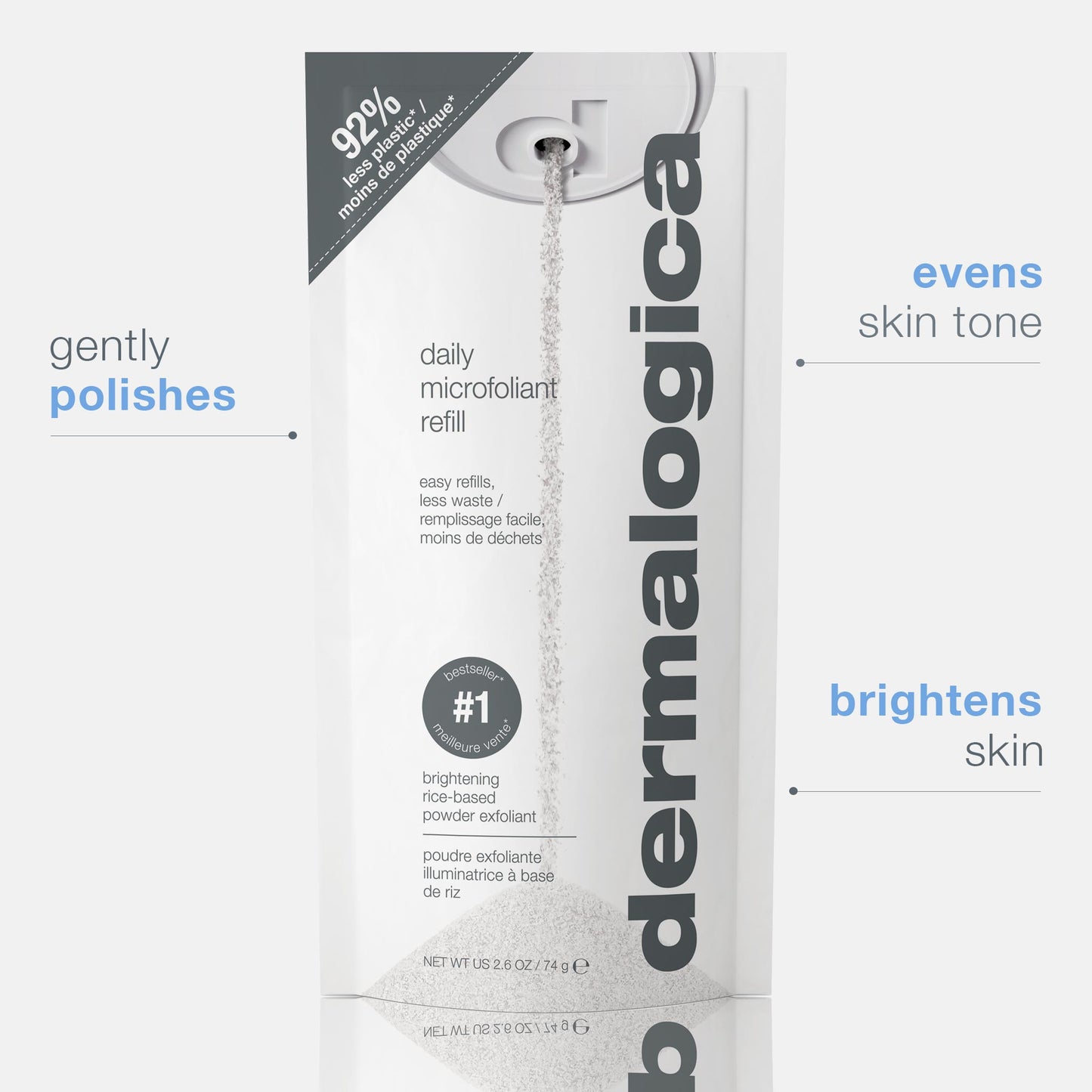
Daily Microfoliant Exfoliator Refill

Daily Microfoliant Exfoliator Refill
dermalogica
daily-microfoliant-exfoliator-refill
Exfoliation
9784815092005
Morning or Evening?
How often will you use this product?
Notes


Highlights
WHAT IS IT?
Rice-based exfoliating powder with AHAs
FEATURES
Brightens, smooths, polishes skin, balances uneven skin tone, calms skin
BEST FOR
all
CHECKS
Paraben-free, artificial colors-free, fragrances-free, gluten-free
Who Is It For?
All Ages And GendersWhat Does It Help With?
Acne Blemishes Dullness Uneven Texture Uneven Skin ToneBudget
Mid-range ($30-$75)How To Use
Which routine should it be used in?
Instructions:
Key Information


What dermalogica Says
Product Description:
Achieve brighter, smoother skin every day with this iconic exfoliating powder. Rice-based powder, rich in Alpha Hydroxy Acids (AHAs), activates upon contact with water, releasing Papain, BHA Salicylic Acid and Rice Bran to polish skin to perfection.
About the Brand:
Ingredients Overview
Ingredients List
Microcrystalline Cellulose, Magnesium Oxide, Sodium Cocoyl Isethionate, Colloidal Oatmeal, Disodium Lauryl Sulfosuccinate, Sodium Lauroyl Glutamate, Oryza Sativa (Rice) Bran Extract, Oryza Sativa (Rice) Starch, Hydrogenated Coconut Acid, Allantoin, Papain, Salicylic Acid, Ginkgo Biloba Leaf Extract, Camellia Sinensis Leaf Extract, Glycyrrhiza Glabra (Licorice) Root Extract, PCA, Populus Tremuloides Bark Extract, Cyclodextrin, Sodium Isethionate, Lauryl Methacrylate/Glycol Dimethacrylate Copolymer, Maltodextrin, Melaleuca Alternifolia (Tea Tree) Leaf Oil, Citrus Paradisi (Grapefruit) Peel Oil, Sodium Dehydroacetate, Hydrolyzed Corn Starch Hydroxyethyl Ether, Water/Aqua/Eau, Limonene, Citric Acid
Key Ingredients
Rice Bran, Papain, Salicylic Acid, Alpha Hydroxy Acids
Ingredients Details
Allantoin
Common Name(s): 5-ureidohydantoin,glyoxyldiureide,aluminum dihydroxy allantoinate
CAS Number: 97-59-6
DESCRIPTION
What It Does: Soothes irritation, accelerates wound healing, promotes skin cell renewal, and provides mild keratolytic exfoliation.
Why It's Used: Gold standard multi-function soothing active – one of the most widely used cosmetic ingredients across all product types for its exceptional tolerability and clinically proven multi-action skin conditioning.
How It Works: Promotes keratinocyte proliferation and fibroblast migration for wound healing. mild keratolytic activity by disrupting corneocyte binding. anti-irritant via direct protein binding and anti-inflammatory cytokine reduction. humectant activity via hydroxyl groups.
Typically Found In: Post-procedure products,sensitive skin formulas,wound care,anti-acne treatments,baby products
TECHNICAL DETAILS
Primary Category: Active ingredient – soothing / anti-inflammatory
Secondary Functions: Wound healing,keratolytic,anti-irritant
Application Areas:

Facial Skincare
Body Care

Hair Care
Beard Care
Color Cosmetics (Makeup)
Dietary/Oral Supplements
Typical Concentration Range: 0.1%–2%
SOURCING & ETHICS
Vegan Status: Yes – synthetic or comfrey-derived
Halal Status: Yes
Source Notes: Plant-derived extract or synthetic.
SKIN COMPATIBILITY
Irritancy Rating: 1/5 – very low
Comedogenicity Rating: 0/5 – non-comedogenic
Sensitivity Concerns: Exceptionally well-tolerated; suitable for all skin types including baby and compromised skin.
Safe for Sensitive Skin: Yes – particularly recommended for sensitive skin
SAFETY & COMPATIBILITY
Safety Profile: Excellent safety profile. ewg score: 1.
Works Well With: Ceramides,panthenol,allantoin,hyaluronic acid,centella asiatica
Avoid Combining With: No significant incompatibilities
SCIENTIFIC NOTE
Allantoin's keratinocyte proliferation stimulation occurs via receptor-mediated signaling (possibly machr activation) rather than non-specific irritation-driven proliferation, making it a true wound-healing stimulant rather than a pro-inflammatory proliferative signal.
Last Verified: Cosing database,cir safety assessment,araújo et al. allantoin review
Primary Sources: 2026-03-12
Colloidal Oatmeal
Common Name(s): Colloidal oatmeal,cosmetic active,established function
CAS Number: N/a
DESCRIPTION
What It Does: Delivers characteristic cosmetic function — skin conditioning, antioxidant protection, active biological benefit, or formulation function — at recommended use concentration.
Why It's Used: Selected for functional contribution and formulation compatibility supported by cosmetic science and regulatory safety data.
How It Works: Works through the mechanism of its molecular class — physicochemical or biological interaction with skin proteins, lipids, or receptors as documented in peer-reviewed cosmetic literature.
Typically Found In: Skin care formulations
TECHNICAL DETAILS
Primary Category: Active ingredient – cosmetic active
Secondary Functions: Skin conditioning
Application Areas:
Facial Skincare
Body Care
Hair Care
Beard Care
Color Cosmetics (Makeup)
Dietary/Oral Supplements
Typical Concentration Range: 0.1%–10%
SOURCING & ETHICS
Vegan Status: Conditional
Halal Status: Yes
Source Notes: Commercially produced for cosmetic use. verify vegan/halal status with supplier.
SKIN COMPATIBILITY
Irritancy Rating: 1/5 – very low
Comedogenicity Rating: 0/5 – non-comedogenic
Sensitivity Concerns: Well-tolerated by most skin types.
Safe for Sensitive Skin: Yes
SAFETY & COMPATIBILITY
Safety Profile: Good safety profile at recommended concentrations. ewg score: 1–2.
Works Well With: Standard skincare actives
Avoid Combining With: No known significant incompatibilities
SCIENTIFIC NOTE
Colloidal oatmeal has an established safety and efficacy profile within the cosmetic regulatory framework at standard use concentrations.
Last Verified: Cosing database,colloidal oatmeal technical literature
Primary Sources: 2026-03-12
Disodium Lauryl Sulfosuccinate
Common Name(s): Dls,elfan sb 0101
CAS Number: 13040-19-2
DESCRIPTION
What It Does: Provides sls-equivalent foam and cleansing with lower irritation from sulfosuccinate chemistry.
Why It's Used: Milder alternative to sls for cleansers requiring good foam performance with improved tolerability for normal-to-sensitive skin.
How It Works: Dianionic structure (two carboxylate anions) provides lower effective charge density vs sls monoanionic sulfate for reduced protein binding. succinate linker provides some skin conditioning via dicarboxylic acid interaction. good micellization for cleansing.
Typically Found In: Gentle cleansers,mild shampoos,sensitive skin products
TECHNICAL DETAILS
Primary Category: Functional ingredient – mild sulfosuccinate surfactant
Secondary Functions: Skin conditioning
Application Areas:
Facial Skincare
Body Care
Hair Care
Beard Care
Color Cosmetics (Makeup)
Dietary/Oral Supplements
Typical Concentration Range: 2%–15%
SOURCING & ETHICS
Vegan Status: Yes – from lauryl alcohol and maleic anhydride
Halal Status: Yes
Source Notes: Commercially produced for cosmetic use. verify vegan/halal status with supplier.
SKIN COMPATIBILITY
Irritancy Rating: 2/5 – low to moderate
Comedogenicity Rating: 0/5 – non-comedogenic
Sensitivity Concerns: Well-tolerated by most skin types.
Safe for Sensitive Skin: Yes
SAFETY & COMPATIBILITY
Safety Profile: Good safety profile at recommended concentrations. ewg score: 1–2.
Works Well With: Standard skincare actives
Avoid Combining With: No known significant incompatibilities
SCIENTIFIC NOTE
Sulfosuccinate surfactants' reduced irritation vs simple sulfates is mechanistically attributed to the dicarboxylic acid moiety that partially blocks one face of the surfactant tail from interacting with membrane phospholipids – a partial steric barrier compared to sls's unencumbered hydrophobic tail.
Last Verified: Cosing database,cir safety assessment
Primary Sources: 2026-03-12
Hydrogenated Coconut Acid
Common Name(s): Hydrogenated coconut acid
DESCRIPTION
What It Does: Loosens corneocyte adhesion in the stratum corneum, accelerating cell turnover, refining skin texture, and improving radiance.
Why It's Used: Organic acids at cosmetic ph values provide controlled keratolytic exfoliation that improves skin texture, pore appearance, and radiance without mechanical irritation.
How It Works: At appropriate ph, the acid's undissociated form penetrates the stratum corneum and dissolves the ionic bonds between corneocyte desmosomes (calcium chelation mechanism), facilitating controlled desquamation and cell renewal.
Typically Found In: Toners,exfoliants,serums,peels,cleansers
TECHNICAL DETAILS
Primary Category: Exfoliants
Secondary Functions: Brightening,keratolytic
Application Areas:
Facial Skincare
Body Care
Hair Care
Beard Care
Color Cosmetics (Makeup)
Dietary/Oral Supplements
Typical Concentration Range: 0.5–20%
SOURCING & ETHICS
Vegan Status: Yes
Halal Status: Yes
Source Notes: Synthetic or plant-derived acid; no animal components.
SKIN COMPATIBILITY
Irritancy Rating: 2
Comedogenicity Rating: 0
Sensitivity Concerns: May cause irritation or stinging in sensitive or barrier-compromised skin at high concentrations; patch test recommended.
Safe for Sensitive Skin: Conditional
SAFETY & COMPATIBILITY
Safety Profile: Safe within recommended ph and concentration ranges. sensitization risk increases above 10% aha. patch test recommended for sensitive skin. mildly irritating to some individuals at typical cosmetic use concentrations.
Works Well With: Niacinamide,hyaluronic acid,ceramides,vitamin c
Avoid Combining With: High concentrations on sensitive/broken skin; avoid with physical exfoliants
SCIENTIFIC NOTE
Cosmetic acids function at the pka boundary: only the undissociated acid (rcooh) penetrates the stratum corneum lipid barrier, while the ionized carboxylate (rcoo⁻) does not. the henderson-hasselbalch equation governs the fraction of active species at formulation ph; typically 0.5–3.0% undissociated acid provides efficacy while minimizing irritation.
Last Verified: Cosing eu database; pcpc cosmetic ingredient safety reviews; ingredient-specific safety and efficacy literature
Primary Sources: 2025-01-15
