

CURESYS
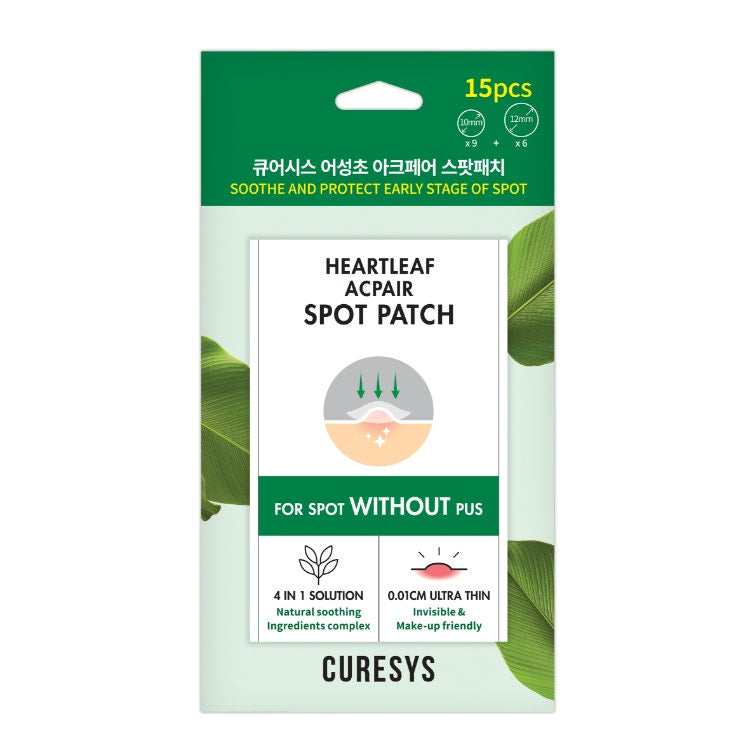
Curesys Heartleaf Acpair Spot Patch 15S

Curesys Heartleaf Acpair Spot Patch 15S
CURESYS
curesys-heartleaf-acpair-spot-patch-15s
Face Mask
10084699701541
Morning or Evening?
How often will you use this product?
Notes


Highlights
WHAT IS IT?
Spot patch with 4 complex ingredients
FEATURES
Highly adhesive, ultra thin, transparent patch, contains Tea Tree Oil, Heart Leaf Extract 5,900ppm, Salicylic Acid, Madecassoside, prevents secondary infection, relieves acne without leaving scar
BEST FOR
sensitive
CHECKS
No wounded area usage, no reusing, avoid stimuli-sensitive users
Who Is It For?
What Does It Help With?
Acne Blemishes Soothing SkinBudget
Affordable (under $30)How To Use
Which routine should it be used in?
Instructions:
Key Information


What CURESYS Says
Product Description:
Curesys Heartleaf Acpair Spot Patch protects blemishes from contamination and contains heartleaf extract for strong soothing effect. Madecassoside, Salicylic Acid and Tea Tree oil are included for various blemishes. The ultra slim patch minimizes visibility and allows make-up to be used effectively.
About the Brand:
Ingredients Overview
Ingredients List
Acrylates-Copolymer,Vinyl-Caprolactam/VP/Dimethylaminoethyl-Methacrylate-Copolymer,Epilobium-Angustifolium-Flower/Leaf/Stem-Extract,PVP,Butylene-Glycol,Houttuynia-Cordata-Extract,Salicylic-Acid,Sorbic-Acid,Phenoxyethanol,Centella-Asiatica-Extract,Sodium-Hydroxide,Sodium-Metabisulfite,1,2-Hexanediol,Melaleuca-Alternifolia-(Tea-Tree)-Leaf-Extract,Madecassoside
Key Ingredients
Tea Tree Oil, Heart Leaf Extract, Salicylic Acid, Madecassoside
Ingredients Details
1-2-hexanediol
Common Name(s): 1-2-hexanediol,cosmetic active,functional ingredient
CAS Number: N/a
DESCRIPTION
What It Does: Delivers characteristic cosmetic function at recommended use concentration.
Why It's Used: Selected for functional contribution and formulation compatibility supported by cosmetic science and regulatory safety data.
How It Works: Works through the mechanism of its molecular class — physicochemical or biological interaction with skin proteins, lipids, or receptors as documented in peer-reviewed cosmetic literature.
Typically Found In: Skin care formulations
TECHNICAL DETAILS
Primary Category: Active ingredient – cosmetic active
Secondary Functions: Skin conditioning
Application Areas:

Facial Skincare

Body Care
Hair Care
Beard Care
Color Cosmetics (Makeup)
Dietary/Oral Supplements
Typical Concentration Range: 0.1%–10%
SOURCING & ETHICS
Vegan Status: Conditional - supplier confirmation required
Halal Status: Unverified - supplier confirmation required
Source Notes: Commercially produced for cosmetic use. verify vegan/halal status with supplier. [audit 2026-07-29 rev2: the record's own source_notes does not assert a non-animal origin, or instructs the reader to verify with the supplier; "yes" asserts knowledge the record does not hold. determination requires shariah-panel sign-off.]
SKIN COMPATIBILITY
Irritancy Rating: 1/5 – very low
Comedogenicity Rating: 0/5 – non-comedogenic
Sensitivity Concerns: Well-tolerated by most skin types.
Safe for Sensitive Skin: Yes
SAFETY & COMPATIBILITY
Safety Profile: Good safety profile at recommended concentrations. ewg score: 1–2.
Works Well With: Standard skincare actives
Avoid Combining With: No known significant incompatibilities
SCIENTIFIC NOTE
1-2-hexanediol has an established safety and efficacy profile within the cosmetic regulatory framework at standard use concentrations.
Last Verified: 2026-03-12
Primary Sources: Cosing database,1-2-hexanediol technical literature
Madecassoside
Common Name(s): 6-o-beta-d-glucopyranosyl madecassic acid glycoside,centella triterpenoid glycoside
CAS Number: 34540-22-2
DESCRIPTION
What It Does: Stimulates collagen synthesis and wound healing while reducing inflammation – the primary active in centella asiatica's skin repair activity.
Why It's Used: Standardized centella active for precise wound healing, collagen stimulation, and anti-inflammatory dosing with superior consistency vs whole centella extract.
How It Works: Activates tgf-beta1 receptor signaling to upregulate collagen i, iii, and iv synthesis in fibroblasts. inhibits nf-kb for anti-inflammatory activity. promotes keratinocyte migration and proliferation for re-epithelialization. also strengthens lamellar body structures.
Typically Found In: Post-procedure recovery,wound healing serums,anti-aging products,sensitive skin formulas
TECHNICAL DETAILS
Primary Category: Active ingredient – soothing / anti-inflammatory
Secondary Functions: Collagen stimulation,wound healing,anti-inflammatory
Application Areas:
Facial Skincare
Body Care
Hair Care
Beard Care
Color Cosmetics (Makeup)
Dietary/Oral Supplements
Typical Concentration Range: 0.01%–2%
SOURCING & ETHICS
Vegan Status: Conditional - supplier confirmation required
Halal Status: Unverified - supplier confirmation required
Source Notes: Extracted from centella asiatica aerial parts. standardized to madecassoside content for consistent bioactivity. [audit 2026-07-29 rev2: status downgraded on audit. determination requires shariah-panel sign-off.]
SKIN COMPATIBILITY
Irritancy Rating: 1/5 – very low
Comedogenicity Rating: 0/5 – non-comedogenic
Sensitivity Concerns: Non-irritating; ideal for reactive and sensitive skin.
Safe for Sensitive Skin: Yes – particularly recommended for sensitive skin
SAFETY & COMPATIBILITY
Safety Profile: Excellent safety profile. ewg score: 1.
Works Well With: Ceramides,panthenol,allantoin,hyaluronic acid,centella asiatica
Avoid Combining With: No significant incompatibilities
SCIENTIFIC NOTE
Madecassoside is the most water-soluble and bioavailable of the four major centella triterpene glycosides. its tgf-beta1-mediated collagen stimulation distinguishes it from other soothing actives – providing not just anti-inflammatory relief but active tissue remodeling and collagen neosynthesis.
Last Verified:
Phenoxyethanol
Common Name(s): 2-phenoxyethanol,rose ether,ethylene glycol monophenyl ether
CAS Number: 122-99-6
DESCRIPTION
What It Does: Prevents microbial contamination and spoilage in cosmetic formulations.
Why It's Used: The benchmark cosmetic preservative – eu-permitted up to 1%, effective against virtually all cosmetically relevant microorganisms, and excellent tolerability.
How It Works: Phenol ring provides broad antimicrobial activity via disruption of bacterial and fungal cell membranes and inhibition of enzymatic activity. effective against gram-positive and gram-negative bacteria, yeasts (candida), and molds (aspergillus). activity ph range: 3-9.
Typically Found In: All cosmetic formulations as primary preservative
TECHNICAL DETAILS
Primary Category: Functional ingredient – broad-spectrum preservative
Secondary Functions: Skin conditioning
Application Areas:
Facial Skincare
Body Care
Hair Care
Beard Care
Color Cosmetics (Makeup)
Dietary/Oral Supplements
Typical Concentration Range: 0.1%–1% (eu max 1%)
SOURCING & ETHICS
Vegan Status: Conditional - supplier confirmation required
Halal Status: Unverified - supplier confirmation required
Source Notes: Commercially produced for cosmetic use. verify vegan/halal status with supplier. [audit 2026-07-29 rev2: the record's own source_notes does not assert a non-animal origin, or instructs the reader to verify with the supplier; "yes" asserts knowledge the record does not hold. determination requires shariah-panel sign-off.]
SKIN COMPATIBILITY
Irritancy Rating: 1/5 – very low
Comedogenicity Rating: 0/5 – non-comedogenic
Sensitivity Concerns: Well-tolerated by most skin types.
Safe for Sensitive Skin: Yes
SAFETY & COMPATIBILITY
Safety Profile: Eu cosmetics regulation max 1%. sccs assessed as safe at ≤1%. avoid use around eyes in baby products per some country regulations. ewg score: 4.
Works Well With: Standard skincare actives
Avoid Combining With: No known significant incompatibilities
SCIENTIFIC NOTE
Phenoxyethanol's widespread adoption as the primary cosmetic preservative followed the phaseout of parabens from many formulations in the 2000s-2010s. despite having a comparable or better safety profile to parabens, it is often cited in 'free-from' formulations – a consumer perception issue rather than a scientific safety concern.
Last Verified:
Pvp
Common Name(s): Pvp,povidone,kollidon
CAS Number: 9003-39-8
DESCRIPTION
What It Does: Provides film formation and hair fixative activity from a water-soluble synthetic polymer.
Why It's Used: Standard hair fixative and film former in styling products – pvp films provide hold, manageability, and styling definition in hair care.
How It Works: Amide carbonyl groups provide water solubility and hydrogen bonding to hair surface. film formation from polymer chain entanglement on water evaporation. variable molecular weight grades provide different film rigidity and humidity resistance.
Typically Found In: Hair sprays,styling gels,hair fixatives,film-forming products
TECHNICAL DETAILS
Primary Category: Functional ingredient – synthetic film former/thickener
Secondary Functions: Skin conditioning
Application Areas:
Facial Skincare
Body Care
Hair Care
Beard Care
Color Cosmetics (Makeup)
Dietary/Oral Supplements
Typical Concentration Range: 0.5%–10%
SOURCING & ETHICS
Vegan Status: Conditional - supplier confirmation required
Halal Status: Unverified - supplier confirmation required
Source Notes: Commercially produced for cosmetic use. verify vegan/halal status with supplier. [audit 2026-07-29 rev2: the record's own source_notes does not assert a non-animal origin, or instructs the reader to verify with the supplier; "yes" asserts knowledge the record does not hold. determination requires shariah-panel sign-off.]
SKIN COMPATIBILITY
Irritancy Rating: 1/5 – very low
Comedogenicity Rating: 0/5 – non-comedogenic
Sensitivity Concerns: Well-tolerated by most skin types.
Safe for Sensitive Skin: Yes
SAFETY & COMPATIBILITY
Safety Profile: Pvp films are humidity-sensitive (hygroscopic) – absorb water in high humidity causing hair style collapse. pvp/va copolymers or other modifications improve humidity resistance.
Works Well With: Standard skincare actives
Avoid Combining With: No known significant incompatibilities
SCIENTIFIC NOTE
Pvp's hair fixative mechanism involves adsorption to and cross-linking between adjacent hair fibers on evaporation of the aqueous vehicle. pvp chains bridge between hair shafts via hydrogen bonding, creating an inter-fiber polymer network that holds hair in its applied configuration. higher mw pvp provides stronger hold from longer polymer chains bridging more fibers simultaneously.
Last Verified: