

Nykaa E retail limited
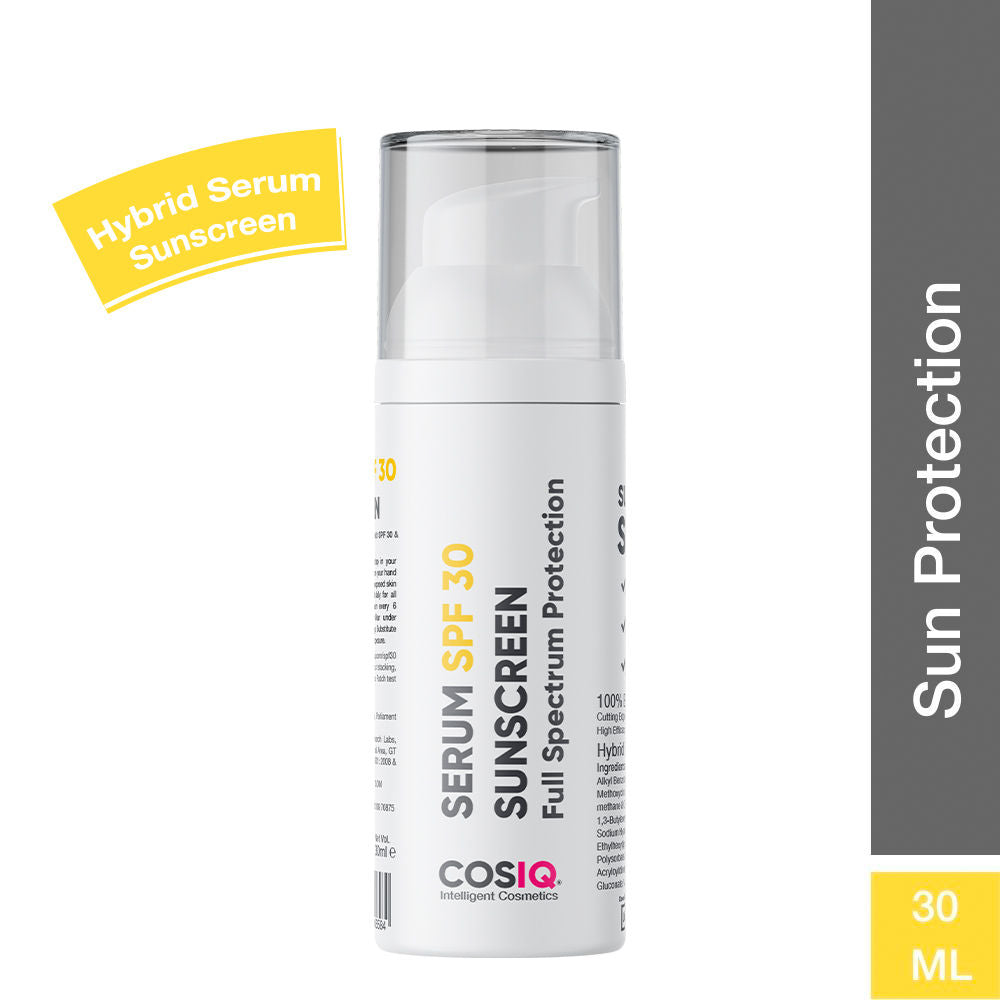
Cos-IQ Spf-30 Daily Use Sunscreen Serum Spf 30 Pa++++

Cos-IQ Spf-30 Daily Use Sunscreen Serum Spf 30 Pa++++
Nykaa E retail limited
cos-iq-spf-30-daily-use-sunscreen-serum-spf-30-pa
Suncare
10084901126437
Morning or Evening?
How often will you use this product?
Notes


Highlights
WHAT IS IT?
Sunscreen serum, 13 ingredients
FEATURES
Lightweight, moisturizing, no white cast, blends well, provides SPF 30 PA++++ protection
BEST FOR
combination
CHECKS
No white cast, doesn't make skin sticky
Who Is It For?
Adults Gender NeutralWhat Does It Help With?
Sun Protection MoisturizingBudget
Mid-range ($30-$75)How To Use
Which routine should it be used in?
Instructions:
Key Information

What Nykaa E retail limited Says
Product Description:
Explore the entire range of Face Sunscreen available on Nykaa. Shop more Cos-IQ products here.You can browse through the complete world of Cos-IQ Face Sunscreen.
About the Brand:
Ingredients Overview
Ingredients List
aqua,aloe-vera-leaf-ext,C12-15-alkyl-benzoate,glycerine,water,ethylhexyl-methoxycinnamate,butyl-methoxydibenzoylmethane,octocrylene,phospholipids,1,3-butylene-glycol,propanediol,zinc-oxide,sodium-hyaluronate,benzyl-alcohol,ethylhexylglycerin,tocopherol,polysorbate-20,bamboo-water,ammonium-acryloyldimethyltaurate/VP-copolymer,sodium-gluconate,vitamin-e
Key Ingredients
Aloe Vera Leaf Extract, Ethylhexyl Methoxycinnamate, Butyl Methoxydibenzoylmethane, Octocrylene, Zinc Oxide, Sodium Hyaluronate, Vitamin E
Ingredients Details
Ethylhexylglycerin
Common Name(s): Octylglycerin,2-ethylhexyl glycerol ether,sensiva sc 10
CAS Number: 70445-33-9
DESCRIPTION
What It Does: Provides antimicrobial skin conditioning with deodorant activity and preservation system enhancement.
Why It's Used: Multifunctional clean beauty preservation active — ethylhexylglycerin provides antimicrobial, deodorant, and skin conditioning in a single ingredient accepted in most natural cosmetic certification schemes.
How It Works: Glycerol ether provides antimicrobial via bacterial membrane phospholipid disruption. deodorant activity via reduction of underarm lipase enzyme activity (similar mechanism to triethyl citrate). skin conditioning from glycerol humectant component. synergistic with phenoxyethanol and diols.
Typically Found In: Natural preservation systems,deodorants,skin conditioning products
TECHNICAL DETAILS
Primary Category: Functional ingredient – antimicrobial glycerol ether
Secondary Functions: Skin conditioning
Application Areas:

Facial Skincare

Body Care
Hair Care
Beard Care
Color Cosmetics (Makeup)
Dietary/Oral Supplements
Typical Concentration Range: 0.1%–0.5%
SOURCING & ETHICS
Vegan Status: Yes – synthetic
Halal Status: Yes
Source Notes: Commercially produced for cosmetic use. verify vegan/halal status with supplier.
SKIN COMPATIBILITY
Irritancy Rating: 1/5 – very low
Comedogenicity Rating: 0/5 – non-comedogenic
Sensitivity Concerns: Well-tolerated by most skin types.
Safe for Sensitive Skin: Yes
SAFETY & COMPATIBILITY
Safety Profile: Good safety profile at recommended concentrations. ewg score: 1–2.
Works Well With: Standard skincare actives
Avoid Combining With: No known significant incompatibilities
SCIENTIFIC NOTE
Ethylhexylglycerin's deodorant mechanism is pharmacologically identical to triethyl citrate: both inhibit skin surface microbial lipase enzymes that convert odourless triglycerides to odorous free fatty acids. the glycerol ether structure of ethylhexylglycerin, combined with the 2-ethylhexyl chain, provides lipase inhibition similar to ester-based lipase inhibitors from a different chemical class.
Last Verified: Cosing database,schülke sensiva sc 10 technical data,cir safety assessment
Primary Sources: 2026-03-12
Glycerine
Common Name(s): Glycerin,universal humectant,water-binding skin conditioning
CAS Number: N/a
DESCRIPTION
What It Does: Attracts and retains moisture in the sc, improves skin barrier function at low concentrations, provides gentle keratolytic softening, and acts as a co-solvent for water-soluble actives.
Why It's Used: The reference humectant — lowest cost, best safety profile, universal formulation compatibility, and present naturally in the sc via lipase-mediated glycerolipid hydrolysis makes glycerin the industry standard against which all humectants are benchmarked.
How It Works: Three hydroxyl groups form 6 h-bonds with water molecules per glycerol unit — the highest oh-group density per carbon of any commercial humectant. glycerin also down-regulates epidermal serine proteases that overactivate in dry sc, improving desquamation and barrier integrity.
Typically Found In: All cosmetics,universal
TECHNICAL DETAILS
Primary Category: Functional ingredient – humectant
Secondary Functions: Tewl reduction,skin plumping
Application Areas:
Facial Skincare
Body Care
Hair Care
Beard Care
Color Cosmetics (Makeup)
Dietary/Oral Supplements
Typical Concentration Range: 1%–40%
SOURCING & ETHICS
Vegan Status: Yes
Halal Status: Yes
Source Notes: Synthetic or naturally derived. excellent aqueous solubility.
SKIN COMPATIBILITY
Irritancy Rating: 1/5 – very low
Comedogenicity Rating: 0/5 – non-comedogenic
Sensitivity Concerns: Non-irritating; suitable for all skin types.
Safe for Sensitive Skin: Yes
SAFETY & COMPATIBILITY
Safety Profile: Excellent safety profile. ewg score: 1.
Works Well With: Ceramides,emollients,occlusives,glycerin,hyaluronic acid
Avoid Combining With: No significant incompatibilities
SCIENTIFIC NOTE
Epidermal lipases hydrolyse sc glycerophospholipids during cornification, releasing glycerol that contributes to the natural nmf — topical glycerin directly supplements this endogenous sc humectant pool.
Last Verified: Cosing database,glycerin universal humectant review
Primary Sources: 2026-03-12
Octocrylene
Common Name(s): 2-ethylhexyl 2-cyano-3,3-diphenylacrylate
CAS Number: 6197-30-4
DESCRIPTION
What It Does: Provides uvb-uva-ii uv protection and essential avobenzone photostabilisation.
Why It's Used: The essential combination partner — octocrylene's dual uv filter + avobenzone photostabilisation function makes it virtually irreplaceable for durable broad-spectrum chemical sunscreens requiring uva-i coverage.
How It Works: Cyanocinnamate chromophore absorbs uvb-uva-ii (λmax 303nm). triplet energy transfer from excited avobenzone to octocrylene photostabilises avobenzone (>90% efficiency at 3:1 avobenzone:octocrylene ratio). hydrophobic character enhances water resistance.
Typically Found In: Broad-spectrum sunscreens,avobenzone-containing formulas
TECHNICAL DETAILS
Primary Category: Active ingredient – uv filter and photostabiliser
Secondary Functions: Skin conditioning
Application Areas:
Facial Skincare
Body Care
Hair Care
Beard Care
Color Cosmetics (Makeup)
Dietary/Oral Supplements
Typical Concentration Range: Up to 10% (eu), 10% (us fda)
SOURCING & ETHICS
Vegan Status: Yes – synthetic
Halal Status: Yes
Source Notes: Commercially produced for cosmetic use. verify vegan/halal status with supplier.
SKIN COMPATIBILITY
Irritancy Rating: 1/5 – very low
Comedogenicity Rating: 0/5 – non-comedogenic
Sensitivity Concerns: Well-tolerated by most skin types.
Safe for Sensitive Skin: Yes
SAFETY & COMPATIBILITY
Safety Profile: Eu max 10%. fda: 10%. ewg score: 3. recent benzophenone impurity concerns from aged product hydrolysis under study.
Works Well With: Standard skincare actives
Avoid Combining With: No known significant incompatibilities
SCIENTIFIC NOTE
Octocrylene's triplet energy transfer photostabilisation of avobenzone operates via a dexter electron exchange mechanism: excited-state avobenzone (triplet) transfers excitation energy to octocrylene via orbital overlap, allowing avobenzone to return to its ground state uv-absorbing form without photodegradation. this energy transfer is only efficient at close molecular proximity — requiring intimate mixing of the two compounds in the formulation oil phase.
Last Verified: Cosing database,fda uv filter otc monograph,sccs octocrylene opinion
Primary Sources: 2026-03-12
Phospholipids
Common Name(s): Lecithin/phospholipid,cell membrane lipid,emulsifier barrier repair
CAS Number: N/a
DESCRIPTION
What It Does: Stabilises o/w and w/o emulsions through biomimetic phospholipid bilayer formation, supplements sc barrier lipids for barrier repair, and forms liposomes and lamellar delivery vehicles for encapsulated active delivery.
Why It's Used: Phospholipids are uniquely bifunctional: they provide conventional emulsification and form genuine liposomal bilayer vesicles for encapsulated active delivery — a dual function unavailable from synthetic emulsifiers.
How It Works: The phosphocholine head group provides strong h-bonding hydrophilicity while the dual fatty acid tails provide lipophilic anchoring — this wedge-shaped geometry spontaneously forms closed bilayer vesicles (liposomes) that encapsulate actives for sustained release and enhanced sc penetration.
Typically Found In: Emulsions,liposomal delivery,barrier repair
TECHNICAL DETAILS
Primary Category: Functional ingredient – emollient
Secondary Functions: Barrier sealing,softening
Application Areas:
Facial Skincare
Body Care
Hair Care
Beard Care
Color Cosmetics (Makeup)
Dietary/Oral Supplements
Typical Concentration Range: 1%–15%
SOURCING & ETHICS
Vegan Status: Conditional
Halal Status: Yes
Source Notes: Plant-derived, synthetic or animal-derived. verify source.
SKIN COMPATIBILITY
Irritancy Rating: 1/5 – very low
Comedogenicity Rating: 1/5 – low; formulation-dependent
Sensitivity Concerns: Non-irritating.
Safe for Sensitive Skin: Yes
SAFETY & COMPATIBILITY
Safety Profile: Excellent safety profile. ewg score: 1.
Works Well With: Humectants,ceramides,actives as carrier
Avoid Combining With: No significant incompatibilities
SCIENTIFIC NOTE
Phospholipid's wedge-shaped geometry (large head relative to two acyl tails) preferentially forms spherical bilayer vesicles (liposomes) rather than flat lamellar phases — this curvature preference enables self-assembly of drug delivery liposomes simply by hydration of the phospholipid film.
Last Verified: Cosing database,lecithin phospholipid liposomal delivery review
Primary Sources: 2026-03-12
