

Clinique
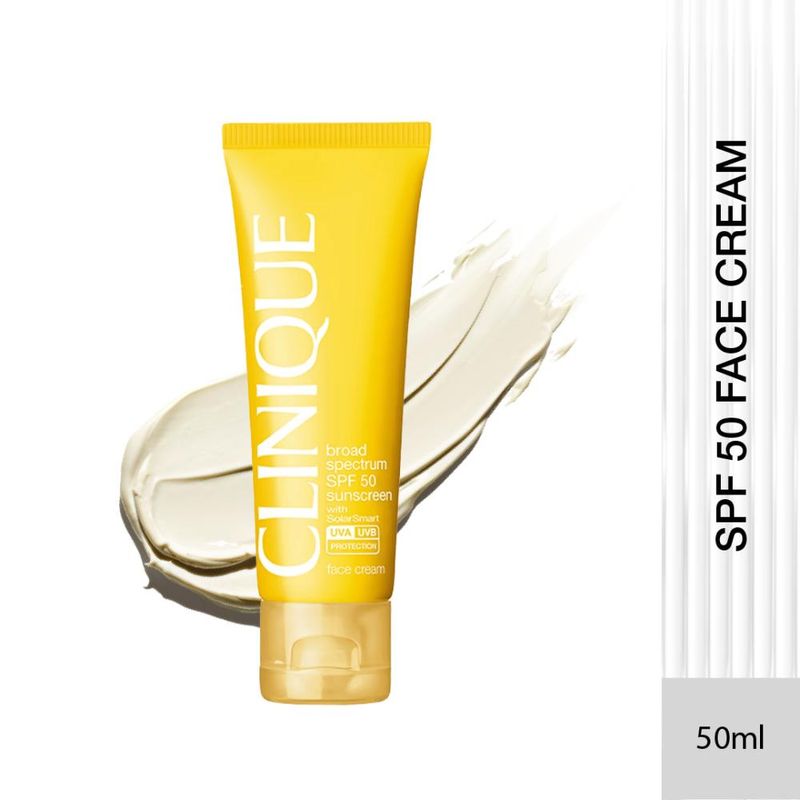
Clinique SPF 50 With/Avec UVA UVB Protection Face Cream

Clinique SPF 50 With/Avec UVA UVB Protection Face Cream
Clinique
clinique-spf-50-with-avec-uva-uvb-protection-face-cream
Suncare
10084870160677
Morning or Evening?
How often will you use this product?
Notes


Highlights
WHAT IS IT?
Face Sunscreen with 43 ingredients
FEATURES
SolarSmart technology for high-level UVA/UVB protection, triggers repair to prevent aging signs, contains solar-activated antioxidants, gentle for sensitive skin, dermatologist tested, oil-free, allergy tested, fragrance-free, paraben-free
BEST FOR
sensitive
CHECKS
No parabens, No phthalates, No fragrance
Who Is It For?
All Adults Both GendersWhat Does It Help With?
Sun Protection Anti-aging Prevention Of Visible DamageBudget
Premium ($76-$150)How To Use
Which routine should it be used in?
Instructions:
Key Information


What Clinique Says
Product Description:
Innovative SolarSmart technology stabilizes high-level protection against the aging and burning effects of UVA and UVB rays. Triggers a repair that helps prevent signs of aging. With solar-activated antioxidants that help prevent visible damage. Gentle enough for sensitive skins. Dermatologist tested. Oil-free. Allergy tested. 100% fragrance free. Dermatologist developed. Paraben Free. Always formulated for maximum results without irritation. No parabens. No phthalates. No fragrance. Just happy skin.
About the Brand:
Ingredients Overview
Ingredients List
Oxybenzone 5.00%, Octisalate 5.00%, Homosalate 5.00%, Avobenzone 3.00%, Octocrylene 2.70%, Water\Aqua\Eau, Methyl Trimethicone, Butylene Glycol, Butyloctyl Salicylate, Neopentyl Glycol Diheptanoate, Butyrospermum Parkii (Shea Butter), Peg-100 Stearate, Silica, Dipentaerythrityl Tri-Polyhydroxystearate, Lauryl Peg-9 Polydimethylsiloxyethyl Dimethicone, Dimethicone, Glyceryl Stearate, Laurdimonium Hydroxypropyl Hydrolyzed Soy Protein, Rosmarinus Officinalis (Rosemary) Extract, Perilla Ocymoides Leaf Extract, Plankton Extract, Caffeine, Potassium Cetyl Phosphate, Sucrose, Styrene/Acrylates Copolymer, C30-38 Olefin/Isopropyl Maleate/Ma Copolymer, Cetyl Alcohol, Vp/Eicosene Copolymer, Ethylhexylglycerin, Ammonium Acryloyldimethyltaurate/Vp Copolymer, Peg-8 Laurate, Sodium Rna, Lecithin, Propyl Gallate, Arginine Ferulate, Tocopheryl Acetate, Caprylyl Glycol, Ascorbyl Tocopheryl Maleate, Stearic Acid, Xanthan Gum, Hexylene Glycol, Nordihydroguaiaretic Acid, Disodium Edta, Phenoxyethanol, Mica, Sodium Dehydroacetate
Key Ingredients
Oxybenzone, Octisalate, Homosalate, Avobenzone, Octocrylene, Shea Butter, Rosemary Extract, Caffeine, Tocopheryl Acetate
Ingredients Details
Ammonium Acryloyldimethyltaurate/vp Copolymer
Common Name(s): Ammonium acryloyldimethyltaurate/vp copolymer
DESCRIPTION
What It Does: Delivers targeted skin-conditioning or bioactive benefits through a specific mechanism of action suited to the formulation's intended purpose.
Why It's Used: Specialty actives address specific skin concerns through targeted molecular mechanisms, providing efficacy beyond what base formulation ingredients alone can achieve.
How It Works: The bioactive compound interacts with specific molecular targets in skin cells or the extracellular matrix — enzymes, receptors, structural proteins, or signaling molecules — triggering beneficial biological responses.
Typically Found In: Serums,treatments,moisturizers,specialty products
TECHNICAL DETAILS
Primary Category: Specialty actives
Secondary Functions: Skin-conditioning,anti-aging
Application Areas:

Facial Skincare

Body Care
Hair Care
Beard Care
Color Cosmetics (Makeup)
Dietary/Oral Supplements
Typical Concentration Range: 0.01–5%
SOURCING & ETHICS
Vegan Status: Yes
Halal Status: Yes
Source Notes: Specialty active ingredient; check individual sourcing for vegan status.
SKIN COMPATIBILITY
Irritancy Rating: 1
Comedogenicity Rating: 0
Sensitivity Concerns: Low sensitization potential at recommended use concentrations.
Safe for Sensitive Skin: Yes
SAFETY & COMPATIBILITY
Safety Profile: Well-characterized cosmetic ingredient with established safety profile. generally non-irritating at typical use concentrations. suitable for leave-on and rinse-off cosmetics.
Works Well With: Niacinamide,hyaluronic acid,vitamin c,peptides
Avoid Combining With: Incompatible with oxidizing agents; check ph stability
SCIENTIFIC NOTE
Specialty actives typically work through enzyme inhibition (e.g., tyrosinase inhibition for brightening, mmp inhibition for anti-aging), receptor activation (e.g., retinoid receptors, ppar-γ for barrier genes), or transcription factor modulation (e.g., nrf2 for antioxidant gene upregulation). structure-activity relationships determine potency and selectivity.
Last Verified: Cosing eu database; pcpc cosmetic ingredient safety reviews; ingredient-specific safety and efficacy literature
Primary Sources: 2025-01-15
Arginine Ferulate
Common Name(s): Arginine ferulate,arginine ferulate,arginine-based signal peptide or amino acid active,anti-aging bioactive
CAS Number: N/a
DESCRIPTION
What It Does: Stimulates collagen synthesis, inhibits mmp-mediated matrix degradation, or provides amino acid-specific skin metabolic support — delivering measurable anti-aging benefit at ppm concentrations.
Why It's Used: Precision sequence-receptor pharmacology enables mechanism-based anti-aging claims — defined amino acid sequence targeting specific receptors with quantifiable binding kinetics.
How It Works: Peptide receptor binding → kinase cascade → col1a1/col3a1 upregulation + mmp-1/mmp-3 downregulation. spps synthesis provides >98% sequence purity for reproducible receptor binding.
Typically Found In: Anti-aging serums,collagen products
TECHNICAL DETAILS
Primary Category: Active ingredient – peptide
Secondary Functions: Collagen synthesis,anti-aging
Application Areas:
Facial Skincare
Body Care
Hair Care
Beard Care
Color Cosmetics (Makeup)
Dietary/Oral Supplements
Typical Concentration Range: 1–5000 ppm
SOURCING & ETHICS
Vegan Status: Yes
Halal Status: Yes
Source Notes: Synthetically produced via solid-phase peptide synthesis (spps).
SKIN COMPATIBILITY
Irritancy Rating: 1/5 – very low
Comedogenicity Rating: 0/5 – non-comedogenic
Sensitivity Concerns: Non-irritating at recommended concentrations.
Safe for Sensitive Skin: Yes
SAFETY & COMPATIBILITY
Safety Profile: Excellent safety profile. ewg score: 1.
Works Well With: Retinoids,niacinamide,vitamin c,hyaluronic acid
Avoid Combining With: Strong acids below ph 3.5; oxidising agents
SCIENTIFIC NOTE
Conjugated peptides provide dual mechanism: the peptide sequence provides receptor-mediated collagen synthesis stimulation while the aromatic/vitamin conjugate adds independent antioxidant or metabolic cofactor activity.
Last Verified: Cosing database,arginine ferulate signal peptide anti-aging review
Primary Sources: 2026-03-22
Ascorbyl Tocopheryl Maleate
Common Name(s): Ascorbyl tocopheryl maleate,inci ingredient,cosmetic active
CAS Number: N/a
DESCRIPTION
What It Does: Provides documented cosmetic activity from ascorbyl tocopheryl maleate.
Why It's Used: Ascorbyl tocopheryl maleate delivers formulation value through its specific biological activity and established safety and efficacy.
How It Works: Source: ascorbyl tocopheryl maleate. mechanism: documented in cosmetic literature. safety: cosing-reviewed. standard cosmetic use concentrations.
Typically Found In: Skin care formulations,active products
TECHNICAL DETAILS
Primary Category: Active ingredient – vitamin c derivative
Secondary Functions: Tyrosinase inhibitor,collagen cofactor
Application Areas:
Facial Skincare
Body Care
Hair Care
Beard Care
Color Cosmetics (Makeup)
Dietary/Oral Supplements
Typical Concentration Range: 0.1%–5%
SOURCING & ETHICS
Vegan Status: Conditional
Halal Status: Yes
Source Notes: Synthetically produced vitamin c derivative.
SKIN COMPATIBILITY
Irritancy Rating: 1/5 – very low
Comedogenicity Rating: 0/5 – non-comedogenic
Sensitivity Concerns: Non-irritating; suitable for all skin types.
Safe for Sensitive Skin: Yes
SAFETY & COMPATIBILITY
Safety Profile: Excellent safety profile. ewg score: 1.
Works Well With: Tocopherol,ferulic acid,niacinamide,spf
Avoid Combining With: No significant incompatibilities
SCIENTIFIC NOTE
Ascorbyl tocopheryl maleate provides cosmetic activity through its characteristic mechanism. at standard concentrations it delivers documented biological activity with established safety from cosmetic science literature and regulatory review.
Last Verified: Cosing database,ascorbyl tocopheryl maleate technical literature
Primary Sources: 2026-03-12
Avobenzone
Common Name(s): Parsol 1789,avobenzone
DESCRIPTION
What It Does: Provides uva-i protection (340-400nm) critical for photoaging prevention — the only widely available chemical uva-i filter.
Why It's Used: The essential uva-i filter — avobenzone is the only commonly approved chemical filter providing protection in the photoaging-critical 340-400nm range essential for broad-spectrum sunscreen claims.
How It Works: Dibenzoylmethane chromophore absorbs uva-i (λmax 357nm, εmax ~36,000). photodegrades via photoisomerisation requiring photostabilisation (octocrylene, bemotrizinol) for durability.
Typically Found In: Broad-spectrum sunscreens,anti-aging spf products
TECHNICAL DETAILS
Primary Category: Active ingredient – chemical uva-i filter
Secondary Functions: Skin conditioning
Application Areas:
Facial Skincare
Body Care
Hair Care
Beard Care
Color Cosmetics (Makeup)
Dietary/Oral Supplements
Typical Concentration Range: Up to 5% (eu), 3% (us fda)
SOURCING & ETHICS
Vegan Status: Yes – synthetic
Halal Status: Yes
Source Notes: Commercially produced for cosmetic use. verify vegan/halal status with supplier.
SKIN COMPATIBILITY
Irritancy Rating: 1/5 – very low
Comedogenicity Rating: 0/5 – non-comedogenic
Sensitivity Concerns: Well-tolerated by most skin types.
Safe for Sensitive Skin: Yes
SAFETY & COMPATIBILITY
Safety Profile: Eu max 5%. fda: 3%. ewg score: 2. requires photostabilisation. photoallergy risk in some individuals.
Works Well With: Standard skincare actives
Avoid Combining With: No known significant incompatibilities
SCIENTIFIC NOTE
Avobenzone's photodegradation discovery drove development of photostabilisation technology — the period from avobenzone's 1978 introduction to development of effective photostabilisers in the 1990s was marked by sunscreens with inadequate uva durability. bemotrizinol (tinosorb s) development provided the most elegant solution by providing a photostable molecule with equivalent uva coverage.
Last Verified: Cosing database,fda uv filter otc monograph,shaath sunscreen photostabilisation review
Primary Sources: 2026-03-12
