

Shiseido
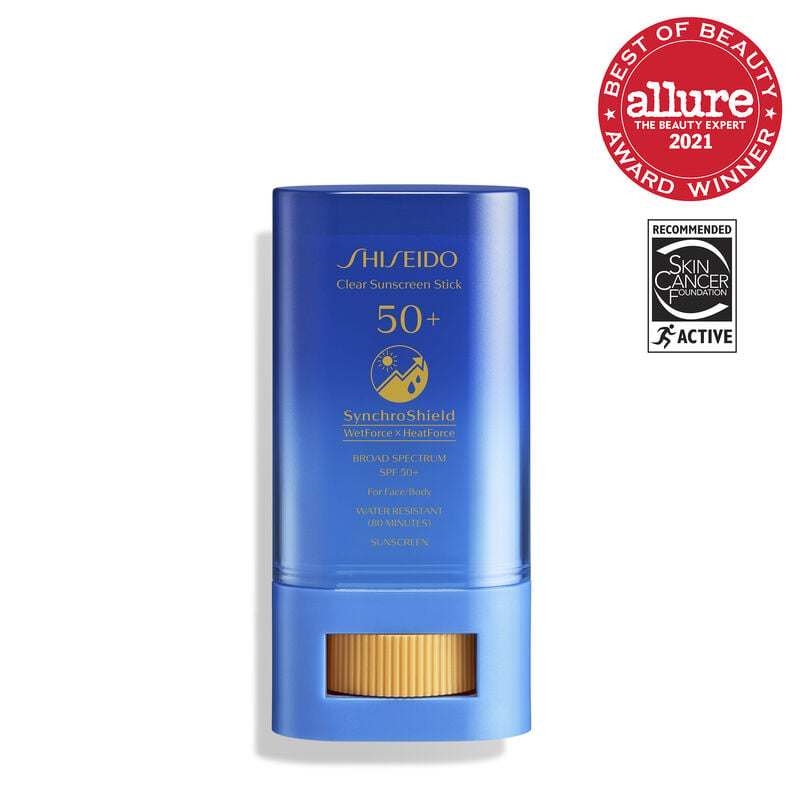
Clear Sunscreen Stick SPF 50+

Clear Sunscreen Stick SPF 50+
Shiseido
clear-sunscreen-stick-spf-50
Suncare
9605083595045
Morning or Evening?
How often will you use this product?
Notes


Highlights
WHAT IS IT?
Sunscreen stick
FEATURES
Portable SPF 50+ formula is ultra-convenient & easy to apply over or under makeup. It combines WetForce & HeatForce technology that becomes even more effective in water & heat.
BEST FOR
All skin types
CHECKS
None specifically mentioned
Who Is It For?
Adults (no Specific Age Range Given) Suitable For Both Women And MenWhat Does It Help With?
Sun Protection Preventing Wrinkles And Dark SpotsBudget
Mid-rangeHow To Use
Which routine should it be used in?
Instructions:
Key Information

What Shiseido Says
Product Description:
A clear sunscreen stick with SPF 50+ that works over and under makeup for sun protection on the go.
About the Brand:
Ingredients Overview
Ingredients List
DIPHENYLSILOXY PHENYL TRIMETHICONE,MINERAL OIL,HYDROXYSTEARIC ACID,TRIETHYLHEXANOIN,PEG/PPG-9/2 DIMETHYL ETHER,METHYL METHACRYLATE CROSSPOLYMER,DIBUTYL LAUROYL GLUTAMIDE,C12-15 ALKYL BENZOATE,POLYAMIDE-8,SILICA DIMETHYL SILYLATE,TOCOPHERYL ACETATE,PEG/PPG-14/7 DIMETHYL ETHER,LECITHIN,GLYCYRRHIZA GLABRA (LICORICE) ROOT EXTRACT,PPG-17,CASTOR OIL/IPDI COPOLYMER,CAPRYLIC/CAPRIC TRIGLYCERIDE,BHT,TOCOPHEROL,PEG-6,PENTAERYTHRITYL TETRA-DI-T-BUTYL HYDROXYHYDROCINNAMATE,SILICA,FRAGRANCE
Key Ingredients
AVOBENZONE, HOMOSALATE, OCTISALATE, OCTOCRYLENE
Ingredients Details
C12-15 Alkyl Benzoate
Common Name(s): C12-15 alkyl benzoate,cosmetic active,functional ingredient
CAS Number: N/a
DESCRIPTION
What It Does: Delivers characteristic cosmetic function at recommended use concentration.
Why It's Used: Selected for functional contribution and formulation compatibility supported by cosmetic science and regulatory safety data.
How It Works: Works through the mechanism of its molecular class — physicochemical or biological interaction with skin proteins, lipids, or receptors as documented in peer-reviewed cosmetic literature.
Typically Found In: Skin care formulations
TECHNICAL DETAILS
Primary Category: Active ingredient – cosmetic active
Secondary Functions: Skin conditioning
Application Areas:

Facial Skincare

Body Care
Hair Care
Beard Care
Color Cosmetics (Makeup)
Dietary/Oral Supplements
Typical Concentration Range: 0.1%–10%
SOURCING & ETHICS
Vegan Status: Conditional - supplier confirmation required
Halal Status: Unverified - supplier confirmation required
Source Notes: Commercially produced for cosmetic use. verify vegan/halal status with supplier. [audit 2026-07-29 rev2: the record's own source_notes does not assert a non-animal origin, or instructs the reader to verify with the supplier; "yes" asserts knowledge the record does not hold. determination requires shariah-panel sign-off.]
SKIN COMPATIBILITY
Irritancy Rating: 1/5 – very low
Comedogenicity Rating: 0/5 – non-comedogenic
Sensitivity Concerns: Well-tolerated by most skin types.
Safe for Sensitive Skin: Yes
SAFETY & COMPATIBILITY
Safety Profile: Good safety profile at recommended concentrations. ewg score: 1–2.
Works Well With: Standard skincare actives
Avoid Combining With: No known significant incompatibilities
SCIENTIFIC NOTE
C12-15 alkyl benzoate has an established safety and efficacy profile within the cosmetic regulatory framework at standard use concentrations.
Last Verified:
Dibutyl Lauroyl Glutamide
Common Name(s): Dibutyl lauroyl glutamide
DESCRIPTION
What It Does: Delivers targeted skin-conditioning or bioactive benefits through a specific mechanism of action suited to the formulation's intended purpose.
Why It's Used: Specialty actives address specific skin concerns through targeted molecular mechanisms, providing efficacy beyond what base formulation ingredients alone can achieve.
How It Works: The bioactive compound interacts with specific molecular targets in skin cells or the extracellular matrix — enzymes, receptors, structural proteins, or signaling molecules — triggering beneficial biological responses.
Typically Found In: Serums,treatments,moisturizers,specialty products
TECHNICAL DETAILS
Primary Category: Specialty actives
Secondary Functions: Skin-conditioning,anti-aging
Application Areas:
Facial Skincare
Body Care
Hair Care
Beard Care
Color Cosmetics (Makeup)
Dietary/Oral Supplements
Typical Concentration Range: 0.01–5%
SOURCING & ETHICS
Vegan Status: Conditional - supplier confirmation required
Halal Status: Unverified - supplier confirmation required
Source Notes: Specialty active ingredient; check individual sourcing for vegan status. [audit 2026-07-29 rev2: the record's own source_notes does not assert a non-animal origin, or instructs the reader to verify with the supplier; "yes" asserts knowledge the record does not hold. determination requires shariah-panel sign-off.]
SKIN COMPATIBILITY
Irritancy Rating: 1
Comedogenicity Rating: 0
Sensitivity Concerns: Low sensitization potential at recommended use concentrations.
Safe for Sensitive Skin: Yes
SAFETY & COMPATIBILITY
Safety Profile: Well-characterized cosmetic ingredient with established safety profile. generally non-irritating at typical use concentrations. suitable for leave-on and rinse-off cosmetics.
Works Well With: Niacinamide,hyaluronic acid,vitamin c,peptides
Avoid Combining With: Incompatible with oxidizing agents; check ph stability
SCIENTIFIC NOTE
Specialty actives typically work through enzyme inhibition (e.g., tyrosinase inhibition for brightening, mmp inhibition for anti-aging), receptor activation (e.g., retinoid receptors, ppar-γ for barrier genes), or transcription factor modulation (e.g., nrf2 for antioxidant gene upregulation). structure-activity relationships determine potency and selectivity.
Last Verified: 2025-01-15
Primary Sources: Cosing eu database; pcpc cosmetic ingredient safety reviews; ingredient-specific safety and efficacy literature
Diphenylsiloxy Phenyl Trimethicone
Common Name(s): Diphenylsiloxy phenyl trimethicone,phenyl silicone,conditioning silky film-forming
CAS Number: N/a
DESCRIPTION
What It Does: Diphenylsiloxy phenyl trimethicone deposits an ultra-thin, flexible conditioning film on skin and hair that dramatically reduces surface friction, provides water-repellent moisture lock-in, protects hair from heat damage and humidity-induced frizz, and delivers the smooth, silky sensory experience that distinguishes premium personal care from basic functional products.
Why It's Used: Formulators choose diphenylsiloxy phenyl trimethicone for its unique functional profile that organic emollients cannot replicate: the si-o backbone (bond angle 150° vs c-c 109°) provides exceptional molecular flexibility allowing the silicone polymer to flatten along any surface topology, creating an ultra-conforming film. the surface energy of cured silicone (~20 mn/m) is lower than any organic emollient, providing superior lubricity without the heaviness or comedogenic character of equivalent organic oils. for hair specifically, silicone deposition dramatically reduces the coefficient of friction between hair fibres from ~0.8 (uncoated) to ~0.25 (silicone-coated), providing the detangling and smoothing that defines premium conditioner performance.
How It Works: Diphenylsiloxy phenyl trimethicone functions through the si-o siloxane backbone's fundamental physical chemistry: (1) surface deposition — the polymer's backbone flexibility allows it to flatten onto hair and skin surfaces, maximising contact area and van der waals adhesion. the polydimethylsiloxane chain adopts a helical conformation in free solution but extends to near-flat conformation on surfaces, providing maximum coverage per molecule deposited; (2) low surface energy film — the methyl groups surrounding the si-o backbone present an array of non-polar, non-hydrogen-bonding surfaces. the surface energy of ~20 mn/m is lower than water (~72 mn/m) and organic oils (~30–35 mn/m), providing excellent lubricity from the lowest-energy surface; (3) thermal stability — si-o bond energy (105 kcal/mol vs c-c 83 kcal/mol) provides exceptional heat resistance, making dimethicone uniquely suitable as a heat-protectant on hair during blow-drying and flat-ironing up to 230°c; (4) breathability — despite the water-repellent surface, silicone films have sufficient molecular-scale porosity to allow oxygen, co₂, and water vapour transmission from the film's non-crystalline, flexible structure — unlike occlusive waxes that form dense impermeable films.
Typically Found In: Hair conditioners,skin care emollients,heat protectants
TECHNICAL DETAILS
Primary Category: Functional ingredient – emollient
Secondary Functions: Barrier sealing,softening
Application Areas:
Facial Skincare
Body Care
Hair Care
Beard Care
Color Cosmetics (Makeup)
Dietary/Oral Supplements
Typical Concentration Range: 0.5%–25%
SOURCING & ETHICS
Vegan Status: Conditional - supplier confirmation required
Halal Status: Unverified - supplier confirmation required
Source Notes: Plant-derived, synthetic or animal-derived. verify source. [audit 2026-07-29 rev2: the record's own source_notes does not assert a non-animal origin, or instructs the reader to verify with the supplier; "yes" asserts knowledge the record does not hold. determination requires shariah-panel sign-off.]
SKIN COMPATIBILITY
Irritancy Rating: 1/5 – very low
Comedogenicity Rating: 1/5 – low; formulation-dependent
Sensitivity Concerns: Non-irritating.
Safe for Sensitive Skin: Yes
SAFETY & COMPATIBILITY
Safety Profile: Excellent safety profile. ewg score: 1.
Works Well With: Humectants,ceramides,actives as carrier
Avoid Combining With: No significant incompatibilities
SCIENTIFIC NOTE
Si-o backbone flexibility vs organic polymers: c-c bond angle is fixed at 109.5° (tetrahedral sp3) with restricted rotation, giving organic polymer chains a preferred helical structure that resists lying flat on surfaces. si-o bond angle is 150° with near-free rotation from the longer si-o bond (1.64 å vs c-c 1.54 å) and lower rotational barrier (~0.6 kcal/mol vs c-c ~3 kcal/mol). this 5× lower rotational barrier allows silicone chains to adopt virtually any conformation essentially free of energy cost — enabling the flat, conforming surface adsorption that provides optimal thin-film coverage and explains the silky-smooth feel unobtainable from rigid organic polymer films.
Last Verified: 2026-03-12
Primary Sources: Cosing database,diphenylsiloxy phenyl trimethicone silicone film conditioning review
Hydroxystearic Acid
Common Name(s): Fatty acid,emollient emulsifier component,sc barrier lipid
CAS Number: N/a
DESCRIPTION
What It Does: Provides skin-compatible emolliency from the fatty acid chain sc integration, forms soaps/fatty acid salts with alkali bases for self-emulsifying cream systems, and supplements sc free fatty acid (ffa) content depleted in barrier-compromised skin.
Why It's Used: Fatty acids are essential in stearic acid/triethanolamine soap-base cream systems — a formulation architecture used for over 100 years producing elegant, stable o/w emulsions through in-situ soap formation during manufacturing.
How It Works: Free fatty acids (rcooh, pka ~4.5–5.5) exist at skin ph as a mixture of protonated (emollient) and ionised (soap) forms. when neutralised with alkali during manufacturing, the carboxylate soap form (rcoo⁻) provides emulsification. the sc barrier's free fatty acid layer includes c16–c22 saturated and unsaturated acids identical to common cosmetic fatty acids — topical fatty acid application directly supplements this barrier lipid fraction.
Typically Found In: Cream formulation,barrier repair,emollient base
TECHNICAL DETAILS
Primary Category: Functional ingredient – emollient
Secondary Functions: Barrier sealing,softening
Application Areas:
Facial Skincare
Body Care
Hair Care
Beard Care
Color Cosmetics (Makeup)
Dietary/Oral Supplements
Typical Concentration Range: 0.5%–20%
SOURCING & ETHICS
Vegan Status: Conditional - feedstock declaration required
Halal Status: Unverified - feedstock declaration required (plant, animal and petrochemical routes all exist)
Source Notes: Plant-derived, synthetic or animal-derived. verify source. [audit 2026-07-29 rev2: origin-dependent: the same inci exists in plant, animal and petrochemical versions and the name does not discriminate. determination requires shariah-panel sign-off.]
SKIN COMPATIBILITY
Irritancy Rating: 1/5 – very low
Comedogenicity Rating: 1/5 – low; formulation-dependent
Sensitivity Concerns: Non-irritating.
Safe for Sensitive Skin: Yes
SAFETY & COMPATIBILITY
Safety Profile: Excellent safety profile. ewg score: 1.
Works Well With: Humectants,ceramides,actives as carrier
Avoid Combining With: No significant incompatibilities
SCIENTIFIC NOTE
Stearic acid/triethanolamine (tea) soap-base creams require precise ph control: below ph 6, excess free stearic acid co-crystallises with the soap providing thickening through acid-soap gel formation; above ph 8, full saponification produces liquid thin emulsions. the ph range 6–7 provides optimal acid-soap balance for cream texture.
Last Verified: 2026-03-12
Primary Sources: Cosing database,hydroxystearic acid fatty acid emollient barrier review