

TULA
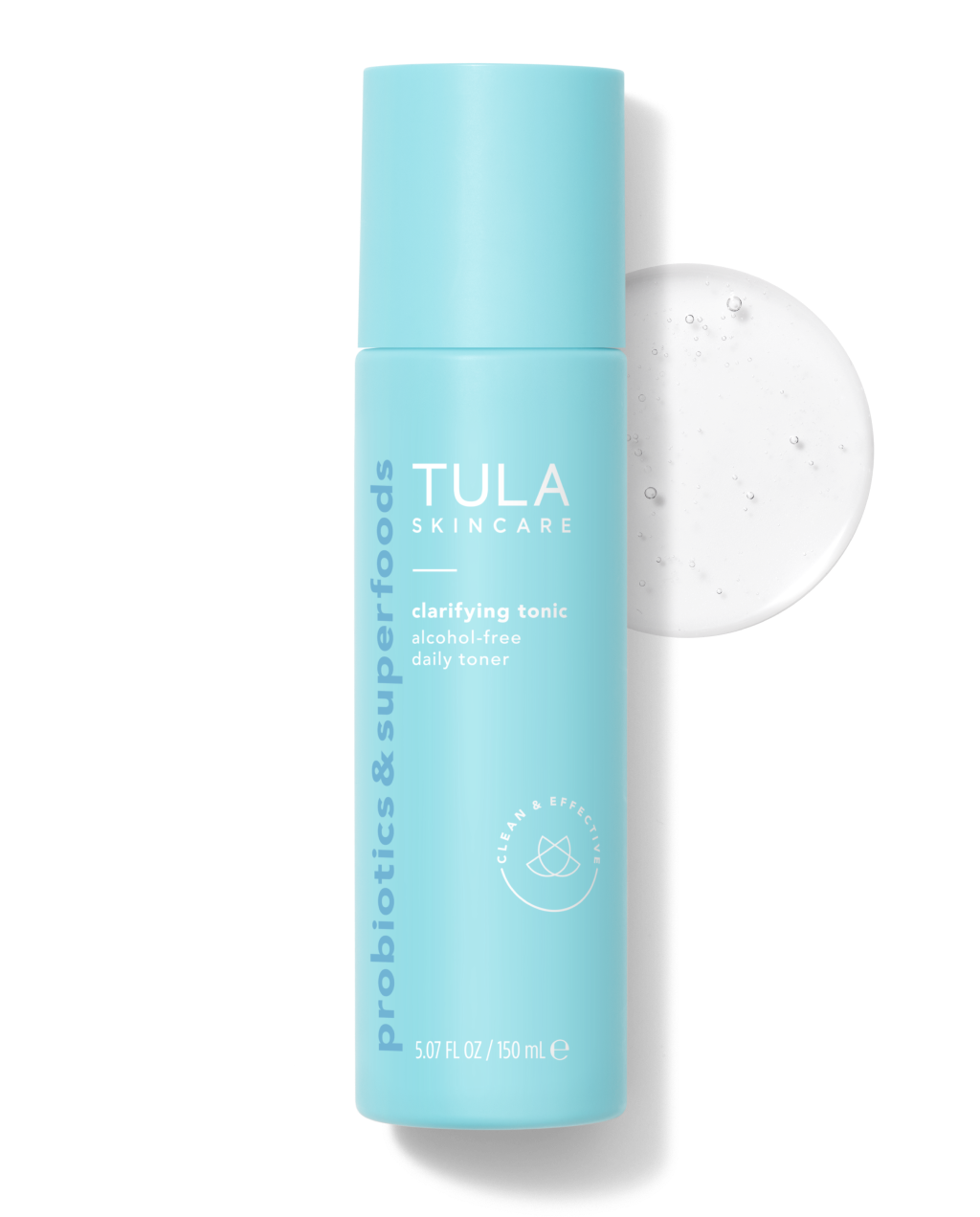
Clarifying Tonic

Clarifying Tonic
TULA
clarifying-tonic
Tone
9818384564517
Morning or Evening?
How often will you use this product?
Notes


Highlights
WHAT IS IT?
Clarifying toner with witch hazel and wild mint leaf
FEATURES
Tightens pores, balances pH, removes pollution/dirt/makeup residue, purifies skin
BEST FOR
combination
CHECKS
Free of alcohol, silicon, sulfate, oil, paraben
Who Is It For?
All Ages All GendersWhat Does It Help With?
Pore Tightening Ph Balancing Skin Purifying BrighteningBudget
Affordable (under $30)How To Use
Which routine should it be used in?
Instructions:
Key Information


What TULA Says
Product Description:
Tighten, brighten & tone! Your twice-daily toner ritual to tighten the look of pores & balance skin's natural pH after cleansing.
About the Brand:
Ingredients Overview
Ingredients List
Aqua/water/eau, Hamamelis Virginiana (witch Hazel) Water, Propanediol, Glycerin, Polysorbate 20, Sodium Pca, Lactobacillus Ferment, Niacinamide, Curcuma Longa (turmeric) Root Extract, Lactococcus Ferment Lysate, Beta Vulgaris (beet) Root Extract, Polymnia Sonchifolia Root Juice, Inulin, Lycium Chinense Fruit Extract, Lactic Acid, Alpha-glucan Oligosaccharide, Phytic Acid,peumus Boldus Leaf Extract, Vaccinium Angustifolium (blueberry) Fruit Extract, Lactobacillus,vaccinium Macrocarpon (cranberry) Fruit Extract, Butylene Glycol, Citric Acid, Maltodextrin, Sodium Benzoate, Gluconic Acid, Yeast Extract,sodium Chloride, Xanthan Gum, Potassium Sorbate, Sodium Hydroxide, Sodium Citrate,caprylyl Glycol, Pentylene Glycol, Phenoxyethanol, Benzoic Acid, 1,2-hexanediol
Key Ingredients
witch hazel, wild mint leaf, lactic acid, PHA, niacinamide
Ingredients Details
Lactic Acid
Common Name(s): L-lactic acid,2-hydroxypropionic acid,milk acid
CAS Number: 50-21-5
DESCRIPTION
What It Does: Exfoliates dead skin cells, attracts and retains moisture, brightens skin tone, and improves texture.
Why It's Used: Dual exfoliant and humectant – uniquely hydrating vs other ahas. gentler and suitable for normal-to-sensitive skin.
How It Works: Disrupts desmosomes to promote exfoliation at low ph. acts as humectant. also stimulates ceramide synthesis at lower concentrations for barrier support.
Typically Found In: Chemical exfoliants,toners,serums,professional peels
TECHNICAL DETAILS
Primary Category: Active ingredient – alpha hydroxy acid (aha)
Secondary Functions: Humectant,brightening,barrier support,ceramide synthesis
Application Areas:

Facial Skincare
Body Care

Hair Care
Beard Care
Color Cosmetics (Makeup)
Dietary/Oral Supplements
Typical Concentration Range: 2%–10% (daily); 20%–90% (professional); active at ph ≤3.9
SOURCING & ETHICS
Vegan Status: Conditional - feedstock declaration required
Halal Status: Unverified - feedstock declaration required (plant, animal and petrochemical routes all exist)
Source Notes: Fermentation-derived from carbohydrates or synthetically produced. both l-form and dl-form used. [audit 2026-07-29 rev2: origin-dependent: the same inci exists in plant, animal and petrochemical versions and the name does not discriminate. determination requires shariah-panel sign-off.]
SKIN COMPATIBILITY
Irritancy Rating: 2/5 – low to moderate
Comedogenicity Rating: 0/5 – non-comedogenic
Sensitivity Concerns: Photosensitizing – spf required. better tolerated than glycolic acid for most skin types.
Safe for Sensitive Skin: Use with caution – spf required
SAFETY & COMPATIBILITY
Safety Profile: Safe at otc concentrations. eu: ≤10% leave-on at ph ≥3.5. mandatory spf advisory.
Works Well With: Niacinamide,ceramides,hyaluronic acid,spf
Avoid Combining With: Retinol in same step; multiple exfoliants simultaneously
SCIENTIFIC NOTE
Lactic acid's role as a natural moisturizing factor (nmf) component makes it uniquely hydrating among ahas. ceramide synthesis stimulation at 2% provides barrier benefits complementing exfoliating activity.
Last Verified: 2026-03-12
Primary Sources: Cosing database,stiller et al. lactic acid review,sccs aha opinion
Niacinamide
Common Name(s): Vitamin b3,nicotinamide,pyridine-3-carboxamide
CAS Number: 98-92-0
DESCRIPTION
What It Does: Niacinamide strengthens the skin barrier, reduces visible pore size, regulates sebum production, fades dark spots, and improves skin texture and tone.
Why It's Used: It is used because it addresses multiple skin concerns at once without irritation, making it suitable for all skin types. it is stable in formulations and pairs well with most other actives.
How It Works: Niacinamide inhibits the transfer of melanosomes (pigment packets) to skin cells, reducing hyperpigmentation. it also stimulates ceramide synthesis to strengthen the skin barrier and reduces inflammation by modulating cytokine activity.
Typically Found In: Serums,moisturizers,toners,cleansers,eye creams,sunscreens,primers
TECHNICAL DETAILS
Primary Category: Active ingredient – vitamin
Secondary Functions: Barrier repair,brightening,anti-inflammatory
Application Areas:
Facial Skincare
Body Care
Hair Care
Beard Care
Color Cosmetics (Makeup)
Dietary/Oral Supplements
Typical Concentration Range: 2%–10% (typical: 5%; higher concentrations may cause flushing in some individuals)
SOURCING & ETHICS
Vegan Status: Yes – synthetically produced
Halal Status: Yes – synthetic origin
Source Notes: Commercially produced via synthesis from nicotinic acid or 3-cyanopyridine. no animal-derived sources used in cosmetic-grade niacinamide.
SKIN COMPATIBILITY
Irritancy Rating: 1/5 – very low; concentrations above 10% may cause temporary flushing in sensitive individuals
Comedogenicity Rating: 0/5 – non-comedogenic
Sensitivity Concerns: At concentrations >10%, some users experience niacin flush (transient redness/tingling). generally very well-tolerated.
Safe for Sensitive Skin: Yes – one of the best-tolerated actives for sensitive skin
SAFETY & COMPATIBILITY
Safety Profile: Extensively studied and considered very safe. ewg hazard score: 1. no significant systemic toxicity concerns at topical concentrations.
Works Well With: Retinol,peptides,ahas/bhas,hyaluronic acid,ceramides,zinc,vitamin c,spf
Avoid Combining With: High concentrations of vitamin c (ascorbic acid) may theoretically convert to niacin – use at different times if using pure l-ascorbic acid above 15%
SCIENTIFIC NOTE
Niacinamide is a precursor to nad+ and nadp+, coenzymes vital to cellular energy metabolism. its benefits for dna repair and mitochondrial function make it a key ingredient in anti-aging strategies.
Last Verified: 2026-03-12
Primary Sources: Cosing database,cir safety assessment,ewg skin deep,pubmed clinical studies
Pha
Common Name(s): Polyhydroxy acid (pha),gentle large-molecule exfoliant,sensitive skin aha
CAS Number: N/a
DESCRIPTION
What It Does: Provides gentle keratolytic exfoliation, skin brightening, and humectant moisture retention simultaneously — with a skin-irritation profile significantly lower than glycolic or lactic acid from slower penetration kinetics.
Why It's Used: The gold standard for sensitive skin chemical exfoliation — phas provide aha-class exfoliation efficacy in fitzpatrick iv–vi and rosacea skin types where glycolic acid is too aggressive.
How It Works: Multiple hydroxyl groups on the pha molecule slow sc penetration (fick's law: d ∝ mw^-0.7) providing gentler keratolytic action. the hydroxyl groups also bind water providing simultaneous humectancy and chelate ca²⁺ to disrupt desmosomal adhesion for exfoliation.
Typically Found In: Sensitive skin,exfoliating toners,post-procedure
TECHNICAL DETAILS
Primary Category: Active ingredient – alpha hydroxy acid (aha)
Secondary Functions: Brightening,collagen stimulation
Application Areas:
Facial Skincare
Body Care
Hair Care
Beard Care
Color Cosmetics (Makeup)
Dietary/Oral Supplements
Typical Concentration Range: 1%–15%
SOURCING & ETHICS
Vegan Status: Yes
Halal Status: Yes
Source Notes: Fermentation-derived or synthetic. ph must be ≤4.0 for aha activity.
SKIN COMPATIBILITY
Irritancy Rating: 2/5 – low to moderate
Comedogenicity Rating: 0/5 – non-comedogenic
Sensitivity Concerns: Photosensitizing – mandatory spf use. start at low frequency.
Safe for Sensitive Skin: Use with caution – spf required
SAFETY & COMPATIBILITY
Safety Profile: Safe at otc concentrations. eu: ≤10% leave-on at ph ≥3.5. mandatory spf advisory.
Works Well With: Niacinamide,ceramides,hyaluronic acid,spf
Avoid Combining With: Retinol in same step; multiple exfoliants simultaneously
SCIENTIFIC NOTE
Phas have a water of hydration shell from multiple oh groups that further slows sc penetration versus equivalent-mw ahas — the combined larger mw and greater hydration shell providing the gentlest keratolytic delivery kinetics of all acid exfoliants.
Last Verified: 2026-03-12
Primary Sources: Cosing database,polyhydroxy acid pha gentle exfoliant review