
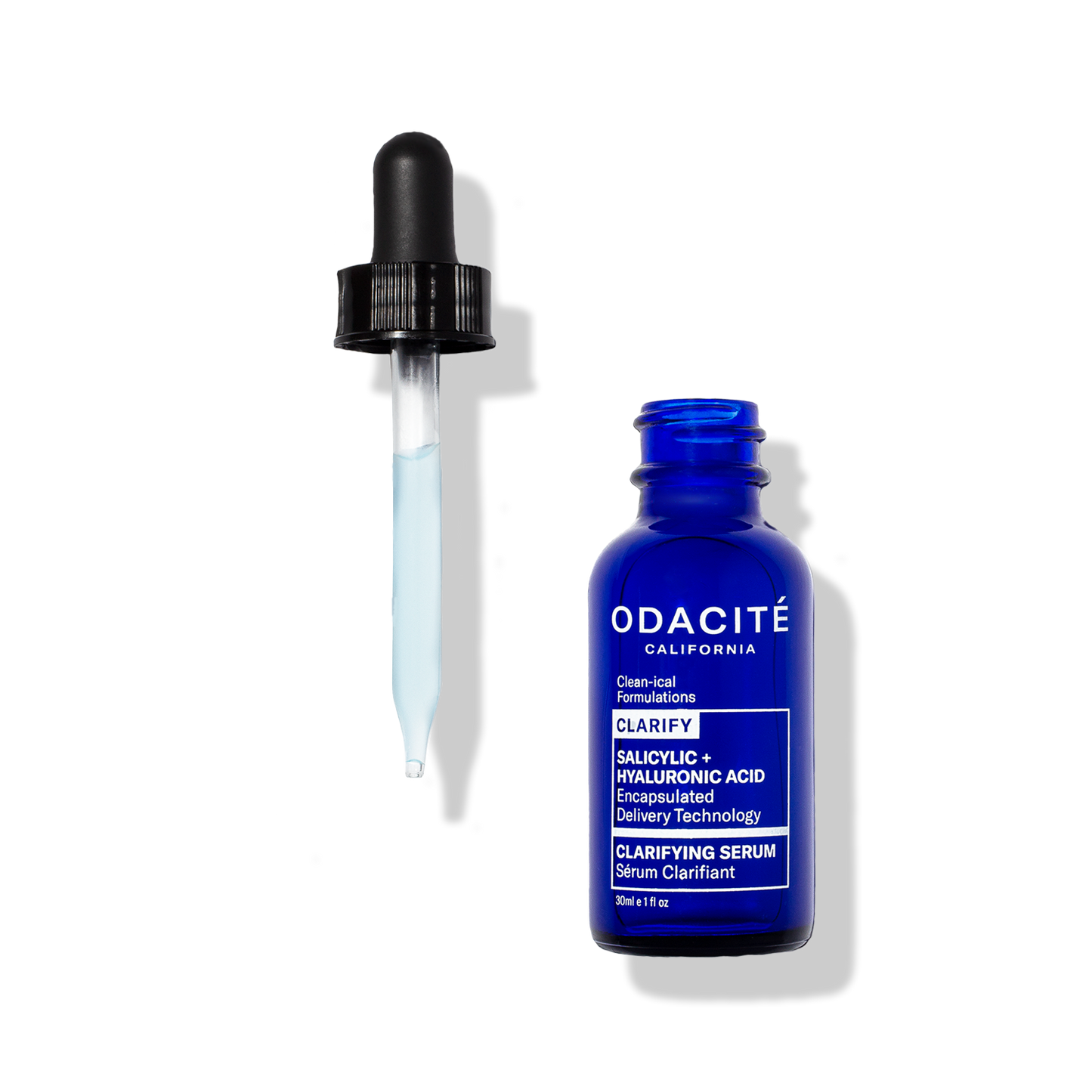

Odacité
Clarifying Serum Salicylic + Hyaluronic Acid

Clarifying Serum Salicylic + Hyaluronic Acid
Odacité
clarifying-serum-salicylic-hyaluronic-acid
Serum
9706787438885
Morning or Evening?
How often will you use this product?
Notes


Highlights
WHAT IS IT?
A clarifying serum with salicylic acid and hyaluronic acid
FEATURES
Advanced Encapsulation Technology, maximizes results while reducing irritation risk
BEST FOR
All skin types, especially those prone to congestion and blemishes
CHECKS
Free of parabens, fillers, nanoparticles, petrochemicals, PEG, synthetic perfumes, dyes, phenoxyethanol
Who Is It For?
Adults (18+) Both Men And WomenWhat Does It Help With?
Blemishes Whiteheads Blackheads Congested Pores Uneven Skin TextureBudget
PremiumHow To Use
Which routine should it be used in?
Instructions:
Key Information


What Odacité Says
Product Description:
See clear-looking skin fast, with this Salicylic Acid Serum expertly formulated with Advanced Encapsulation Technology, to maximize results while reducing risk of irritation. Salicylic Acid pairs with Hyaluronic Acid to support a fresh, clean-looking complexion.
About the Brand:
Ingredients Overview
Ingredients List
Cananga Odorata (Ylang Ylang) Flower Distillate Water, Glycerin, Salicylic Acid, Sodium polyacrylate, Lonicera japonica flower extract, Sodium Hyaluronate, Amorphophallus konjac, Aqua, Aloe Barbadensis (Aloe) Leaf/ Flower Extract, Phospholipids, Tocopheryl Acetate (Vitamin E), Retiny Palmitate (Vitamin A), Pantothenic Acid (Vitamin B5), Ascorbyl Palmitate(Vitamin C),Cholecalciferol (Vitamin D3), Cananga odorata Oil, Benzyl Alcohol, Benzoic Acid, Dehydroacetic Acid, Tocopherol, Melia Azadirachta (Neem) Leaf/ Flower Extract, Corallina Officinalis (Red Seaweed) Extract, Coccinia Indica (Ivy Gourd) Fruit Extract, Solanum Melongena (Eggplant) Fruit Extract, Ocimum Sanctum Leaf Extract, Ocimum Basilicum (Basil) Flower/Leaf Extract, Curcuma Longa (Turmeric) Root Extract
Key Ingredients
Salicylic Acid, Hyaluronic Acid, Vitamin Complex (A, B, D, E), Ylang Ylang Floral Water
Ingredients Details
Glycerin
Common Name(s): Glycerol,glycerine,1,2,3-propanetriol
CAS Number: 56-81-5
DESCRIPTION
What It Does: Glycerin pulls water from the environment and deeper skin layers into the outer skin layer (epidermis), boosting moisture levels and keeping skin soft, smooth, and plump.
Why It's Used: It is used in virtually every moisturizer, serum, and cleanser because it is highly effective at hydrating skin, is well-tolerated by all skin types, and enhances the texture and spreadability of formulations.
How It Works: As a humectant, glycerin forms hydrogen bonds with water molecules, trapping them in the skin. it also reinforces the skin barrier by integrating into lipid structures between skin cells.
Typically Found In: Moisturizers,serums,cleansers,toners,sheet masks,sunscreens,body lotions,shampoos,conditioners
TECHNICAL DETAILS
Primary Category: Humectant
Secondary Functions: Skin barrier support,emollient,solvent
Application Areas:

Facial Skincare
Body Care
Hair Care
Beard Care

Color Cosmetics (Makeup)
Dietary/Oral Supplements
Typical Concentration Range: 1%–30% (typical: 3–10%)
SOURCING & ETHICS
Vegan Status: Conditional - feedstock declaration required
Halal Status: Unverified - feedstock declaration required (plant, animal and petrochemical routes all exist)
Source Notes: Derived from plant oils via hydrolysis or saponification; synthetic versions also available. palm-derived glycerin carries sustainability concerns. [audit 2026-07-29 rev2: origin-dependent: the same inci exists in plant, animal and petrochemical versions and the name does not discriminate. determination requires shariah-panel sign-off.]
SKIN COMPATIBILITY
Irritancy Rating: 1/5 – very low; non-irritating at all standard concentrations
Comedogenicity Rating: 0/5 – non-comedogenic
Sensitivity Concerns: Extremely rare allergic reactions; generally safe for all skin types including sensitive and baby skin
Safe for Sensitive Skin: Yes
SAFETY & COMPATIBILITY
Safety Profile: Widely recognized as safe. ewg hazard score: 1. no significant concerns for irritation, sensitization, or toxicity at typical concentrations (up to 50%).
Works Well With: Hyaluronic acid,ceramides,niacinamide,panthenol,urea,peptides,retinol,ahas/bhas
Avoid Combining With: No known incompatibilities at standard concentrations
SCIENTIFIC NOTE
Glycerin is an endogenous skin component found naturally in the stratum corneum. aquaporin-3 channels in keratinocytes facilitate glycerin transport, making it integral to natural skin hydration pathways.
Last Verified: 2026-03-12
Primary Sources: Cosing database,cir safety assessment,ewg skin deep,inci decoder
Lonicera Japonica Flower Extract
Common Name(s): Lonicera japonica flower extract,botanical extract,phytochemical active
CAS Number: N/a
DESCRIPTION
What It Does: Provides antioxidant protection from reactive oxygen species, reduces inflammatory cytokine production in skin, and conditions skin through the plant's phytochemical complex.
Why It's Used: Natural origin narrative, traditional use heritage, and multi-functional phytochemical profile supporting concurrent skin care claims from one ingredient.
How It Works: Polyphenols, terpenoids, and alkaloids scavenge ros via h• donation, inhibit nf-kb or cox-2 inflammatory pathways, and interact with skin surface proteins for conditioning.
Typically Found In: Botanical skin care,natural products
TECHNICAL DETAILS
Primary Category: Active ingredient – antioxidant
Secondary Functions: Free radical scavenging,anti-aging
Application Areas:
Facial Skincare
Body Care
Hair Care
Beard Care
Color Cosmetics (Makeup)
Dietary/Oral Supplements
Typical Concentration Range: 0.1%–10%
SOURCING & ETHICS
Vegan Status: Conditional - supplier confirmation required
Halal Status: Yes
Source Notes: Plant-derived extract or synthetic. [audit 2026-07-29 rev2: status downgraded on audit. determination requires shariah-panel sign-off.]
SKIN COMPATIBILITY
Irritancy Rating: 1/5 – very low
Comedogenicity Rating: 0/5 – non-comedogenic
Sensitivity Concerns: Non-irritating; well-tolerated.
Safe for Sensitive Skin: Yes
SAFETY & COMPATIBILITY
Safety Profile: Excellent safety profile. ewg score: 1.
Works Well With: Vitamin c,vitamin e,ferulic acid,spf,other antioxidants
Avoid Combining With: No significant incompatibilities
SCIENTIFIC NOTE
Plant secondary metabolites evolved as photoprotectants and antimicrobials — mechanisms directly applicable to cosmetic antioxidant and anti-inflammatory activity in human skin.
Last Verified: 2026-03-12
Primary Sources: Cosing database,lonicera japonica flower extract botanical review
Phospholipids
Common Name(s): Lecithin/phospholipid,cell membrane lipid,emulsifier barrier repair
CAS Number: N/a
DESCRIPTION
What It Does: Stabilises o/w and w/o emulsions through biomimetic phospholipid bilayer formation, supplements sc barrier lipids for barrier repair, and forms liposomes and lamellar delivery vehicles for encapsulated active delivery.
Why It's Used: Phospholipids are uniquely bifunctional: they provide conventional emulsification and form genuine liposomal bilayer vesicles for encapsulated active delivery — a dual function unavailable from synthetic emulsifiers.
How It Works: The phosphocholine head group provides strong h-bonding hydrophilicity while the dual fatty acid tails provide lipophilic anchoring — this wedge-shaped geometry spontaneously forms closed bilayer vesicles (liposomes) that encapsulate actives for sustained release and enhanced sc penetration.
Typically Found In: Emulsions,liposomal delivery,barrier repair
TECHNICAL DETAILS
Primary Category: Functional ingredient – emollient
Secondary Functions: Barrier sealing,softening
Application Areas:
Facial Skincare
Body Care
Hair Care
Beard Care
Color Cosmetics (Makeup)
Dietary/Oral Supplements
Typical Concentration Range: 1%–15%
SOURCING & ETHICS
Vegan Status: Conditional - supplier confirmation required
Halal Status: Unverified - supplier confirmation required
Source Notes: Plant-derived, synthetic or animal-derived. verify source. [audit 2026-07-29 rev2: the record's own source_notes does not assert a non-animal origin, or instructs the reader to verify with the supplier; "yes" asserts knowledge the record does not hold. determination requires shariah-panel sign-off.]
SKIN COMPATIBILITY
Irritancy Rating: 1/5 – very low
Comedogenicity Rating: 1/5 – low; formulation-dependent
Sensitivity Concerns: Non-irritating.
Safe for Sensitive Skin: Yes
SAFETY & COMPATIBILITY
Safety Profile: Excellent safety profile. ewg score: 1.
Works Well With: Humectants,ceramides,actives as carrier
Avoid Combining With: No significant incompatibilities
SCIENTIFIC NOTE
Phospholipid's wedge-shaped geometry (large head relative to two acyl tails) preferentially forms spherical bilayer vesicles (liposomes) rather than flat lamellar phases — this curvature preference enables self-assembly of drug delivery liposomes simply by hydration of the phospholipid film.
Last Verified: 2026-03-12
Primary Sources: Cosing database,lecithin phospholipid liposomal delivery review
Salicylic Acid
Common Name(s): Bha,2-hydroxybenzoic acid,orthohydroxybenzoic acid,willow bark acid
CAS Number: 69-72-7
DESCRIPTION
What It Does: Salicylic acid exfoliates the skin surface and inside pores, dissolves the 'glue' holding dead skin cells together, reduces sebum production, and combats acne-causing bacteria.
Why It's Used: Its oil solubility makes it uniquely effective at penetrating pores and dissolving sebum plugs – a function that water-soluble ahas cannot perform. it is the preferred exfoliant for oily, acne-prone, and congested skin.
How It Works: Salicylic acid disrupts desmosomal bonds between corneocytes, promoting exfoliation. its oil solubility allows it to penetrate the sebaceous follicle, dissolving sebum and dead cells. it also has anti-inflammatory properties by inhibiting prostaglandin synthesis.
Typically Found In: Cleansers,toners,serums,spot treatments,masks,chemical peels,anti-dandruff shampoos,acne treatments
TECHNICAL DETAILS
Primary Category: Active ingredient – beta hydroxy acid (bha)
Secondary Functions: Anti-acne,anti-dandruff,keratolytic
Application Areas:
Facial Skincare
Body Care
Hair Care
Beard Care
Color Cosmetics (Makeup)
Dietary/Oral Supplements
Typical Concentration Range: 0.5%–2% (otc acne treatment in us); up to 30% in professional chemical peels
SOURCING & ETHICS
Vegan Status: Yes – synthetic or willow bark derived
Halal Status: Yes
Source Notes: Naturally occurring in willow bark (salix alba) and wintergreen oil. commercially produced synthetically via kolbe-schmitt reaction for cosmetic use.
SKIN COMPATIBILITY
Irritancy Rating: 3/5 – moderate; can cause dryness, peeling, and irritation, especially at higher concentrations
Comedogenicity Rating: 0/5 – non-comedogenic; actually anti-comedogenic
Sensitivity Concerns: Can cause irritation, dryness, and sun sensitivity. avoid contact with eyes. not recommended during pregnancy at high concentrations. can be drying – follow with moisturizer.
Safe for Sensitive Skin: Use with caution – start with lower concentrations and frequency; may not be suitable for reactive or rosacea-prone skin
SAFETY & COMPATIBILITY
Safety Profile: Safe at otc concentrations (0.5–2%). regulated as a drug in some countries (us: fda category i acne treatment). avoid in pregnancy at high concentrations.
Works Well With: Niacinamide,zinc,tea tree oil,benzoyl peroxide (at different times),hyaluronic acid (to counteract dryness)
Avoid Combining With: High concentrations of retinol (cumulative irritation),multiple exfoliating acids simultaneously,benzoyl peroxide in same step (can increase irritation)
SCIENTIFIC NOTE
Salicylic acid is a member of the salicylate family and shares structural similarity with aspirin. its anti-inflammatory mechanism mirrors aspirin's cox inhibition pathway, making it uniquely effective for inflammatory acne.
Last Verified: 2026-03-12
Primary Sources: Cosing database,cir safety assessment,us fda acne monograph,journal of the american academy of dermatology