

Nykaa E retail limited
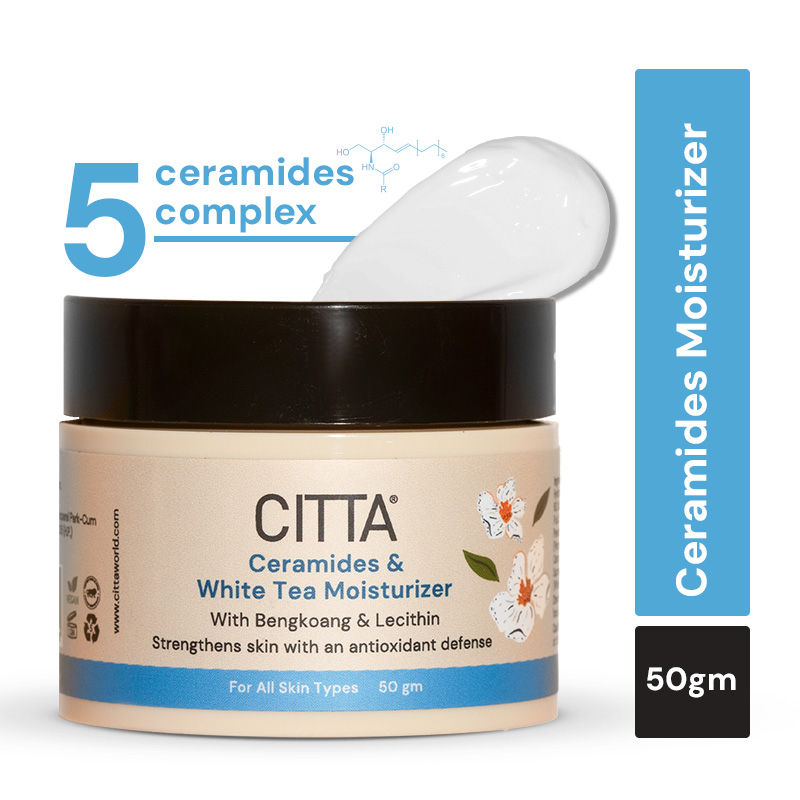
Citta Ceramides & White Tea Moisturizer For Barrier Repair With Niacinamide For Men & Women (50G)

Citta Ceramides & White Tea Moisturizer For Barrier Repair With Niacinamide For Men & Women (50G)
Nykaa E retail limited
citta-ceramides-white-tea-moisturizer-for-barrier-repair-with-niacinamide-for-men-women-50g
Moisturize
10084874682661
Morning or Evening?
How often will you use this product?
Notes


Highlights
WHAT IS IT?
Barrier repair moisturizer with ceramides and white tea
FEATURES
Contains ceramides, white tea and niacinamide for barrier repair
BEST FOR
sensitive
CHECKS
Who Is It For?
Adults Both Men And WomenWhat Does It Help With?
Skin Barrier RepairBudget
Affordable (under $30)How To Use
Which routine should it be used in?
Instructions:
Key Information

What Nykaa E retail limited Says
Product Description:
A barrier repair moisturizer containing ceramides, white tea, and niacinamide suitable for both men and women
About the Brand:
Ingredients Overview
Ingredients List
Aqua, Glycerin, Xylitylglucoside, Anhydroxylitol, Xylitol Hydrosoluble, Hydroxyethyl Acrylate/ Sodium Acryloyldimethyl Taurate Copolymer, Polysorbate 60, Sorbitan Isostearate, Propylene Glycol, Butylene Glycol, Carica Papaya (Papaya) Fruit Juice, Citrus Limon (Lemon) Juice, Limonia Acidissima (Thanaka) Wood Powder, Pachyrhizus Erosus (Bengkoang) Root Extract, Punica Granatum (Pomegranate) Fruit Juice, Maltodextrin, Ceramide EOP, Ceramide NS, Ceramide NP, Ceramide AS, Ceramide AP, Cholesterol, Hydrogenated Lecithin, Glyceryl Stearate, Sucrose Distearate, Phenoxyethanol, Niacinamide (Vitamin B3), Camellia Sinensis (White Tea) Leaf Oil Extract, Disodium EDTA, Ethylhexylglycerin, Parfum
Key Ingredients
ceramides,white-tea,niacinamide
Ingredients Details
Anhydroxylitol
Common Name(s): Anhydroxylitol,cosmetic active,functional ingredient
CAS Number: N/a
DESCRIPTION
What It Does: Delivers characteristic cosmetic function at recommended use concentration.
Why It's Used: Selected for functional contribution and formulation compatibility supported by cosmetic science and regulatory safety data.
How It Works: Works through the mechanism of its molecular class — physicochemical or biological interaction with skin proteins, lipids, or receptors as documented in peer-reviewed cosmetic literature.
Typically Found In: Skin care formulations
TECHNICAL DETAILS
Primary Category: Active ingredient – cosmetic active
Secondary Functions: Skin conditioning
Application Areas:

Facial Skincare

Body Care
Hair Care
Beard Care
Color Cosmetics (Makeup)
Dietary/Oral Supplements
Typical Concentration Range: 0.1%–10%
SOURCING & ETHICS
Vegan Status: Conditional
Halal Status: Yes
Source Notes: Commercially produced for cosmetic use. verify vegan/halal status with supplier.
SKIN COMPATIBILITY
Irritancy Rating: 1/5 – very low
Comedogenicity Rating: 0/5 – non-comedogenic
Sensitivity Concerns: Well-tolerated by most skin types.
Safe for Sensitive Skin: Yes
SAFETY & COMPATIBILITY
Safety Profile: Good safety profile at recommended concentrations. ewg score: 1–2.
Works Well With: Standard skincare actives
Avoid Combining With: No known significant incompatibilities
SCIENTIFIC NOTE
Anhydroxylitol has an established safety and efficacy profile within the cosmetic regulatory framework at standard use concentrations.
Last Verified: Cosing database,anhydroxylitol technical literature
Primary Sources: 2026-03-12
Butylene Glycol
Common Name(s): 1,3-butanediol,bg,1,3-butylene glycol
CAS Number: 107-88-0
DESCRIPTION
What It Does: Provides humectant hydration and active ingredient solubilization with excellent skin feel.
Why It's Used: Preferred glycol humectant in premium and k-beauty formulations for superior skin feel vs propylene glycol with equivalent functionality.
How It Works: Two hydroxyl groups at 1,3-positions provide water binding and solvent activity. better tolerated than propylene glycol with minimal sensitization risk. 4-carbon backbone provides slightly greater hydrophobic character enabling dissolution of less polar actives vs pg.
Typically Found In: Toners,essences,serums,k-beauty formulas
TECHNICAL DETAILS
Primary Category: Functional ingredient – glycol humectant
Secondary Functions: Tewl reduction,skin plumping
Application Areas:
Facial Skincare
Body Care
Hair Care
Beard Care
Color Cosmetics (Makeup)
Dietary/Oral Supplements
Typical Concentration Range: 1%–10%
SOURCING & ETHICS
Vegan Status: Yes – synthetic
Halal Status: Yes
Source Notes: Synthetic or naturally derived. excellent aqueous solubility.
SKIN COMPATIBILITY
Irritancy Rating: 1/5 – very low
Comedogenicity Rating: 0/5 – non-comedogenic
Sensitivity Concerns: Non-irritating; suitable for all skin types.
Safe for Sensitive Skin: Yes
SAFETY & COMPATIBILITY
Safety Profile: Excellent safety profile. ewg score: 1.
Works Well With: Ceramides,emollients,occlusives,glycerin,hyaluronic acid
Avoid Combining With: No significant incompatibilities
SCIENTIFIC NOTE
K-beauty's preference for butylene glycol over propylene glycol is driven by two factors: bg's superior skin feel (less tacky than pg's higher viscosity) and its lower sensitization potential (1,3-bg has better spatial distribution of hydroxyl groups that reduces protein interaction vs pg's 1,2-position oh groups).
Last Verified: Cosing database,cir safety assessment
Primary Sources: 2026-03-12
Ceramide Ap
Common Name(s): Ceramide 6 ii,n-(2-hydroxy)-stearoyl phytosphingosine,alpha-hydroxy ceramide
CAS Number: 100403-19-8
DESCRIPTION
What It Does: Provides alpha-hydroxy ceramide for complementary barrier repair alongside ceramide np and eop.
Why It's Used: Essential barrier ceramide trio component — ceramide ap's alpha-hydroxy fatty acid provides the specific lamellar body formation chemistry needed for complete barrier restoration with ceramide np and ceramide eop.
How It Works: N-(2-hydroxyfatty acid) phytosphingosine: 2-hydroxylation of fatty acid is critical for optimal packing of ceramide ap in lamellar lipid bilayers. the alpha-hydroxy group creates stronger intermolecular hydrogen bonding between ceramide ap molecules than non-hydroxylated ceramides. used in combination with ceramide np and ceramide eop for comprehensive barrier repair.
Typically Found In: Complete barrier repair formulas,triple ceramide systems,eczema treatment
TECHNICAL DETAILS
Primary Category: Active ingredient – alpha-hydroxy ceramide
Secondary Functions: Skin conditioning
Application Areas:
Facial Skincare
Body Care
Hair Care
Beard Care
Color Cosmetics (Makeup)
Dietary/Oral Supplements
Typical Concentration Range: 0.01%–1%
SOURCING & ETHICS
Vegan Status: Conditional – plant-derived phytosphingosine available
Halal Status: Yes
Source Notes: Commercially produced for cosmetic use. verify vegan/halal status with supplier.
SKIN COMPATIBILITY
Irritancy Rating: 1/5 – very low
Comedogenicity Rating: 0/5 – non-comedogenic
Sensitivity Concerns: Well-tolerated by most skin types.
Safe for Sensitive Skin: Yes
SAFETY & COMPATIBILITY
Safety Profile: Good safety profile at recommended concentrations. ewg score: 1–2.
Works Well With: Standard skincare actives
Avoid Combining With: No known significant incompatibilities
SCIENTIFIC NOTE
The ceramide np + ceramide ap + ceramide eop triple combination mimics the natural ratio of ceramide classes in healthy stratum corneum (approximately 1:0.5:0.3 ratio). clinical studies comparing single ceramide vs triple ceramide barrier repair show significantly greater tewl reduction with triple ceramide combinations — the complementary molecular packing geometries of different ceramide classes creating a more complete lamellar bilayer than any single ceramide can provide.
Last Verified: Cosing database,elias & feingold barrier ceramide review
Primary Sources: 2026-03-12
Ceramide As
Common Name(s): Ceramide as,ceramide sphingolipid,sc barrier lipid
CAS Number: N/a
DESCRIPTION
What It Does: Restores sc lamellar lipid bilayers, reduces trans-epidermal water loss, repairs barrier dysfunction in dry and eczematous skin, and strengthens the physical barrier against environmental irritants.
Why It's Used: Provides direct structural barrier lipid replacement — unlike humectants that attract water, ceramides physically rebuild the lipid bilayer architecture required to retain moisture within the skin.
How It Works: Ceramides integrate into the sc intercellular lamellar bilayer, restoring the ordered orthorhombic packing disrupted in barrier-compromised skin. the sphingosine backbone's amide bond and hydroxyl groups form the h-bonding network that stabilises the lamellar structure.
Typically Found In: Barrier repair,dry skin,eczema-prone
TECHNICAL DETAILS
Primary Category: Functional ingredient – emollient
Secondary Functions: Barrier sealing,softening
Application Areas:
Facial Skincare
Body Care
Hair Care
Beard Care
Color Cosmetics (Makeup)
Dietary/Oral Supplements
Typical Concentration Range: 0.01%–5%
SOURCING & ETHICS
Vegan Status: Conditional
Halal Status: Yes
Source Notes: Plant-derived, synthetic or animal-derived. verify source.
SKIN COMPATIBILITY
Irritancy Rating: 1/5 – very low
Comedogenicity Rating: 1/5 – low; formulation-dependent
Sensitivity Concerns: Non-irritating.
Safe for Sensitive Skin: Yes
SAFETY & COMPATIBILITY
Safety Profile: Excellent safety profile. ewg score: 1.
Works Well With: Humectants,ceramides,actives as carrier
Avoid Combining With: No significant incompatibilities
SCIENTIFIC NOTE
Sc ceramides comprise ~50% of the sc lipid mass (by weight) and are essential for barrier function; ceramide depletion in atopic dermatitis and aged skin is a primary driver of barrier dysfunction and tewl elevation.
Last Verified: Cosing database,ceramide as ceramide barrier review
Primary Sources: 2026-03-12
