

Nykaa E retail limited
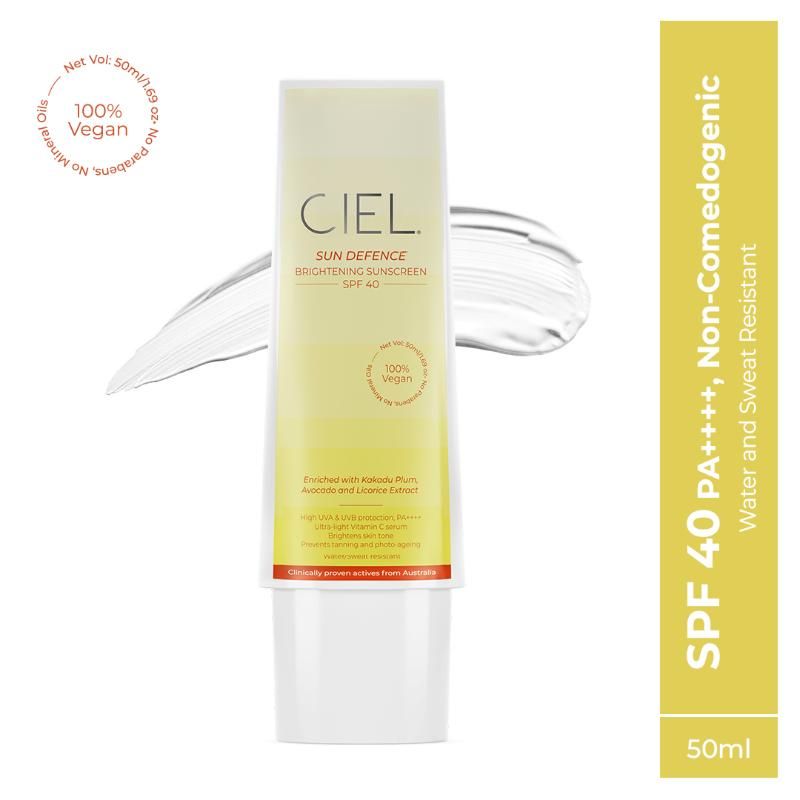
Ciel Sun Defence Brightening Sunscreen SPF 40

Ciel Sun Defence Brightening Sunscreen SPF 40
Nykaa E retail limited
ciel-sun-defence-brightening-sunscreen-spf-40
Suncare
10085495734565
Morning or Evening?
How often will you use this product?
Notes


Highlights
WHAT IS IT?
Brightening Sunscreen with 5 key natural ingredients
FEATURES
Offers broad spectrum UVA/UVB protection with PA++++, fast absorbing, enriched with vitamin C from Kakadu Plum, hydrating antioxidants such as Avocado and Olive, brightens skin and fades blemishes with Kiwi and Licorice Root, suitable for all skin types, dermatologically tested, clean and vegan formula
BEST FOR
all skin types
CHECKS
Parabens, Phthalates, Sulfates, Mineral Oils, Animal Derivatives
Who Is It For?
Men And Women Of Adult AgeWhat Does It Help With?
Prevents Sunspots Photoaging Pigmentation Brightens And Evens Skin Tone Hydrates Delays AgingBudget
Affordable (under $30)How To Use
Which routine should it be used in?
Instructions:
Key Information


What Nykaa E retail limited Says
Product Description:
CIEL Brightening Sunscreen SPF 40 provides broad spectrum UVA and UVB protection. Enriched with Kakadu Plum, nature's highest source of Vitamin C, it prevents the formation of sunspots, defends against free radical induced damage, and evens out skin tone. Suitable for all skin types, this serum feels light on the skin and absorbs effortlessly to give a radiant glow. Features include PA++++ broad spectrum protection, fast absorption, hydration with antioxidants, suitability for all skin types, and clean, vegan, and cruelty-free formulation.
About the Brand:
Ingredients Overview
Ingredients List
kakadu-plum, avocado-oil, licorice-root-extract, kiwi,olive-leaf-extract
Key Ingredients
Kakadu Plum, Avocado Oil, Licorice Root Extract, Kiwi, Olive Leaf Extract
Ingredients Details
Avocado Oil
Common Name(s): Avocado oil,avocado butter (solid fraction)
CAS Number: 8024-32-6
DESCRIPTION
What It Does: Provides deep moisturization with rich oleic acid, phytosterols, and lutein antioxidants for mature, dry skin.
Why It's Used: Rich, deeply penetrating oil for dry and mature skin requiring intensive emolliency beyond lightweight oils.
How It Works: Very high oleic acid (55-74%) penetrates deeply into stratum corneum for conditioning. beta-sitosterol and other phytosterols provide barrier repair and mild anti-inflammatory activity. lutein provides antioxidant protection. high unsaponifiable fraction (2-11%) provides unique skin bioactives.
Typically Found In: Rich moisturizers,dry skin oils,anti-aging formulas,body butters
TECHNICAL DETAILS
Primary Category: Functional ingredient – emollient
Secondary Functions: Deep penetrating emollient,phytosterol activity,anti-aging
Application Areas:

Facial Skincare
Body Care
Hair Care

Beard Care
Color Cosmetics (Makeup)
Dietary/Oral Supplements
Typical Concentration Range: 1%–50%
SOURCING & ETHICS
Vegan Status: Yes – from persea gratissima fruits
Halal Status: Yes
Source Notes: Cold-pressed from avocado fruit flesh. high unsaponifiable fraction (unsaponified lipids) makes avocado oil uniquely bioactive vs other oils with low unsaponifiable content.
SKIN COMPATIBILITY
Irritancy Rating: 1/5 – very low
Comedogenicity Rating: 3/5 – moderate; high oleic acid; test for skin type
Sensitivity Concerns: Non-irritating.
Safe for Sensitive Skin: Yes
SAFETY & COMPATIBILITY
Safety Profile: Excellent safety profile. ewg score: 1.
Works Well With: Humectants,ceramides,actives as carrier
Avoid Combining With: No significant incompatibilities
SCIENTIFIC NOTE
Avocado oil's unusually high unsaponifiable fraction (2-11% vs <2% for most plant oils) contains phytosterols, terpenes, vitamin e, and chlorophyll that remain after saponification and provide skin-active benefits not present in most other plant oils. this unsaponifiable fraction is what makes avocado oil pharmacologically distinct from simple fatty acid triglyceride oils.
Last Verified: 2026-03-12
Primary Sources: Cosing database,dreher & davenport avocado review,cir safety assessment
Licorice Root Extract
Common Name(s): Licorice root extract,licorice extract,glycyrrhiza extract
CAS Number: 84775-66-6
DESCRIPTION
What It Does: Brightens skin and reduces hyperpigmentation through glabridin tyrosinase inhibition while calming inflammation.
Why It's Used: Combined brightening + soothing in one botanical – ideal for hyperpigmentation with skin reactivity where brightening actives (ahas, retinoids) increase sensitivity.
How It Works: Glabridin inhibits uvb-induced melanin synthesis and tyrosinase activity. isoliquiritigenin inhibits melanocyte-stimulating hormone (msh). glycyrrhizinic acid inhibits prostaglandin synthesis for anti-inflammatory activity. licochalcone a inhibits nf-kb.
Typically Found In: Brightening serums,anti-inflammatory formulas,post-sun products,sensitive skin brightening
TECHNICAL DETAILS
Primary Category: Active ingredient – soothing / anti-inflammatory
Secondary Functions: Glabridin tyrosinase inhibition,anti-inflammatory,post-inflammatory hyperpigmentation
Application Areas:
Facial Skincare
Body Care
Hair Care
Beard Care
Color Cosmetics (Makeup)
Dietary/Oral Supplements
Typical Concentration Range: 0.1%–5%
SOURCING & ETHICS
Vegan Status: Yes – glycyrrhiza glabra root-derived
Halal Status: Yes
Source Notes: Plant-derived extract or synthetic.
SKIN COMPATIBILITY
Irritancy Rating: 1/5 – very low
Comedogenicity Rating: 0/5 – non-comedogenic
Sensitivity Concerns: Non-irritating; ideal for reactive and sensitive skin.
Safe for Sensitive Skin: Yes – particularly recommended for sensitive skin
SAFETY & COMPATIBILITY
Safety Profile: Excellent safety profile. ewg score: 1.
Works Well With: Ceramides,panthenol,allantoin,hyaluronic acid,centella asiatica
Avoid Combining With: No significant incompatibilities
SCIENTIFIC NOTE
Glabridin's tyrosinase inhibition mechanism differs from both kojic acid (copper chelation) and arbutin (substrate competition) – it inhibits the enzyme's catalytic conformation without substrate competition, providing a third distinct brightening mechanism suitable for formulation with the other inhibitor types for synergistic brightening.
Last Verified: 2026-03-12
Primary Sources: Cosing database,yokota et al. glabridin study,plenkov et al. licorice review
Olive Leaf Extract
Common Name(s): Olive leaf extract extract
DESCRIPTION
What It Does: Provides antioxidant protection, soothing anti-inflammatory effects, and skin-conditioning benefits through plant-derived polyphenols and phytochemicals.
Why It's Used: Plant extracts concentrate bioactive phytochemicals evolved for environmental protection — uv, microbial, and oxidative stressors — that translate to skin benefits.
How It Works: Polyphenols (flavonoids, phenolic acids) inhibit nf-κb-mediated inflammatory signaling, scavenge reactive oxygen species through electron donation, and chelate pro-oxidant metal ions to reduce oxidative skin damage.
Typically Found In: Serums,toners,moisturizers,masks,essences
TECHNICAL DETAILS
Primary Category: Botanical extracts
Secondary Functions: Antioxidant,anti-inflammatory
Application Areas:
Facial Skincare
Body Care
Hair Care
Beard Care
Color Cosmetics (Makeup)
Dietary/Oral Supplements
Typical Concentration Range: 0.1–10%
SOURCING & ETHICS
Vegan Status: Yes
Halal Status: Yes
Source Notes: Plant-derived extract; no animal components.
SKIN COMPATIBILITY
Irritancy Rating: 1899-12-31 00:00:00 -0800
Sensitivity Concerns: Low sensitization potential at recommended use concentrations.
Safe for Sensitive Skin: Yes
SAFETY & COMPATIBILITY
Safety Profile: Well-characterized cosmetic ingredient with established safety profile. generally non-irritating at typical use concentrations. suitable for leave-on and rinse-off cosmetics.
Works Well With: Niacinamide,hyaluronic acid,vitamin c,ceramides
Avoid Combining With: Strong oxidizing agents
SCIENTIFIC NOTE
Plant secondary metabolites (flavonoids, terpenes, phenolic acids) are biosynthesized as defense compounds against uv, herbivores, and pathogens. their anti-inflammatory activity typically derives from competitive inhibition of cox-2 and 5-lox enzymes (ic50 1–50 µm), while antioxidant activity involves single electron transfer (set) and hydrogen atom transfer (hat) mechanisms with structure-dependent rate constants.
Last Verified: 2025-01-15
Primary Sources: Cosing eu database; pcpc cosmetic ingredient safety reviews; phytochemical and ethnobotanical literature