

Charlotte Tilbury
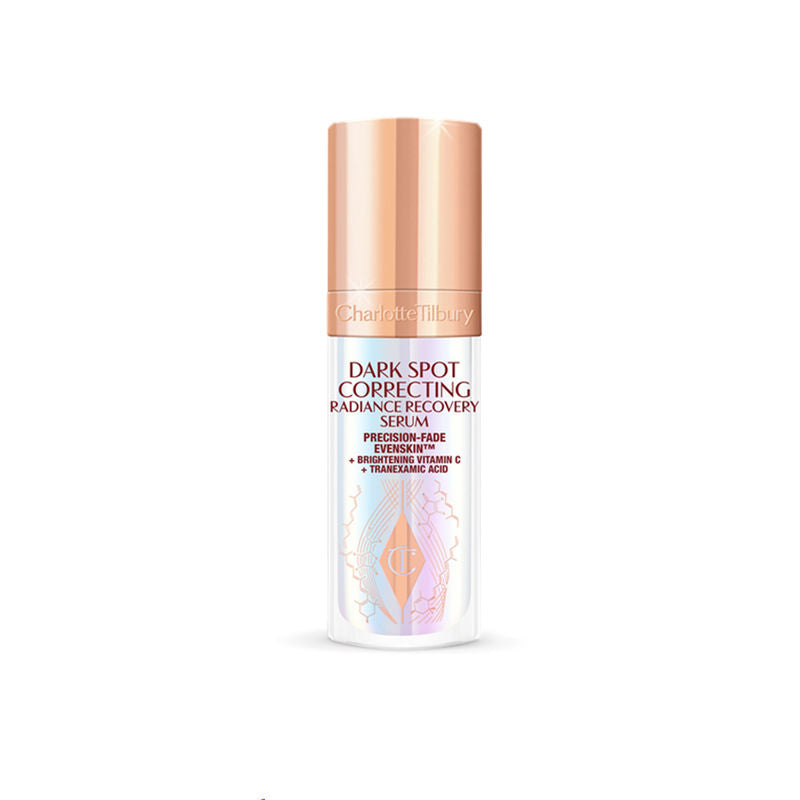
Charlotte Tilbury Dark Spots Correcting Radiance Recovery Serum

Charlotte Tilbury Dark Spots Correcting Radiance Recovery Serum
Charlotte Tilbury
charlotte-tilbury-dark-spots-correcting-radiance-recovery-serum
Serum
10084761010469
Morning or Evening?
How often will you use this product?
Notes


Highlights
WHAT IS IT?
Dark spot correcting radiance recovery serum
FEATURES
Targets all forms of dark spots with laser-like precision, strengthens skin barrier, corrects dark spots without compromising natural skin tone, silky-feel formula
BEST FOR
sensitive
CHECKS
Paraben-Free
Who Is It For?
What Does It Help With?
Dark Spots Uneven Skin Tone Post-blemish Marks Age Spots Skin Barrier Strengthening Radiance RecoveryBudget
Premium ($76-$150)How To Use
Which routine should it be used in?
Instructions:
Key Information

What Charlotte Tilbury Says
Product Description:
New! Dark spot correcting radiance recovery serum for skin that looks brighter + more even immediately. Targets all forms of dark spots with laser-like precision including post-blemish marks and age spots. Delivers a highly potent dark spot correcting complex into targeted areas whilst strengthening the skin barrier. Correct your dark spots without compromising your natural skin tone.
About the Brand:
Ingredients Overview
Ingredients List
Aqua/Water/Eau, Squalane, C13-15 Alkane, Glycerin, Xylitol, Pentylene Glycol, Polyquaternium-37, Hydrogenated Phosphatidylcholine, Phytosphingosine, Phytosterols, Niacinamide, 3-O-Ethyl Ascorbic Acid, Xanthophylls, Panthenol, Hyaluronic Acid, Tocopherol, Betula Alba Bark Extract, Tranexamic Acid, Phytosteryl Isostearate, Beta-Sitosterol, Sodium Beta-Sitosteryl Sulfate, Tamarindus Indica Seed Gum, Phenylpropanol, Caprylyl Glycol, Silica, Cetyl-Pg Hydroxyethyl Palmitamide, Lysolecithin, Sorbitan Caprylate, Lecithin, Pentaerythrityl Tetra-Di-T-Butyl Hydroxyhydrocinnamate, Propanediol, Octyldodecanol, Parfum, Hydroxyacetophenone, Pelargonium Graveolens Flower Oil, Citrus Limon (Lemon) Peel Oil, Limonene, Citrus Aurantium Dulcis (Orange) Peel Oil, Citrus Sinensis (Orange) Peel Oil, Citrus Aurantium Bergamia (Bergamot) Peel Oil, Cananga Odorata Flower Extract, Pogostemon Cablin Oil, Geraniol, Citronellol, Linalool, Citral
Key Ingredients
Niacinamide, 3-O-Ethyl Ascorbic Acid, Tranexamic Acid, Hyaluronic Acid, Panthenol
Ingredients Details
3-o-ethyl Ascorbic Acid
Common Name(s): 3-o-ethyl ascorbic acid
DESCRIPTION
What It Does: Loosens corneocyte adhesion in the stratum corneum, accelerating cell turnover, refining skin texture, and improving radiance.
Why It's Used: Organic acids at cosmetic ph values provide controlled keratolytic exfoliation that improves skin texture, pore appearance, and radiance without mechanical irritation.
How It Works: At appropriate ph, the acid's undissociated form penetrates the stratum corneum and dissolves the ionic bonds between corneocyte desmosomes (calcium chelation mechanism), facilitating controlled desquamation and cell renewal.
Typically Found In: Toners,exfoliants,serums,peels,cleansers
TECHNICAL DETAILS
Primary Category: Exfoliants
Secondary Functions: Brightening,keratolytic
Application Areas:

Facial Skincare

Body Care
Hair Care
Beard Care
Color Cosmetics (Makeup)
Dietary/Oral Supplements
Typical Concentration Range: 0.5–20%
SOURCING & ETHICS
Vegan Status: Yes
Halal Status: Yes
Source Notes: Synthetic or plant-derived acid; no animal components.
SKIN COMPATIBILITY
Irritancy Rating: 2
Comedogenicity Rating: 0
Sensitivity Concerns: May cause irritation or stinging in sensitive or barrier-compromised skin at high concentrations; patch test recommended.
Safe for Sensitive Skin: Conditional
SAFETY & COMPATIBILITY
Safety Profile: Safe within recommended ph and concentration ranges. sensitization risk increases above 10% aha. patch test recommended for sensitive skin. mildly irritating to some individuals at typical cosmetic use concentrations.
Works Well With: Niacinamide,hyaluronic acid,ceramides,vitamin c
Avoid Combining With: High concentrations on sensitive/broken skin; avoid with physical exfoliants
SCIENTIFIC NOTE
Cosmetic acids function at the pka boundary: only the undissociated acid (rcooh) penetrates the stratum corneum lipid barrier, while the ionized carboxylate (rcoo⁻) does not. the henderson-hasselbalch equation governs the fraction of active species at formulation ph; typically 0.5–3.0% undissociated acid provides efficacy while minimizing irritation.
Last Verified: 2025-01-15
Primary Sources: Cosing eu database; pcpc cosmetic ingredient safety reviews; ingredient-specific safety and efficacy literature
Aqua/water/eau
Common Name(s): Aqua/water/eau extract
DESCRIPTION
What It Does: Provides antioxidant protection, soothing anti-inflammatory effects, and skin-conditioning benefits through plant-derived polyphenols and phytochemicals.
Why It's Used: Plant extracts concentrate bioactive phytochemicals evolved for environmental protection — uv, microbial, and oxidative stressors — that translate to skin benefits.
How It Works: Polyphenols (flavonoids, phenolic acids) inhibit nf-κb-mediated inflammatory signaling, scavenge reactive oxygen species through electron donation, and chelate pro-oxidant metal ions to reduce oxidative skin damage.
Typically Found In: Serums,toners,moisturizers,masks,essences
TECHNICAL DETAILS
Primary Category: Botanical extracts
Secondary Functions: Antioxidant,anti-inflammatory
Application Areas:
Facial Skincare
Body Care
Hair Care
Beard Care
Color Cosmetics (Makeup)
Dietary/Oral Supplements
Typical Concentration Range: 0.1–10%
SOURCING & ETHICS
Vegan Status: Yes
Halal Status: Yes
Source Notes: Plant-derived extract; no animal components.
SKIN COMPATIBILITY
Irritancy Rating: 1
Comedogenicity Rating: 0
Sensitivity Concerns: Low sensitization potential at recommended use concentrations.
Safe for Sensitive Skin: Yes
SAFETY & COMPATIBILITY
Safety Profile: Well-characterized cosmetic ingredient with established safety profile. generally non-irritating at typical use concentrations. suitable for leave-on and rinse-off cosmetics.
Works Well With: Niacinamide,hyaluronic acid,vitamin c,ceramides
Avoid Combining With: Strong oxidizing agents
SCIENTIFIC NOTE
Plant secondary metabolites (flavonoids, terpenes, phenolic acids) are biosynthesized as defense compounds against uv, herbivores, and pathogens. their anti-inflammatory activity typically derives from competitive inhibition of cox-2 and 5-lox enzymes (ic50 1–50 µm), while antioxidant activity involves single electron transfer (set) and hydrogen atom transfer (hat) mechanisms with structure-dependent rate constants.
Last Verified: 2025-01-15
Primary Sources: Cosing eu database; pcpc cosmetic ingredient safety reviews; phytochemical and ethnobotanical literature
Beta-sitosterol
Common Name(s): 22,23-dihydrostigmasterol,sitosterin
CAS Number: 83-46-5
DESCRIPTION
What It Does: Provides plant membrane sterol anti-inflammatory and barrier support with 5-alpha-reductase inhibition.
Why It's Used: Multi-function phytosterol combining barrier mimicry (identical to cholesterol structure) with anti-inflammatory and anti-androgenic activity for acne-prone and aging skin.
How It Works: Integrates into stratum corneum lipid bilayers analogous to cholesterol for barrier support. inhibits 5-alpha-reductase for dht reduction. inhibits nf-kb and cox for anti-inflammatory activity. cholesterol analog provides skin conditioning and membrane stabilization.
Typically Found In: Anti-inflammatory serums,anti-acne products,natural oils and butters (as unsaponifiable component)
TECHNICAL DETAILS
Primary Category: Active ingredient – phytosterol anti-inflammatory
Secondary Functions: Barrier cholesterol analog,5-alpha-reductase inhibition
Application Areas:
Facial Skincare
Body Care
Hair Care
Beard Care
Color Cosmetics (Makeup)
Dietary/Oral Supplements
Typical Concentration Range: 0.1%–3%
SOURCING & ETHICS
Vegan Status: Conditional - supplier confirmation required
Halal Status: Unverified - supplier confirmation required
Source Notes: Plant-derived, synthetic or animal-derived. verify source. [audit 2026-07-29 rev2: the record's own source_notes does not assert a non-animal origin, or instructs the reader to verify with the supplier; "yes" asserts knowledge the record does not hold. determination requires shariah-panel sign-off.]
SKIN COMPATIBILITY
Irritancy Rating: 1/5 – very low
Comedogenicity Rating: 1/5 – low; formulation-dependent
Sensitivity Concerns: Non-irritating.
Safe for Sensitive Skin: Yes
SAFETY & COMPATIBILITY
Safety Profile: Excellent safety profile. ewg score: 1.
Works Well With: Humectants,ceramides,actives as carrier
Avoid Combining With: No significant incompatibilities
SCIENTIFIC NOTE
Beta-sitosterol's structural identity with cholesterol (only one additional ethyl group at c-24) allows it to substitute for cholesterol in cell membrane bilayers and skin barrier lipid structures. this structural mimicry explains its barrier-supportive activity while its c-24 ethyl group subtly alters enzyme interactions, providing 5-alpha-reductase inhibition not seen with mammalian cholesterol.
Last Verified: 2026-03-12
Primary Sources: Cosing database,bouic phytosterol review,cir safety assessment
Betula Alba Bark Extract
Common Name(s): Betula alba bark extract,botanical extract,phytochemical active
CAS Number: N/a
DESCRIPTION
What It Does: Provides antioxidant protection, anti-inflammatory activity, and skin conditioning from polyphenols, terpenoids, and phytochemicals in the extract.
Why It's Used: Natural plant extracts provide multi-functional phytochemical profiles supporting concurrent skin care claims from one ingredient with authentic botanical heritage.
How It Works: Polyphenols scavenge ros via h• donation; terpenoids inhibit nf-kb or cox inflammatory pathways; vitamins and minerals provide cofactor skin nutrition.
Typically Found In: Botanical skin care,natural products
TECHNICAL DETAILS
Primary Category: Active ingredient – antioxidant
Secondary Functions: Free radical scavenging,anti-aging
Application Areas:
Facial Skincare
Body Care
Hair Care
Beard Care
Color Cosmetics (Makeup)
Dietary/Oral Supplements
Typical Concentration Range: 0.1%–30%
SOURCING & ETHICS
Vegan Status: Conditional - supplier confirmation required
Halal Status: Conditional - basis not stated in source record; supplier origin confirmation required to determine what evidence applies
Source Notes: Plant-derived extract or synthetic. [audit 2026-07-29 rev2: status downgraded on audit. determination requires shariah-panel sign-off.]
SKIN COMPATIBILITY
Irritancy Rating: 1/5 – very low
Comedogenicity Rating: 0/5 – non-comedogenic
Sensitivity Concerns: Non-irritating; well-tolerated.
Safe for Sensitive Skin: Yes
SAFETY & COMPATIBILITY
Safety Profile: Excellent safety profile. ewg score: 1.
Works Well With: Vitamin c,vitamin e,ferulic acid,spf,other antioxidants
Avoid Combining With: No significant incompatibilities
SCIENTIFIC NOTE
Plant secondary metabolites evolved for uv photoprotection and pathogen defence — mechanisms directly applicable to cosmetic antioxidant and anti-inflammatory activity in human skin.
Last Verified: 2026-03-12
Primary Sources: Cosing database,betula alba bark extract botanical review