
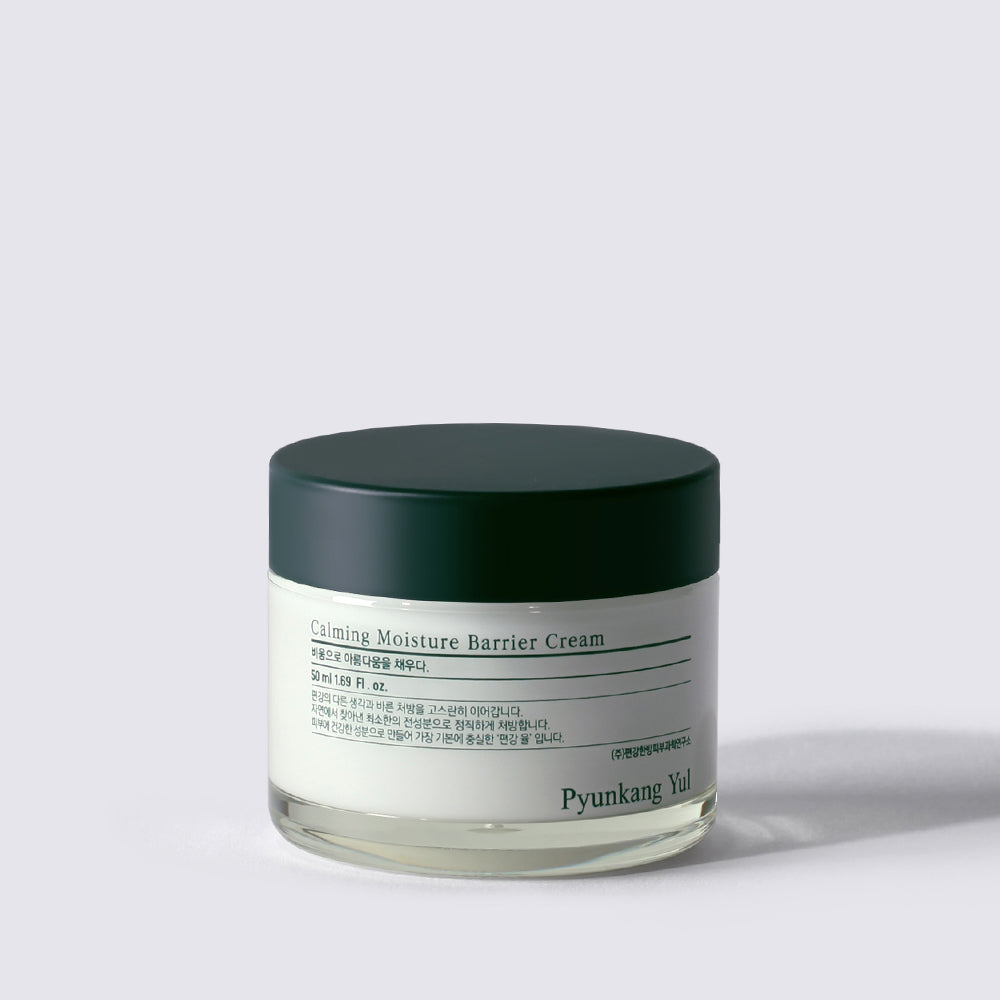
Pyunkang Yul
Calming Moisture Barrier Cream 50ml
Calming Moisture Barrier Cream 50ml
Pyunkang Yul
calming-moisture-barrier-cream-50ml
Moisturize
9706813260069
Morning or Evening?
How often will you use this product?
Notes


Highlights
WHAT IS IT?
A moisturizing cream with multiple hydrating and soothing ingredients
FEATURES
Calms and reduces inflammation, strengthens moisture barrier, provides deep hydration
BEST FOR
Sensitive skin
CHECKS
Free of parabens, artificial fragrances, colorants
Who Is It For?
Adults Both Men And WomenWhat Does It Help With?
Sensitive And Irritated Skin Dryness InflammationBudget
AffordableHow To Use
Which routine should it be used in?
Instructions:
Key Information


What Pyunkang Yul Says
Product Description:
The Pyunkang Yul Calming Moisture Barrier Cream is a soothing and protective solution for sensitive, irritated skin, formulated with Centella Asiatica Extract, Tea Tree Extract, and Lonicera Japonica Flower Extract to calm and reduce inflammation. It strengthens the skin's moisture barrier with the help of Ceramide, ensuring long-lasting hydration and protection against moisture loss. Enriched with Panthenol, 5 Hyaluronic Acids, Squalene, and Shea Butter, this cream provides deep, nourishing hydration, leaving the skin plump, smooth, and healthy. Designed with EWG safe ingredients, it's ideal for sensitive skin, offering both safety and efficacy without irritation.
About the Brand:
Ingredients Overview
Ingredients List
Water, Dipropylene Glycol, Glycerin, Caprylic/Capric Triglyceride, Isohexadecane, Cetearyl Alcohol, Ethylhexyl Palmitate, Cetyl Ethylhexanoate, Stearic Acid, Hydroxypropyltrimonium Hyaluronate, Hydrolyzed Hyaluronic Acid, Sodium Hyaluronate, Lonicera Japonica (Honeysuckle) Flower Extract, Melaleuca Alternifolia (Tea Tree) Leaf Extract, Sodium Hyaluronate Crosspolymer, Sodium Acetylated Hyaluronate, Ammonium Acryloyldimethyltaurate/VP Copolymer, Cetearyl Glucoside, Pentylene Glycol, Trehalose, Ceramide NP, Arachidic Acid, Glucose, Palmitic Acid, Oleic Acid, Centella Asiatica Extract, Madecassoside, Madecassic Acid, Asiaticoside, Asiatic Acid, Squalane, Olea Europaea (Olive) Fruit Oil, Butyrospermum Parkii (Shea) Butter, Camellia Japonica Flower Extract, Salvia Officinalis (Sage) Leaf Extract, Hydroxyacetophenone, Butylene Glycol, Caprylyl Glycol, Tocopherol, Disodium EDTA, 1,2-Hexanediol, Tromethamine, Hydrogenated Lecithin, Ethylhexylglycerin
Key Ingredients
Centella Asiatica Extract, Tea Tree Extract, Lonicera Japonica Flower Extract, Ceramide, Panthenol, 5 Hyaluronic Acids, Squalene, Shea Butter
Ingredients Details
Caprylic/capric Triglyceride
Common Name(s): Mct oil,fractionated coconut oil,c8/c10 triglyceride
CAS Number: 73398-61-5
DESCRIPTION
What It Does: Lightweight, stable emollient that solubilizes oil-soluble actives for excellent delivery without greasy feel.
Why It's Used: Universal lightweight emollient base and solubilizer for oil-soluble actives in serums and low-viscosity formulations where mineral oil or petrolatum would be too heavy.
How It Works: Medium-chain length provides ideal balance of spreading coefficient, penetration rate, and barrier-sealing properties. excellent solubilizer for vitamin e, retinoids, and other lipophilic actives.
Typically Found In: Serums,facial oils,sunscreens,anti-aging products,hair products
TECHNICAL DETAILS
Primary Category: Active ingredient – medium-chain triglyceride emollient
Secondary Functions: Active solubilizer,spreading agent
Application Areas:

Facial Skincare
Body Care
Hair Care

Beard Care
Color Cosmetics (Makeup)
Dietary/Oral Supplements
Typical Concentration Range: 1%–50%
SOURCING & ETHICS
Vegan Status: Conditional - feedstock declaration required
Halal Status: Unverified - feedstock declaration required (plant, animal and petrochemical routes all exist)
Source Notes: Fractionated by hydrolysis and re-esterification of coconut oil. only c8 and c10 fatty acids retained. [audit 2026-07-29 rev2: origin-dependent: the same inci exists in plant, animal and petrochemical versions and the name does not discriminate. determination requires shariah-panel sign-off.]
SKIN COMPATIBILITY
Irritancy Rating: 1/5 – very low
Comedogenicity Rating: 1/5 – very low; medium-chain length generally non-comedogenic
Sensitivity Concerns: Non-irritating.
Safe for Sensitive Skin: Yes
SAFETY & COMPATIBILITY
Safety Profile: Excellent safety profile. ewg score: 1.
Works Well With: Humectants,ceramides,actives as carrier
Avoid Combining With: No significant incompatibilities
SCIENTIFIC NOTE
Mct oil's medium-chain length (c8/c10) provides superior oxidative stability vs longer polyunsaturated chains and better skin aesthetics (lighter, less greasy) vs longer chain emollients (c16/c18). excellent solubilizer for retinoic acid, tocopheryl esters, and other lipophilic actives.
Last Verified: 2026-03-12
Primary Sources: Cosing database,cir safety assessment,ewg skin deep
Cetearyl Alcohol
Common Name(s): Cetostearyl alcohol,c16-18 fatty alcohol
CAS Number: 8005-44-5
DESCRIPTION
What It Does: Provides fatty alcohol emulsification and thickening for stable, well-textured emulsions.
Why It's Used: The most widely used fatty alcohol in cosmetics – provides emulsification, thickening, and emolliency simultaneously from a single ingredient with excellent safety profile.
How It Works: Forms bilayer lamellar structures in water with emulsifiers creating a viscous structured network that thickens and stabilizes emulsions. fatty alcohol emolliency provides direct skin conditioning. bilayer formation reduces inter-droplet coalescence in emulsions.
Typically Found In: Creams,lotions,conditioners – virtually all emulsion products
TECHNICAL DETAILS
Primary Category: Functional ingredient – fatty alcohol emulsifier/thickener
Secondary Functions: Barrier sealing,softening
Application Areas:
Facial Skincare
Body Care
Hair Care
Beard Care
Color Cosmetics (Makeup)
Dietary/Oral Supplements
Typical Concentration Range: 1%–25%
SOURCING & ETHICS
Vegan Status: Yes - standard ethanol routes are non-animal; confirm denaturant origin
Halal Status: Conditional - ethanol production route and residual concentration; jurisdiction-dependent, refer to certifier stance
Source Notes: Plant-derived, synthetic or animal-derived. verify source. [audit 2026-07-29 rev2: ethanol pathway; determination depends on route, on whether the plant also produces beverage alcohol, and on residual concentration. determination requires shariah-panel sign-off.]
SKIN COMPATIBILITY
Irritancy Rating: 1/5 – very low
Comedogenicity Rating: 1/5 – low; formulation-dependent
Sensitivity Concerns: Non-irritating.
Safe for Sensitive Skin: Yes
SAFETY & COMPATIBILITY
Safety Profile: Excellent safety profile. ewg score: 1.
Works Well With: Humectants,ceramides,actives as carrier
Avoid Combining With: No significant incompatibilities
SCIENTIFIC NOTE
Cetearyl alcohol's ability to form lamellar liquid crystal structures ('krafft phases') with water and co-emulsifiers provides not only emulsion stability but also enhanced skin penetration via the lamellar skin barrier pathway. these crystalline structures can act as a reservoir for active ingredients, slowly releasing them as the lamellar structure melts on skin contact.
Last Verified: 2026-03-12
Primary Sources: Cosing database,cir safety assessment
Cetyl Ethylhexanoate
Common Name(s): Cetyl ethylhexanoate,cetyl ethylhexanoate,cosmetic functional ingredient,established active
CAS Number: N/a
DESCRIPTION
What It Does: Provides the characteristic cosmetic function of its ingredient class through molecular chemistry at recommended use concentration.
Why It's Used: Cetyl ethylhexanoate is selected for the specific functional properties of its molecular class — the chemical architecture of cetyl ethylhexanoate delivers the required cosmetic performance through documented interactions with skin biology and formulation matrix.
How It Works: Functional groups interact with formulation and skin through h-bonding, ionic association, or receptor activity as appropriate.
Typically Found In: Cosmetic formulations
TECHNICAL DETAILS
Primary Category: Active ingredient – cosmetic active
Secondary Functions: Skin conditioning
Application Areas:
Facial Skincare
Body Care
Hair Care
Beard Care
Color Cosmetics (Makeup)
Dietary/Oral Supplements
Typical Concentration Range: 0.1%–10%
SOURCING & ETHICS
Vegan Status: Conditional - supplier confirmation required
Halal Status: Unverified - supplier confirmation required
Source Notes: Commercially produced for cosmetic use. verify vegan/halal status with supplier. [audit 2026-07-29 rev2: the record's own source_notes does not assert a non-animal origin, or instructs the reader to verify with the supplier; "yes" asserts knowledge the record does not hold. determination requires shariah-panel sign-off.]
SKIN COMPATIBILITY
Irritancy Rating: 1/5 – very low
Comedogenicity Rating: 0/5 – non-comedogenic
Sensitivity Concerns: Well-tolerated by most skin types.
Safe for Sensitive Skin: Yes
SAFETY & COMPATIBILITY
Safety Profile: Good safety profile at recommended concentrations. ewg score: 1–2.
Works Well With: Standard skincare actives
Avoid Combining With: No known significant incompatibilities
SCIENTIFIC NOTE
Safety documented in cosing at standard formulation concentrations.
Last Verified: 2026-03-22
Primary Sources: Cosing database,cetyl ethylhexanoate technical review
Dipropylene Glycol
Common Name(s): Dipropylene glycol,glycol co-solvent,humectant formulation aid
CAS Number: N/a
DESCRIPTION
What It Does: Provides humectant, co-solvent, and fragrance fixative in cosmetic formulations, improving active ingredient dissolution and product texture while delivering mild skin conditioning.
Why It's Used: Glycol solvents are essential for dissolving actives with limited water or oil solubility — the intermediate polarity of glycol ethers provides access to the wider solubility parameter space between pure water and oil phases.
How It Works: Hydroxyl and ether groups provide h-bonding for water miscibility; the organic chain provides compatibility with lipophilic actives. medium-chain glycols (c3–c6) provide the optimal balance of water compatibility, lipophilic active dissolution, and skin-compatible humectancy.
Typically Found In: Skin care formulations,co-solvent systems
TECHNICAL DETAILS
Primary Category: Functional ingredient – humectant
Secondary Functions: Tewl reduction,skin plumping
Application Areas:
Facial Skincare
Body Care
Hair Care
Beard Care
Color Cosmetics (Makeup)
Dietary/Oral Supplements
Typical Concentration Range: 1%–30%
SOURCING & ETHICS
Vegan Status: Conditional - supplier confirmation required
Halal Status: Unverified - supplier confirmation required
Source Notes: Synthetic or naturally derived. excellent aqueous solubility. [audit 2026-07-29 rev2: status downgraded on audit. determination requires shariah-panel sign-off.]
SKIN COMPATIBILITY
Irritancy Rating: 1/5 – very low
Comedogenicity Rating: 0/5 – non-comedogenic
Sensitivity Concerns: Non-irritating; suitable for all skin types.
Safe for Sensitive Skin: Yes
SAFETY & COMPATIBILITY
Safety Profile: Excellent safety profile. ewg score: 1.
Works Well With: Ceramides,emollients,occlusives,glycerin,hyaluronic acid
Avoid Combining With: No significant incompatibilities
SCIENTIFIC NOTE
Glycol ether co-solvents enhance sc penetration of co-applied actives by increasing their thermodynamic activity in the sc lipid phase — high thermodynamic activity (near saturation) drives diffusion by concentration gradient even when absolute concentration is low.
Last Verified: 2026-03-12
Primary Sources: Cosing database,dipropylene glycol glycol solvent review