
![[Bundle of 4] Simple Protect N Glow Vitamin C Glow Facial Wash 150Ml + Clay Mask 50G + Moisturising Glow Gel 40G + Soothing Toner 200Ml (121122056 + 121122055 + 121122057 + 121012399)](http://mosaique.skin/cdn/shop/files/195913_1.jpg?v=1757591294&width=3840)
SIMPLE
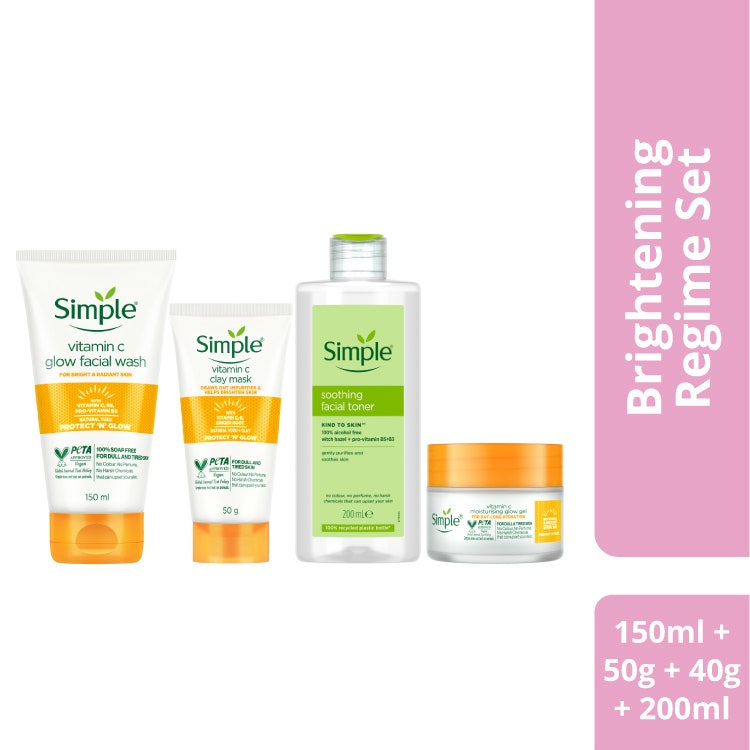
[Bundle of 4] Simple Protect N Glow Vitamin C Glow Facial Wash 150Ml + Clay Mask 50G + Moisturising Glow Gel 40G + Soothing Toner 200Ml (121122056 + 121122055 + 121122057 + 121012399)

[Bundle of 4] Simple Protect N Glow Vitamin C Glow Facial Wash 150Ml + Clay Mask 50G + Moisturising Glow Gel 40G + Soothing Toner 200Ml (121122056 + 121122055 + 121122057 + 121012399)
SIMPLE
bundle-of-4-simple-protect-n-glow-vitamin-c-glow-facial-wash-150ml-clay-mask-50g-moisturising-glow-gel-40g-soothing-toner-200ml-121122056-121122055-121122057-121012399
Face Mask
10084894998821
Morning or Evening?
How often will you use this product?
Notes


Highlights
WHAT IS IT?
Clay Mask with 14 ingredients
FEATURES
Removes dust and impurities, unclogs pores, 3x antioxidants blend, removes excess oil, sebum, and pollution, brightens skin, hydrates and brightens skin, suitable for all skin types including sensitive
BEST FOR
sensitive
CHECKS
Paraben-Free,Preservative-Free
Who Is It For?
All Genders And Ages Not SpecifiedWhat Does It Help With?
Removing Dust Impurities Excess Oil Sebum Pollution Dead Cells Dark Spots Hydration BrightnessBudget
Mid-range ($30-$75)How To Use
Which routine should it be used in?
Instructions:
Key Information


What SIMPLE Says
Product Description:
Infused with Yuzu Lemon, Ginger, and 100% Bentonite Clay, Simple Vitamin C Clay Mask is proven to remove dust and impurities like a magnet by unclogging pores to reveal skin's natural glow. With 3x blend of antioxidants, this clay mask removes excess oil, sebum, and pollution for bright, fresh, and glowing skin. The added infusion of Glycerine and Ginger Root Juice gives this mask the dual benefit of removing dead cells and dark spots while leaving the skin hydrated and bright. Suitable for all skin types, even the most sensitive ones.
About the Brand:
Ingredients Overview
Ingredients List
AQUA,KAOLIN,GLYCERIN,BENTONITE,STEARIC-ACID,PHENOXYETHANOL,SODIUM-COCOYL-ISETHIONATE,CITRIC-ACID,COCONUT-ACID,SODIUM-ISETHIONATE,NIACINAMIDE,SODIUM-ASCORBYL-PHOSPHATE,TOCOPHERYL-ACETATE,ZINGIBER-OFFICINALE-(GINGER)-ROOT-JUICE,CITRUS-JUNOS-FRUIT-EXTRACT
Key Ingredients
Yuzu Lemon,Ginger,Bentonite Clay,Glycerine,Ginger Root Juice,3x antioxidants
Ingredients Details
Bentonite
Common Name(s): Montmorillonite,volcanic ash clay,swelling clay
CAS Number: 1302-78-9
DESCRIPTION
What It Does: Provides thixotropic clay gellation and deep oil absorption from swelling smectite clay.
Why It's Used: Strongest adsorbing clay for deep cleansing masks – bentonite's high cation exchange capacity and swelling capacity provide the deepest oil and toxin adsorption of common cosmetic clays.
How It Works: Montmorillonite 2:1 layered silicate swells up to 15× in water via interlayer water absorption. very high cation exchange capacity (cec: 80-150 meq/100g) provides exceptional adsorption of cations, oils, and toxins. thixotropic gel provides 'mask that hardens' sensory experience.
Typically Found In: Clay masks,deep cleansing products,detoxifying formulas
TECHNICAL DETAILS
Primary Category: Functional ingredient – swelling clay mineral
Secondary Functions: Skin conditioning
Application Areas:

Facial Skincare

Body Care
Hair Care
Beard Care
Color Cosmetics (Makeup)
Dietary/Oral Supplements
Typical Concentration Range: 1%–25%
SOURCING & ETHICS
Vegan Status: Conditional - supplier confirmation required
Halal Status: Unverified - supplier confirmation required
Source Notes: Commercially produced for cosmetic use. verify vegan/halal status with supplier. [audit 2026-07-29 rev2: the record's own source_notes does not assert a non-animal origin, or instructs the reader to verify with the supplier; "yes" asserts knowledge the record does not hold. determination requires shariah-panel sign-off.]
SKIN COMPATIBILITY
Irritancy Rating: 1/5 – very low
Comedogenicity Rating: 0/5 – non-comedogenic
Sensitivity Concerns: Well-tolerated by most skin types.
Safe for Sensitive Skin: Yes
SAFETY & COMPATIBILITY
Safety Profile: Good safety profile at recommended concentrations. ewg score: 1–2.
Works Well With: Standard skincare actives
Avoid Combining With: No known significant incompatibilities
SCIENTIFIC NOTE
Bentonite's extraordinary swelling (up to 15× dry volume) arises from its 2:1 layer structure: sodium bentonite's inter-layer sodium cations attract very thick water shells, forcing the silicate layers apart by electrostatic repulsion. calcium bentonite swells only 2-3× by comparison, explaining why sodium-exchanged bentonite is the industrial standard for swelling applications.
Last Verified: 2026-03-12
Primary Sources: Cosing database,cir safety assessment
Glycerin
Common Name(s): Glycerol,glycerine,1,2,3-propanetriol
CAS Number: 56-81-5
DESCRIPTION
What It Does: Glycerin pulls water from the environment and deeper skin layers into the outer skin layer (epidermis), boosting moisture levels and keeping skin soft, smooth, and plump.
Why It's Used: It is used in virtually every moisturizer, serum, and cleanser because it is highly effective at hydrating skin, is well-tolerated by all skin types, and enhances the texture and spreadability of formulations.
How It Works: As a humectant, glycerin forms hydrogen bonds with water molecules, trapping them in the skin. it also reinforces the skin barrier by integrating into lipid structures between skin cells.
Typically Found In: Moisturizers,serums,cleansers,toners,sheet masks,sunscreens,body lotions,shampoos,conditioners
TECHNICAL DETAILS
Primary Category: Humectant
Secondary Functions: Skin barrier support,emollient,solvent
Application Areas:
Facial Skincare
Body Care
Hair Care
Beard Care
Color Cosmetics (Makeup)
Dietary/Oral Supplements
Typical Concentration Range: 1%–30% (typical: 3–10%)
SOURCING & ETHICS
Vegan Status: Conditional - feedstock declaration required
Halal Status: Unverified - feedstock declaration required (plant, animal and petrochemical routes all exist)
Source Notes: Derived from plant oils via hydrolysis or saponification; synthetic versions also available. palm-derived glycerin carries sustainability concerns. [audit 2026-07-29 rev2: origin-dependent: the same inci exists in plant, animal and petrochemical versions and the name does not discriminate. determination requires shariah-panel sign-off.]
SKIN COMPATIBILITY
Irritancy Rating: 1/5 – very low; non-irritating at all standard concentrations
Comedogenicity Rating: 0/5 – non-comedogenic
Sensitivity Concerns: Extremely rare allergic reactions; generally safe for all skin types including sensitive and baby skin
Safe for Sensitive Skin: Yes
SAFETY & COMPATIBILITY
Safety Profile: Widely recognized as safe. ewg hazard score: 1. no significant concerns for irritation, sensitization, or toxicity at typical concentrations (up to 50%).
Works Well With: Hyaluronic acid,ceramides,niacinamide,panthenol,urea,peptides,retinol,ahas/bhas
Avoid Combining With: No known incompatibilities at standard concentrations
SCIENTIFIC NOTE
Glycerin is an endogenous skin component found naturally in the stratum corneum. aquaporin-3 channels in keratinocytes facilitate glycerin transport, making it integral to natural skin hydration pathways.
Last Verified: 2026-03-12
Primary Sources: Cosing database,cir safety assessment,ewg skin deep,inci decoder
Kaolin
Common Name(s): China clay,kaolinite,white cosmetic clay
CAS Number: 1332-58-7
DESCRIPTION
What It Does: Provides oil absorption and matting from the fine platelet clay structure.
Why It's Used: Most versatile cosmetic clay – gentle enough for sensitive skin while providing effective oil absorption, matting, and mineral conditioning.
How It Works: 1:1 layered silicate clay platelets absorb oils via capillary action in inter-platelet spaces. very mild ph (6-7). white colour from al-o-si lattice. fine particle size (0.5-4μm) provides gentle exfoliation and smooth texture. negative surface charge provides light skin conditioning.
Typically Found In: Masks,foundations,dry shampoo,mattifying products
TECHNICAL DETAILS
Primary Category: Functional ingredient – white clay mineral
Secondary Functions: Skin conditioning
Application Areas:
Facial Skincare
Body Care
Hair Care
Beard Care
Color Cosmetics (Makeup)
Dietary/Oral Supplements
Typical Concentration Range: 0.1%–50%
SOURCING & ETHICS
Vegan Status: Conditional - supplier confirmation required
Halal Status: Unverified - supplier confirmation required
Source Notes: Commercially produced for cosmetic use. verify vegan/halal status with supplier. [audit 2026-07-29 rev2: the record's own source_notes does not assert a non-animal origin, or instructs the reader to verify with the supplier; "yes" asserts knowledge the record does not hold. determination requires shariah-panel sign-off.]
SKIN COMPATIBILITY
Irritancy Rating: 1/5 – very low
Comedogenicity Rating: 0/5 – non-comedogenic
Sensitivity Concerns: Well-tolerated by most skin types.
Safe for Sensitive Skin: Yes
SAFETY & COMPATIBILITY
Safety Profile: Good safety profile at recommended concentrations. ewg score: 1–2.
Works Well With: Standard skincare actives
Avoid Combining With: No known significant incompatibilities
SCIENTIFIC NOTE
Kaolin's oil absorption mechanism involves genuine capillary condensation of oils into the inter-platelet micropores between its layered silicate sheets. the surface area of cosmetic-grade kaolin (10-30 m²/g) provides thousands of square meters of oil-adsorbing surface per gram – explaining its exceptional mattifying efficacy despite its inert mineral composition.
Last Verified: 2026-03-12
Primary Sources: Cosing database,cir safety assessment
Niacinamide
Common Name(s): Vitamin b3,nicotinamide,pyridine-3-carboxamide
CAS Number: 98-92-0
DESCRIPTION
What It Does: Niacinamide strengthens the skin barrier, reduces visible pore size, regulates sebum production, fades dark spots, and improves skin texture and tone.
Why It's Used: It is used because it addresses multiple skin concerns at once without irritation, making it suitable for all skin types. it is stable in formulations and pairs well with most other actives.
How It Works: Niacinamide inhibits the transfer of melanosomes (pigment packets) to skin cells, reducing hyperpigmentation. it also stimulates ceramide synthesis to strengthen the skin barrier and reduces inflammation by modulating cytokine activity.
Typically Found In: Serums,moisturizers,toners,cleansers,eye creams,sunscreens,primers
TECHNICAL DETAILS
Primary Category: Active ingredient – vitamin
Secondary Functions: Barrier repair,brightening,anti-inflammatory
Application Areas:
Facial Skincare
Body Care
Hair Care
Beard Care
Color Cosmetics (Makeup)
Dietary/Oral Supplements
Typical Concentration Range: 2%–10% (typical: 5%; higher concentrations may cause flushing in some individuals)
SOURCING & ETHICS
Vegan Status: Yes – synthetically produced
Halal Status: Yes – synthetic origin
Source Notes: Commercially produced via synthesis from nicotinic acid or 3-cyanopyridine. no animal-derived sources used in cosmetic-grade niacinamide.
SKIN COMPATIBILITY
Irritancy Rating: 1/5 – very low; concentrations above 10% may cause temporary flushing in sensitive individuals
Comedogenicity Rating: 0/5 – non-comedogenic
Sensitivity Concerns: At concentrations >10%, some users experience niacin flush (transient redness/tingling). generally very well-tolerated.
Safe for Sensitive Skin: Yes – one of the best-tolerated actives for sensitive skin
SAFETY & COMPATIBILITY
Safety Profile: Extensively studied and considered very safe. ewg hazard score: 1. no significant systemic toxicity concerns at topical concentrations.
Works Well With: Retinol,peptides,ahas/bhas,hyaluronic acid,ceramides,zinc,vitamin c,spf
Avoid Combining With: High concentrations of vitamin c (ascorbic acid) may theoretically convert to niacin – use at different times if using pure l-ascorbic acid above 15%
SCIENTIFIC NOTE
Niacinamide is a precursor to nad+ and nadp+, coenzymes vital to cellular energy metabolism. its benefits for dna repair and mitochondrial function make it a key ingredient in anti-aging strategies.
Last Verified: 2026-03-12
Primary Sources: Cosing database,cir safety assessment,ewg skin deep,pubmed clinical studies