
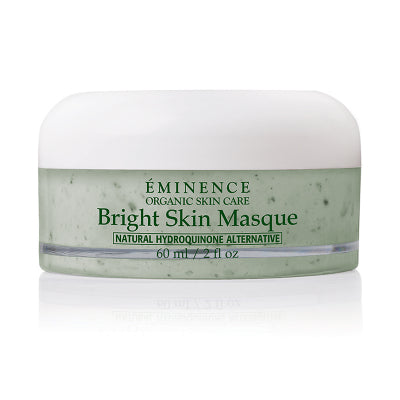

Eminence Organic Skin Care
Bright Skin Masque

Bright Skin Masque
Eminence Organic Skin Care
bright-skin-masque
Face Mask
9628200173861
Morning or Evening?
How often will you use this product?
Notes


Highlights
WHAT IS IT?
Face mask
FEATURES
Brightens skin appearance, reduces appearance of dark spots and signs of aging
BEST FOR
Dry, Normal
CHECKS
Does not contain parabens, sodium lauryl sulfates, synthetic dyes, petrochemicals, animal by-products, phthalates, GMOs, triclosan
Who Is It For?
Not Specified Likely For Adults (18+) Of All GendersWhat Does It Help With?
Uneven Pigmentation Dark Spots Signs Of AgingBudget
PremiumHow To Use
Which routine should it be used in?
Instructions:
Key Information


What Eminence Organic Skin Care Says
Product Description:
Fight off the appearance of uneven pigmentation with our Bright Skin Masque. Natural Hydroquinone Alternative and Swiss Alpine Plant Extracts help brighten skin's appearance and reduce the appearance of dark spots and the signs of aging. Cruelty-free and formulated without parabens, sodium lauryl sulfates, synthetic dyes, petrochemicals, animal by-products, phthalates, GMOs and triclosan.
About the Brand:
Ingredients Overview
Ingredients List
Aloe Barbadensis (Aloe) Juice; Glycyrrhiza Glabra (Licorice) Root Extract; Citrus Limon (Lemon) Peel Extract; Cymbopogon Schoenanthus (Lemongrass) Extract; Salix Alba (Willow) Bark Extract; Arctostaphylos Uva-Ursi (Bearberry) Leaf Extract; Mentha Piperita (Peppermint) Leaf Extract; Rosmarinus Officinalis (Rosemary) Leaf Extract; Salvia Officinalis (Sage) Extract; vegetable glycerin; Cetearyl Alcohol; Bolus Alba (Kaolin Clay); Zea Mays (Corn) Germ Oil; vegetable glycerin; Caesalpinia Spinosa (Tara Tree) Gum; vegetable glycerin; Butyrospermum Parkii (Shea Butter); Glyceryl Stearate; stearic acid; propanediol; Sempervivum Tectorum (Stone Crop) Extract; Cera Alba (Beeswax); Tocopheryl Acetate (Vitamin E); benzyl alcohol; salicylic acid; sorbic acid; Malva Sylvestris (Mallow) Extract; Mentha Piperita (Peppermint) Leaf Extract; Primula Veris Extract; Alchemilla Vulgaris Extract; Veronica Officinalis Extract; Melissa Officinalis Leaf Extract; Achillea Millefolium Extract; Hypoxis Rooperi (African Potato) Extract; panthenol (provitamin B5); lactic acid; sodium cetearyl sulfate; corn-derived methyl glucose sesquistearate; xanthan gum; chlorophyll; sodium benzoate; potassium sorbate; sodium salicylate; Carum Petroselinum (Parsley); Citrus Aurantifolia (Lime) Extract; Lavandula Angustifolia (Lavender) Oil; Citrus Limon (Lemon) Oil; ascorbyl palmitate (vitamin C ester); soy lecithin; biocomplex 2™; Euterpe Oleracea (Acai); Citrus Limon (Lemon); Malpighia Glabra (Barbados Cherry); Emblica Officinalis (Indian Gooseberry); Adansonia Digitata (Baobab); Myrciaria Dubia (Camu Camu); Daucus Carota Sativa (Carrot); Cocos Nucifera (Coconut) Water; Lycium Barbarum (Goji) Berry; tapioca starch (from cassava root); thioctic acid (alpha lipoic acid); ubiquinone (coenzyme Q10)
Key Ingredients
Salicylic Acid, Bearberry Leaf Extract, Rosemary Leaf Extract, Sage Extract, Vitamin E, African Potato Extract, Thioctic Acid (Alpha Lipoic Acid), Ubiquinone (Coenzyme Q10), Lactic Acid, Licorice Root Extract, Vegetable Glycerin, Aloe Juice, Lemongrass Extract, Willow Bark Extract, Sage Extract, Mallow Extract, Achillea Millefolium (Yarrow) Extract, Provitamin B5
Ingredients Details
Salicylic Acid
Common Name(s): Bha,2-hydroxybenzoic acid,orthohydroxybenzoic acid,willow bark acid
CAS Number: 69-72-7
DESCRIPTION
What It Does: Salicylic acid exfoliates the skin surface and inside pores, dissolves the 'glue' holding dead skin cells together, reduces sebum production, and combats acne-causing bacteria.
Why It's Used: Its oil solubility makes it uniquely effective at penetrating pores and dissolving sebum plugs – a function that water-soluble ahas cannot perform. it is the preferred exfoliant for oily, acne-prone, and congested skin.
How It Works: Salicylic acid disrupts desmosomal bonds between corneocytes, promoting exfoliation. its oil solubility allows it to penetrate the sebaceous follicle, dissolving sebum and dead cells. it also has anti-inflammatory properties by inhibiting prostaglandin synthesis.
Typically Found In: Cleansers,toners,serums,spot treatments,masks,chemical peels,anti-dandruff shampoos,acne treatments
TECHNICAL DETAILS
Primary Category: Active ingredient – beta hydroxy acid (bha)
Secondary Functions: Anti-acne,anti-dandruff,keratolytic
Application Areas:

Facial Skincare

Body Care
Hair Care
Beard Care
Color Cosmetics (Makeup)
Dietary/Oral Supplements
Typical Concentration Range: 0.5%–2% (otc acne treatment in us); up to 30% in professional chemical peels
SOURCING & ETHICS
Vegan Status: Yes – synthetic or willow bark derived
Halal Status: Yes
Source Notes: Naturally occurring in willow bark (salix alba) and wintergreen oil. commercially produced synthetically via kolbe-schmitt reaction for cosmetic use.
SKIN COMPATIBILITY
Irritancy Rating: 3/5 – moderate; can cause dryness, peeling, and irritation, especially at higher concentrations
Comedogenicity Rating: 0/5 – non-comedogenic; actually anti-comedogenic
Sensitivity Concerns: Can cause irritation, dryness, and sun sensitivity. avoid contact with eyes. not recommended during pregnancy at high concentrations. can be drying – follow with moisturizer.
Safe for Sensitive Skin: Use with caution – start with lower concentrations and frequency; may not be suitable for reactive or rosacea-prone skin
SAFETY & COMPATIBILITY
Safety Profile: Safe at otc concentrations (0.5–2%). regulated as a drug in some countries (us: fda category i acne treatment). avoid in pregnancy at high concentrations.
Works Well With: Niacinamide,zinc,tea tree oil,benzoyl peroxide (at different times),hyaluronic acid (to counteract dryness)
Avoid Combining With: High concentrations of retinol (cumulative irritation),multiple exfoliating acids simultaneously,benzoyl peroxide in same step (can increase irritation)
SCIENTIFIC NOTE
Salicylic acid is a member of the salicylate family and shares structural similarity with aspirin. its anti-inflammatory mechanism mirrors aspirin's cox inhibition pathway, making it uniquely effective for inflammatory acne.
Last Verified: 2026-03-12
Primary Sources: Cosing database,cir safety assessment,us fda acne monograph,journal of the american academy of dermatology