

Bobbi Brown
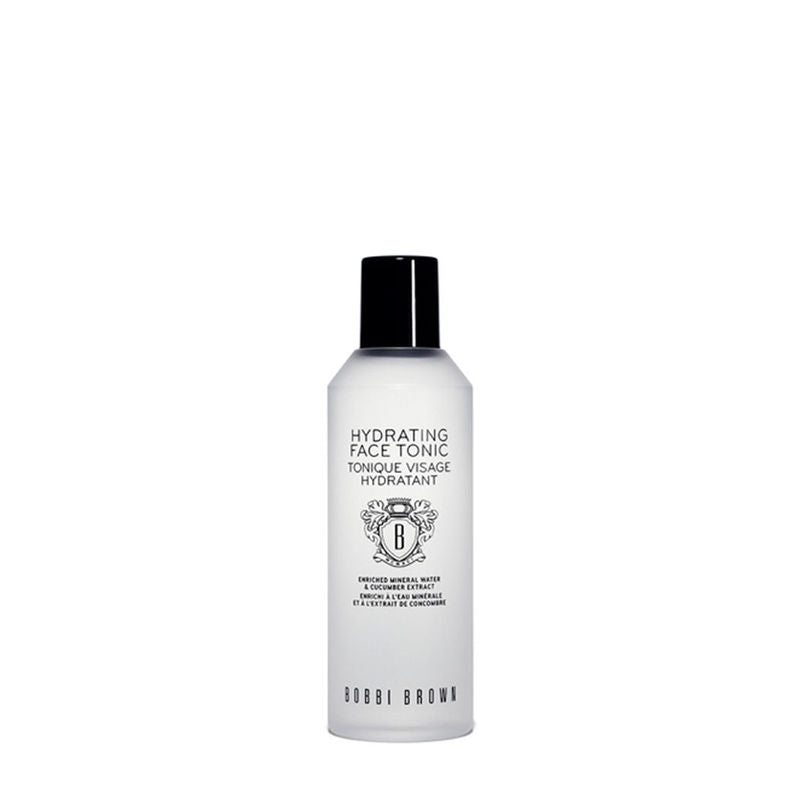
Bobbi Brown Hydrating Face Tonic

Bobbi Brown Hydrating Face Tonic
Bobbi Brown
bobbi-brown-hydrating-face-tonic
Tone
10084999430437
Morning or Evening?
How often will you use this product?
Notes


Highlights
WHAT IS IT?
Skin-conditioning tonic
FEATURES
Restores and balances skin, softens and smooths skin, prepares skin for treatment products, contains Enriched Mineral Water Blend, cucumber, chamomile, licorice, aloe leaf, lavender, Vitamin B5
BEST FOR
dry
CHECKS
Paraben-free, phthalate-free, sulfate-free, sulfite-free
Who Is It For?
Anyone Especially Dry Or Sensitive SkinWhat Does It Help With?
Hydration Skin Softening Skin Conditioning Prepping Skin For TreatmentBudget
Premium ($76-$150)How To Use
Which routine should it be used in?
Instructions:
Key Information


What Bobbi Brown Says
Product Description:
Applied immediately after cleansing, this skin-conditioning tonic begins to restore and balance skin, leaving it soft, smoothed and perfectly prepared for the treatment products to follow. Made with Bobbi Brown's signature Enriched Mineral Water Blend, plus cucumber, chamomile, licorice, aloe leaf and lavender smooth and soften skin. Vitamin B5 softens and conditions so skin is prepared for the next treatment step. Paraben-free; phthalate-free; sulfate-free; sulfite-free
About the Brand:
Ingredients Overview
Ingredients List
Water-Aqua-Eau,Hexylene-Glycol,Butylene-Glycol,Propanediol,Polysorbate-20,Glycerin,Camellia-Sinensis-Leaf-Extract,Cucumis-Sativus-Fruit-Extract,Chamomilla-Recutita-Extract,Aesculus-Hippocastanum-Bark-Extract,Glycyrrhiza-Glabra-Root-Extract,Codium-Tomentosum-Extract,Citrus-Aurantium-Dulcis,Pantethine,Cymbopogon-Martini,Cholesterol,Trehalose,Aloe-Barbadensis-Leaf-Juice,Sodium-Hyaluronate,Lavandula-Angustifolia-Oil,Linoleic-Acid,Acrylates-Copolymer,Phytantriol,Phytosphingosine,Glycine,Hydroxyproline,Proline,Carbomer,Linalool,Geraniol,Limonene,Disodium-Edta,Pentaerythrityl-Tetra-Di-T-Butyl-Hydroxyhydrocinnamate,Phenoxyethanol
Key Ingredients
Enriched Mineral Water Blend, cucumber, chamomile, licorice, aloe leaf, lavender, Vitamin B5
Ingredients Details
Carbomer
Common Name(s): Carbopol,polyacrylic acid,carboxyvinyl polymer
DESCRIPTION
What It Does: Provides transparent gel textures and thickening at very low concentrations via ph-responsive swelling.
Why It's Used: The most widely used gel thickener – provides crystal-clear, stable gels at concentrations as low as 0.1-0.5% with ph-controlled viscosity.
How It Works: Highly crosslinked polyacrylic acid remains tightly coiled at acidic ph. neutralization with naoh or triethanolamine ionizes carboxylic groups causing electrostatic repulsion that unfolds and swells the polymer coils, dramatically increasing viscosity. concentration-dependent thickening.
Typically Found In: Gels,serums,emulsions,sunscreens
TECHNICAL DETAILS
Primary Category: Functional ingredient – polyacrylic acid thickener
Secondary Functions: Skin conditioning
Application Areas:

Facial Skincare

Body Care
Hair Care
Beard Care
Color Cosmetics (Makeup)
Dietary/Oral Supplements
Typical Concentration Range: 0.1%–2%
SOURCING & ETHICS
Vegan Status: Conditional - supplier confirmation required
Halal Status: Unverified - supplier confirmation required
Source Notes: Commercially produced for cosmetic use. verify vegan/halal status with supplier. [audit 2026-07-29 rev2: the record's own source_notes does not assert a non-animal origin, or instructs the reader to verify with the supplier; "yes" asserts knowledge the record does not hold. determination requires shariah-panel sign-off.]
SKIN COMPATIBILITY
Irritancy Rating: 1/5 – very low
Comedogenicity Rating: 0/5 – non-comedogenic
Sensitivity Concerns: Well-tolerated by most skin types.
Safe for Sensitive Skin: Yes
SAFETY & COMPATIBILITY
Safety Profile: Good safety profile at recommended concentrations. ewg score: 1–2.
Works Well With: Standard skincare actives
Avoid Combining With: No known significant incompatibilities
SCIENTIFIC NOTE
Carbomer's ph-responsive swelling mechanism provides an elegant formulation control tool: a neutralized gel can be liquefied by ph reduction (adding acid) and re-thickened by reneutralization. this reversible rheology control allows two-phase products that mix on application without the need for mechanical emulsification.
Last Verified: 2026-03-12
Primary Sources: Cosing database,cir safety assessment
Cholesterol
Common Name(s): 5-cholesten-3-ol,cholesterin
CAS Number: 57-88-5
DESCRIPTION
What It Does: Provides essential barrier sterol function as one of three critical stratum corneum lipid components.
Why It's Used: Essential component of complete barrier repair formulations – the stratum corneum barrier requires ceramides:cholesterol:fatty acids in approximately 1:1:1 molar ratio for complete barrier restoration.
How It Works: Integrates between ceramide headgroups in lamellar body structures, providing fluidity and flexibility to the otherwise rigid ceramide-dominated lipid matrix. controls lamellar body phase behavior for functional barrier.
Typically Found In: Barrier repair moisturizers,eczema treatments,dry skin formulations
TECHNICAL DETAILS
Primary Category: Active ingredient – barrier sterol
Secondary Functions: Lamellar body structure,barrier sterol
Application Areas:
Facial Skincare
Body Care
Hair Care
Beard Care
Color Cosmetics (Makeup)
Dietary/Oral Supplements
Typical Concentration Range: 0.01%–1%
SOURCING & ETHICS
Vegan Status: Conditional - feedstock declaration required
Halal Status: Unverified - feedstock declaration required (plant, animal and petrochemical routes all exist)
Source Notes: Traditionally from lanolin (wool grease). plant-derived cholesterol alternatives include phytosterols, though these show slightly different barrier integration. verify for vegan/halal. [audit 2026-07-29 rev2: origin-dependent: the same inci exists in plant, animal and petrochemical versions and the name does not discriminate. determination requires shariah-panel sign-off.]
SKIN COMPATIBILITY
Irritancy Rating: 1/5 – very low
Comedogenicity Rating: 0/5 – non-comedogenic
Sensitivity Concerns: Endogenous molecule; excellent tolerability.
Safe for Sensitive Skin: Yes
SAFETY & COMPATIBILITY
Safety Profile: Exceptional safety profile. natural skin component. ewg score: 1.
Works Well With: Other ceramides,cholesterol,free fatty acids,hyaluronic acid,niacinamide
Avoid Combining With: No significant incompatibilities
SCIENTIFIC NOTE
Elias demonstrated that barrier repair requires all three lipid classes (ceramides, cholesterol, fatty acids) in approximately equimolar ratios. formulations providing only ceramides without cholesterol and fatty acids show significantly inferior barrier restoration vs complete triple-lipid combinations.
Last Verified: 2026-03-12
Primary Sources: Cosing database,elias et al. barrier lipid ratio study,loden barrier repair review
Geraniol
Common Name(s): (e)-3,7-dimethyl-2,6-octadien-1-ol,geranyl alcohol
CAS Number: 106-24-1
DESCRIPTION
What It Does: Provides fresh rose-geranium floral scent with antimicrobial activity.
Why It's Used: The rose fragrance terpene – geraniol defines the fresh, sweet rose-geranium note found in more than 60 essential oils and is essential for recreating natural floral fragrance profiles.
How It Works: Monoterpene alcohol inhibits bacterial membrane integrity for antimicrobial activity. activates trpv1 for anti-nociception. inhibits nf-kb for anti-inflammatory activity. antioxidant via allylic radical scavenging.
Typically Found In: Rose-scented products,floral fragrances,natural cosmetics
TECHNICAL DETAILS
Primary Category: Fragrance component – acyclic monoterpene alcohol
Secondary Functions: Skin conditioning
Application Areas:
Facial Skincare
Body Care
Hair Care
Beard Care
Color Cosmetics (Makeup)
Dietary/Oral Supplements
Typical Concentration Range: 0.001%–1%
SOURCING & ETHICS
Vegan Status: Conditional - supplier confirmation required
Halal Status: Unverified - supplier confirmation required
Source Notes: Commercially produced for cosmetic use. verify vegan/halal status with supplier. [audit 2026-07-29 rev2: the record's own source_notes does not assert a non-animal origin, or instructs the reader to verify with the supplier; "yes" asserts knowledge the record does not hold. determination requires shariah-panel sign-off.]
SKIN COMPATIBILITY
Irritancy Rating: 1/5 – very low
Comedogenicity Rating: 0/5 – non-comedogenic
Sensitivity Concerns: Well-tolerated by most skin types.
Safe for Sensitive Skin: Yes
SAFETY & COMPATIBILITY
Safety Profile: Eu cosmetics regulation: declared fragrance allergen. ifra guidelines apply.
Works Well With: Standard skincare actives
Avoid Combining With: No known significant incompatibilities
SCIENTIFIC NOTE
Geraniol's isomers (geraniol, nerol, citronellol) provide subtly different scent characters despite identical molecular formulae (c10h18o): geraniol provides the sweet, fresh rose note while its z-isomer nerol has a more delicate, neroli-like character. these isomeric scent differences arise from different spatial presentation of the hydroxyl and double bond groups to the olfactory receptor – demonstrating the extraordinary structural sensitivity of olfactory perception.
Last Verified: 2026-03-12
Primary Sources: Cosing database,ifra standards
Glycerin
Common Name(s): Glycerol,glycerine,1,2,3-propanetriol
CAS Number: 56-81-5
DESCRIPTION
What It Does: Glycerin pulls water from the environment and deeper skin layers into the outer skin layer (epidermis), boosting moisture levels and keeping skin soft, smooth, and plump.
Why It's Used: It is used in virtually every moisturizer, serum, and cleanser because it is highly effective at hydrating skin, is well-tolerated by all skin types, and enhances the texture and spreadability of formulations.
How It Works: As a humectant, glycerin forms hydrogen bonds with water molecules, trapping them in the skin. it also reinforces the skin barrier by integrating into lipid structures between skin cells.
Typically Found In: Moisturizers,serums,cleansers,toners,sheet masks,sunscreens,body lotions,shampoos,conditioners
TECHNICAL DETAILS
Primary Category: Humectant
Secondary Functions: Skin barrier support,emollient,solvent
Application Areas:
Facial Skincare
Body Care
Hair Care
Beard Care
Color Cosmetics (Makeup)
Dietary/Oral Supplements
Typical Concentration Range: 1%–30% (typical: 3–10%)
SOURCING & ETHICS
Vegan Status: Conditional - feedstock declaration required
Halal Status: Unverified - feedstock declaration required (plant, animal and petrochemical routes all exist)
Source Notes: Derived from plant oils via hydrolysis or saponification; synthetic versions also available. palm-derived glycerin carries sustainability concerns. [audit 2026-07-29 rev2: origin-dependent: the same inci exists in plant, animal and petrochemical versions and the name does not discriminate. determination requires shariah-panel sign-off.]
SKIN COMPATIBILITY
Irritancy Rating: 1/5 – very low; non-irritating at all standard concentrations
Comedogenicity Rating: 0/5 – non-comedogenic
Sensitivity Concerns: Extremely rare allergic reactions; generally safe for all skin types including sensitive and baby skin
Safe for Sensitive Skin: Yes
SAFETY & COMPATIBILITY
Safety Profile: Widely recognized as safe. ewg hazard score: 1. no significant concerns for irritation, sensitization, or toxicity at typical concentrations (up to 50%).
Works Well With: Hyaluronic acid,ceramides,niacinamide,panthenol,urea,peptides,retinol,ahas/bhas
Avoid Combining With: No known incompatibilities at standard concentrations
SCIENTIFIC NOTE
Glycerin is an endogenous skin component found naturally in the stratum corneum. aquaporin-3 channels in keratinocytes facilitate glycerin transport, making it integral to natural skin hydration pathways.
Last Verified: 2026-03-12
Primary Sources: Cosing database,cir safety assessment,ewg skin deep,inci decoder