

Clinique
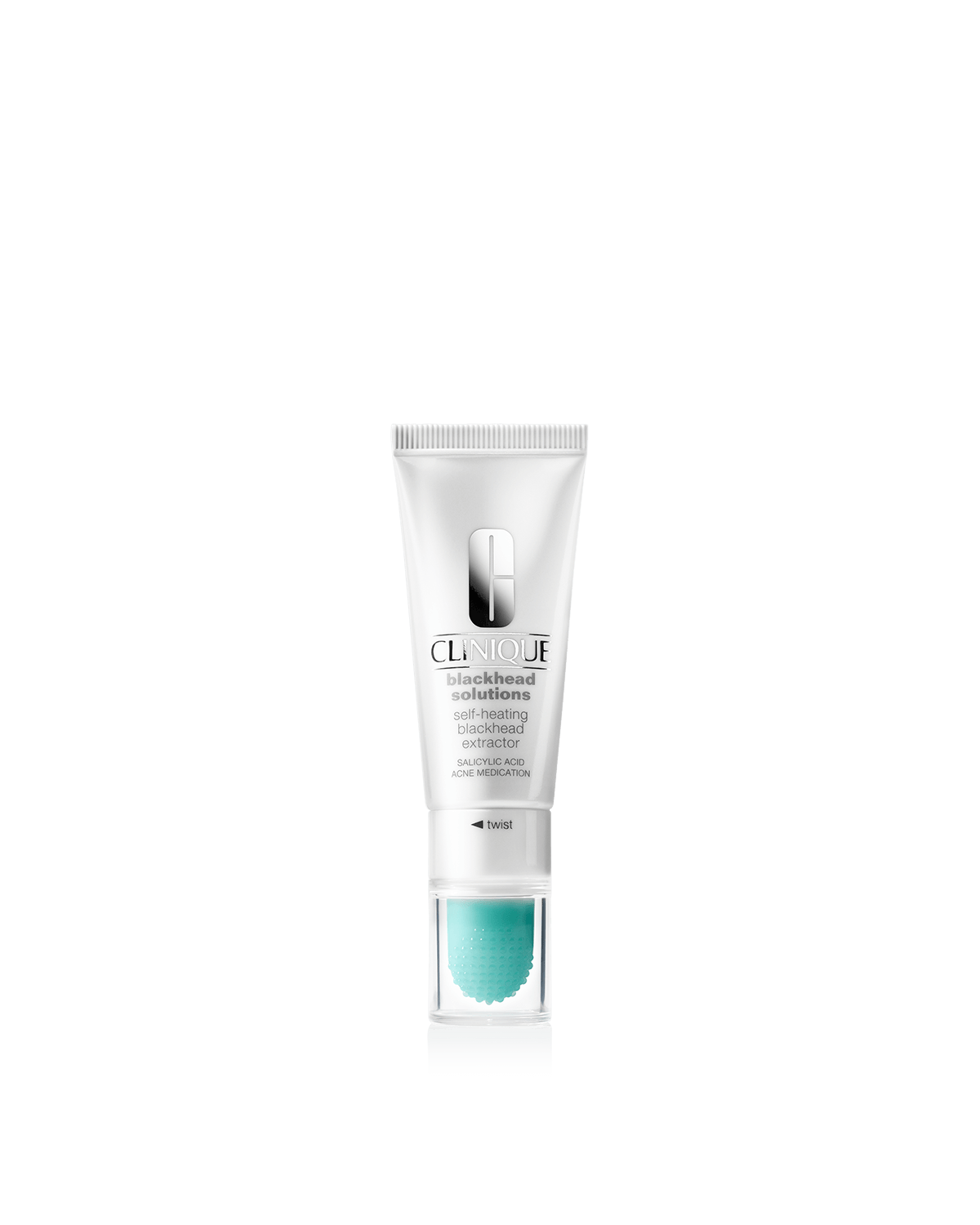
Blackhead Solutions Self-Heating Blackhead Extractor

Blackhead Solutions Self-Heating Blackhead Extractor
Clinique
blackhead-solutions-self-heating-blackhead-extractor
Exfoliation
9784806539557
Morning or Evening?
How often will you use this product?
Notes


Highlights
WHAT IS IT?
Self-heating blackhead extractor treatment
FEATURES
Self-heating formula, Thermal Active Technology, Helps reduce visible blackheads, Minimizes shine, Unclogs pores
BEST FOR
oily
CHECKS
Free of Fragrance, Parabens, Phthalates, Sodium lauryl sulfate, Sodium laureth sulfate
Who Is It For?
All Ages With Blackhead ConcernsWhat Does It Help With?
Blackheads Unclogging Pores Dead Skin Cell Removal Skin Texture ImprovementBudget
Mid-range ($30-$75)How To Use
Which routine should it be used in?
Instructions:
Key Information


What Clinique Says
Product Description:
Self-heating treatment provides a 93% reduction in blackheads in 6 weeks. Gentle yet effective dermatologist-tested formula that helps loosen dirt to unclog pores, clear away dead surface skin cells, and prevent future blackheads.
About the Brand:
Ingredients Overview
Ingredients List
Magnesium Sulfate, Dimethicone, Isononyl Isononanoate, Isododecane, Polysilicone-11, Phenyl Trimethicone, Hydrogenated Lecithin, Acetyl Glucosamine, Polysorbate 20, Polysorbate 80, Polyethylene, Diatomaceous Earth\Solum Diatomeae\Terre De Diatomees, Triethylhexanoin, Pumice, Bambusa Arundinacea (Bamboo) Stem Extract, Peg-15/Lauryl Dimethicone Crosspolymer, Caprylyl Glycol, Stearyl Glycyrrhetinate, Water\Aqua\Eau, Silica
Key Ingredients
salicylic acid, glucosamine, diatomaceous earth, bamboo powder, pumice
Ingredients Details
Acetyl Glucosamine
Common Name(s): Acetyl glucosamine,cosmetic active,functional ingredient
CAS Number: N/a
DESCRIPTION
What It Does: Delivers characteristic cosmetic function — skin conditioning, protection, preservation, or active biological benefit — at recommended use concentration.
Why It's Used: Selected for its functional contribution and formulation compatibility — supported by cosmetic science literature and regulatory safety assessment.
How It Works: Works through the mechanism of its molecular class — physicochemical interaction with the formulation or biological interaction with skin proteins, lipids, or receptors as documented in peer-reviewed literature.
Typically Found In: Skin care formulations
TECHNICAL DETAILS
Primary Category: Active ingredient – cosmetic active
Secondary Functions: Skin conditioning
Application Areas:

Facial Skincare

Body Care
Hair Care
Beard Care
Color Cosmetics (Makeup)
Dietary/Oral Supplements
Typical Concentration Range: 0.1%–10%
SOURCING & ETHICS
Vegan Status: Conditional
Halal Status: Yes
Source Notes: Commercially produced for cosmetic use. verify vegan/halal status with supplier.
SKIN COMPATIBILITY
Irritancy Rating: 1/5 – very low
Comedogenicity Rating: 0/5 – non-comedogenic
Sensitivity Concerns: Well-tolerated by most skin types.
Safe for Sensitive Skin: Yes
SAFETY & COMPATIBILITY
Safety Profile: Good safety profile at recommended concentrations. ewg score: 1–2.
Works Well With: Standard skincare actives
Avoid Combining With: No known significant incompatibilities
SCIENTIFIC NOTE
Acetyl glucosamine delivers documented functional benefit with an established safety profile within the cosmetic regulatory framework (cosing eu, cir usa).
Last Verified: Cosing database,acetyl glucosamine technical literature
Primary Sources: 2026-03-12
Dimethicone
Common Name(s): Pdms,polydimethylsiloxane,silicone fluid
CAS Number: 9006-65-9
DESCRIPTION
What It Does: Provides silicone-characteristic silky feel and skin protection with adjustable viscosity.
Why It's Used: The benchmark cosmetic silicone – sets the gold standard for silky application feel, spreadability, and skin protection in virtually all skin care categories.
How It Works: Polydimethylsiloxane chain flexibility provides extremely low surface tension and high spreadability. inert si-o backbone provides chemical stability and excellent skin tolerance. occlusive film formation reduces tewl. higher viscosity grades provide more intense conditioning.
Typically Found In: Moisturizers,foundations,primers,sunscreens – nearly universal
TECHNICAL DETAILS
Primary Category: Functional ingredient – polydimethylsiloxane
Secondary Functions: Barrier sealing,softening
Application Areas:
Facial Skincare
Body Care
Hair Care
Beard Care
Color Cosmetics (Makeup)
Dietary/Oral Supplements
Typical Concentration Range: 0.1%–30%
SOURCING & ETHICS
Vegan Status: Yes – synthetic
Halal Status: Yes
Source Notes: Plant-derived, synthetic or animal-derived. verify source.
SKIN COMPATIBILITY
Irritancy Rating: 1/5 – very low
Comedogenicity Rating: 1/5 – low; formulation-dependent
Sensitivity Concerns: Non-irritating.
Safe for Sensitive Skin: Yes
SAFETY & COMPATIBILITY
Safety Profile: Excellent safety profile. ewg score: 1.
Works Well With: Humectants,ceramides,actives as carrier
Avoid Combining With: No significant incompatibilities
SCIENTIFIC NOTE
Dimethicone's exceptional silky feel arises from its very low intermolecular attractive forces (weak van der waals forces due to non-polar methyl groups) that allow silicone chains to slide freely over skin. the coefficient of kinetic friction for pdms against skin (~0.04) is among the lowest of any cosmetic material – explaining why even small amounts transform product feel.
Last Verified: Cosing database,cir safety assessment
Primary Sources: 2026-03-12
Hydrogenated Lecithin
Common Name(s): Lecithin/phospholipid,cell membrane lipid,emulsifier barrier repair
CAS Number: N/a
DESCRIPTION
What It Does: Stabilises o/w and w/o emulsions through biomimetic phospholipid bilayer formation, supplements sc barrier lipids for barrier repair, and forms liposomes and lamellar delivery vehicles for encapsulated active delivery.
Why It's Used: Phospholipids are uniquely bifunctional: they provide conventional emulsification and form genuine liposomal bilayer vesicles for encapsulated active delivery — a dual function unavailable from synthetic emulsifiers.
How It Works: The phosphocholine head group provides strong h-bonding hydrophilicity while the dual fatty acid tails provide lipophilic anchoring — this wedge-shaped geometry spontaneously forms closed bilayer vesicles (liposomes) that encapsulate actives for sustained release and enhanced sc penetration.
Typically Found In: Emulsions,liposomal delivery,barrier repair
TECHNICAL DETAILS
Primary Category: Functional ingredient – emollient
Secondary Functions: Barrier sealing,softening
Application Areas:
Facial Skincare
Body Care
Hair Care
Beard Care
Color Cosmetics (Makeup)
Dietary/Oral Supplements
Typical Concentration Range: 1%–15%
SOURCING & ETHICS
Vegan Status: Conditional
Halal Status: Yes
Source Notes: Plant-derived, synthetic or animal-derived. verify source.
SKIN COMPATIBILITY
Irritancy Rating: 1/5 – very low
Comedogenicity Rating: 1/5 – low; formulation-dependent
Sensitivity Concerns: Non-irritating.
Safe for Sensitive Skin: Yes
SAFETY & COMPATIBILITY
Safety Profile: Excellent safety profile. ewg score: 1.
Works Well With: Humectants,ceramides,actives as carrier
Avoid Combining With: No significant incompatibilities
SCIENTIFIC NOTE
Phospholipid's wedge-shaped geometry (large head relative to two acyl tails) preferentially forms spherical bilayer vesicles (liposomes) rather than flat lamellar phases — this curvature preference enables self-assembly of drug delivery liposomes simply by hydration of the phospholipid film.
Last Verified: Cosing database,lecithin phospholipid liposomal delivery review
Primary Sources: 2026-03-12
Isododecane
Common Name(s): Permethyl 99a,c12 isoparaffin,volatile hydrocarbon
CAS Number: 31807-55-3
DESCRIPTION
What It Does: Provides quick-dry volatile hydrocarbon carrier for colour cosmetics with complete evaporation and no residue.
Why It's Used: Primary colour cosmetic carrier — isododecane's volatility and excellent pigment dispersion combined with complete evaporation make it the standard carrier for long-wear foundations and colour cosmetics.
How It Works: Volatile isoparaffin (bp 177-188°c) evaporates from skin within 10-20 minutes. excellent pigment dispersion for colour cosmetics. spreading enhancement from low surface tension. no residue after evaporation provides clean, long-wear finish.
Typically Found In: Long-wear foundations,colour cosmetics,primers,sunscreens
TECHNICAL DETAILS
Primary Category: Functional ingredient – volatile hydrocarbon
Secondary Functions: Barrier sealing,softening
Application Areas:
Facial Skincare
Body Care
Hair Care
Beard Care
Color Cosmetics (Makeup)
Dietary/Oral Supplements
Typical Concentration Range: 5%–60%
SOURCING & ETHICS
Vegan Status: Yes – synthetic
Halal Status: Yes
Source Notes: Plant-derived, synthetic or animal-derived. verify source.
SKIN COMPATIBILITY
Irritancy Rating: 1/5 – very low
Comedogenicity Rating: 1/5 – low; formulation-dependent
Sensitivity Concerns: Non-irritating.
Safe for Sensitive Skin: Yes
SAFETY & COMPATIBILITY
Safety Profile: Excellent safety profile. ewg score: 1.
Works Well With: Humectants,ceramides,actives as carrier
Avoid Combining With: No significant incompatibilities
SCIENTIFIC NOTE
Isododecane's position as the preferred colour cosmetic carrier arises from a unique combination of properties that no other solvent provides simultaneously: volatility (complete evaporation for clean finish), pigment dispersion (superior to water or alcohols), compatibility with silicones (unlike many solvents), and skin safety (inert hydrocarbon without irritation potential of polar solvents).
Last Verified: Cosing database,cir safety assessment
Primary Sources: 2026-03-12
