
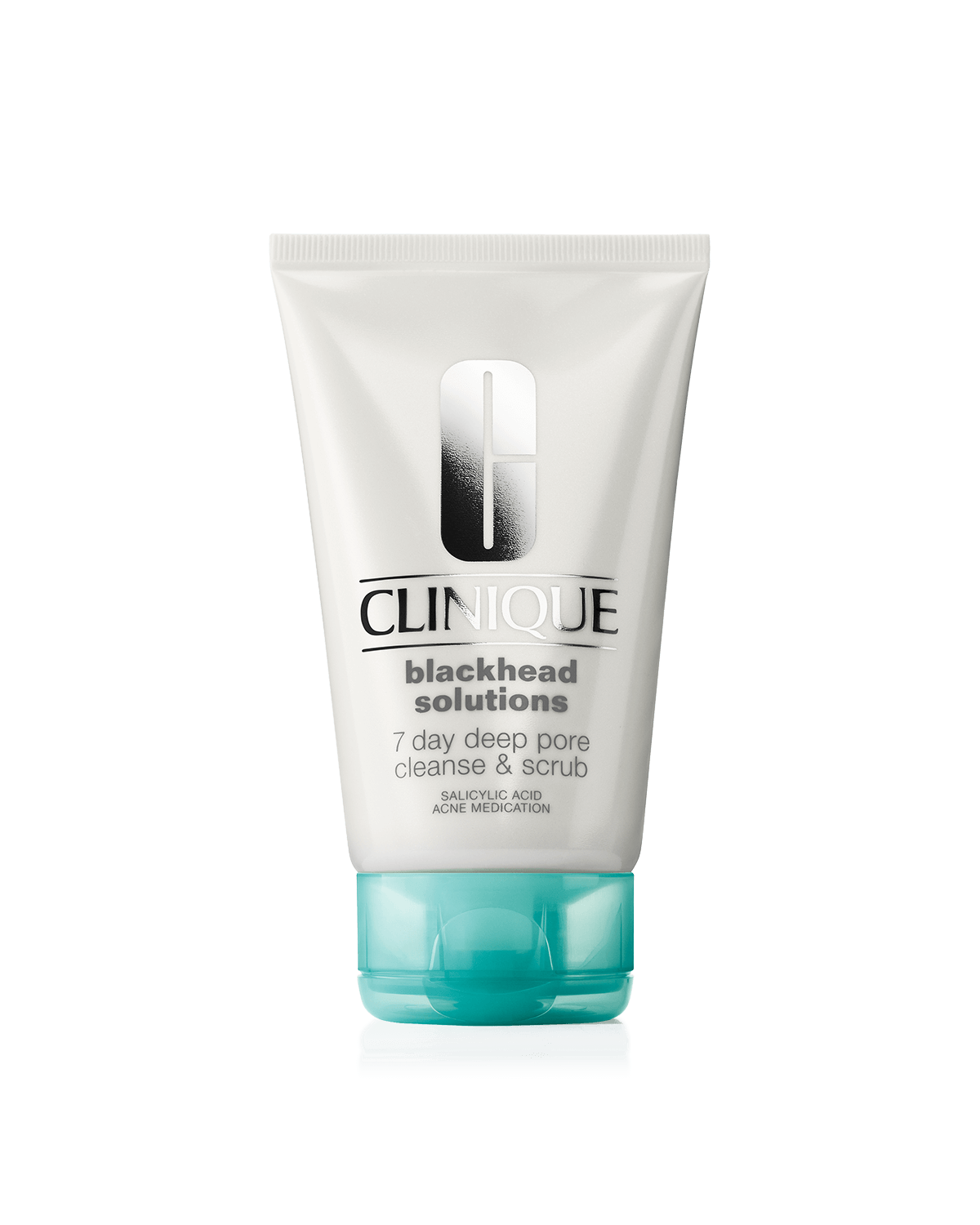

Clinique
Blackhead Solutions 7 Day Deep Pore Cleanse & Scrub

Blackhead Solutions 7 Day Deep Pore Cleanse & Scrub
Clinique
blackhead-solutions-7-day-deep-pore-cleanse-scrub
Exfoliation
9784805425445
Morning or Evening?
How often will you use this product?
Notes


Highlights
WHAT IS IT?
3-in-1 cleanser-scrub-mask
FEATURES
Reduces appearance of visible pores and blackheads, dermatologist tested, allergy tested
BEST FOR
oily
CHECKS
Free of Fragrance, Parabens, Phthalates, Oil, Sodium lauryl sulfate, Sodium laureth sulfate
Who Is It For?
All Ages All GendersWhat Does It Help With?
Blackheads Visible Pores Excess OilBudget
Affordable (under $30)How To Use
Which routine should it be used in?
Instructions:
Key Information


What Clinique Says
Product Description:
3-in-1 cleanser-scrub-mask reduces the appearance of visible pores and blackheads. Dermatologist tested. Allergy tested. 100% fragrance free.
About the Brand:
Ingredients Overview
Ingredients List
Water\Aqua\Eau, Kaolin, Glycerin, Butylene Glycol, Magnesium Aluminum Silicate, Glyceryl Stearate, Peg-100 Stearate, Silica, Sodium Lauroyl Sarcosinate, Allyl Methacrylates Crosspolymer, Gentiana Lutea (Gentian) Root Extract, Laminaria Saccharina Extract, Sucrose, Acetyl Glucosamine, Caprylyl Glycol, 1,2-Hexanediol, Tocopheryl Acetate, Sodium Hydroxide, Xanthan Gum, Disodium Edta, Phenoxyethanol, Titanium Dioxide (Ci 77891), Blue 1 (Ci 42090), Yellow 5 (Ci 19140)
Key Ingredients
salicylic acid, glucosamine, silica, kaolin clay, laminaria saccharina extract, vitamin E
Ingredients Details
Allyl Methacrylates Crosspolymer
Common Name(s): Carbomer/acrylate crosspolymer,highly efficient gel former,rheology modifier
CAS Number: N/a
DESCRIPTION
What It Does: Forms transparent to translucent high-viscosity gels at very low concentration, suspends particles and pigments against sedimentation through yield stress, and provides the elegant shear-thinning texture of premium gel serums.
Why It's Used: The most efficient aqueous thickener available — achieving gel viscosity at 0.1% that requires 3–5% of xanthan gum or 2% of cellulose thickeners, enabling clean-label lightweight formulations with high active loading.
How It Works: At ph <4: –cooh groups protonated, polymer coiled compact, low viscosity. neutralisation with naoh/tea deprotonates –cooh to –coo⁻; like-charge repulsion expands polymer coil 100–1000×. above overlap concentration c* (~0.1%), expanded coils entangle forming viscoelastic gel network providing high zero-shear viscosity and shear-thinning.
Typically Found In: Gel serums,transparent toners,suspension systems
TECHNICAL DETAILS
Primary Category: Active ingredient – cosmetic active
Secondary Functions: Skin conditioning
Application Areas:

Facial Skincare

Body Care
Hair Care
Beard Care
Color Cosmetics (Makeup)
Dietary/Oral Supplements
Typical Concentration Range: 0.1%–2%
SOURCING & ETHICS
Vegan Status: Yes
Halal Status: Yes
Source Notes: Commercially produced for cosmetic use. verify vegan/halal status with supplier.
SKIN COMPATIBILITY
Irritancy Rating: 1/5 – very low
Comedogenicity Rating: 0/5 – non-comedogenic
Sensitivity Concerns: Well-tolerated by most skin types.
Safe for Sensitive Skin: Yes
SAFETY & COMPATIBILITY
Safety Profile: Good safety profile at recommended concentrations. ewg score: 1–2.
Works Well With: Standard skincare actives
Avoid Combining With: No known significant incompatibilities
SCIENTIFIC NOTE
Carbomer is edta-sensitive — divalent cation contamination (ca²⁺, mg²⁺ from hard water) can collapse the electrostatic gel network. including edta or citric acid chelation in carbomer-gelled formulas is standard practice to maintain gel integrity.
Last Verified: Cosing database,carbomer polyacrylate gel mechanism review
Primary Sources: 2026-03-12
Butylene Glycol
Common Name(s): 1,3-butanediol,bg,1,3-butylene glycol
CAS Number: 107-88-0
DESCRIPTION
What It Does: Provides humectant hydration and active ingredient solubilization with excellent skin feel.
Why It's Used: Preferred glycol humectant in premium and k-beauty formulations for superior skin feel vs propylene glycol with equivalent functionality.
How It Works: Two hydroxyl groups at 1,3-positions provide water binding and solvent activity. better tolerated than propylene glycol with minimal sensitization risk. 4-carbon backbone provides slightly greater hydrophobic character enabling dissolution of less polar actives vs pg.
Typically Found In: Toners,essences,serums,k-beauty formulas
TECHNICAL DETAILS
Primary Category: Functional ingredient – glycol humectant
Secondary Functions: Tewl reduction,skin plumping
Application Areas:
Facial Skincare
Body Care
Hair Care
Beard Care
Color Cosmetics (Makeup)
Dietary/Oral Supplements
Typical Concentration Range: 1%–10%
SOURCING & ETHICS
Vegan Status: Yes – synthetic
Halal Status: Yes
Source Notes: Synthetic or naturally derived. excellent aqueous solubility.
SKIN COMPATIBILITY
Irritancy Rating: 1/5 – very low
Comedogenicity Rating: 0/5 – non-comedogenic
Sensitivity Concerns: Non-irritating; suitable for all skin types.
Safe for Sensitive Skin: Yes
SAFETY & COMPATIBILITY
Safety Profile: Excellent safety profile. ewg score: 1.
Works Well With: Ceramides,emollients,occlusives,glycerin,hyaluronic acid
Avoid Combining With: No significant incompatibilities
SCIENTIFIC NOTE
K-beauty's preference for butylene glycol over propylene glycol is driven by two factors: bg's superior skin feel (less tacky than pg's higher viscosity) and its lower sensitization potential (1,3-bg has better spatial distribution of hydroxyl groups that reduces protein interaction vs pg's 1,2-position oh groups).
Last Verified: Cosing database,cir safety assessment
Primary Sources: 2026-03-12
Glycerin
Common Name(s): Glycerol,glycerine,1,2,3-propanetriol
CAS Number: 56-81-5
DESCRIPTION
What It Does: Glycerin pulls water from the environment and deeper skin layers into the outer skin layer (epidermis), boosting moisture levels and keeping skin soft, smooth, and plump.
Why It's Used: It is used in virtually every moisturizer, serum, and cleanser because it is highly effective at hydrating skin, is well-tolerated by all skin types, and enhances the texture and spreadability of formulations.
How It Works: As a humectant, glycerin forms hydrogen bonds with water molecules, trapping them in the skin. it also reinforces the skin barrier by integrating into lipid structures between skin cells.
Typically Found In: Moisturizers,serums,cleansers,toners,sheet masks,sunscreens,body lotions,shampoos,conditioners
TECHNICAL DETAILS
Primary Category: Humectant
Secondary Functions: Skin barrier support,emollient,solvent
Application Areas:
Facial Skincare
Body Care
Hair Care
Beard Care
Color Cosmetics (Makeup)
Dietary/Oral Supplements
Typical Concentration Range: 1%–30% (typical: 3–10%)
SOURCING & ETHICS
Vegan Status: Yes – plant-derived (coconut, soy, palm) or synthetic
Halal Status: Yes – when plant-derived or synthetic; verify source with supplier
Source Notes: Derived from plant oils via hydrolysis or saponification; synthetic versions also available. palm-derived glycerin carries sustainability concerns.
SKIN COMPATIBILITY
Irritancy Rating: 1/5 – very low; non-irritating at all standard concentrations
Comedogenicity Rating: 0/5 – non-comedogenic
Sensitivity Concerns: Extremely rare allergic reactions; generally safe for all skin types including sensitive and baby skin
Safe for Sensitive Skin: Yes
SAFETY & COMPATIBILITY
Safety Profile: Widely recognized as safe. ewg hazard score: 1. no significant concerns for irritation, sensitization, or toxicity at typical concentrations (up to 50%).
Works Well With: Hyaluronic acid,ceramides,niacinamide,panthenol,urea,peptides,retinol,ahas/bhas
Avoid Combining With: No known incompatibilities at standard concentrations
SCIENTIFIC NOTE
Glycerin is an endogenous skin component found naturally in the stratum corneum. aquaporin-3 channels in keratinocytes facilitate glycerin transport, making it integral to natural skin hydration pathways.
Last Verified: Cosing database,cir safety assessment,ewg skin deep,inci decoder
Primary Sources: 2026-03-12
Glyceryl Stearate
Common Name(s): Glycerol monostearate,gms,glycerin monostearate
CAS Number: 31566-31-1
DESCRIPTION
What It Does: Provides o/w emulsification with emolliency and skin feel improvement from a natural glycerol ester.
Why It's Used: Standard cosmetic monoglyceride emulsifier – widely used for o/w cream formation with clean, natural-origin credentials and good sensory profile.
How It Works: Monoglyceride structure (one fatty acid + glycerol) provides amphiphilic hlb ~3-4 for o/w emulsification when combined with higher hlb co-emulsifiers. forms alpha-gel lamellar structure with water for emulsion stabilization. direct skin conditioning via fatty acid film.
Typically Found In: Creams,lotions,moisturizers – standard in o/w emulsions
TECHNICAL DETAILS
Primary Category: Functional ingredient – monoglyceride emulsifier
Secondary Functions: Barrier sealing,softening
Application Areas:
Facial Skincare
Body Care
Hair Care
Beard Care
Color Cosmetics (Makeup)
Dietary/Oral Supplements
Typical Concentration Range: 1%–10%
SOURCING & ETHICS
Vegan Status: Yes – from vegetable glycerol and stearic acid
Halal Status: Yes
Source Notes: Plant-derived, synthetic or animal-derived. verify source.
SKIN COMPATIBILITY
Irritancy Rating: 1/5 – very low
Comedogenicity Rating: 1/5 – low; formulation-dependent
Sensitivity Concerns: Non-irritating.
Safe for Sensitive Skin: Yes
SAFETY & COMPATIBILITY
Safety Profile: Excellent safety profile. ewg score: 1.
Works Well With: Humectants,ceramides,actives as carrier
Avoid Combining With: No significant incompatibilities
SCIENTIFIC NOTE
Glyceryl stearate's alpha-gel lamellar phase formation (distinguishable by x-ray crystallography from beta crystalline phase) provides superior emulsion stability compared to its beta crystalline form. the alpha-gel phase creates a viscoelastic network that resists droplet coalescence – the fundamental mechanism behind gms's long use as a reliable primary emulsifier.
Last Verified: Cosing database,cir safety assessment
Primary Sources: 2026-03-12
