

Bioderma
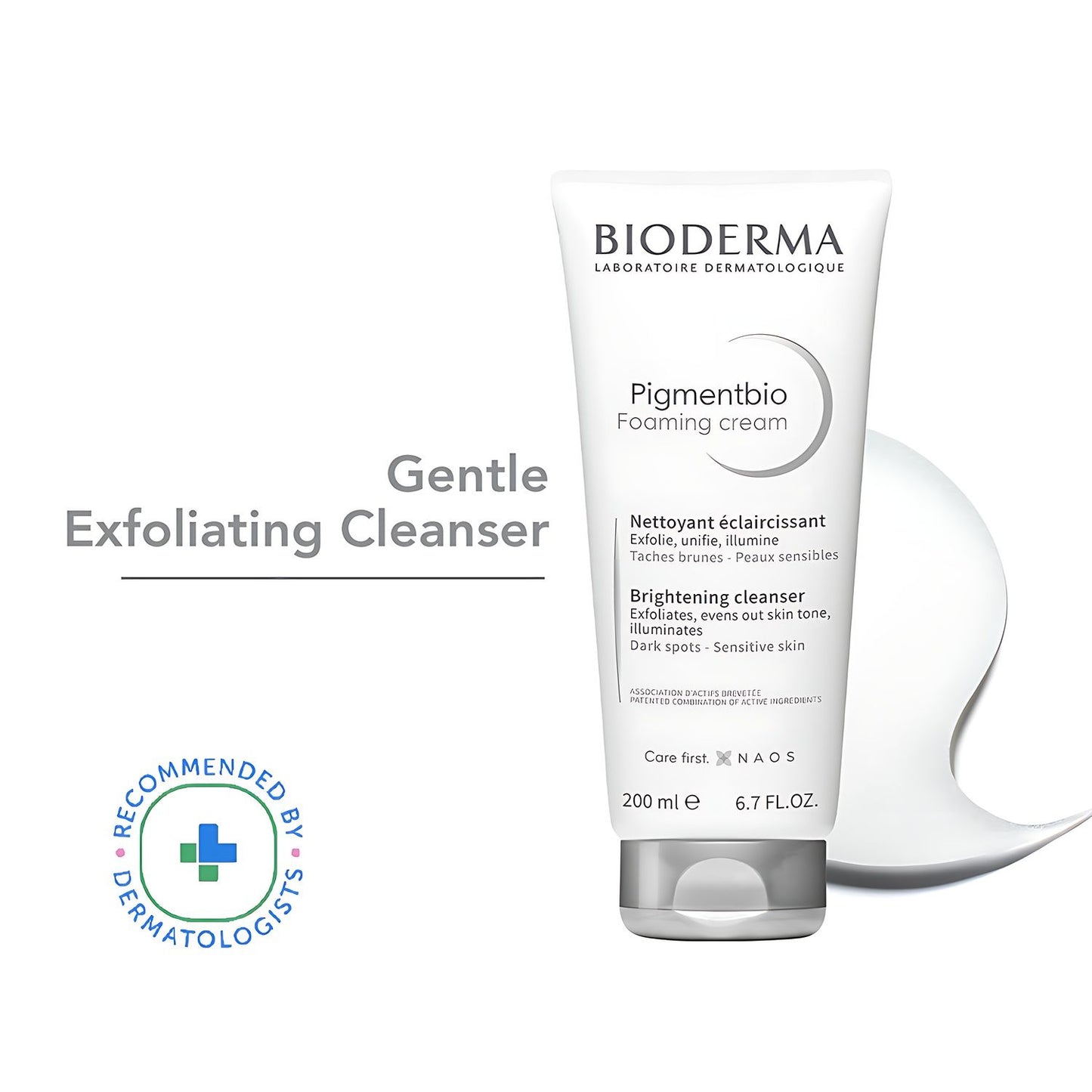
Bioderma Pigmentbio Foaming Cream Brightening Exfoliating Cleanser

Bioderma Pigmentbio Foaming Cream Brightening Exfoliating Cleanser
Bioderma
bioderma-pigmentbio-foaming-cream-brightening-exfoliating-cleanser
Cleanse
10085023416613
Morning or Evening?
How often will you use this product?
Notes


Highlights
WHAT IS IT?
Brightening exfoliating cleanser with 25 ingredients
FEATURES
Gentle foaming cream, brightens skin, exfoliates, soft and hydrated skin, can be used as a face mask
BEST FOR
sensitive
CHECKS
Fragrance
Who Is It For?
Adults All GendersWhat Does It Help With?
Brightening Exfoliating Cleansing HydrationBudget
Affordable (under $30)How To Use
Which routine should it be used in?
Instructions:
Key Information


What Bioderma Says
Product Description:
A gentle foaming cream cleanser that brightens and exfoliates the skin, containing multiple active ingredients to help cleanse and promote a more radiant complexion.
About the Brand:
Ingredients Overview
Ingredients List
Aqua-Water-Eau,Citric-Acid,Butyrospermum-Parkii-Shea-Oil,Magnesium-Laureth-Sulfate,Sodium-Hydroxide,Cellulose-Acetate,Sodium-Cocoamphoacetate,Methylpropanediol,Acrylates-C10-30-Alkyl-Acrylate-Crosspolymer,Coco-Glucoside,Glyceryl-Oleate,Sodium-Cocoyl-Glutamate,Xanthan-Gum,Sodium-Citrate,Benzoic-Acid,Propanediol,Acrylates-Vinyl-Isodecanoate-Crosspolymer,Mannitol,Xylitol,Rhamnose,Tocopherol,Helianthus-Annuus-Sunflower-Seed-Oil,Lysine,Azelaic-Acid,Andrographis-Paniculata-Leaf-Extract,Fructooligosaccharides,Caprylic-Capric-Triglyceride,Hydrogenated-Palm-Glycerides-Citrate,Laminaria-Ochroleuca-Extract,Fragrance-Parfum
Key Ingredients
Azelaic Acid, Andrographis Paniculata Leaf Extract, Tocopherol
Ingredients Details
Coco-glucoside
Common Name(s): Coconut glucoside,apg c8-c16
CAS Number: 68515-73-1
DESCRIPTION
What It Does: Provides gentle, natural-origin cleansing with good foam from mixed coconut chain alkyl glucosides.
Why It's Used: Widely used natural surfactant for green beauty formulations requiring good foam performance with natural-origin and mild credentials.
How It Works: Mixed c8-c16 fatty alcohol chain lengths from coconut provide broader foam stability than single-chain glucosides. non-ionic glucoside headgroup provides mildness. better detergency and rinsing than individual chain-length apgs due to mixed chain distribution.
Typically Found In: Natural shampoos,body washes,facial cleansers
TECHNICAL DETAILS
Primary Category: Functional ingredient – coconut alkyl glucoside
Secondary Functions: Skin conditioning
Application Areas:

Facial Skincare
Body Care
Hair Care

Beard Care
Color Cosmetics (Makeup)
Dietary/Oral Supplements
Typical Concentration Range: 2%–20%
SOURCING & ETHICS
Vegan Status: Yes – from coconut fatty alcohols and glucose
Halal Status: Yes
Source Notes: Commercially produced for cosmetic use. verify vegan/halal status with supplier.
SKIN COMPATIBILITY
Irritancy Rating: 1/5 – very low
Comedogenicity Rating: 0/5 – non-comedogenic
Sensitivity Concerns: Well-tolerated by most skin types.
Safe for Sensitive Skin: Yes
SAFETY & COMPATIBILITY
Safety Profile: Good safety profile at recommended concentrations. ewg score: 1–2.
Works Well With: Standard skincare actives
Avoid Combining With: No known significant incompatibilities
SCIENTIFIC NOTE
Coco-glucoside's natural chain length distribution (c8-c16) provides synergistic surfactant effects where different chain lengths optimize different properties: shorter chains provide initial foam burst, longer chains provide foam stability and soil removal, creating better overall performance than any single chain length alone.
Last Verified: Cosing database,cir safety assessment
Primary Sources: 2026-03-12
Fructooligosaccharides
Common Name(s): Fos,oligofructose,short-chain inulin
CAS Number: 308066-66-2
DESCRIPTION
What It Does: Provides rapid-acting prebiotic microbiome support with humectant conditioning from short-chain fructan oligomers.
Why It's Used: Fast-acting prebiotic for rapid microbiome support — fos's shorter chain length provides faster fermentation by beneficial bacteria vs long-chain inulin, enabling quicker microbiome compositional shifts.
How It Works: Dp 2-10 fructooligomers (vs inulin's dp 10-60) provide more rapid access to bacterial fermentation enzymes. higher water solubility and humectant activity than long-chain inulin. more bioavailable to skin surface bacteria vs longer-chain inulin that penetrates deeper before fermentation.
Typically Found In: Prebiotic skin care,rapid microbiome support products
TECHNICAL DETAILS
Primary Category: Active ingredient – short-chain prebiotic
Secondary Functions: Tewl reduction,skin plumping
Application Areas:
Facial Skincare
Body Care
Hair Care
Beard Care
Color Cosmetics (Makeup)
Dietary/Oral Supplements
Typical Concentration Range: 0.5%–5%
SOURCING & ETHICS
Vegan Status: Yes – from sucrose enzymatic synthesis or inulin hydrolysis
Halal Status: Yes
Source Notes: Synthetic or naturally derived. excellent aqueous solubility.
SKIN COMPATIBILITY
Irritancy Rating: 1/5 – very low
Comedogenicity Rating: 0/5 – non-comedogenic
Sensitivity Concerns: Non-irritating; suitable for all skin types.
Safe for Sensitive Skin: Yes
SAFETY & COMPATIBILITY
Safety Profile: Excellent safety profile. ewg score: 1.
Works Well With: Ceramides,emollients,occlusives,glycerin,hyaluronic acid
Avoid Combining With: No significant incompatibilities
SCIENTIFIC NOTE
Fos's shorter chain length provides different prebiotic kinetics vs long-chain inulin: short-chain fos (dp 2-5) is fermented within 12-24 hours by surface bacteria, while long-chain inulin (dp 10-60) ferments over 48-72 hours. this temporal difference enables formulation of 'fast-acting' (fos) vs 'sustained-release' (inulin) prebiotic products with different microbiome support kinetics.
Last Verified: Cosing database,roberfroid fos prebiotic review
Primary Sources: 2026-03-12
Lysine
Common Name(s): 2,6-diaminohexanoic acid,l-lysine hcl
CAS Number: 56-87-1
DESCRIPTION
What It Does: Provides collagen crosslink precursor activity and nmf conditioning from the essential diaminoamino acid.
Why It's Used: Collagen crosslink amino acid — lysine's hydroxylation to hydroxylysine and subsequent cross-link formation via lysyl oxidase provides the structural crosslinks that give collagen mechanical strength.
How It Works: Converted to hydroxylysine by lysyl hydroxylase. hydroxylysine provides collagen crosslink sites for lysyl oxidase-catalysed aldehyde cross-links. nmf amino acid component. basic amino acid (ε-amino group pka 10.5) provides antimicrobial cationic character. antiviral via competition with arginine (essential for herpes virus replication).
Typically Found In: Collagen-support products,antiviral skin care,nmf products
TECHNICAL DETAILS
Primary Category: Active ingredient – essential amino acid
Secondary Functions: Skin conditioning
Application Areas:
Facial Skincare
Body Care
Hair Care
Beard Care
Color Cosmetics (Makeup)
Dietary/Oral Supplements
Typical Concentration Range: 0.5%–5%
SOURCING & ETHICS
Vegan Status: Yes – fermentation
Halal Status: Yes
Source Notes: Commercially produced for cosmetic use. verify vegan/halal status with supplier.
SKIN COMPATIBILITY
Irritancy Rating: 1/5 – very low
Comedogenicity Rating: 0/5 – non-comedogenic
Sensitivity Concerns: Well-tolerated by most skin types.
Safe for Sensitive Skin: Yes
SAFETY & COMPATIBILITY
Safety Profile: Good safety profile at recommended concentrations. ewg score: 1–2.
Works Well With: Standard skincare actives
Avoid Combining With: No known significant incompatibilities
SCIENTIFIC NOTE
Lysine's antiviral activity for herpes simplex virus is pharmacologically validated: hsv replicates using arginine as a structural protein component, while lysine competes with arginine for cellular uptake via the same transporter. high lysine:arginine ratio reduces viral protein synthesis — the basis for the clinical practice of high-lysine dietary supplementation and topical application for cold sore prevention.
Last Verified: Cosing database,griffith et al. lysine herpes study,cir safety assessment
Primary Sources: 2026-03-12
Mannitol
Common Name(s): D-mannitol,manna sugar,mannite
CAS Number: 69-65-8
DESCRIPTION
What It Does: Provides exceptional hydroxyl radical scavenging antioxidant protection alongside humectant moisture retention.
Why It's Used: Used for potent hydroxyl radical scavenging where standard antioxidants (tocopherol, ascorbic acid) are less effective, combined with humectant activity.
How It Works: 6 hydroxyl groups provide both water binding (humectant) and direct hydroxyl radical (.oh) scavenging. hydroxyl radicals are the most reactive and damaging free radicals – mannitol is one of few compounds that scavenges them directly.
Typically Found In: Antioxidant formulations,premium moisturizers,protective skincare
TECHNICAL DETAILS
Primary Category: Functional ingredient – sugar alcohol / free radical scavenger
Secondary Functions: Free radical scavenger,superior antioxidant
Application Areas:
Facial Skincare
Body Care
Hair Care
Beard Care
Color Cosmetics (Makeup)
Dietary/Oral Supplements
Typical Concentration Range: 1%–10%
SOURCING & ETHICS
Vegan Status: Yes – plant-derived or synthetic
Halal Status: Yes
Source Notes: Plant-derived from ash tree manna, seaweed, mushrooms, or produced by reduction of mannose. gras food-approved.
SKIN COMPATIBILITY
Irritancy Rating: 1/5 – very low
Comedogenicity Rating: 0/5 – non-comedogenic
Sensitivity Concerns: Non-irritating; suitable for all skin types.
Safe for Sensitive Skin: Yes
SAFETY & COMPATIBILITY
Safety Profile: Excellent safety profile. ewg score: 1.
Works Well With: Ceramides,emollients,occlusives,glycerin,hyaluronic acid
Avoid Combining With: No significant incompatibilities
SCIENTIFIC NOTE
Mannitol's rate constant for hydroxyl radical scavenging (k = 1.4 × 10^7 m^-1s^-1) makes it one of the most effective biological hydroxyl radical scavengers. this is important because hydroxyl radicals cannot be scavenged by standard antioxidants like tocopherol or ascorbic acid.
Last Verified: Cosing database,halliwell et al. free radical scavenging,cir safety assessment
Primary Sources: 2026-03-12
