
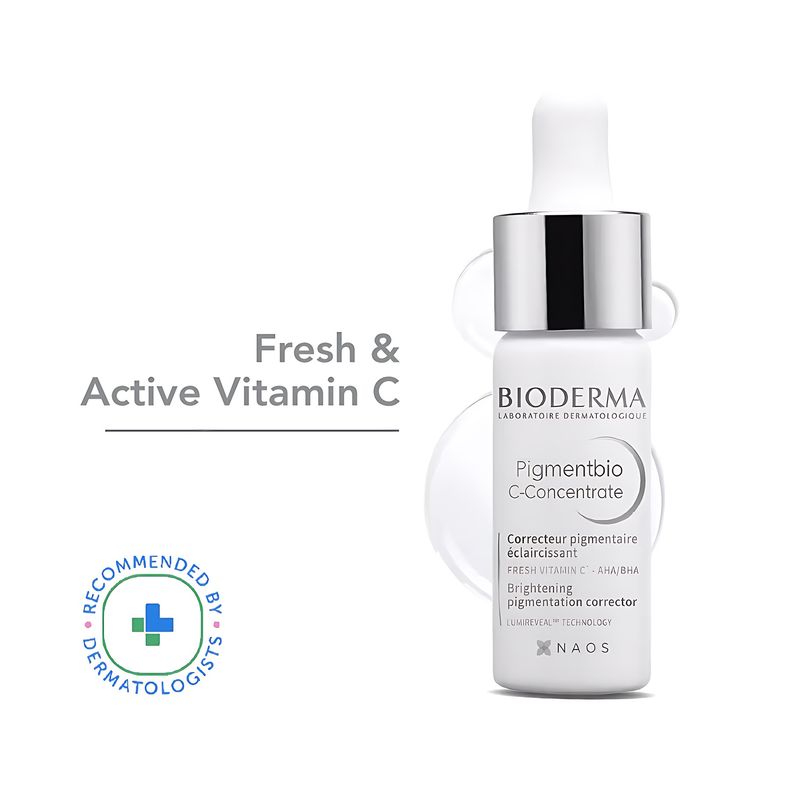

Bioderma
Bioderma Brightening Serum - Pigmentbio C-Concentrate

Bioderma Brightening Serum - Pigmentbio C-Concentrate
Bioderma
bioderma-brightening-serum-pigmentbio-c-concentrate
Serum
10085054021925
Morning or Evening?
How often will you use this product?
Notes


Highlights
WHAT IS IT?
Brightening serum with multiple active ingredients targeting hyperpigmentation
FEATURES
Reduces dark spot size and intensity, prevents new spots, smooths and refines skin texture, evens and brightens skin tone, hydrates skin for 8 hours, light gel-cream texture with fast absorption
BEST FOR
combination
CHECKS
Does not dry skin, non-comedogenic, good tolerance
Who Is It For?
Adults All GendersWhat Does It Help With?
Hyperpigmentation Dark Spots Uneven Skin Tone Skin DullnessBudget
Premium ($76-$150)How To Use
Which routine should it be used in?
Instructions:
Key Information


What Bioderma Says
Product Description:
Inspired by the leading treatments used by dermatologists in the treatment of hyperpigmented marks, Bioderma has developed LumiReveal Technology. It works effectively and durably on the 3 biological stages that cause hyperpigmentation, while ensuring good tolerance: Inflammation reduction with glabridin, melanin production limitation with andrographolide and azelaic acid, and cellular renewal boosting with Epidermactiv. Supplemented with vitamins C, E, and PP for skin barrier protection and strengthened hydration for 8 hours, providing gentle peeling efficacy without skin damage or dryness.
About the Brand:
Ingredients Overview
Ingredients List
aqua-water-eau,propanediol,glycolic-acid,glycerin,dipropylene-glycol,propylheptyl-caprylate,sodium-hydroxide,ascorbyl-glucoside,niacinamide,salicylic-acid,ammonium-acryloyldimethyltaurate-vp-copolymer,sorbitan-sesquioleat,pentylene-glycol,tocopheryl-acetate,xanthan-gum,sodium-citrate,lysine,azelaic-acid,mannitol,xylitol,sodium-metabisulfite,andrographis-paniculata-leaf-extract,rhamnose,saccharide-isomerate,glycyrrhiza-glabra-root-extract,tocopherol,fructooligosaccharides,caprylic-capric-triglyceride,laminaria-ochroleuca-extract,fragrance-parfum
Key Ingredients
glabridin,andrographolide,azelaic acid,vitamin C,vitamin E,vitamin PP,AHA,BHA, Epidermactiv glycolic acid,salicylic acid
Ingredients Details
Fructooligosaccharides
Common Name(s): Fos,oligofructose,short-chain inulin
CAS Number: 308066-66-2
DESCRIPTION
What It Does: Provides rapid-acting prebiotic microbiome support with humectant conditioning from short-chain fructan oligomers.
Why It's Used: Fast-acting prebiotic for rapid microbiome support — fos's shorter chain length provides faster fermentation by beneficial bacteria vs long-chain inulin, enabling quicker microbiome compositional shifts.
How It Works: Dp 2-10 fructooligomers (vs inulin's dp 10-60) provide more rapid access to bacterial fermentation enzymes. higher water solubility and humectant activity than long-chain inulin. more bioavailable to skin surface bacteria vs longer-chain inulin that penetrates deeper before fermentation.
Typically Found In: Prebiotic skin care,rapid microbiome support products
TECHNICAL DETAILS
Primary Category: Active ingredient – short-chain prebiotic
Secondary Functions: Tewl reduction,skin plumping
Application Areas:

Facial Skincare
Body Care
Hair Care

Beard Care
Color Cosmetics (Makeup)
Dietary/Oral Supplements
Typical Concentration Range: 0.5%–5%
SOURCING & ETHICS
Vegan Status: Conditional - supplier confirmation required
Halal Status: Unverified - supplier confirmation required
Source Notes: Synthetic or naturally derived. excellent aqueous solubility. [audit 2026-07-29 rev2: status downgraded on audit. determination requires shariah-panel sign-off.]
SKIN COMPATIBILITY
Irritancy Rating: 1/5 – very low
Comedogenicity Rating: 0/5 – non-comedogenic
Sensitivity Concerns: Non-irritating; suitable for all skin types.
Safe for Sensitive Skin: Yes
SAFETY & COMPATIBILITY
Safety Profile: Excellent safety profile. ewg score: 1.
Works Well With: Ceramides,emollients,occlusives,glycerin,hyaluronic acid
Avoid Combining With: No significant incompatibilities
SCIENTIFIC NOTE
Fos's shorter chain length provides different prebiotic kinetics vs long-chain inulin: short-chain fos (dp 2-5) is fermented within 12-24 hours by surface bacteria, while long-chain inulin (dp 10-60) ferments over 48-72 hours. this temporal difference enables formulation of 'fast-acting' (fos) vs 'sustained-release' (inulin) prebiotic products with different microbiome support kinetics.
Last Verified: 2026-03-12
Primary Sources: Cosing database,roberfroid fos prebiotic review
Glycerin
Common Name(s): Glycerol,glycerine,1,2,3-propanetriol
CAS Number: 56-81-5
DESCRIPTION
What It Does: Glycerin pulls water from the environment and deeper skin layers into the outer skin layer (epidermis), boosting moisture levels and keeping skin soft, smooth, and plump.
Why It's Used: It is used in virtually every moisturizer, serum, and cleanser because it is highly effective at hydrating skin, is well-tolerated by all skin types, and enhances the texture and spreadability of formulations.
How It Works: As a humectant, glycerin forms hydrogen bonds with water molecules, trapping them in the skin. it also reinforces the skin barrier by integrating into lipid structures between skin cells.
Typically Found In: Moisturizers,serums,cleansers,toners,sheet masks,sunscreens,body lotions,shampoos,conditioners
TECHNICAL DETAILS
Primary Category: Humectant
Secondary Functions: Skin barrier support,emollient,solvent
Application Areas:
Facial Skincare
Body Care
Hair Care
Beard Care
Color Cosmetics (Makeup)
Dietary/Oral Supplements
Typical Concentration Range: 1%–30% (typical: 3–10%)
SOURCING & ETHICS
Vegan Status: Conditional - feedstock declaration required
Halal Status: Unverified - feedstock declaration required (plant, animal and petrochemical routes all exist)
Source Notes: Derived from plant oils via hydrolysis or saponification; synthetic versions also available. palm-derived glycerin carries sustainability concerns. [audit 2026-07-29 rev2: origin-dependent: the same inci exists in plant, animal and petrochemical versions and the name does not discriminate. determination requires shariah-panel sign-off.]
SKIN COMPATIBILITY
Irritancy Rating: 1/5 – very low; non-irritating at all standard concentrations
Comedogenicity Rating: 0/5 – non-comedogenic
Sensitivity Concerns: Extremely rare allergic reactions; generally safe for all skin types including sensitive and baby skin
Safe for Sensitive Skin: Yes
SAFETY & COMPATIBILITY
Safety Profile: Widely recognized as safe. ewg hazard score: 1. no significant concerns for irritation, sensitization, or toxicity at typical concentrations (up to 50%).
Works Well With: Hyaluronic acid,ceramides,niacinamide,panthenol,urea,peptides,retinol,ahas/bhas
Avoid Combining With: No known incompatibilities at standard concentrations
SCIENTIFIC NOTE
Glycerin is an endogenous skin component found naturally in the stratum corneum. aquaporin-3 channels in keratinocytes facilitate glycerin transport, making it integral to natural skin hydration pathways.
Last Verified: 2026-03-12
Primary Sources: Cosing database,cir safety assessment,ewg skin deep,inci decoder
Lysine
Common Name(s): 2,6-diaminohexanoic acid,l-lysine hcl
CAS Number: 56-87-1
DESCRIPTION
What It Does: Provides collagen crosslink precursor activity and nmf conditioning from the essential diaminoamino acid.
Why It's Used: Collagen crosslink amino acid — lysine's hydroxylation to hydroxylysine and subsequent cross-link formation via lysyl oxidase provides the structural crosslinks that give collagen mechanical strength.
How It Works: Converted to hydroxylysine by lysyl hydroxylase. hydroxylysine provides collagen crosslink sites for lysyl oxidase-catalysed aldehyde cross-links. nmf amino acid component. basic amino acid (ε-amino group pka 10.5) provides antimicrobial cationic character. antiviral via competition with arginine (essential for herpes virus replication).
Typically Found In: Collagen-support products,antiviral skin care,nmf products
TECHNICAL DETAILS
Primary Category: Active ingredient – essential amino acid
Secondary Functions: Skin conditioning
Application Areas:
Facial Skincare
Body Care
Hair Care
Beard Care
Color Cosmetics (Makeup)
Dietary/Oral Supplements
Typical Concentration Range: 0.5%–5%
SOURCING & ETHICS
Vegan Status: Conditional - feedstock declaration required
Halal Status: Unverified - feedstock declaration required (plant, animal and petrochemical routes all exist)
Source Notes: Commercially produced for cosmetic use. verify vegan/halal status with supplier. [audit 2026-07-29 rev2: origin-dependent: the same inci exists in plant, animal and petrochemical versions and the name does not discriminate. determination requires shariah-panel sign-off.]
SKIN COMPATIBILITY
Irritancy Rating: 1/5 – very low
Comedogenicity Rating: 0/5 – non-comedogenic
Sensitivity Concerns: Well-tolerated by most skin types.
Safe for Sensitive Skin: Yes
SAFETY & COMPATIBILITY
Safety Profile: Good safety profile at recommended concentrations. ewg score: 1–2.
Works Well With: Standard skincare actives
Avoid Combining With: No known significant incompatibilities
SCIENTIFIC NOTE
Lysine's antiviral activity for herpes simplex virus is pharmacologically validated: hsv replicates using arginine as a structural protein component, while lysine competes with arginine for cellular uptake via the same transporter. high lysine:arginine ratio reduces viral protein synthesis — the basis for the clinical practice of high-lysine dietary supplementation and topical application for cold sore prevention.
Last Verified: 2026-03-12
Primary Sources: Cosing database,griffith et al. lysine herpes study,cir safety assessment
Mannitol
Common Name(s): D-mannitol,manna sugar,mannite
CAS Number: 69-65-8
DESCRIPTION
What It Does: Provides exceptional hydroxyl radical scavenging antioxidant protection alongside humectant moisture retention.
Why It's Used: Used for potent hydroxyl radical scavenging where standard antioxidants (tocopherol, ascorbic acid) are less effective, combined with humectant activity.
How It Works: 6 hydroxyl groups provide both water binding (humectant) and direct hydroxyl radical (.oh) scavenging. hydroxyl radicals are the most reactive and damaging free radicals – mannitol is one of few compounds that scavenges them directly.
Typically Found In: Antioxidant formulations,premium moisturizers,protective skincare
TECHNICAL DETAILS
Primary Category: Functional ingredient – sugar alcohol / free radical scavenger
Secondary Functions: Free radical scavenger,superior antioxidant
Application Areas:
Facial Skincare
Body Care
Hair Care
Beard Care
Color Cosmetics (Makeup)
Dietary/Oral Supplements
Typical Concentration Range: 1%–10%
SOURCING & ETHICS
Vegan Status: Yes – plant-derived or synthetic
Halal Status: Yes
Source Notes: Plant-derived from ash tree manna, seaweed, mushrooms, or produced by reduction of mannose. gras food-approved.
SKIN COMPATIBILITY
Irritancy Rating: 1/5 – very low
Comedogenicity Rating: 0/5 – non-comedogenic
Sensitivity Concerns: Non-irritating; suitable for all skin types.
Safe for Sensitive Skin: Yes
SAFETY & COMPATIBILITY
Safety Profile: Excellent safety profile. ewg score: 1.
Works Well With: Ceramides,emollients,occlusives,glycerin,hyaluronic acid
Avoid Combining With: No significant incompatibilities
SCIENTIFIC NOTE
Mannitol's rate constant for hydroxyl radical scavenging (k = 1.4 × 10^7 m^-1s^-1) makes it one of the most effective biological hydroxyl radical scavengers. this is important because hydroxyl radicals cannot be scavenged by standard antioxidants like tocopherol or ascorbic acid.
Last Verified: 2026-03-12
Primary Sources: Cosing database,halliwell et al. free radical scavenging,cir safety assessment