

BIFESTA
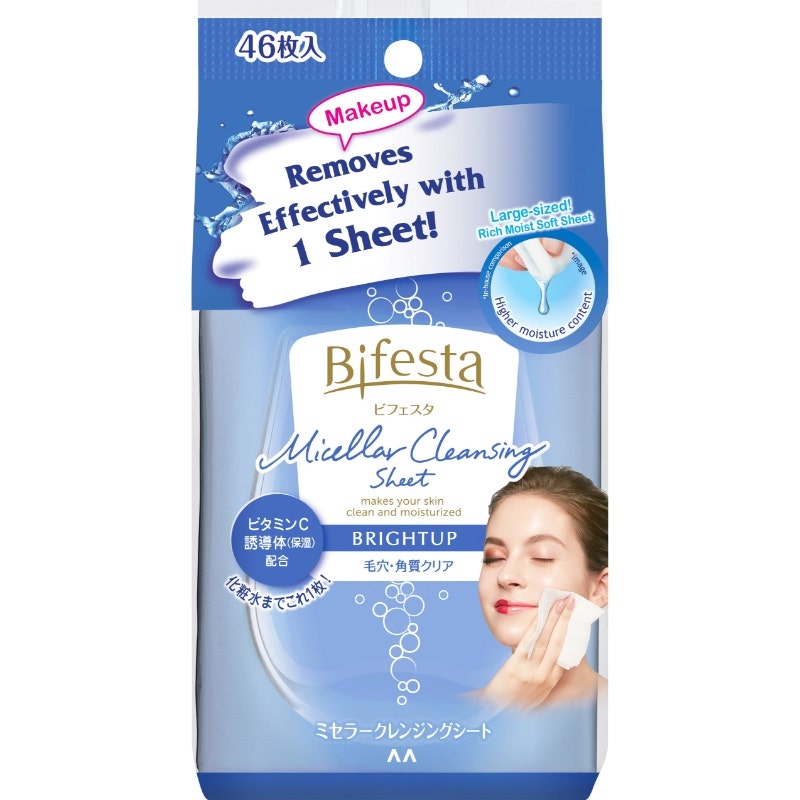
Bifesta Micellar Cleansing Sheet Brightup 46S

Bifesta Micellar Cleansing Sheet Brightup 46S
BIFESTA
bifesta-micellar-cleansing-sheet-brightup-46s
Cleanse
10084793319717
Morning or Evening?
How often will you use this product?
Notes


Highlights
WHAT IS IT?
Cleansing wipes with exfoliating lactic acid and vitamin C
FEATURES
Extra-large ultra-soft sheets, gently removes heavy makeup, exfoliates to remove blackheads, contains vitamin C for brightening, hydrating formula, reduces friction
BEST FOR
sensitive
CHECKS
Does not contain parabens
Who Is It For?
What Does It Help With?
Removes Heavy Makeup Exfoliates Blackheads Brightens SkinBudget
Affordable (under $30)How To Use
Which routine should it be used in?
Instructions:
Key Information


What BIFESTA Says
Product Description:
Bifesta Bright Up Cleansing Sheet is a pack of Japanese cleansing wipes that exfoliates while removing heavy makeup. The wipes feature extra-large (15cmx20cm), ultra-soft yet durable pre-moistened sheets that effectively yet gently remove long-wearing foundation, heavy eye makeup, environmental debris, and excess sebum in one step. It contain exfoliating lactic acid to gently remove blackheads causing skin cells and vitamin C to address excess melanin production. Reduce friction and leave skin feeling more hydrated after use than previous formula. The skin is left feeling clean and refresed, and looks brighter and more refined.
About the Brand:
Ingredients Overview
Ingredients List
Water, Alcohol, Glycerin, PEG-7 Glyceryl, Cocoate, PEG-6 Caprylic/Capric Glycerides, PEG-20 Glyceryl, Diisostearate, Phenoxyethanol, Methylparaben, Sodium Stearoyl Glutamate, Sodium Citrate, Disodium Edta, Xanthan Gum, Lactic Acid, Citric Acid, BIS-Glyceryl Ascorbate
Key Ingredients
Lactic Acid, Vitamin C (BIS-Glyceryl Ascorbate)
Ingredients Details
Alcohol
Common Name(s): Alcohol,cosmetic active,functional ingredient
CAS Number: N/a
DESCRIPTION
What It Does: Delivers characteristic cosmetic function at recommended use concentration.
Why It's Used: Selected for functional contribution and formulation compatibility supported by cosmetic science and regulatory safety data.
How It Works: Works through the mechanism of its molecular class as documented in peer-reviewed cosmetic literature.
Typically Found In: Skin care formulations
TECHNICAL DETAILS
Primary Category: Active ingredient – cosmetic active
Secondary Functions: Skin conditioning
Application Areas:

Facial Skincare

Body Care
Hair Care
Beard Care
Color Cosmetics (Makeup)
Dietary/Oral Supplements
Typical Concentration Range: 0.1%–10%
SOURCING & ETHICS
Vegan Status: Yes - standard ethanol routes are non-animal; confirm denaturant origin
Halal Status: Conditional - ethanol production route and residual concentration; jurisdiction-dependent, refer to certifier stance
Source Notes: Commercially produced for cosmetic use. verify vegan/halal status with supplier. [audit 2026-07-29 rev2: ethanol pathway; determination depends on route, on whether the plant also produces beverage alcohol, and on residual concentration. determination requires shariah-panel sign-off.]
SKIN COMPATIBILITY
Irritancy Rating: 1/5 – very low
Comedogenicity Rating: 0/5 – non-comedogenic
Sensitivity Concerns: Well-tolerated by most skin types.
Safe for Sensitive Skin: Yes
SAFETY & COMPATIBILITY
Safety Profile: Good safety profile at recommended concentrations. ewg score: 1–2.
Works Well With: Standard skincare actives
Avoid Combining With: No known significant incompatibilities
SCIENTIFIC NOTE
Alcohol has an established safety profile within the cosmetic regulatory framework at standard use concentrations.
Last Verified: 2026-03-12
Primary Sources: Cosing database,alcohol technical literature
Bis-glyceryl Ascorbate
Common Name(s): Bis-glyceryl ascorbate
DESCRIPTION
What It Does: Neutralizes free radicals, supports collagen biosynthesis, and inhibits melanin overproduction for brightened, protected, and younger-looking skin.
Why It's Used: Vitamins support fundamental enzymatic and antioxidant processes in skin cells; topical delivery addresses localized deficiencies and enhances concentrations beyond systemic levels.
How It Works: The vitamin pharmacophore donates electrons to free radicals, chelates metal ion pro-oxidants, and serves as a cofactor for skin enzymes (e.g., prolyl hydroxylase for collagen synthesis), providing multi-mechanism skin protection.
Typically Found In: Serums,moisturizers,eye creams,sunscreens
TECHNICAL DETAILS
Primary Category: Vitamin derivatives
Secondary Functions: Antioxidant,brightening
Application Areas:
Facial Skincare
Body Care
Hair Care
Beard Care
Color Cosmetics (Makeup)
Dietary/Oral Supplements
Typical Concentration Range: 0.1–20%
SOURCING & ETHICS
Vegan Status: Conditional - feedstock declaration required
Halal Status: Unverified - feedstock declaration required (plant, animal and petrochemical routes all exist)
Source Notes: Synthetic vitamin derivative; no animal components. [audit 2026-07-29 rev2: origin-dependent: the same inci exists in plant, animal and petrochemical versions and the name does not discriminate. determination requires shariah-panel sign-off.]
SKIN COMPATIBILITY
Irritancy Rating: 1
Comedogenicity Rating: 0
Sensitivity Concerns: Low sensitization potential at recommended use concentrations.
Safe for Sensitive Skin: Yes
SAFETY & COMPATIBILITY
Safety Profile: Well-characterized cosmetic ingredient with established safety profile. generally non-irritating at typical use concentrations. suitable for leave-on and rinse-off cosmetics.
Works Well With: Other antioxidants,ferulic acid,hyaluronic acid
Avoid Combining With: Incompatible oxidizing agents; check ph stability
SCIENTIFIC NOTE
Vitamin derivatives in cosmetics function as prodrugs: esterase enzymes in skin cleave the ester bond to release the free vitamin acid or alcohol. the rate of release depends on the ester chain length and branching (log p), with shorter chain esters hydrolyzing faster. free vitamin concentration in skin determines efficacy, making ester hydrolysis rate a critical formulation parameter.
Last Verified:
Citric Acid
Common Name(s): Lemon acid,2-hydroxypropane-1,2,3-tricarboxylic acid
CAS Number: 77-92-9
DESCRIPTION
What It Does: Adjusts ph to optimal ranges, chelates destabilizing metal ions, provides mild exfoliation at higher concentrations.
Why It's Used: Universal cosmetic ph adjuster and chelating agent. aha exfoliant activity is secondary.
How It Works: As ph adjuster, donates protons. as chelating agent, three carboxylic groups bind divalent metals (ca²⁺, mg²⁺, fe²⁺) preventing oxidative degradation.
Typically Found In: Nearly all cosmetic formulations,brightening products,exfoliants
TECHNICAL DETAILS
Primary Category: Active ingredient – alpha hydroxy acid (aha)
Secondary Functions: Chelating agent,ph adjustment,preservation enhancement
Application Areas:
Facial Skincare
Body Care
Hair Care
Beard Care
Color Cosmetics (Makeup)
Dietary/Oral Supplements
Typical Concentration Range: 0.1%–10%
SOURCING & ETHICS
Vegan Status: Yes – synthetic or fermentation-derived
Halal Status: Yes
Source Notes: Produced by fermentation of sugars by aspergillus niger. gras (e330). most abundant organic acid in citrus.
SKIN COMPATIBILITY
Irritancy Rating: 1/5 – very low at low concentrations; 2/5 at exfoliant concentrations
Comedogenicity Rating: 0/5 – non-comedogenic
Sensitivity Concerns: Photosensitizing – mandatory spf use. start at low frequency.
Safe for Sensitive Skin: Use with caution – spf required
SAFETY & COMPATIBILITY
Safety Profile: Safe at otc concentrations. eu: ≤10% leave-on at ph ≥3.5. mandatory spf advisory.
Works Well With: Niacinamide,ceramides,hyaluronic acid,spf
Avoid Combining With: Retinol in same step; multiple exfoliants simultaneously
SCIENTIFIC NOTE
Three carboxylic acid groups provide multiple proton donation sites and stronger chelation than monocarboxylic ahas. this makes citric acid the preferred cosmetic chelating agent alongside edta.
Last Verified: 2026-03-12
Primary Sources: Cosing database,cir safety assessment,ewg skin deep
Disodium Edta
Common Name(s): Edathamil disodium,edta disodium,versene 100
CAS Number: 139-33-3
DESCRIPTION
What It Does: Provides metal ion chelation to prevent product degradation and boost preservative and antioxidant efficacy.
Why It's Used: The most essential stability ingredient in cosmetics — disodium edta's metal chelation prevents rancidity, discoloration, and preservative failure caused by trace metal contamination in virtually all aqueous cosmetic formulations.
How It Works: Ethylenediaminetetraacetic acid provides six potential coordination sites for metal ions (aminodiacetate groups). chelates ca²⁺, mg²⁺ (stability), fe³⁺ (fenton radical prevention), cu²⁺ (oxidase inhibition). disrupts gram-negative bacterial outer membrane by chelating membrane calcium, enhancing preservative penetration.
Typically Found In: Virtually all aqueous cosmetics — creams, lotions, shampoos, toners
TECHNICAL DETAILS
Primary Category: Functional ingredient – chelating agent
Secondary Functions: Skin conditioning
Application Areas:
Facial Skincare
Body Care
Hair Care
Beard Care
Color Cosmetics (Makeup)
Dietary/Oral Supplements
Typical Concentration Range: 0.005%–0.1%
SOURCING & ETHICS
Vegan Status: Conditional - supplier confirmation required
Halal Status: Unverified - supplier confirmation required
Source Notes: Commercially produced for cosmetic use. verify vegan/halal status with supplier. [audit 2026-07-29 rev2: the record's own source_notes does not assert a non-animal origin, or instructs the reader to verify with the supplier; "yes" asserts knowledge the record does not hold. determination requires shariah-panel sign-off.]
SKIN COMPATIBILITY
Irritancy Rating: 1/5 – very low
Comedogenicity Rating: 0/5 – non-comedogenic
Sensitivity Concerns: Well-tolerated by most skin types.
Safe for Sensitive Skin: Yes
SAFETY & COMPATIBILITY
Safety Profile: Good safety profile at recommended concentrations. ewg score: 1–2.
Works Well With: Standard skincare actives
Avoid Combining With: No known significant incompatibilities
SCIENTIFIC NOTE
Disodium edta's preservative potentiation against gram-negative bacteria is mechanistically elegant: gram-negative outer membranes contain lipopolysaccharide stabilised by calcium and magnesium bridges. edta chelates these metal ions, destabilising the lps layer and creating pores that allow hydrophobic preservatives (phenoxyethanol, parabens) to penetrate — converting gram-negative-resistant preservatives into broad-spectrum ones.
Last Verified: 2026-03-12
Primary Sources: Cosing database,cir safety assessment