

Benefit Cosmetics
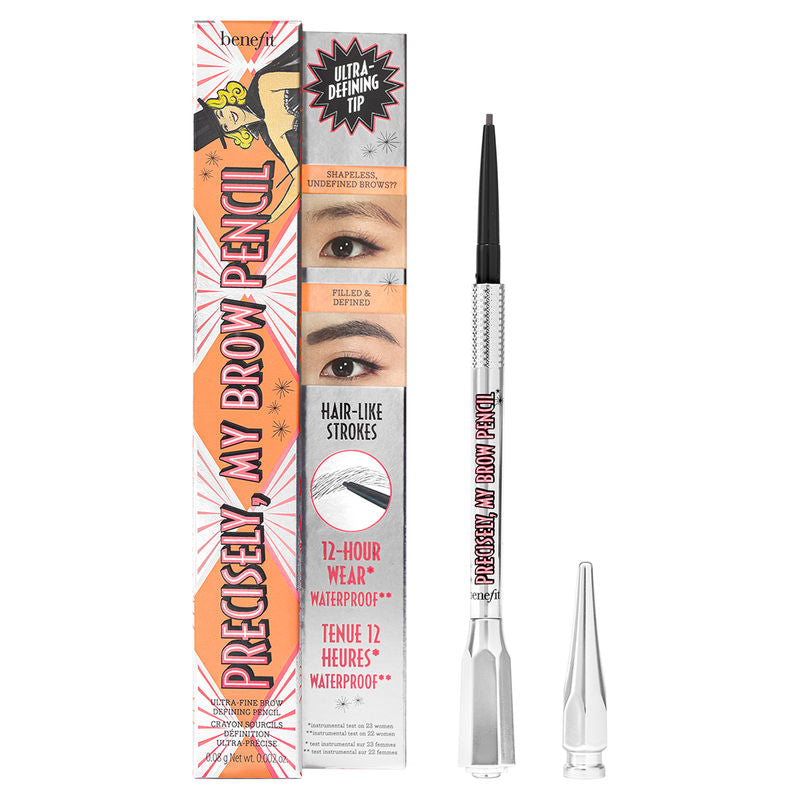
Benefit Cosmetics Precisely, My Brow Pencil

Benefit Cosmetics Precisely, My Brow Pencil
Benefit Cosmetics
benefit-cosmetics-precisely-my-brow-pencil
10084979278117
Morning or Evening?
How often will you use this product?
Notes


Highlights
WHAT IS IT?
ultra-fine brow defining pencil
FEATURES
Ultra-fine eyebrow pencil, natural-looking hair-like strokes, lasts 12 budge-proof hours, twist-up non-sharpen tip, built-in spoolie-brush, waterproof
BEST FOR
CHECKS
Who Is It For?
What Does It Help With?
Defined Eyebrows Natural Looking EyebrowsBudget
Premium ($76-$150)How To Use
Which routine should it be used in?
Instructions:
Key Information

What Benefit Cosmetics Says
Product Description:
Ultra-fine brow defining pencil. Oh my WOW. precise & defined eyebrows! This ultra-fine eyebrow pencil draws incredibly natural-looking, hair-like strokes that last 12 budge-proof hours. A few strokes of the rich yet blendable color will transform brows from shapeless & undefined to filled & defined eyebrows. Comes in full size & mini. Twist-up, non-sharpen tip. Built-in spoolie-brush. Waterproof.
About the Brand:
Ingredients Overview
Ingredients List
STEARIC-ACID, RHUS-SUCCEDANEA-FRUIT-WAX, TALC, HYDROGENATED-CASTOR-OIL, CERA-ALBA-(BEESWAX), CERA-MICROCRISTALLINA-(MICROCRYSTALLINE-WAX), PARAFFINUM-LIQUIDUM-(MINERAL-OIL), HYDROGENATED-COCONUT-OIL, HYDROGENATED-PALM-KERNEL-OIL, ALUMINUM-HYDROXIDE, HYDROGENATED-PALM-OIL, TOCOPHEROL, LECITHIN, BHT, CI-19140-(YELLOW-5,-YELLOW-5-LAKE), CI-42090-(BLUE-1-LAKE), CI-77007-(ULTRAMARINES), CI-77163-(BISMUTH-OXYCHLORIDE), CI-77288-(CHROMIUM-OXIDE-GREENS), CI-77289-(CHROMIUM-HYDROXIDE-GREEN), CI-77491, CI-77492, CI-77499-(IRON-OXIDES), CI-77510-(FERRIC-FERROCYANIDE,-FERRIC-AMMONIUM-FERROCYANIDE), CI-77742-(MANGANESE-VIOLET), CI-77891-(TITANIUM-DIOXIDE)
Key Ingredients
Ingredients Details
Bht
Common Name(s): Bht
DESCRIPTION
What It Does: Delivers targeted skin-conditioning or bioactive benefits through a specific mechanism of action suited to the formulation's intended purpose.
Why It's Used: Specialty actives address specific skin concerns through targeted molecular mechanisms, providing efficacy beyond what base formulation ingredients alone can achieve.
How It Works: The bioactive compound interacts with specific molecular targets in skin cells or the extracellular matrix — enzymes, receptors, structural proteins, or signaling molecules — triggering beneficial biological responses.
Typically Found In: Serums,treatments,moisturizers,specialty products
TECHNICAL DETAILS
Primary Category: Specialty actives
Secondary Functions: Skin-conditioning,anti-aging
Application Areas:

Facial Skincare

Body Care
Hair Care
Beard Care
Color Cosmetics (Makeup)
Dietary/Oral Supplements
Typical Concentration Range: 0.01–5%
SOURCING & ETHICS
Vegan Status: Conditional - supplier confirmation required
Halal Status: Unverified - supplier confirmation required
Source Notes: Specialty active ingredient; check individual sourcing for vegan status. [audit 2026-07-29 rev2: the record's own source_notes does not assert a non-animal origin, or instructs the reader to verify with the supplier; "yes" asserts knowledge the record does not hold. determination requires shariah-panel sign-off.]
SKIN COMPATIBILITY
Irritancy Rating: 1
Comedogenicity Rating: 0
Sensitivity Concerns: Low sensitization potential at recommended use concentrations.
Safe for Sensitive Skin: Yes
SAFETY & COMPATIBILITY
Safety Profile: Well-characterized cosmetic ingredient with established safety profile. generally non-irritating at typical use concentrations. suitable for leave-on and rinse-off cosmetics.
Works Well With: Niacinamide,hyaluronic acid,vitamin c,peptides
Avoid Combining With: Incompatible with oxidizing agents; check ph stability
SCIENTIFIC NOTE
Specialty actives typically work through enzyme inhibition (e.g., tyrosinase inhibition for brightening, mmp inhibition for anti-aging), receptor activation (e.g., retinoid receptors, ppar-γ for barrier genes), or transcription factor modulation (e.g., nrf2 for antioxidant gene upregulation). structure-activity relationships determine potency and selectivity.
Last Verified:
Lecithin
Common Name(s): Soy lecithin,sunflower lecithin,phosphatidylcholine complex
CAS Number: 8002-43-5
DESCRIPTION
What It Does: Provides natural phospholipid emulsification with barrier-compatible delivery and liposome-forming properties.
Why It's Used: The most biologically authentic emulsifier – identical to cell membrane composition providing barrier-compatible delivery and liposome formation unavailable from synthetic emulsifiers.
How It Works: Phosphatidylcholine (pc), phosphatidylethanolamine (pe), phosphatidylinositol (pi) mixture provides hlb 7-12 for o/w emulsification. forms liposomal bilayers for active encapsulation. pc/pe/pi composition mirrors cell membrane for barrier-compatible delivery.
Typically Found In: Natural cosmetics,liposomal products,barrier repair,penetration-enhanced formulas
TECHNICAL DETAILS
Primary Category: Functional ingredient – natural phospholipid emulsifier
Secondary Functions: Skin conditioning
Application Areas:
Facial Skincare
Body Care
Hair Care
Beard Care
Color Cosmetics (Makeup)
Dietary/Oral Supplements
Typical Concentration Range: 0.5%–10%
SOURCING & ETHICS
Vegan Status: No - animal-derived
Halal Status: Conditional - animal origin stated in the record's own description; documentation required
Source Notes: Commercially produced for cosmetic use. verify vegan/halal status with supplier. [audit 2026-07-29 rev2: pass-1 miss: the record's own detail text states an animal derivation, but pass 1 classified on the name and source_notes only. determination requires shariah-panel sign-off.]
SKIN COMPATIBILITY
Irritancy Rating: 1/5 – very low
Comedogenicity Rating: 0/5 – non-comedogenic
Sensitivity Concerns: Well-tolerated by most skin types.
Safe for Sensitive Skin: Yes
SAFETY & COMPATIBILITY
Safety Profile: Good safety profile at recommended concentrations. ewg score: 1–2.
Works Well With: Standard skincare actives
Avoid Combining With: No known significant incompatibilities
SCIENTIFIC NOTE
Lecithin's phospholipid composition mirrors the composition of the stratum corneum's own lamellar bodies that deliver barrier lipids to the skin surface. this structural mimicry allows lecithin-based delivery systems to integrate seamlessly with the barrier lipid structure, exploiting the same transport pathway the skin uses for its own lipid secretion.
Last Verified: 2026-03-12
Primary Sources: Cosing database,cir safety assessment
Talc
Common Name(s): Magnesium silicate,french chalk,soapstone powder
CAS Number: 14807-96-6
DESCRIPTION
What It Does: Provides the smoothest slip and oil absorption from the softest mineral for cosmetic powder formulations.
Why It's Used: The industry-standard cosmetic powder base – talc's unmatched softness (mohs 1 – softer than skin) provides the smoothest cosmetic feel of any mineral powder.
How It Works: Layered mg3si4o10(oh)2 structure provides inter-layer slip from weakly bonded oh surfaces. mohs hardness 1 – softer than all skin components. very low coefficient of friction from silicone-like siloxane surface. oil absorption via inter-layer capillary action.
Typically Found In: Face powders,baby powder,eyeshadow – foundational cosmetic powder ingredient
TECHNICAL DETAILS
Primary Category: Functional ingredient – talcum mineral
Secondary Functions: Skin conditioning
Application Areas:
Facial Skincare
Body Care
Hair Care
Beard Care
Color Cosmetics (Makeup)
Dietary/Oral Supplements
Typical Concentration Range: 0.1%–80%
SOURCING & ETHICS
Vegan Status: Conditional - supplier confirmation required
Halal Status: Unverified - supplier confirmation required
Source Notes: Commercially produced for cosmetic use. verify vegan/halal status with supplier. [audit 2026-07-29 rev2: the record's own source_notes does not assert a non-animal origin, or instructs the reader to verify with the supplier; "yes" asserts knowledge the record does not hold. determination requires shariah-panel sign-off.]
SKIN COMPATIBILITY
Irritancy Rating: 1/5 – very low
Comedogenicity Rating: 0/5 – non-comedogenic
Sensitivity Concerns: Well-tolerated by most skin types.
Safe for Sensitive Skin: Yes
SAFETY & COMPATIBILITY
Safety Profile: Cosmetic-grade talc must be free of asbestos contamination – asbestos is a known carcinogen. only asbestos-free cosmetic talc should be used. avoid inhalation of talc powders.
Works Well With: Standard skincare actives
Avoid Combining With: No known significant incompatibilities
SCIENTIFIC NOTE
Talc's mohs hardness of 1 (the reference mineral for mohs scale minimum) means it is softer than skin itself (estimated mohs ~0.5-1 for soft skin, 2+ for callused skin). this exceptional softness means talc particles don't scratch skin during application – physical contact between talc and skin surface is literally softer than touching skin to itself, explaining talc's unmatched 'like silk' application feel.
Last Verified: 2026-03-12
Primary Sources: Cosing database,fda talc safety,cir safety assessment
Tocopherol
Common Name(s): Vitamin e,alpha-tocopherol,d-alpha-tocopherol,(+)-alpha-tocopherol
CAS Number: 59-02-9
DESCRIPTION
What It Does: Tocopherol neutralizes free radicals that damage skin cells, protects cell membranes from lipid peroxidation, moisturizes, and helps maintain a healthy skin barrier.
Why It's Used: It is used as both a skin-active antioxidant and a formulation stabilizer (preventing oxidation of other ingredients). it has decades of safety and efficacy evidence and works synergistically with vitamin c.
How It Works: As a chain-breaking antioxidant, tocopherol donates hydrogen atoms to interrupt lipid peroxidation chain reactions. it is regenerated by vitamin c (ascorbic acid) in the vitamins c+e antioxidant cycle, creating a more durable antioxidant defense.
Typically Found In: Moisturizers,serums,oils,sunscreens,eye creams,lip balms,antioxidant formulations,haircare products
TECHNICAL DETAILS
Primary Category: Active ingredient – antioxidant/vitamin e
Secondary Functions: Emollient,formulation stabilizer,barrier support
Application Areas:
Facial Skincare
Body Care
Hair Care
Beard Care
Color Cosmetics (Makeup)
Dietary/Oral Supplements
Typical Concentration Range: 0.1%–1% (typical: 0.1–0.5% as active; higher as formulation antioxidant)
SOURCING & ETHICS
Vegan Status: Yes – plant-derived (soybean, sunflower, wheat germ oil) or synthetic
Halal Status: Yes – plant-derived or synthetic
Source Notes: Natural d-alpha-tocopherol is derived from plant oils and is more bioactive. synthetic dl-alpha-tocopherol is less expensive. tocopherol acetate (tocopheryl acetate) is the more stable ester form.
SKIN COMPATIBILITY
Irritancy Rating: 1/5 – very low; rare contact sensitivity reported
Comedogenicity Rating: 2/5 – mildly comedogenic at higher concentrations; formulation-dependent
Sensitivity Concerns: A small percentage of people report contact sensitization to tocopherol, particularly with leave-on products. comedogenicity risk is higher in oil-heavy formulations.
Safe for Sensitive Skin: Generally yes; perform patch test if history of vitamin e sensitivity
SAFETY & COMPATIBILITY
Safety Profile: Very safe; widely used. ewg hazard score: 2–3 (depending on concentration). no significant systemic concerns from topical use.
Works Well With: Ascorbic acid (vitamin c) – synergistic antioxidant pair,ferulic acid – stabilizes and boosts both c and e,ceramides,spf,retinol
Avoid Combining With: Very high concentrations of benzoyl peroxide may oxidize tocopherol; potential comedogenicity concerns in acne-prone skin when in heavy oil bases
SCIENTIFIC NOTE
The combination of vitamin c, vitamin e, and ferulic acid (the 'ce ferulic' formulation) provides fourfold photoprotection against uv-induced free radical damage – a synergy documented in landmark research by pinnell et al.
Last Verified: ##########
Primary Sources: Cosing database,cir safety assessment,pinnell et al. (2005) journal of investigative dermatology,efsa panel on food additives