

Skinfix US
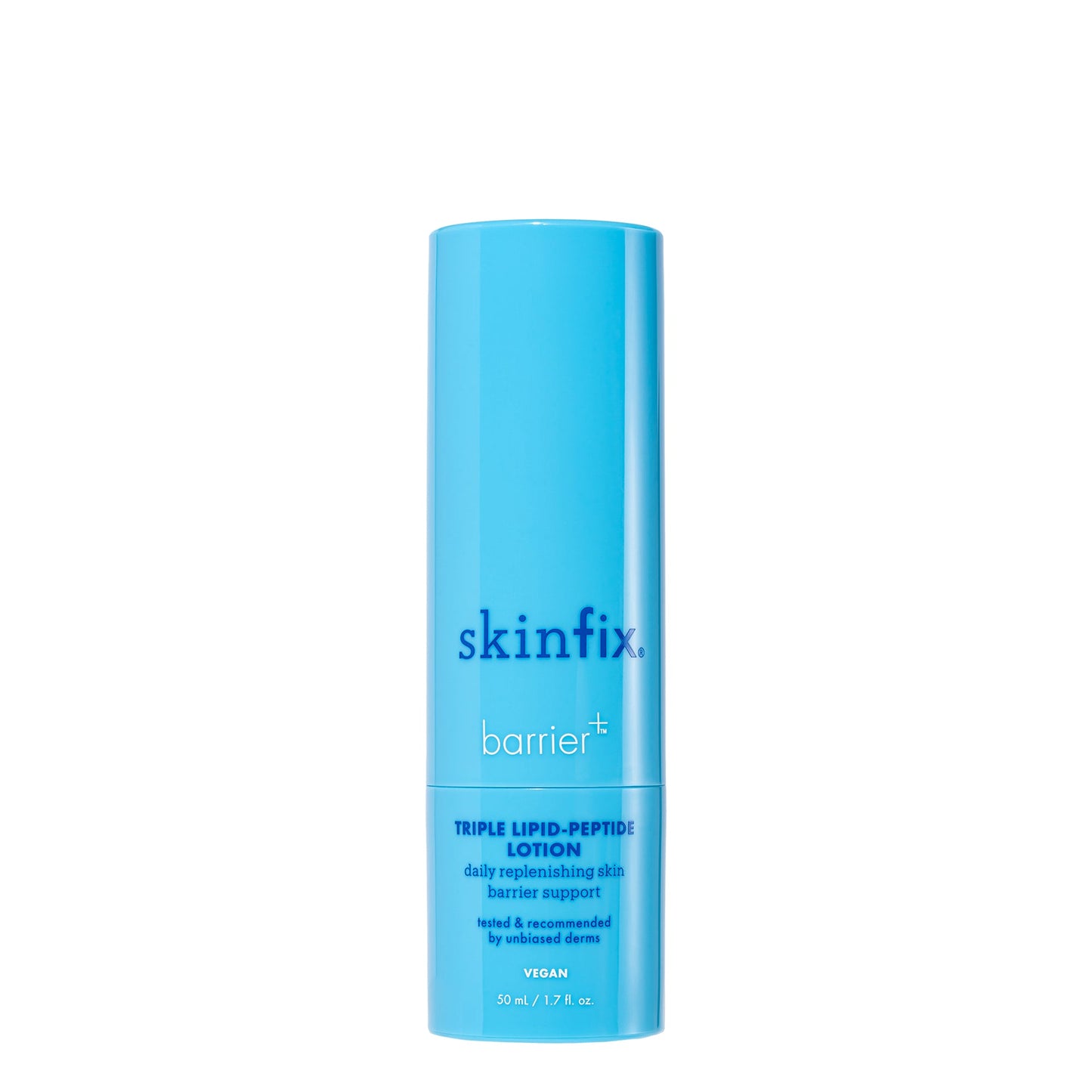
Barrier+ Triple Lipid-Peptide Lotion

Barrier+ Triple Lipid-Peptide Lotion
Skinfix US
barrier-triple-lipid-peptide-lotion
Moisturize
9818379059493
Morning or Evening?
How often will you use this product?
Notes


Highlights
WHAT IS IT?
Lightweight face lotion with triple lipid-peptide complex
FEATURES
pH balanced, allergy tested, contains skin-similar lipids, long-term hydration
BEST FOR
Combination, Dryness, Aging Skin, Damaged Skin Barrier
CHECKS
Free from fragrance, silicone/dimethicone, parabens, sulfates, essential oils, formaldehyde, phthalates, lanolin, petrolatum, propylene glycol, PEGs, and gluten
Who Is It For?
All Ages All GendersWhat Does It Help With?
Dehydration Barrier Repair Moisture RetentionBudget
Mid-range ($30-$75)How To Use
Which routine should it be used in?
Instructions:
Key Information


What Skinfix US Says
Product Description:
Triple Lipid-Peptide Lotion is a non-comedogenic, lightweight face lotion with active level skin-similar good fats: squalene, jojoba and macadamia oils. Features red seaweed blend and sodium hyaluronate for long-term hydration. Ideal for normal to dry skin, including sensitive skin.
About the Brand:
Ingredients Overview
Ingredients List
Water/Eau, Dicaprylyl Carbonate, Caprylic/Capric Triglyceride, Glycerin, Propanediol, Caprylyl Caprylate/Caprate, Jojoba Oil/Macadamia Seed Oil Esters, Behenyl Alcohol, Glyceryl Stearate, Butyrospermum Parkii (Shea) Butter, Lecithin, Stearyl Alcohol, Nylon-11, Dicaprylyl Ether, Sodium Hyaluronate, Oryza Sativa (Rice) Bran Extract, Glycine Soja (Soybean) Seed Extract, Squalene, Hydrolyzed Rice Protein, Hydrogenated Vegetable Oil, Glycine Soja (Soybean) Sterols, Phytosteryl Canola Glycerides, Chondrus Crispus Extract, Phytosteryl Macadamiate, Phytosterols, Aloe Barbadensis Leaf Juice, Rosmarinus Officinalis (Rosemary) Leaf Extract, Helianthus Annuus (Sunflower) Extract, Ethylhexylglycerin, Tocopherol, Dilinoleic Acid/Propanediol Copolymer, Pentylene Glycol, Trisodium Ethylenediamine Disuccinate, Gluconolactone, Sodium Benzoate, Xanthan Gum, Phenoxyethanol, Potassium Sorbate, Citric Acid
Key Ingredients
squalene, jojoba oil, macadamia oil, red seaweed blend, sodium hyaluronate
Ingredients Details
Jojoba Oil
Common Name(s): Jojoba oil,jojoba seed oil
CAS Number: 61789-91-1
DESCRIPTION
What It Does: Provides sebum-identical emolliency with outstanding oxidative stability and non-comedogenic profile.
Why It's Used: The most sebum-compatible plant oil – its wax ester composition mimics human sebum for superior skin compatibility across all skin types including oily and acne-prone.
How It Works: Liquid wax ester composition (primarily c20:1 and c22:1 wax esters) provides exceptional molecular mimicry of human sebum wax esters. regulates sebum production via negative feedback to sebaceous glands. remarkable oxidative stability from fully unsaturated wax ester structure vs polyunsaturated triglycerides.
Typically Found In: Facial oils,hair oils,serums,body care,lip care,virtually all product categories
TECHNICAL DETAILS
Primary Category: Functional ingredient – emollient
Secondary Functions: Sebum balancing,oxidative stability,non-comedogenic
Application Areas:

Facial Skincare
Body Care
Hair Care
Beard Care

Color Cosmetics (Makeup)
Dietary/Oral Supplements
Typical Concentration Range: 1%–100%
SOURCING & ETHICS
Vegan Status: Yes – from simmondsia chinensis (jojoba) seeds
Halal Status: Yes
Source Notes: Cold-pressed from jojoba seeds. among the most oxidation-stable plant oils (shelf life 5+ years). desert-grown, drought-resistant crop.
SKIN COMPATIBILITY
Irritancy Rating: 1/5 – very low
Comedogenicity Rating: 0/5 – non-comedogenic; sebum-identical composition
Sensitivity Concerns: Non-irritating.
Safe for Sensitive Skin: Yes
SAFETY & COMPATIBILITY
Safety Profile: Excellent safety profile. ewg score: 1.
Works Well With: Humectants,ceramides,actives as carrier
Avoid Combining With: No significant incompatibilities
SCIENTIFIC NOTE
Jojoba oil's wax ester composition is uniquely different from all other plant oils (which are triglycerides). human sebum contains approximately 25% wax esters – the proportion matched by jojoba. this structural identity explains jojoba's superior skin and hair compatibility versus conventional triglyceride oils.
Last Verified: 2026-03-12
Primary Sources: Cosing database,gad et al. jojoba review,cir safety assessment
Macadamia Oil
Common Name(s): Macadamia nut oil,australian nut oil
CAS Number: 128497-20-1
DESCRIPTION
What It Does: Provides sebum-compatible palmitoleic acid emolliency balancing aging skin's declining sebum production.
Why It's Used: Highest palmitoleic acid plant oil for sebum-mimetic skin conditioning particularly relevant for mature skin where palmitoleic acid (sebum's dominant fatty acid) production declines.
How It Works: Very high palmitoleic acid (c16:1 omega-7, 17-22%) closely mimics human sebum composition. palmitoleic acid declines in human sebum with age, making macadamia oil's high content particularly relevant for mature skin conditioning.
Typically Found In: Anti-aging facial oils,mature skin products,hair oils
TECHNICAL DETAILS
Primary Category: Functional ingredient – emollient
Secondary Functions: Palmitoleic acid sebum mimicry,anti-aging
Application Areas:
Facial Skincare
Body Care
Hair Care
Beard Care
Color Cosmetics (Makeup)
Dietary/Oral Supplements
Typical Concentration Range: 1%–50%
SOURCING & ETHICS
Vegan Status: Conditional - supplier confirmation required
Halal Status: Unverified - supplier confirmation required
Source Notes: Plant-derived, synthetic or animal-derived. verify source. [audit 2026-07-29 rev2: the record's own source_notes does not assert a non-animal origin, or instructs the reader to verify with the supplier; "yes" asserts knowledge the record does not hold. determination requires shariah-panel sign-off.]
SKIN COMPATIBILITY
Irritancy Rating: 1/5 – very low
Comedogenicity Rating: 2/5 – low
Sensitivity Concerns: Non-irritating.
Safe for Sensitive Skin: Yes
SAFETY & COMPATIBILITY
Safety Profile: Excellent safety profile. ewg score: 1.
Works Well With: Humectants,ceramides,actives as carrier
Avoid Combining With: No significant incompatibilities
SCIENTIFIC NOTE
Sebum palmitoleic acid content declines from ~23% at age 20 to ~14% at age 60. this decline corresponds to reduced skin surface antimicrobial protection (palmitoleic acid is antimicrobial against s. aureus) and changed sebum film properties. topical macadamia oil replenishes this age-declining fatty acid.
Last Verified: 2026-03-12
Primary Sources: Cosing database,cir safety assessment,cashman & warshaw sebum composition review
Sodium Hyaluronate
Common Name(s): Sodium salt of hyaluronic acid,naha
CAS Number: 9067-32-7
DESCRIPTION
What It Does: Provides hyaluronic acid hydration in the most formulation-stable and compatible form.
Why It's Used: The standard form of ha used in cosmetics – more stable than free ha, better solubility, and equivalent skin hydration benefits.
How It Works: Sodium salt reduces the polyelectrolyte repulsion of ha chains, allowing better packing in formulations. on skin, sodium ions dissociate and the ha chain unfolds to its full water-binding conformation. provides full ha humectant and barrier benefits equivalent to free ha.
Typically Found In: Hydrating serums,toners,moisturizers,sheet masks,anti-aging products
TECHNICAL DETAILS
Primary Category: Active ingredient – ha sodium salt
Secondary Functions: Equivalent ha hydration,superior stability
Application Areas:
Facial Skincare
Body Care
Hair Care
Beard Care
Color Cosmetics (Makeup)
Dietary/Oral Supplements
Typical Concentration Range: 0.1%–2%
SOURCING & ETHICS
Vegan Status: Conditional - feedstock declaration required
Halal Status: Unverified - feedstock declaration required (plant, animal and petrochemical routes all exist)
Source Notes: Synthetic or naturally derived. excellent aqueous solubility. [audit 2026-07-29 rev2: origin-dependent: the same inci exists in plant, animal and petrochemical versions and the name does not discriminate. determination requires shariah-panel sign-off.]
SKIN COMPATIBILITY
Irritancy Rating: 1/5 – very low
Comedogenicity Rating: 0/5 – non-comedogenic
Sensitivity Concerns: Non-irritating; suitable for all skin types.
Safe for Sensitive Skin: Yes
SAFETY & COMPATIBILITY
Safety Profile: Excellent safety profile. ewg score: 1.
Works Well With: Ceramides,emollients,occlusives,glycerin,hyaluronic acid
Avoid Combining With: No significant incompatibilities
SCIENTIFIC NOTE
The sodium salt form of ha has approximately 10% better water solubility than free hyaluronic acid at equivalent molecular weight due to reduced chain-chain electrostatic repulsion from partial sodium counterion screening. this improved solubility enables higher concentration formulations without viscosity issues.
Last Verified: 2026-03-12
Primary Sources: Cosing database,cir safety assessment
Squalene
Common Name(s): Squalane,endogenous skin lipid,lightweight non-comedogenic emollient
CAS Number: N/a
DESCRIPTION
What It Does: Provides lightweight, fast-absorbing emolliency without comedogenicity — integrating into sc lipid bilayers, reducing tewl, and restoring sebum squalene depleted by aging and uv exposure.
Why It's Used: Uniquely produced by human sebaceous glands — squalane/squalene is the only conventional emollient with truly endogenous human origin, explaining zero comedogenicity and zero sensitisation potential.
How It Works: The branched, isoprenoid (2,6,10,15,19,23-hexamethyltetracosane) structure of squalane provides excellent sc integration through chain-length compatibility with sc lipids while the methyl branching prevents the tight packing that causes comedogenicity in straight-chain fatty acids.
Typically Found In: All skin types,facial oils,acne-safe
TECHNICAL DETAILS
Primary Category: Functional ingredient – emollient
Secondary Functions: Barrier sealing,softening
Application Areas:
Facial Skincare
Body Care
Hair Care
Beard Care
Color Cosmetics (Makeup)
Dietary/Oral Supplements
Typical Concentration Range: 1%–100%
SOURCING & ETHICS
Vegan Status: No - animal-derived
Halal Status: Conditional - animal origin stated in the record's own description; documentation required
Source Notes: Plant-derived, synthetic or animal-derived. verify source. [audit 2026-07-29 rev2: pass-1 miss: the record's own detail text states an animal derivation, but pass 1 classified on the name and source_notes only. determination requires shariah-panel sign-off.]
SKIN COMPATIBILITY
Irritancy Rating: 1/5 – very low
Comedogenicity Rating: 1/5 – low; formulation-dependent
Sensitivity Concerns: Non-irritating.
Safe for Sensitive Skin: Yes
SAFETY & COMPATIBILITY
Safety Profile: Excellent safety profile. ewg score: 1.
Works Well With: Humectants,ceramides,actives as carrier
Avoid Combining With: No significant incompatibilities
SCIENTIFIC NOTE
Sustainable squalane is now exclusively derived from olive oil (olea europaea) unsaponifiables by hydrogenation of plant squalene, replacing the shark liver oil source — cosmos approved from plant-derived sources.
Last Verified: 2026-03-12
Primary Sources: Cosing database,squalane endogenous lipid non-comedogenic review