

AfricanBotanicsStaging
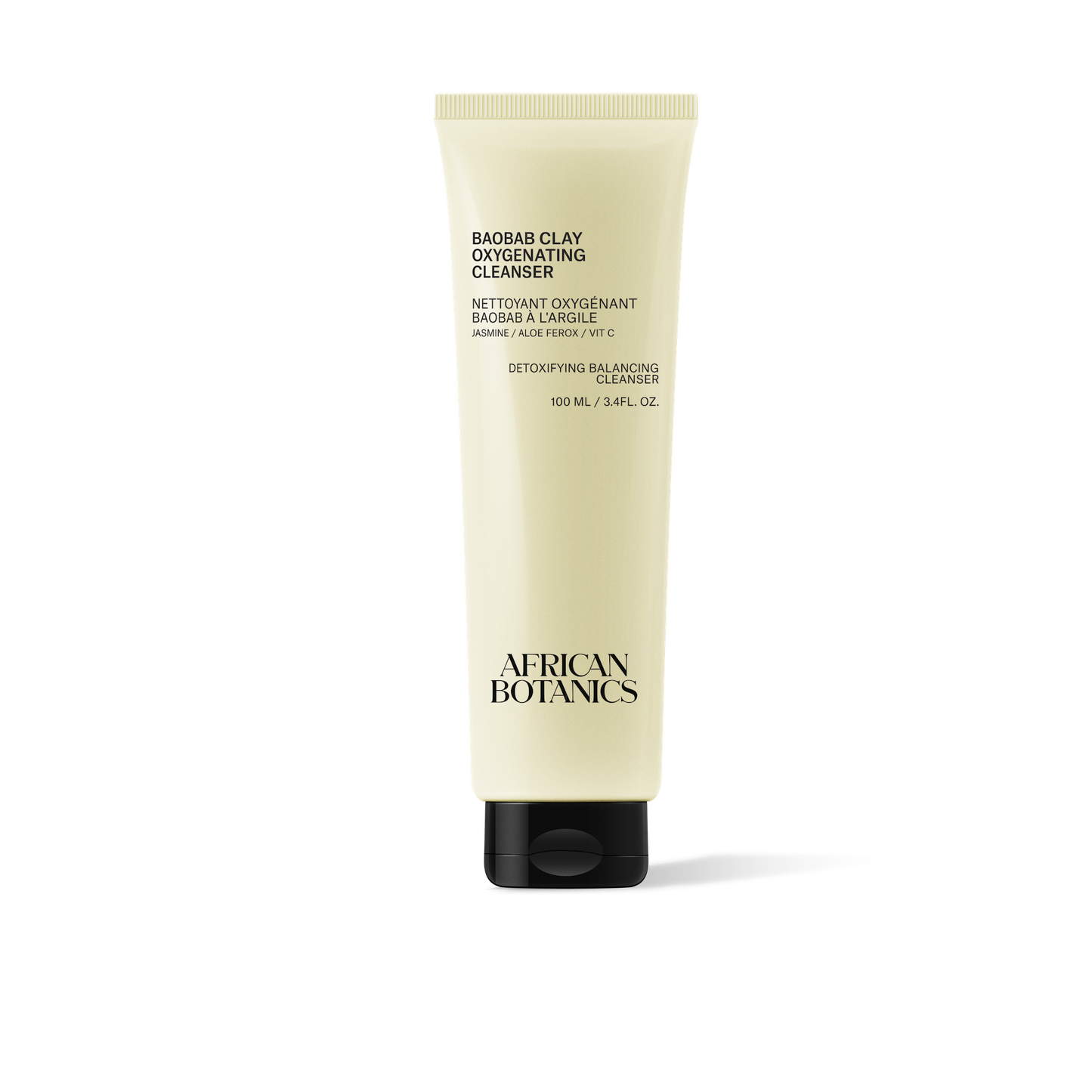
Baobab Clay Oxygenating Cleanser

Baobab Clay Oxygenating Cleanser
AfricanBotanicsStaging
baobab-clay-oxygenating-cleanser
Cleanse
9784846483749
Morning or Evening?
How often will you use this product?
Notes


Highlights
WHAT IS IT?
Clay-based oxygenating facial cleanser
FEATURES
pH balanced (4.88-5.5), water-soluble, pore-unclogging, sebum-regulating, non-drying
BEST FOR
combination
CHECKS
Parabens-free, silicones-free, phthalates-free, mineral oil-free, artificial fragrance-free, colorants-free, SLS-free
Who Is It For?
All Ages All GendersWhat Does It Help With?
Sebum Control Pore Cleansing Redness Reduction Skin BalancingBudget
Mid-range ($30-$75)How To Use
Which routine should it be used in?
Instructions:
Key Information


What AfricanBotanicsStaging Says
Product Description:
A skin balancing water soluble facial cleanser that eliminates impurities and unclogs pores without over-drying or irritating. Helps regulate sebum production leaving skin with a soft matte finish while calming the epidermis and reducing redness. Formulated to balance the skin's pH and promote glowing skin.
About the Brand:
Ingredients Overview
Ingredients List
Aqua (Water), Cocamidopropyl Betaine, Coco Glucoside, Lauryl Glucoside, Glycerin (Vegetable), Adansonia Digitata (Baobab) Fruit Powder, Sclerocarya Birrea (Marula) Seed Oil, Aloe Ferox (Aloe) Leaf Extract, Nylon-12 Fluorescent Brightener 230 Salt, Polyvinylalcohol Crosspolymer, Jasmine Officinale (Jasmine) Oil, Sodium Ascorbyl Phosphate (Vitamin C), Bentonite (White Clay), Hypoxis Hemerocallidea (African Potatoe) Extract, Citris Sinensis (Orange) Oil, Illicium Verum (Anise) Oil, Alpha Tocopheryl Acetate (Vitamin E), Santalum Album (Sandalwood) Oil, Kigelia Africana Fruit Extract, Propanediol, Citric Acid, Parfum (Natural), Limonene, Phenoxyethanol, Ethylhexylglycerin
Key Ingredients
baobab,clay
Ingredients Details
Cocamidopropyl Betaine
Common Name(s): Capb,cocoamidopropyl betaine,coconut betaine
CAS Number: 61789-40-0
DESCRIPTION
What It Does: Boosts foam, enhances mildness, and conditions skin and hair when combined with primary surfactants.
Why It's Used: The standard foam booster and mildness enhancer in virtually all shampoos, body washes, and facial cleansers – provides synergistic mildness improvement with anionic surfactants.
How It Works: Amphoteric (zwitterionic) character provides positive charge interaction with hair keratin for antistatic conditioning. reduces irritation of co-formulated anionic surfactants via ionic complex formation. foam stabilization via bilayer reinforcement in foam lamellae.
Typically Found In: Shampoos,body washes,facial cleansers,baby products
TECHNICAL DETAILS
Primary Category: Functional ingredient – amphoteric surfactant
Secondary Functions: Skin conditioning
Application Areas:

Facial Skincare
Body Care
Hair Care

Beard Care
Color Cosmetics (Makeup)
Dietary/Oral Supplements
Typical Concentration Range: 2%–15%
SOURCING & ETHICS
Vegan Status: Conditional - feedstock declaration required
Halal Status: Unverified - feedstock declaration required (plant, animal and petrochemical routes all exist)
Source Notes: Commercially produced for cosmetic use. verify vegan/halal status with supplier. [audit 2026-07-29 rev2: origin-dependent: the same inci exists in plant, animal and petrochemical versions and the name does not discriminate. determination requires shariah-panel sign-off.]
SKIN COMPATIBILITY
Irritancy Rating: 1/5 – very low
Comedogenicity Rating: 0/5 – non-comedogenic
Sensitivity Concerns: Well-tolerated by most skin types.
Safe for Sensitive Skin: Yes
SAFETY & COMPATIBILITY
Safety Profile: Good safety profile at recommended concentrations. ewg score: 1–2.
Works Well With: Standard skincare actives
Avoid Combining With: No known significant incompatibilities
SCIENTIFIC NOTE
Capb's mildness-enhancing synergy with sls has a molecular mechanism: capb's positive imidazoline head group forms an ion pair complex with sls's anionic sulfate group, reducing sls's free monomer concentration (the irritation-causing species) without significantly reducing micelle-forming capacity (the cleansing species).
Last Verified: 2026-03-12
Primary Sources: Cosing database,ananthapadmanabhan surfactant review,cir safety assessment
Coco-glucoside
Common Name(s): Coconut glucoside,apg c8-c16
CAS Number: 68515-73-1
DESCRIPTION
What It Does: Provides gentle, natural-origin cleansing with good foam from mixed coconut chain alkyl glucosides.
Why It's Used: Widely used natural surfactant for green beauty formulations requiring good foam performance with natural-origin and mild credentials.
How It Works: Mixed c8-c16 fatty alcohol chain lengths from coconut provide broader foam stability than single-chain glucosides. non-ionic glucoside headgroup provides mildness. better detergency and rinsing than individual chain-length apgs due to mixed chain distribution.
Typically Found In: Natural shampoos,body washes,facial cleansers
TECHNICAL DETAILS
Primary Category: Functional ingredient – coconut alkyl glucoside
Secondary Functions: Skin conditioning
Application Areas:
Facial Skincare
Body Care
Hair Care
Beard Care
Color Cosmetics (Makeup)
Dietary/Oral Supplements
Typical Concentration Range: 2%–20%
SOURCING & ETHICS
Vegan Status: Conditional - supplier confirmation required
Halal Status: Unverified - supplier confirmation required
Source Notes: Commercially produced for cosmetic use. verify vegan/halal status with supplier. [audit 2026-07-29 rev2: the record's own source_notes does not assert a non-animal origin, or instructs the reader to verify with the supplier; "yes" asserts knowledge the record does not hold. determination requires shariah-panel sign-off.]
SKIN COMPATIBILITY
Irritancy Rating: 1/5 – very low
Comedogenicity Rating: 0/5 – non-comedogenic
Sensitivity Concerns: Well-tolerated by most skin types.
Safe for Sensitive Skin: Yes
SAFETY & COMPATIBILITY
Safety Profile: Good safety profile at recommended concentrations. ewg score: 1–2.
Works Well With: Standard skincare actives
Avoid Combining With: No known significant incompatibilities
SCIENTIFIC NOTE
Coco-glucoside's natural chain length distribution (c8-c16) provides synergistic surfactant effects where different chain lengths optimize different properties: shorter chains provide initial foam burst, longer chains provide foam stability and soil removal, creating better overall performance than any single chain length alone.
Last Verified: 2026-03-12
Primary Sources: Cosing database,cir safety assessment
Lauryl Glucoside
Common Name(s): C12 glucoside,dodecyl glucoside,apg surfactant
CAS Number: 110615-47-9
DESCRIPTION
What It Does: Provides mild, naturally-derived cleansing with excellent biodegradability from glucose and lauryl alcohol.
Why It's Used: The natural cleansing standard — lauryl glucoside's combination of renewability, biodegradability, mildness, and foaming makes it the benchmark natural surfactant for clean beauty facial cleansers.
How It Works: C12 alkyl chain provides cmc and foaming. glucose head group provides mild non-ionic/weakly anionic character from hydroxyl groups. very low irritation potential from polyol head group. excellent biodegradability >95% bod28 from glucoside hydrolysis. cosmos approved.
Typically Found In: Natural facial cleansers,baby shampoos,cosmos certified products
TECHNICAL DETAILS
Primary Category: Functional ingredient – alkyl glucoside surfactant
Secondary Functions: Skin conditioning
Application Areas:
Facial Skincare
Body Care
Hair Care
Beard Care
Color Cosmetics (Makeup)
Dietary/Oral Supplements
Typical Concentration Range: 2%–15%
SOURCING & ETHICS
Vegan Status: Conditional - supplier confirmation required
Halal Status: Unverified - supplier confirmation required
Source Notes: Commercially produced for cosmetic use. verify vegan/halal status with supplier. [audit 2026-07-29 rev2: the record's own source_notes does not assert a non-animal origin, or instructs the reader to verify with the supplier; "yes" asserts knowledge the record does not hold. determination requires shariah-panel sign-off.]
SKIN COMPATIBILITY
Irritancy Rating: 1/5 – very low
Comedogenicity Rating: 0/5 – non-comedogenic
Sensitivity Concerns: Well-tolerated by most skin types.
Safe for Sensitive Skin: Yes
SAFETY & COMPATIBILITY
Safety Profile: Good safety profile at recommended concentrations. ewg score: 1–2.
Works Well With: Standard skincare actives
Avoid Combining With: No known significant incompatibilities
SCIENTIFIC NOTE
Lauryl glucoside's mildness vs sls at equivalent foam performance is measurable by draize eye score: sls scores approximately 55 (mild irritant) while lauryl glucoside scores <15 (essentially non-irritant) in identical eye irritation testing. this quantitative mildness advantage explains why apg surfactants command premium pricing despite renewable/natural origin — actual performance superiority justifies the cost.
Last Verified: 2026-03-12
Primary Sources: Cosing database,cosmos standard,cir safety assessment
Nylon-12 Fluorescent Brightener 230 Salt
Common Name(s): Nylon-12 fluorescent brightener 230 salt,nylon-12 fluorescent brightener 230 salt,cosmetic functional ingredient,established active
CAS Number: N/a
DESCRIPTION
What It Does: Provides the characteristic cosmetic function of its ingredient class through molecular chemistry at recommended use concentration.
Why It's Used: Nylon-12 fluorescent brightener 230 salt is selected for the specific functional properties of its molecular class — the chemical architecture of nylon-12 fluorescent brightener 230 salt delivers the required cosmetic performance through documented interactions with skin biology and formulation matrix.
How It Works: Functional groups interact with formulation components and skin through h-bonding, ionic association, surface adsorption, or receptor activity as appropriate to the molecular class.
Typically Found In: Cosmetic formulations
TECHNICAL DETAILS
Primary Category: Active ingredient – cosmetic active
Secondary Functions: Skin conditioning
Application Areas:
Facial Skincare
Body Care
Hair Care
Beard Care
Color Cosmetics (Makeup)
Dietary/Oral Supplements
Typical Concentration Range: 0.1%–10%
SOURCING & ETHICS
Vegan Status: Conditional - supplier confirmation required
Halal Status: Unverified - supplier confirmation required
Source Notes: Commercially produced for cosmetic use. verify vegan/halal status with supplier. [audit 2026-07-29 rev2: the record's own source_notes does not assert a non-animal origin, or instructs the reader to verify with the supplier; "yes" asserts knowledge the record does not hold. determination requires shariah-panel sign-off.]
SKIN COMPATIBILITY
Irritancy Rating: 1/5 – very low
Comedogenicity Rating: 0/5 – non-comedogenic
Sensitivity Concerns: Well-tolerated by most skin types.
Safe for Sensitive Skin: Yes
SAFETY & COMPATIBILITY
Safety Profile: Good safety profile at recommended concentrations. ewg score: 1–2.
Works Well With: Standard skincare actives
Avoid Combining With: No known significant incompatibilities
SCIENTIFIC NOTE
Safety documented in cosing at standard formulation concentrations.
Last Verified: 2026-03-22
Primary Sources: Cosing database,nylon-12 fluorescent brightener 230 technical review