
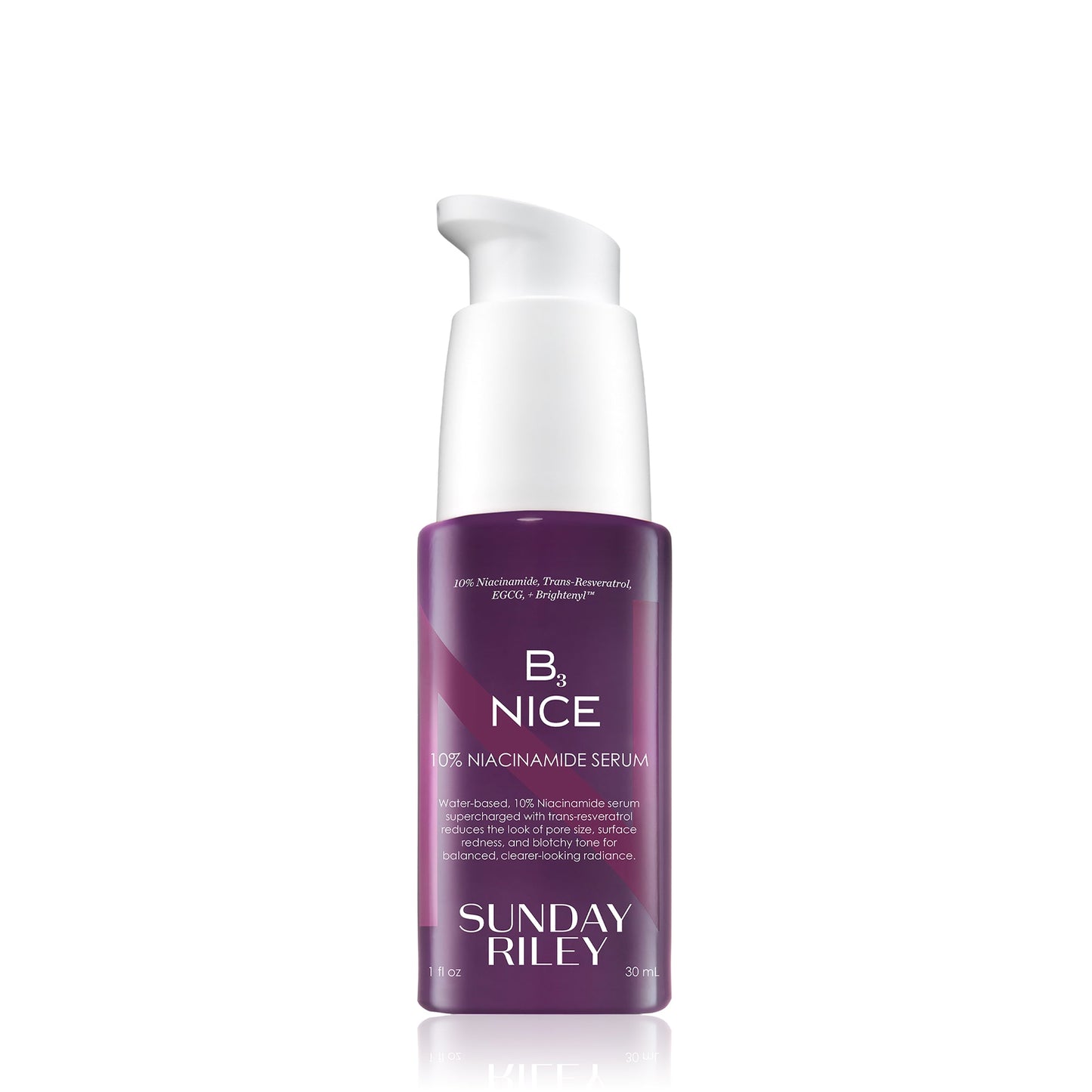

Sunday Riley
B3 Nice 10% Niacinamide Serum

B3 Nice 10% Niacinamide Serum
Sunday Riley
b3-nice-10-niacinamide-serum
Serum
9784780325157
Morning or Evening?
How often will you use this product?
Notes


Highlights
WHAT IS IT?
Niacinamide Serum with 10% concentration
FEATURES
Minimizes pores, improves dark spots, reduces surface redness, promotes radiant complexion
BEST FOR
combination
CHECKS
Sulfate-free, Paraben-free, Gluten-free, Soy-free, Phthalate-free, Fragrance-free
Who Is It For?
All AdultsWhat Does It Help With?
Pore Appearance Post-acne Dark Spots Surface Redness Radiant ComplexionBudget
Mid-range ($30-$75)How To Use
Which routine should it be used in?
Instructions:
Key Information


What Sunday Riley Says
Product Description:
An advanced 10% Niacinamide serum to help minimize pores' appearance and help improve post-acne dark spots and surface redness while promoting an overall radiant complexion.
About the Brand:
Ingredients Overview
Ingredients List
WATER/EAU/AQUA, NIACINAMIDE, GLYCERIN, PHENYL TRIMETHICONE, DIMETHYL ISOSORBIDE, OCTYLDODECANOL, RESVERATROL, DIGLUCOSYL GALLIC ACID, ASIATICOSIDE, MADECASSOSIDE, EPIGALLOCATECHIN GALLATYL GLUCOSIDE, BOSWELLIA SERRATA RESIN EXTRACT, CURCUMA LONGA (TURMERIC) ROOT EXTRACT, OCIMUM BASILICUM (BASIL) FLOWER/LEAF EXTRACT, OCIMUM SANCTUM LEAF EXTRACT, ALOE BARBADENSIS FLOWER EXTRACT, SOLANUM MELONGENA (EGGPLANT) FRUIT EXTRACT, COCCINIA INDICA FRUIT EXTRACT, BETAINE, CORALLINA OFFICINALIS EXTRACT, MELIA AZADIRACHTA FLOWER EXTRACT, MELIA AZADIRACHTA LEAF EXTRACT, BENZOTRIAZOLYL DODECYL P-CRESOL, PEG-8, TETRAHYDRODIFERULOYLMETHANE, TETRAHYDRODEMETHOXYDIFERULOYLMETHANE, TETRAHYDROBISDEMETHOXYDIFERULOYLMETHANE, PUNICA GRANATUM FRUIT EXTRACT, ARGANIA SPINOSA KERNEL OIL, CITRUS AURANTIUM DULCIS (ORANGE) PEEL EXTRACT, CITRUS GRANDIS (GRAPEFRUIT) PEEL EXTRACT, CITRUS TANGERINA (TANGERINE) PEEL OIL, CALENDULA OFFICINALIS FLOWER EXTRACT, CITRUS LIMON (LEMON) PEEL OIL, SODIUM PHYTATE, HYDROXYETHYL ACRYLATE/SODIUM ACRYLOYLDIMETHYL TAURATE COPOLYMER, POLYSORBATE 60, SORBITAN ISOSTEARATE, PENTAERYTHRITYL TETRA-DI-T-BUTYL HYDROXYHYDROCINNAMATE, POLYGLYCERYL-10 STEARATE, SODIUM ACRYLATE/SODIUM ACRYLOYLDIMETHYL TAURATE COPOLYMER, DIMETHICONE, TRIDECETH-6, PEG/PPG-18/18 DIMETHICONE, TOCOPHEROL, PHENOXYETHANOL, CAPRYLYL GLYCOL, CHLORPHENESIN, TRIETHYL CITRATE.
Key Ingredients
Niacinamide
Ingredients Details
Asiaticoside
Common Name(s): Centella asiatica glycoside,asiaticoside b
CAS Number: 16830-15-2
DESCRIPTION
What It Does: Accelerates wound healing and reduces scar formation through fibroblast activation and collagen synthesis stimulation.
Why It's Used: Clinically proven scar reduction and wound healing active – the compound behind centella's legendary wound healing reputation.
How It Works: Promotes fibroblast proliferation and collagen synthesis via tgf-β independent mechanism (distinct from madecassoside). also inhibits hyaluronidase protecting extracellular matrix. antimicrobial activity supports wound healing environment.
Typically Found In: Post-surgical products,scar treatments,wound healing formulations
TECHNICAL DETAILS
Primary Category: Active ingredient – soothing / anti-inflammatory
Secondary Functions: Scar reduction,wound healing,collagen stimulation
Application Areas:

Facial Skincare
Body Care

Hair Care
Beard Care
Color Cosmetics (Makeup)
Dietary/Oral Supplements
Typical Concentration Range: 0.01%–2%
SOURCING & ETHICS
Vegan Status: Conditional - supplier confirmation required
Halal Status: Unverified - supplier confirmation required
Source Notes: Extracted from centella asiatica aerial parts alongside madecassoside, asiatic acid, and madecassic acid. [audit 2026-07-29 rev2: status downgraded on audit. determination requires shariah-panel sign-off.]
SKIN COMPATIBILITY
Irritancy Rating: 1/5 – very low
Comedogenicity Rating: 0/5 – non-comedogenic
Sensitivity Concerns: Non-irritating; ideal for reactive and sensitive skin.
Safe for Sensitive Skin: Yes – particularly recommended for sensitive skin
SAFETY & COMPATIBILITY
Safety Profile: Excellent safety profile. ewg score: 1.
Works Well With: Ceramides,panthenol,allantoin,hyaluronic acid,centella asiatica
Avoid Combining With: No significant incompatibilities
SCIENTIFIC NOTE
Asiaticoside's mechanism of wound healing involves release of aglycone asiatic acid after hydrolysis by skin beta-glucosidases. the glycoside form provides better stratum corneum penetration than the hydrophobic aglycone, acting as a prodrug for the active asiatic acid at the wound healing site.
Last Verified:
Boswellia Serrata Resin Extract
Common Name(s): Boswellia serrata resin extract
DESCRIPTION
What It Does: Provides antioxidant protection, soothing anti-inflammatory effects, and skin-conditioning benefits through plant-derived polyphenols and phytochemicals.
Why It's Used: Plant extracts concentrate bioactive phytochemicals evolved for environmental protection — uv, microbial, and oxidative stressors — that translate to skin benefits.
How It Works: Polyphenols (flavonoids, phenolic acids) inhibit nf-κb-mediated inflammatory signaling, scavenge reactive oxygen species through electron donation, and chelate pro-oxidant metal ions to reduce oxidative skin damage.
Typically Found In: Serums,toners,moisturizers,masks,essences
TECHNICAL DETAILS
Primary Category: Botanical extracts
Secondary Functions: Antioxidant,anti-inflammatory
Application Areas:
Facial Skincare
Body Care
Hair Care
Beard Care
Color Cosmetics (Makeup)
Dietary/Oral Supplements
Typical Concentration Range: 0.1–10%
SOURCING & ETHICS
Vegan Status: Yes
Halal Status: Yes
Source Notes: Plant-derived extract; no animal components.
SKIN COMPATIBILITY
Irritancy Rating: 1
Comedogenicity Rating: 0
Sensitivity Concerns: Low sensitization potential at recommended use concentrations.
Safe for Sensitive Skin: Yes
SAFETY & COMPATIBILITY
Safety Profile: Well-characterized cosmetic ingredient with established safety profile. generally non-irritating at typical use concentrations. suitable for leave-on and rinse-off cosmetics.
Works Well With: Niacinamide,hyaluronic acid,vitamin c,ceramides
Avoid Combining With: Strong oxidizing agents
SCIENTIFIC NOTE
Plant secondary metabolites (flavonoids, terpenes, phenolic acids) are biosynthesized as defense compounds against uv, herbivores, and pathogens. their anti-inflammatory activity typically derives from competitive inhibition of cox-2 and 5-lox enzymes (ic50 1–50 µm), while antioxidant activity involves single electron transfer (set) and hydrogen atom transfer (hat) mechanisms with structure-dependent rate constants.
Last Verified: 2025-01-15
Primary Sources: Cosing eu database; pcpc cosmetic ingredient safety reviews; phytochemical and ethnobotanical literature
Diglucosyl Gallic Acid
Common Name(s): Diglucosyl gallic acid,cosmetic active,functional ingredient
CAS Number: N/a
DESCRIPTION
What It Does: Delivers characteristic cosmetic function at recommended use concentration.
Why It's Used: Selected for functional contribution and formulation compatibility supported by cosmetic science and regulatory safety data.
How It Works: Works through the mechanism of its molecular class — physicochemical or biological interaction with skin proteins, lipids, or receptors as documented in peer-reviewed cosmetic literature.
Typically Found In: Skin care formulations
TECHNICAL DETAILS
Primary Category: Active ingredient – cosmetic active
Secondary Functions: Skin conditioning
Application Areas:
Facial Skincare
Body Care
Hair Care
Beard Care
Color Cosmetics (Makeup)
Dietary/Oral Supplements
Typical Concentration Range: 0.1%–10%
SOURCING & ETHICS
Vegan Status: Conditional - supplier confirmation required
Halal Status: Unverified - supplier confirmation required
Source Notes: Commercially produced for cosmetic use. verify vegan/halal status with supplier. [audit 2026-07-29 rev2: the record's own source_notes does not assert a non-animal origin, or instructs the reader to verify with the supplier; "yes" asserts knowledge the record does not hold. determination requires shariah-panel sign-off.]
SKIN COMPATIBILITY
Irritancy Rating: 1/5 – very low
Comedogenicity Rating: 0/5 – non-comedogenic
Sensitivity Concerns: Well-tolerated by most skin types.
Safe for Sensitive Skin: Yes
SAFETY & COMPATIBILITY
Safety Profile: Good safety profile at recommended concentrations. ewg score: 1–2.
Works Well With: Standard skincare actives
Avoid Combining With: No known significant incompatibilities
SCIENTIFIC NOTE
Diglucosyl gallic acid has an established safety and efficacy profile within the cosmetic regulatory framework at standard use concentrations.
Last Verified: 2026-03-12
Primary Sources: Cosing database,diglucosyl gallic acid technical literature
Dimethyl Isosorbide
Common Name(s): Dmi,isosorbide dimethyl ether,arlasolve dmi
CAS Number: 5306-85-4
DESCRIPTION
What It Does: Provides biocompatible penetration enhancement for improved active ingredient delivery.
Why It's Used: Biocompatible penetration enhancer from renewable sorbitol — dmi provides penetration enhancement without the toxicity of oleic acid or conventional chemical penetration enhancers.
How It Works: Cyclic ether from sorbitol is biocompatible and biodegradable. disrupts stratum corneum lipid packing via ether oxygen hydrogen bonding. solubilises challenging actives (retinoids, salicylic acid, ahas). enhances penetration 2–5× vs equivalent concentrations without dmi.
Typically Found In: Active delivery formulas,penetration-enhanced products,retinoid vehicles
TECHNICAL DETAILS
Primary Category: Functional ingredient – penetration-enhancing solvent
Secondary Functions: Skin conditioning
Application Areas:
Facial Skincare
Body Care
Hair Care
Beard Care
Color Cosmetics (Makeup)
Dietary/Oral Supplements
Typical Concentration Range: 1%–20%
SOURCING & ETHICS
Vegan Status: Conditional - supplier confirmation required
Halal Status: Unverified - supplier confirmation required
Source Notes: Commercially produced for cosmetic use. verify vegan/halal status with supplier. [audit 2026-07-29 rev2: the record's own source_notes does not assert a non-animal origin, or instructs the reader to verify with the supplier; "yes" asserts knowledge the record does not hold. determination requires shariah-panel sign-off.]
SKIN COMPATIBILITY
Irritancy Rating: 1/5 – very low
Comedogenicity Rating: 0/5 – non-comedogenic
Sensitivity Concerns: Well-tolerated by most skin types.
Safe for Sensitive Skin: Yes
SAFETY & COMPATIBILITY
Safety Profile: Good safety profile at recommended concentrations. ewg score: 1–2.
Works Well With: Standard skincare actives
Avoid Combining With: No known significant incompatibilities
SCIENTIFIC NOTE
Dmi's penetration enhancement mechanism differs from oleic acid's lipid disruption: dmi hydrogen bonds to stratum corneum proteins and lipids, temporarily creating more permeable protein-lipid domains without the membrane-fluidisation that causes oleic acid's irritation. this protein-hydrogen-bonding mechanism provides penetration enhancement from a different, gentler pathway.
Last Verified: 2026-03-12
Primary Sources: Cosing database,croda arlasolve dmi technical data,cir safety assessment