
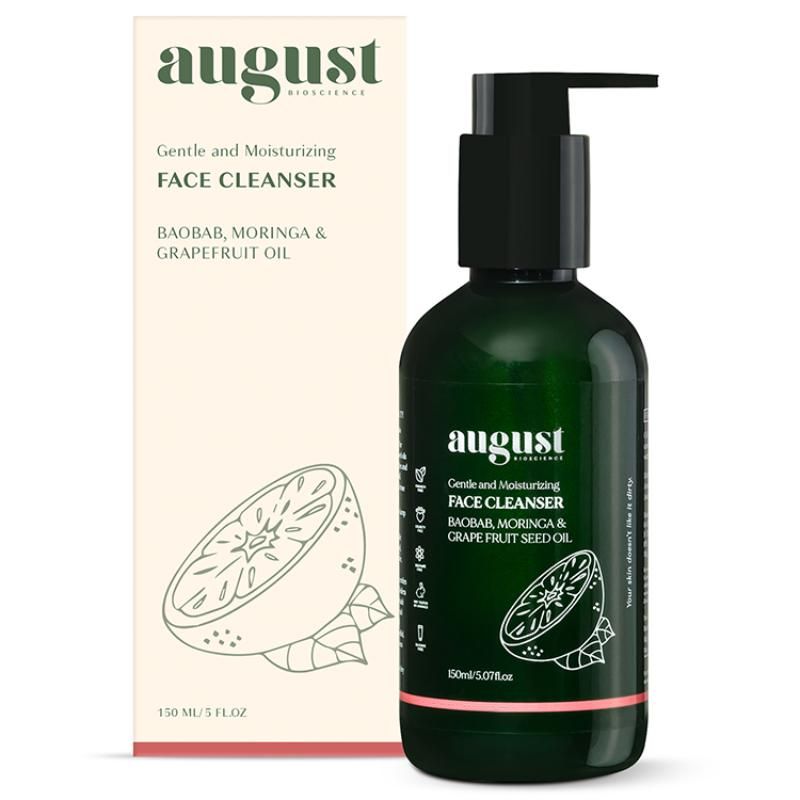

August Bioscience
August Bioscience Gentle Makeup Remover & Cleanser Oil, Infused with Grapefruit, Baobab

August Bioscience Gentle Makeup Remover & Cleanser Oil, Infused with Grapefruit, Baobab
August Bioscience
august-bioscience-gentle-makeup-remover-cleanser-oil-infused-with-grapefruit-baobab
Cleanse
10085090197797
Morning or Evening?
How often will you use this product?
Notes


Highlights
WHAT IS IT?
Makeup Remover & Cleanser Oil, 12 ingredients
FEATURES
Infused with Grapefruit and Baobab; gentle makeup remover and cleanser oil; effectively cleanses skin without drying; helps even out skin tone
BEST FOR
sensitive
CHECKS
Does not contain sulfates, parabens, alcohol
Who Is It For?
All Genders Age Range Not SpecifiedWhat Does It Help With?
Makeup Removal Cleansing Evening Skin ToneBudget
Mid-range ($30-$75)How To Use
Which routine should it be used in?
Instructions:
Key Information


What August Bioscience Says
Product Description:
Explore the entire range of Cleanser available on Nykaa. Shop more August Bioscience products here.You can browse through the complete world of August Bioscience Cleanser.
About the Brand:
Ingredients Overview
Ingredients List
laureth-4, caprylic-capric-triglyceride, octyldodecanol, diethylhexyl-sodium-sulfosuccinate, prunus-amygdalus-dulcis-sweet-almond-oil, caprylic-capric-glycerides-polyglycerin-10-esters, moringa-oleifera-seed-oil, adansonia-digitata-baobab-seed-oil, citrus-paradisi-grapefruit-seed-oil, glyceryl-caprylate, glyceryl-undecylenate, polycetronellol, tocopherol, helianthus-annuus-sunflower-seed-oil
Key Ingredients
Grapefruit Seed Oil, Baobab Seed Oil, Sweet Almond Oil
Ingredients Details
Laureth-4
Common Name(s): Laureth-4,cosmetic active,functional ingredient
CAS Number: N/a
DESCRIPTION
What It Does: Delivers characteristic cosmetic function at recommended use concentration.
Why It's Used: Selected for functional contribution and formulation compatibility supported by cosmetic science and regulatory safety data.
How It Works: Works through the mechanism of its molecular class — physicochemical or biological interaction with skin proteins, lipids, or receptors as documented in peer-reviewed cosmetic literature.
Typically Found In: Skin care formulations
TECHNICAL DETAILS
Primary Category: Active ingredient – cosmetic active
Secondary Functions: Skin conditioning
Application Areas:

Facial Skincare

Body Care
Hair Care
Beard Care
Color Cosmetics (Makeup)
Dietary/Oral Supplements
Typical Concentration Range: 0.1%–10%
SOURCING & ETHICS
Vegan Status: Conditional
Halal Status: Yes
Source Notes: Commercially produced for cosmetic use. verify vegan/halal status with supplier.
SKIN COMPATIBILITY
Irritancy Rating: 1/5 – very low
Comedogenicity Rating: 0/5 – non-comedogenic
Sensitivity Concerns: Well-tolerated by most skin types.
Safe for Sensitive Skin: Yes
SAFETY & COMPATIBILITY
Safety Profile: Good safety profile at recommended concentrations. ewg score: 1–2.
Works Well With: Standard skincare actives
Avoid Combining With: No known significant incompatibilities
SCIENTIFIC NOTE
Laureth-4 has an established safety and efficacy profile within the cosmetic regulatory framework at standard use concentrations.
Last Verified: Cosing database,laureth-4 technical literature
Primary Sources: 2026-03-12
Octyldodecanol
Common Name(s): 2-octyldodecanol,eutanol g,c20 branched alcohol
CAS Number: 5333-42-6
DESCRIPTION
What It Does: Provides elegant dry-touch emolliency with excellent solubilisation for active ingredients.
Why It's Used: Premium emollient solvent — octyldodecanol's branched c20 structure provides a uniquely dry, elegant emollient character with exceptional compatibility for challenging actives.
How It Works: Branched c20 fatty alcohol provides dry, non-greasy emolliency. excellent solvent for fat-soluble vitamins, retinoids, uv filters, and flavour compounds. lower viscosity than longer-chain fatty alcohols for elegant application. very good spreading coefficient for uniform application.
Typically Found In: Premium skincare,sunscreens,vitamin delivery systems
TECHNICAL DETAILS
Primary Category: Functional ingredient – emollient
Secondary Functions: Barrier sealing,softening
Application Areas:
Facial Skincare
Body Care
Hair Care
Beard Care
Color Cosmetics (Makeup)
Dietary/Oral Supplements
Typical Concentration Range: 1%–20%
SOURCING & ETHICS
Vegan Status: Yes – from c10 alcohols via guerbet reaction (plant-derived)
Halal Status: Yes
Source Notes: Plant-derived, synthetic or animal-derived. verify source.
SKIN COMPATIBILITY
Irritancy Rating: 1/5 – very low
Comedogenicity Rating: 1/5 – low; formulation-dependent
Sensitivity Concerns: Non-irritating.
Safe for Sensitive Skin: Yes
SAFETY & COMPATIBILITY
Safety Profile: Excellent safety profile. ewg score: 1.
Works Well With: Humectants,ceramides,actives as carrier
Avoid Combining With: No significant incompatibilities
SCIENTIFIC NOTE
Octyldodecanol is produced via the guerbet reaction — a base-catalysed self-condensation of two c10 alcohol molecules (decanol) yielding the branched c20 2-octyldodecanol. this reaction produces a highly branched structure that prevents crystallisation (liquid at room temperature), providing liquid-state emolliency with a completely different tactile profile than the waxy feel of linear c20 fatty alcohols.
Last Verified: Cosing database,cir safety assessment
Primary Sources: 2026-03-12
Tocopherol
Common Name(s): Vitamin e,alpha-tocopherol,d-alpha-tocopherol,(+)-alpha-tocopherol
CAS Number: 59-02-9
DESCRIPTION
What It Does: Tocopherol neutralizes free radicals that damage skin cells, protects cell membranes from lipid peroxidation, moisturizes, and helps maintain a healthy skin barrier.
Why It's Used: It is used as both a skin-active antioxidant and a formulation stabilizer (preventing oxidation of other ingredients). it has decades of safety and efficacy evidence and works synergistically with vitamin c.
How It Works: As a chain-breaking antioxidant, tocopherol donates hydrogen atoms to interrupt lipid peroxidation chain reactions. it is regenerated by vitamin c (ascorbic acid) in the vitamins c+e antioxidant cycle, creating a more durable antioxidant defense.
Typically Found In: Moisturizers,serums,oils,sunscreens,eye creams,lip balms,antioxidant formulations,haircare products
TECHNICAL DETAILS
Primary Category: Active ingredient – antioxidant/vitamin e
Secondary Functions: Emollient,formulation stabilizer,barrier support
Application Areas:
Facial Skincare
Body Care
Hair Care
Beard Care
Color Cosmetics (Makeup)
Dietary/Oral Supplements
Typical Concentration Range: 0.1%–1% (typical: 0.1–0.5% as active; higher as formulation antioxidant)
SOURCING & ETHICS
Vegan Status: Yes – plant-derived (soybean, sunflower, wheat germ oil) or synthetic
Halal Status: Yes – plant-derived or synthetic
Source Notes: Natural d-alpha-tocopherol is derived from plant oils and is more bioactive. synthetic dl-alpha-tocopherol is less expensive. tocopherol acetate (tocopheryl acetate) is the more stable ester form.
SKIN COMPATIBILITY
Irritancy Rating: 1/5 – very low; rare contact sensitivity reported
Comedogenicity Rating: 2/5 – mildly comedogenic at higher concentrations; formulation-dependent
Sensitivity Concerns: A small percentage of people report contact sensitization to tocopherol, particularly with leave-on products. comedogenicity risk is higher in oil-heavy formulations.
Safe for Sensitive Skin: Generally yes; perform patch test if history of vitamin e sensitivity
SAFETY & COMPATIBILITY
Safety Profile: Very safe; widely used. ewg hazard score: 2–3 (depending on concentration). no significant systemic concerns from topical use.
Works Well With: Ascorbic acid (vitamin c) – synergistic antioxidant pair,ferulic acid – stabilizes and boosts both c and e,ceramides,spf,retinol
Avoid Combining With: Very high concentrations of benzoyl peroxide may oxidize tocopherol; potential comedogenicity concerns in acne-prone skin when in heavy oil bases
SCIENTIFIC NOTE
The combination of vitamin c, vitamin e, and ferulic acid (the 'ce ferulic' formulation) provides fourfold photoprotection against uv-induced free radical damage – a synergy documented in landmark research by pinnell et al.
Last Verified: Cosing database,cir safety assessment,pinnell et al. (2005) journal of investigative dermatology,efsa panel on food additives
Primary Sources: 2026-03-12
