

ASTALIFT
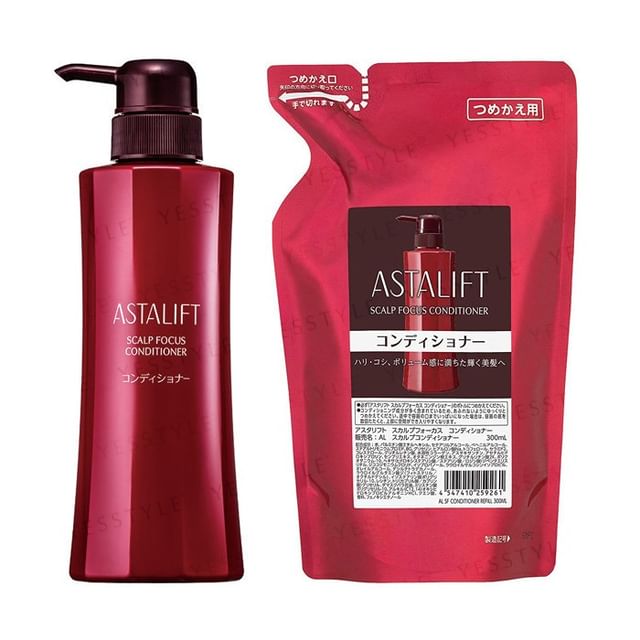
ASTALIFT Scalp Focus Conditioner
ASTALIFT Scalp Focus Conditioner is a non-silicone conditioner formulated with human-type nano hair ceramide to penetrate hair strands, replenishing lost ceramides and providing strength and resilience. It also contains astaxanthin and three types of collagen to protect the scalp and hair from UV rays and other environmental factors, while moisturizing dry hair and scalp.
Sulfate-free
Paraben-free
Silicone-free
Natural
Damage Repair
Dryness
Optimized for Your Environment & Lifestyle
Nykaa
In stock
Recommended

ASTALIFT Scalp Focus Conditioner
ASTALIFT
astalift-scalp-focus-conditioner
Conditioner
10407576240421
Morning or Evening?
How often will you use this product?
Notes


Secure payment protection
Your Biodata Compatibility Analysis
Based on your 6 hair health indices and environmental factors
Poor Match
Significant incompatibilities
Growth Cycle Health Index
Hair Match
Hair Health Index Alignment
Optimal for OSI, SSI, DI, HSI
Ingredient Efficacy
Matching Ingredient Score
Environment Compatibility
Current UV, Air Quality & Humidity
Why This Works for Your Specific Profile
Damage Index:
Damaged hair structure cannot withstand product intensity causing increased breakage and further compromise
Water Quality:
Medium to coarse textures require more intensive formulation than lightweight product provides
Hair:
Porous structure over-absorbs product leading to buildup, stiffness, or excessive dryness
Active Lifestyle:
High activity and frequent washing rapidly strip product benefits requiring excessive reapplication
Your Hair Profile Integration
Your Hair Archetype

Density Level

Washing Frequency

Shedding Level

Oil Level
Your Hair Health Indices
Oil Secretion (OSI)
Very low oil production
Scalp Sensitivity (SSI)
Very low sensitivity
Growth Rate (CMR)
Poor metabolism rate
Damage Index (DI)
Minimal damage
Hair Strength (HSI)
Very weak strength
Softness Index (SI)
Significant improvement needed
Water & Environmental Integration

Water:


Expected Results & Timeline
Key Highlights

What is it?
Conditioner with human-type nano hair ceramide

Who Is It For
All ages, Unisex

Budget
$33.80 - $67.60

Timeline
Immediate improvement in hair texture; noticeable strengthening and repair with regular use
Why You’ll Love It

What Does It Help With?
Damage Repair, Dryness, Breakage, Split Ends, Dullness

Best for
Damage Repair

Features
Non-silicone, contains human-type nano hair ceramide, astaxanthin, and three types of collagen, protects against UV rays and environmental factors, moisturizes dry hair and scalp

Checks
Paraben-free, Silicone-free, Sulfate-free
Ingredients Overview
Ingredients List
water, ethylhexyl-palmitate, cetearyl-alcohol, behenyl-alcohol, steartrimonium-bromide, butylene-glycol, glycerin, sodium-hyaluronate, tocopherol, ceramide-2, cholesterol, glycyrrhetinic-acid, soluble-collagen, astaxanthin, acetyl-hydroxyproline, swertia-japonica-extract, panax-ginseng-root-extract, dipotassium-glycyrrhizate, polyquaternium-10, dipentaerythrityl-hexahydroxystearate/hexastearate/hexarosinate, dicocodimonium-chloride, isopropyl-alcohol, isopropyl-lauroyl-sarcosinate, oleyl-alcohol, decyltetradecanol, phytosteryl/octyldodecyl-lauroyl-glutamate, polyglyceryl-10-isostearate, lecithin, caprylic/capric-triglyceride, rosa-damascena-flower-oil, polyglyceryl-10-myristate, hydroxypropyl-arginine-lauryl/myristyl-ether-hcl, citric-acid, fragrance, phenoxyethanol
Key Ingredients
human-type-nano-hair-ceramide, astaxanthin, soluble-collagen, sodium-hyaluronate, tocopherol
Ingredients Details
Astaxanthin
Common Name(s): 3,3'-dihydroxy-beta-carotene-4,4'-dione,ketocarotenoid
CAS Number: 472-61-7
DESCRIPTION
What It Does: Provides the most powerful natural antioxidant activity from the unique membrane-spanning ketocarotenoid.
Why It's Used: Maximum natural antioxidant — astaxanthin's unmatched singlet oxygen quenching capacity from marine microalgae provides superior photodamage prevention per unit applied.
How It Works: Unique spanning carotenoid structure crosses membrane bilayer quenching radicals at both inner and outer membrane surfaces simultaneously. singlet oxygen quenching kq ~3×10¹⁰ l/mol/s — highest of all carotenoids. 11 conjugated double bonds for exceptional electron transfer. inhibits nf-kb for anti-inflammatory activity.
Typically Found In: Premium anti-aging serums,sunscreen boosters,photoprotection products
TECHNICAL DETAILS
Primary Category: Active ingredient – antioxidant
Secondary Functions: Free radical scavenging,anti-aging
Application Areas:

Facial Skincare
Body Care

Hair Care
Beard Care
Color Cosmetics (Makeup)
Dietary/Oral Supplements
Typical Concentration Range: 0.01%–0.2%
SOURCING & ETHICS
Vegan Status: Conditional - supplier confirmation required
Halal Status: Unverified - supplier confirmation required
Source Notes: Plant-derived extract or synthetic. [audit 2026-07-29 rev2: status downgraded on audit. determination requires shariah-panel sign-off.]
SKIN COMPATIBILITY
Irritancy Rating: 1/5 – very low
Comedogenicity Rating: 0/5
Sensitivity Concerns: Non-irritating; well-tolerated.
Safe for Sensitive Skin: Yes
SAFETY & COMPATIBILITY
Safety Profile: Excellent safety profile. ewg score: 1.
Works Well With: Vitamin c,vitamin e,ferulic acid,spf,other antioxidants
Avoid Combining With: No significant incompatibilities
SCIENTIFIC NOTE
Astaxanthin's membrane-spanning structural uniqueness: its 3.6nm molecular length exactly spans a phospholipid bilayer membrane, allowing simultaneous quenching of radicals at both membrane surfaces. no other known antioxidant achieves this dual-surface protection — the structural basis for astaxanthin's extraordinary antioxidant potency.
Last Verified: 2026-03-12
Primary Sources: Cosing database,naguib astaxanthin antioxidant comparison study
Astaxanthin
Common Name(s): 3,3'-dihydroxy-beta-carotene-4,4'-dione,ketocarotenoid
CAS Number: 472-61-7
DESCRIPTION
What It Does: Provides the most powerful natural antioxidant activity from the unique membrane-spanning ketocarotenoid.
Why It's Used: Maximum natural antioxidant — astaxanthin's unmatched singlet oxygen quenching capacity from marine microalgae provides superior photodamage prevention per unit applied.
How It Works: Unique spanning carotenoid structure crosses membrane bilayer quenching radicals at both inner and outer membrane surfaces simultaneously. singlet oxygen quenching kq ~3×10¹⁰ l/mol/s — highest of all carotenoids. 11 conjugated double bonds for exceptional electron transfer. inhibits nf-kb for anti-inflammatory activity.
Typically Found In: Premium anti-aging serums,sunscreen boosters,photoprotection products
TECHNICAL DETAILS
Primary Category: Active ingredient – antioxidant
Secondary Functions: Free radical scavenging,anti-aging
Application Areas:
Facial Skincare
Body Care
Hair Care
Beard Care
Color Cosmetics (Makeup)
Dietary/Oral Supplements
Typical Concentration Range: 0.01%–0.2%
SOURCING & ETHICS
Vegan Status: Conditional - supplier confirmation required
Halal Status: Unverified - supplier confirmation required
Source Notes: Plant-derived extract or synthetic. [audit 2026-07-29 rev2: status downgraded on audit. determination requires shariah-panel sign-off.]
SKIN COMPATIBILITY
Irritancy Rating: 1/5 – very low
Comedogenicity Rating: 0/5
Sensitivity Concerns: Non-irritating; well-tolerated.
Safe for Sensitive Skin: Yes
SAFETY & COMPATIBILITY
Safety Profile: Excellent safety profile. ewg score: 1.
Works Well With: Vitamin c,vitamin e,ferulic acid,spf,other antioxidants
Avoid Combining With: No significant incompatibilities
SCIENTIFIC NOTE
Astaxanthin's membrane-spanning structural uniqueness: its 3.6nm molecular length exactly spans a phospholipid bilayer membrane, allowing simultaneous quenching of radicals at both membrane surfaces. no other known antioxidant achieves this dual-surface protection — the structural basis for astaxanthin's extraordinary antioxidant potency.
Last Verified: 2026-03-12
Primary Sources: Cosing database,naguib astaxanthin antioxidant comparison study
Cholesterol
Common Name(s): 5-cholesten-3-ol,cholesterin
CAS Number: 57-88-5
DESCRIPTION
What It Does: Provides essential barrier sterol function as one of three critical stratum corneum lipid components.
Why It's Used: Essential component of complete barrier repair formulations – the stratum corneum barrier requires ceramides:cholesterol:fatty acids in approximately 1:1:1 molar ratio for complete barrier restoration.
How It Works: Integrates between ceramide headgroups in lamellar body structures, providing fluidity and flexibility to the otherwise rigid ceramide-dominated lipid matrix. controls lamellar body phase behavior for functional barrier.
Typically Found In: Barrier repair moisturizers,eczema treatments,dry skin formulations
TECHNICAL DETAILS
Primary Category: Active ingredient – barrier sterol
Secondary Functions: Lamellar body structure,barrier sterol
Application Areas:
Facial Skincare
Body Care
Hair Care
Beard Care
Color Cosmetics (Makeup)
Dietary/Oral Supplements
Typical Concentration Range: 0.01%–1%
SOURCING & ETHICS
Vegan Status: Conditional - feedstock declaration required
Halal Status: Unverified - feedstock declaration required (plant, animal and petrochemical routes all exist)
Source Notes: Traditionally from lanolin (wool grease). plant-derived cholesterol alternatives include phytosterols, though these show slightly different barrier integration. verify for vegan/halal. [audit 2026-07-29 rev2: origin-dependent: the same inci exists in plant, animal and petrochemical versions and the name does not discriminate. determination requires shariah-panel sign-off.]
SKIN COMPATIBILITY
Irritancy Rating: 1/5 – very low
Comedogenicity Rating: 0/5 – non-comedogenic
Sensitivity Concerns: Endogenous molecule; excellent tolerability.
Safe for Sensitive Skin: Yes
SAFETY & COMPATIBILITY
Safety Profile: Exceptional safety profile. natural skin component. ewg score: 1.
Works Well With: Other ceramides,cholesterol,free fatty acids,hyaluronic acid,niacinamide
Avoid Combining With: No significant incompatibilities
SCIENTIFIC NOTE
Elias demonstrated that barrier repair requires all three lipid classes (ceramides, cholesterol, fatty acids) in approximately equimolar ratios. formulations providing only ceramides without cholesterol and fatty acids show significantly inferior barrier restoration vs complete triple-lipid combinations.
Last Verified: 2026-03-12
Primary Sources: Cosing database,elias et al. barrier lipid ratio study,loden barrier repair review
Decyltetradecanol
Common Name(s): Decyltetradecanol
DESCRIPTION
What It Does: Reduces surface tension at oil-water interfaces, enabling effective cleansing, emulsification, and formulation stability.
Why It's Used: Surface-active agents are essential for emulsification, cleansing, and stabilization of cosmetic formulations containing both aqueous and lipid phases.
How It Works: The amphiphilic molecular structure positions the hydrophilic head in water and the lipophilic tail in oils, creating micelles that solubilize sebum, dirt, and oil-soluble impurities for rinsing in cleansers or stable emulsions in leave-on products.
Typically Found In: Cleansers,shampoos,body washes,foaming treatments
TECHNICAL DETAILS
Primary Category: Surfactants
Secondary Functions: Emulsifying,cleansing
Application Areas:
Facial Skincare
Body Care
Hair Care
Beard Care
Color Cosmetics (Makeup)
Dietary/Oral Supplements
Typical Concentration Range: 0.5–30%
SOURCING & ETHICS
Vegan Status: Yes
Halal Status: Yes
Source Notes: Synthetic or semi-synthetic surfactant; no animal components.
SKIN COMPATIBILITY
Irritancy Rating: 2
Comedogenicity Rating: 0
Sensitivity Concerns: May cause irritation or stinging in sensitive or barrier-compromised skin at high concentrations; patch test recommended.
Safe for Sensitive Skin: Conditional
SAFETY & COMPATIBILITY
Safety Profile: Well-characterized cosmetic ingredient with established safety profile. mildly irritating to some individuals at typical use concentrations. suitable for leave-on and rinse-off cosmetics.
Works Well With: Other surfactants,thickeners,conditioning agents
Avoid Combining With: High concentrations in sensitive skin formulations
SCIENTIFIC NOTE
Surfactant critical micelle concentration (cmc) determines the threshold for emulsification: above the cmc, amphiphilic molecules self-assemble into micelles with hydrophobic cores that solubilize oils. hlb (hydrophile-lipophile balance) value predicts surfactant function: hlb 3–6 for w/o emulsifiers, 8–18 for o/w emulsifiers, >15 for solubilizers.
Last Verified: 2025-01-15
Primary Sources: Cosing eu database; pcpc cosmetic ingredient safety reviews; ingredient-specific safety and efficacy literature
Personalized Usage Instructions
How to Use
Step 1
After shampooing, wring out the water lightly, and spread conditioner on your hands
Step 2
Run your fingers through the hair and evenly apply for 2-3 minutes
Step 3
Rinse well
Medical Chemicals

Protein/Moisture
- Protein/Moisture balance
pH Level
- Acidic

Porosity Taget
- All Porosity Levels
Customized for Your Profile
Scalp Condtions
Sensitive Scalp, pH Balanced, Oil Control, Dry Scalp
Climate Suitability
Humid, Dry, UV Protection, Pollution Shield, Winter, Summer
Clinical Claims
Frequency
After shampooing, wring out the water lightly, and spread conditioner on your hands. Run your fingers through the hair and evenly apply for 2-3 minutes. Rinse well.
Product Information

Paraben-free
Silicone-free
Sulfate-free