

Nykaa E retail limited
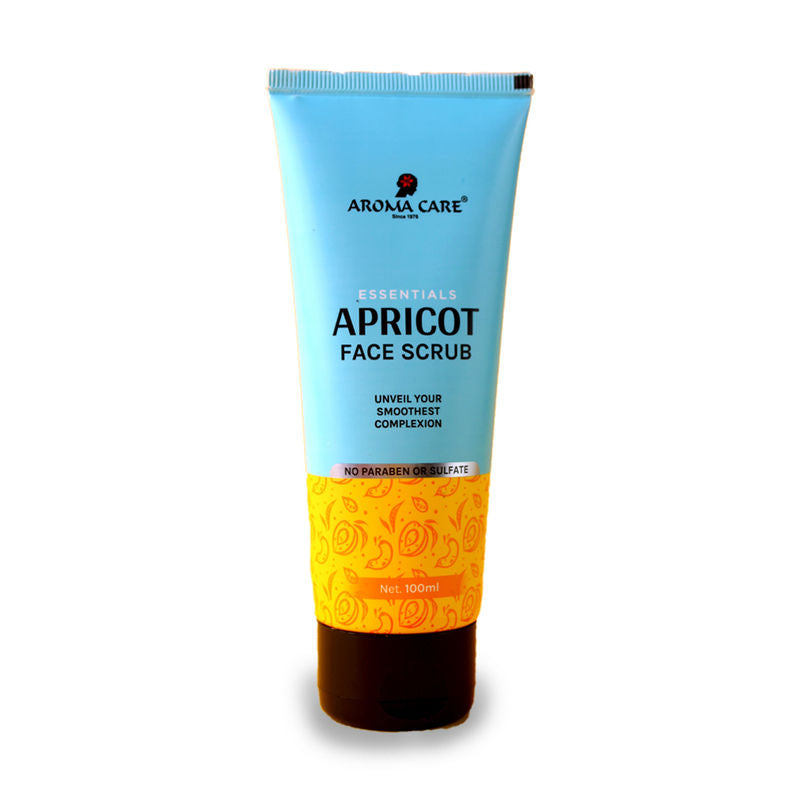
Aroma Care Essentials Apricot Face Scrub

Aroma Care Essentials Apricot Face Scrub
Nykaa E retail limited
aroma-care-essentials-apricot-face-scrub
Exfoliation
10084999037221
Morning or Evening?
How often will you use this product?
Notes


Highlights
WHAT IS IT?
Face scrub, 18 ingredients
FEATURES
Gently exfoliates to refresh dull and tired-looking skin, Infused with prunus armeniaca fruit extract, Unveils a smoother and more radiant complexion, Suitable for all skin types, GMP and ISO 9001 certified, Free from parabens, harmful silicones, cyclopentasiloxane, and sulfates, Vegan and cruelty-free
BEST FOR
normal
CHECKS
No parabens, no sulfates, no harmful silicones, no cyclopentasiloxane, vegan, cruelty-free
Who Is It For?
All Genders No Specific Age Range MentionedWhat Does It Help With?
Removes Dead Skin Cells Refreshes Dull And Tired-looking Skin Improves Skin Texture Helps Reduce Blackheads And Whiteheads Leaves Skin Soft And RadiantBudget
Affordable (under $30)How To Use
Which routine should it be used in?
Instructions:
Key Information


What Nykaa E retail limited Says
Product Description:
Get ready to indulge in the magic of Aroma Care Apricot Scrub. Say goodbye to dull and tired-looking skin as this luxurious cream scrub unveils your smoothest complexion yet. Formulated without any parabens or sulfates, it is suitable for all skin types. Experience a confidence-boosting transformation with this irresistible apricot scrub.
About the Brand:
Ingredients Overview
Ingredients List
Purified-Water, Carbomer, Stearic-Acid, Cetostearyl-Alcohol, Paraffinum-Liquidum, Glycerine, Glyceryl-Stearate, PEG-100-Stearate, Propylene-Glycol, Sodium-Lactate, Sodium-Gluconate, Polyquaternium-39, Methylchloroisothiazolinone, Methylisothiazolinone, Zea-Mays-Starch, Triethanolamine, Juglans-Regia-Walnut-Shell-Powder, Sodium-Cocoyl-Isethionates, Prunus-Armeniaca-Apricot-Fruit-Extract, Perfume, Colour-CI-No-15985,19140
Key Ingredients
Prunus Armeniaca (Apricot) Fruit Extract, Juglans Regia (Walnut) Shell Powder
Ingredients Details
Carbomer
Common Name(s): Carbopol,polyacrylic acid,carboxyvinyl polymer
DESCRIPTION
What It Does: Provides transparent gel textures and thickening at very low concentrations via ph-responsive swelling.
Why It's Used: The most widely used gel thickener – provides crystal-clear, stable gels at concentrations as low as 0.1-0.5% with ph-controlled viscosity.
How It Works: Highly crosslinked polyacrylic acid remains tightly coiled at acidic ph. neutralization with naoh or triethanolamine ionizes carboxylic groups causing electrostatic repulsion that unfolds and swells the polymer coils, dramatically increasing viscosity. concentration-dependent thickening.
Typically Found In: Gels,serums,emulsions,sunscreens
TECHNICAL DETAILS
Primary Category: Functional ingredient – polyacrylic acid thickener
Secondary Functions: Skin conditioning
Application Areas:

Facial Skincare

Body Care
Hair Care
Beard Care
Color Cosmetics (Makeup)
Dietary/Oral Supplements
Typical Concentration Range: 0.1%–2%
SOURCING & ETHICS
Vegan Status: Conditional - supplier confirmation required
Halal Status: Unverified - supplier confirmation required
Source Notes: Commercially produced for cosmetic use. verify vegan/halal status with supplier. [audit 2026-07-29 rev2: the record's own source_notes does not assert a non-animal origin, or instructs the reader to verify with the supplier; "yes" asserts knowledge the record does not hold. determination requires shariah-panel sign-off.]
SKIN COMPATIBILITY
Irritancy Rating: 1/5 – very low
Comedogenicity Rating: 0/5 – non-comedogenic
Sensitivity Concerns: Well-tolerated by most skin types.
Safe for Sensitive Skin: Yes
SAFETY & COMPATIBILITY
Safety Profile: Good safety profile at recommended concentrations. ewg score: 1–2.
Works Well With: Standard skincare actives
Avoid Combining With: No known significant incompatibilities
SCIENTIFIC NOTE
Carbomer's ph-responsive swelling mechanism provides an elegant formulation control tool: a neutralized gel can be liquefied by ph reduction (adding acid) and re-thickened by reneutralization. this reversible rheology control allows two-phase products that mix on application without the need for mechanical emulsification.
Last Verified: 2026-03-12
Primary Sources: Cosing database,cir safety assessment
Glycerine
Common Name(s): Glycerin,universal humectant,water-binding skin conditioning
CAS Number: N/a
DESCRIPTION
What It Does: Attracts and retains moisture in the sc, improves skin barrier function at low concentrations, provides gentle keratolytic softening, and acts as a co-solvent for water-soluble actives.
Why It's Used: The reference humectant — lowest cost, best safety profile, universal formulation compatibility, and present naturally in the sc via lipase-mediated glycerolipid hydrolysis makes glycerin the industry standard against which all humectants are benchmarked.
How It Works: Three hydroxyl groups form 6 h-bonds with water molecules per glycerol unit — the highest oh-group density per carbon of any commercial humectant. glycerin also down-regulates epidermal serine proteases that overactivate in dry sc, improving desquamation and barrier integrity.
Typically Found In: All cosmetics,universal
TECHNICAL DETAILS
Primary Category: Functional ingredient – humectant
Secondary Functions: Tewl reduction,skin plumping
Application Areas:
Facial Skincare
Body Care
Hair Care
Beard Care
Color Cosmetics (Makeup)
Dietary/Oral Supplements
Typical Concentration Range: 1%–40%
SOURCING & ETHICS
Vegan Status: Yes
Halal Status: Yes
Source Notes: Synthetic or naturally derived. excellent aqueous solubility.
SKIN COMPATIBILITY
Irritancy Rating: 1/5 – very low
Comedogenicity Rating: 0/5 – non-comedogenic
Sensitivity Concerns: Non-irritating; suitable for all skin types.
Safe for Sensitive Skin: Yes
SAFETY & COMPATIBILITY
Safety Profile: Excellent safety profile. ewg score: 1.
Works Well With: Ceramides,emollients,occlusives,glycerin,hyaluronic acid
Avoid Combining With: No significant incompatibilities
SCIENTIFIC NOTE
Epidermal lipases hydrolyse sc glycerophospholipids during cornification, releasing glycerol that contributes to the natural nmf — topical glycerin directly supplements this endogenous sc humectant pool.
Last Verified: 2026-03-12
Primary Sources: Cosing database,glycerin universal humectant review
Methylchloroisothiazolinone
Common Name(s): Methylchloroisothiazolinone,cosmetic active,functional ingredient
CAS Number: N/a
DESCRIPTION
What It Does: Delivers characteristic cosmetic function at recommended use concentration.
Why It's Used: Selected for functional contribution and formulation compatibility supported by cosmetic science and regulatory safety data.
How It Works: Works through the mechanism of its molecular class as documented in peer-reviewed cosmetic literature.
Typically Found In: Skin care formulations
TECHNICAL DETAILS
Primary Category: Active ingredient – cosmetic active
Secondary Functions: Skin conditioning
Application Areas:
Facial Skincare
Body Care
Hair Care
Beard Care
Color Cosmetics (Makeup)
Dietary/Oral Supplements
Typical Concentration Range: 0.1%–10%
SOURCING & ETHICS
Vegan Status: Conditional - supplier confirmation required
Halal Status: Unverified - supplier confirmation required
Source Notes: Commercially produced for cosmetic use. verify vegan/halal status with supplier. [audit 2026-07-29 rev2: the record's own source_notes does not assert a non-animal origin, or instructs the reader to verify with the supplier; "yes" asserts knowledge the record does not hold. determination requires shariah-panel sign-off.]
SKIN COMPATIBILITY
Irritancy Rating: 1/5 – very low
Comedogenicity Rating: 0/5 – non-comedogenic
Sensitivity Concerns: Well-tolerated by most skin types.
Safe for Sensitive Skin: Yes
SAFETY & COMPATIBILITY
Safety Profile: Good safety profile at recommended concentrations. ewg score: 1–2.
Works Well With: Standard skincare actives
Avoid Combining With: No known significant incompatibilities
SCIENTIFIC NOTE
Methylchloroisothiazolinone has an established safety profile within the cosmetic regulatory framework at standard use concentrations.
Last Verified: 2026-03-12
Primary Sources: Cosing database,methylchloroisothiazolinone technical literature
Methylisothiazolinone
Common Name(s): Mit,kathon,neolone
CAS Number: 2682-20-4
DESCRIPTION
What It Does: Provides highly potent broad-spectrum preservation at very low concentrations in rinse-off formulations.
Why It's Used: Most potent cosmetic preservative — mit provides effective preservation at concentrations 10-100× lower than most other preservatives, enabling clean-label preservation at minimal ingredient load.
How It Works: Electrophilic isothiazolinone ring reacts with bacterial thiol enzymes (glutathione, coa-dependent enzymes) via michael addition for rapid kill. very potent — mic vs e. coli 0.06μg/ml (vs phenoxyethanol mic ~400μg/ml — 6000× more potent). rapidly biodegradable.
Typically Found In: Rinse-off shampoos,body washes,conditioners
TECHNICAL DETAILS
Primary Category: Functional ingredient – isothiazolinone preservative
Secondary Functions: Skin conditioning
Application Areas:
Facial Skincare
Body Care
Hair Care
Beard Care
Color Cosmetics (Makeup)
Dietary/Oral Supplements
Typical Concentration Range: 0.0015%–0.0015% (max 15ppm eu rinse-off)
SOURCING & ETHICS
Vegan Status: Conditional - supplier confirmation required
Halal Status: Unverified - supplier confirmation required
Source Notes: Commercially produced for cosmetic use. verify vegan/halal status with supplier. [audit 2026-07-29 rev2: the record's own source_notes does not assert a non-animal origin, or instructs the reader to verify with the supplier; "yes" asserts knowledge the record does not hold. determination requires shariah-panel sign-off.]
SKIN COMPATIBILITY
Irritancy Rating: 1/5 – very low
Comedogenicity Rating: 0/5 – non-comedogenic
Sensitivity Concerns: Well-tolerated by most skin types.
Safe for Sensitive Skin: Yes
SAFETY & COMPATIBILITY
Safety Profile: Eu regulation 2014/1298: mit banned from leave-on products. max 15ppm in rinse-off only. contact sensitiser — causes occupational dermatitis epidemic in hairdressers and consumers. sccs noted no safe level for leave-on. 2016 eu restriction driven by major sensitisation epidemic.
Works Well With: Standard skincare actives
Avoid Combining With: No known significant incompatibilities
SCIENTIFIC NOTE
Mit's sensitisation epidemic (2010-2015) is one of the most significant cosmetic safety events in modern dermatology: a dramatic increase in contact allergy patch test positive rates from <1% (2005) to 7% (2015) in the eu was directly traceable to the widespread introduction of mit in leave-on products. this epidemic prompted the fastest eu cosmetic regulatory action in history and demonstrates the critical importance of patch test surveillance in monitoring emerging cosmetic allergens.
Last Verified: 2026-03-12
Primary Sources: Cosing database,eu regulation 2014/1298,yazar et al. mit sensitisation epidemic study